

Background
- The organization operated multiple pharmaceutical facilities handling manufacturing, quality control, and distribution under GxP regulations. Over several years, systems had been added incrementally to support compliance reporting, batch execution, and supply chain visibility. Each addition addressed a specific requirement at the time, but the environment had become layered rather than integrated. Leadership began noticing delays in routine reporting and increasing effort required to align operational views across teams operating in regulated pharmaceutical supply chain environments.
- The engagement was not initiated to fix broken systems or implement new technology. Instead, the request was to understand whether the friction teams experienced daily was structural or avoidable. The question posed was whether operational reality still matched how systems were organized, or if misalignment had quietly accumulated over time. No solutions were assumed in advance.
Initial Assessment
Early discussions revealed that most teams had developed informal practices to work around system boundaries. Manufacturing tracked certain metrics in spreadsheets before entering them into the ERP. Quality maintained parallel logs for deviation tracking that were later reconciled with the quality management system. Supply chain teams often cross-referenced inventory data across multiple sources before finalizing shipment decisions. These workarounds were not treated as problems but as necessary adaptations.
What became clear was that the same operational data often existed in two or three places, each considered authoritative for different purposes. Reconciliation was required not because data was wrong, but because different systems reflected different moments in a workflow. Teams had built coordination mechanisms around this reality, but those mechanisms were rarely documented or formalized. Trust in shared numbers required effort.
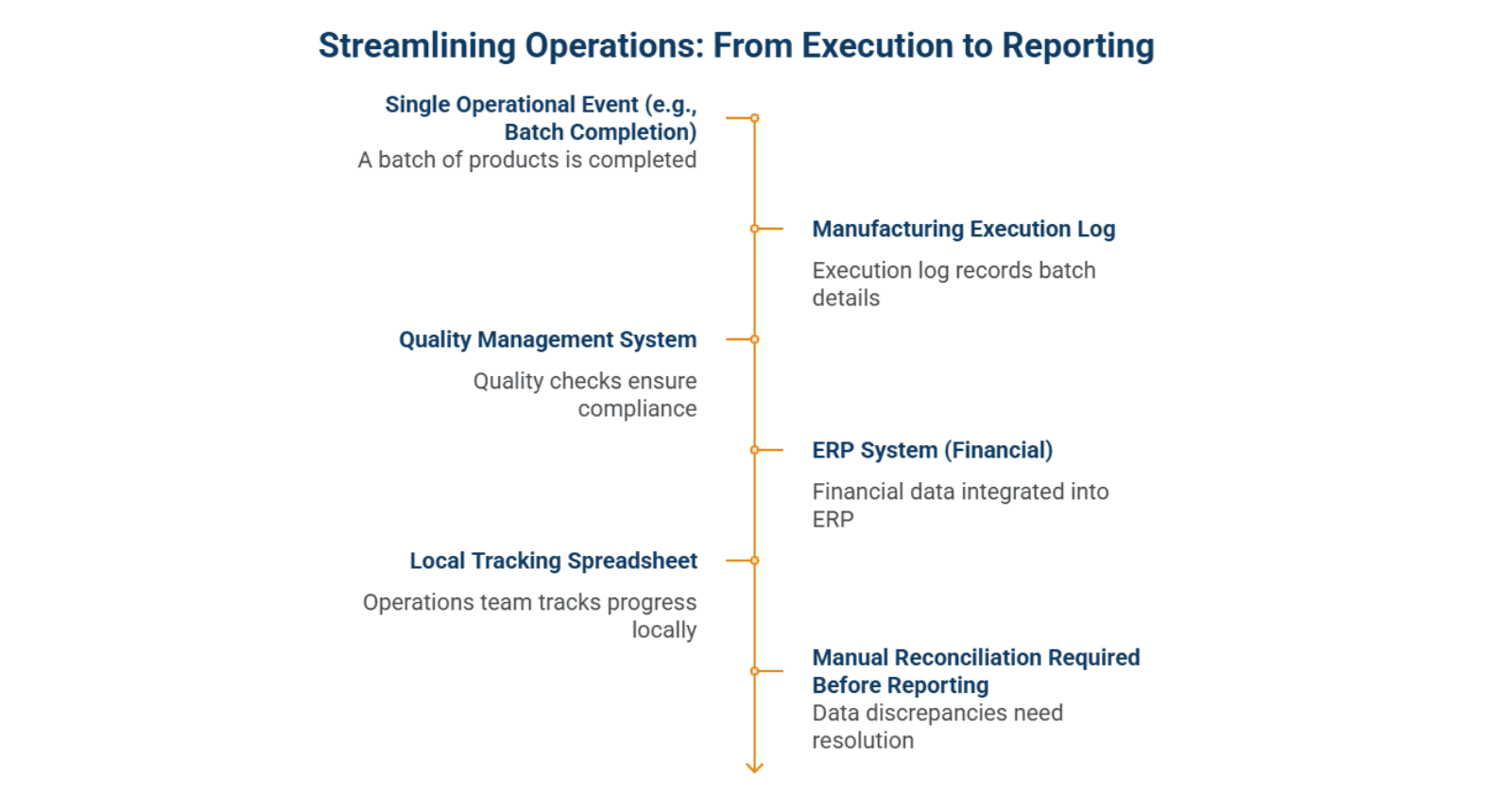
Reporting delays were especially visible during month-end closings and regulatory submissions. Preparing a single consolidated view required manual alignment across systems, with multiple review cycles to ensure consistency. The time required was predictable, but leadership questioned whether it reflected unavoidable compliance complexity or something that could be clarified. The goal was to separate operational necessity from accumulated habit.
Operational Review Approach
Rather than evaluating systems individually, we focused on how work moved between them. We mapped handoffs where responsibility for data accuracy shifted from one team to another. We identified steps where manual intervention had become embedded in routine operations, even when automation was technically possible.
We traced reporting workflows backward to understand where alignment effort was concentrated and why certain data sources were trusted over others. Much of this analysis related to broader efforts around systems integration and data alignment, where the objective is not to replace tools but to clarify boundaries, ownership, and trust so reconciliation becomes less necessary.
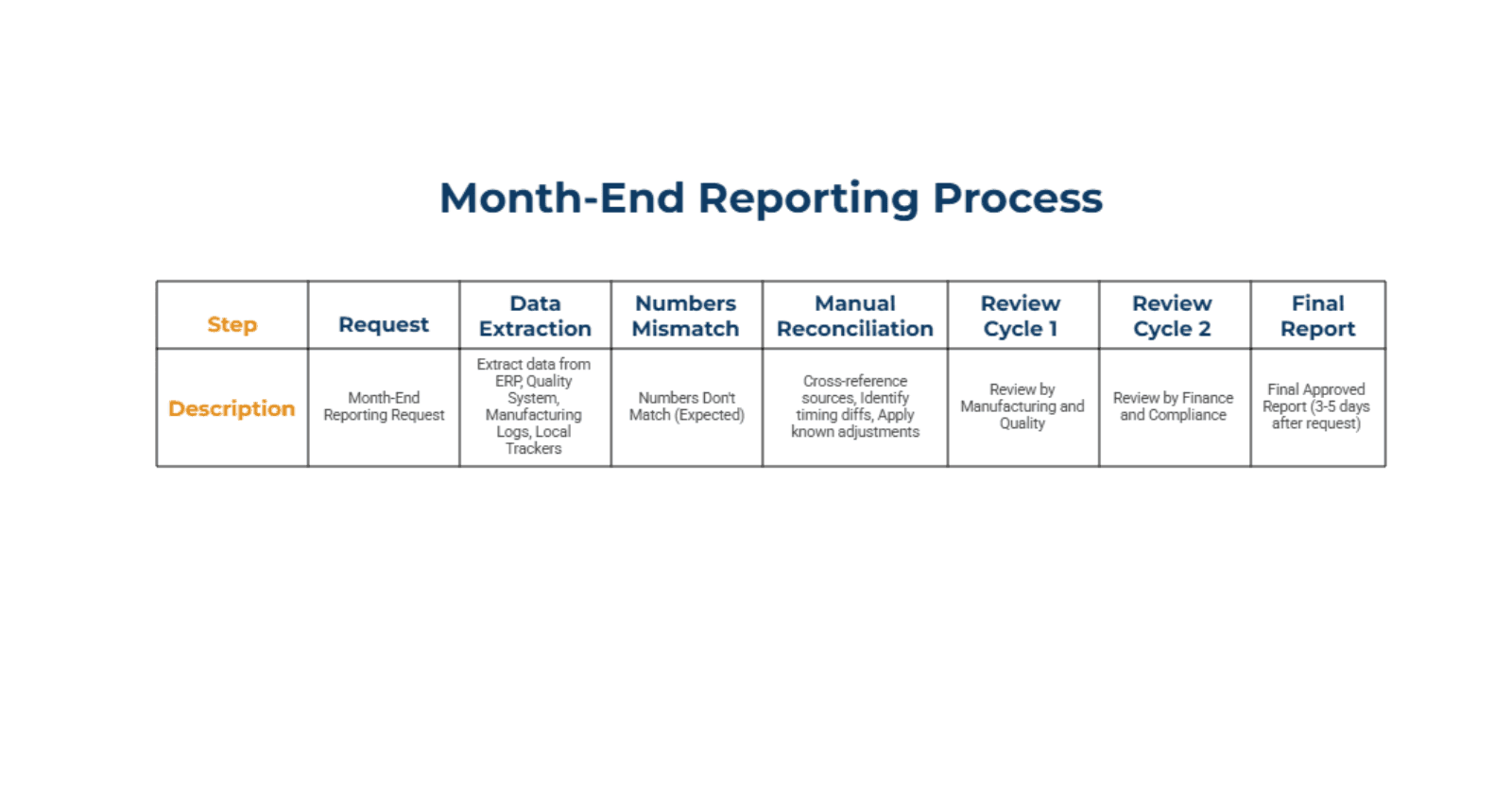
The review also examined accountability structures around operational data. In many cases, ownership was clear informally but not explicitly defined. Teams knew who to ask when numbers didn't align, but there was no documented agreement on which system held the source of truth for specific workflows. This ambiguity didn't cause failures, but it required ongoing coordination to maintain consistency.
We avoided framing observations as system deficiencies or process failures. The environment was stable and compliant. The question was whether clarity could reduce friction without introducing new risks or disrupting validated workflows. The approach was diagnostic, not prescriptive.
Key Findings
Most friction did not originate from technical limitations or missing functionality. The ERP was functioning as designed, but only for workflows that fit its original scope. Over time, quality and compliance requirements had driven the creation of parallel processes that were never fully reintegrated. These processes were not redundant in the traditional sense they served real operational needs but they created overlapping data ownership.
Reporting complexity had increased as teams optimized locally for speed and compliance, without revisiting how those optimizations affected downstream alignment. Manual reconciliation had become a coordination mechanism rather than a temporary workaround. It served to bridge system boundaries that had never been formally resolved. Eliminating reconciliation without addressing those boundaries would have introduced risk.
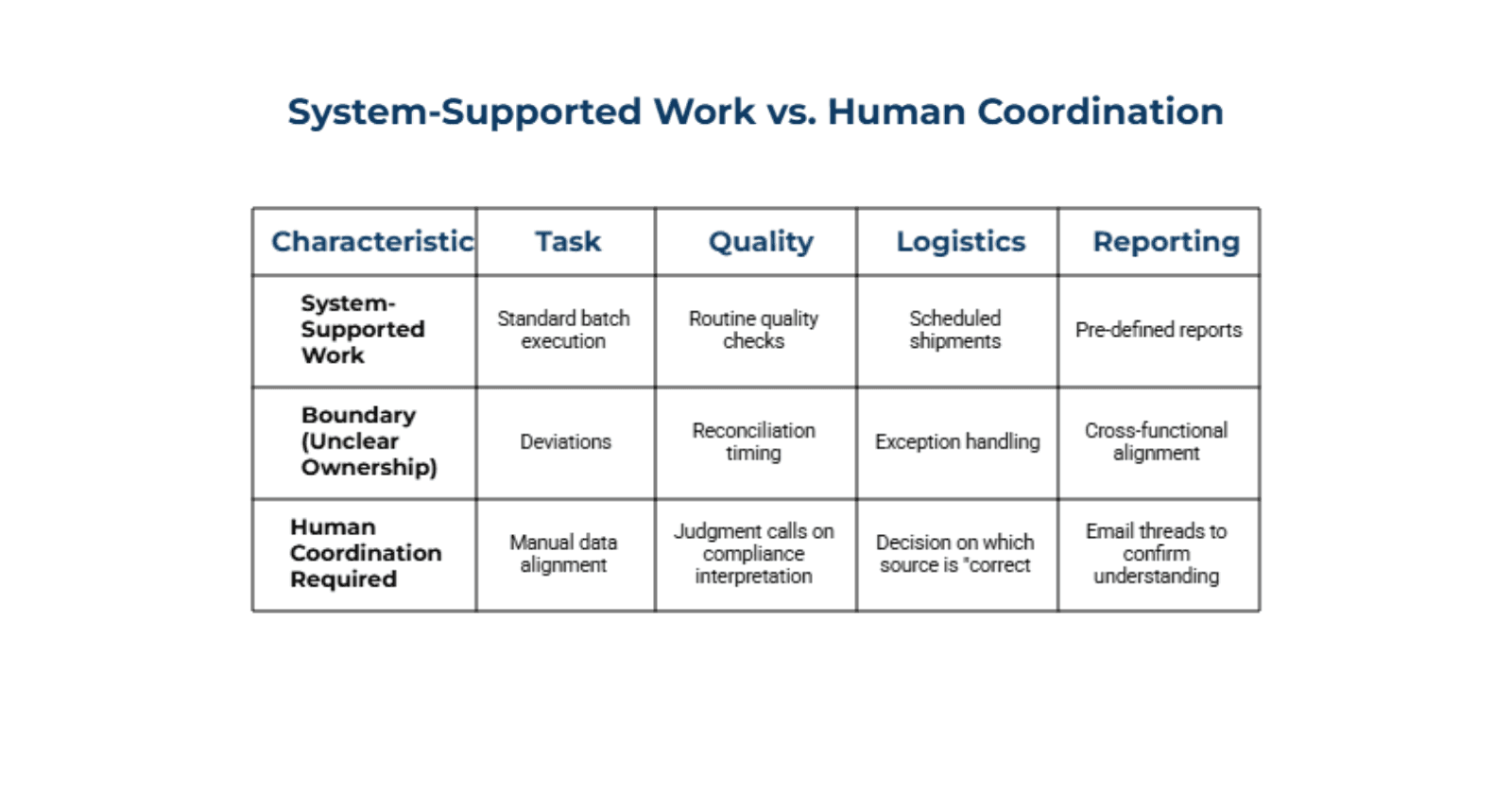
In several areas, the appropriate conclusion was that no system change was necessary. What was needed instead was explicit agreement on data ownership, clearer handoff definitions, and documented expectations for reconciliation timing and responsibility. Technology was not the constraint. Organizational clarity was.
Outcomes and Changes
Based on the findings, a full ERP replacement was explicitly ruled out. The system was stable, validated, and adequate for its intended scope. Expanding it to cover all workflows would have introduced complexity without addressing the underlying misalignment. Several broad automation initiatives were also deferred, as automating unclear handoffs would have embedded existing friction rather than resolving it.
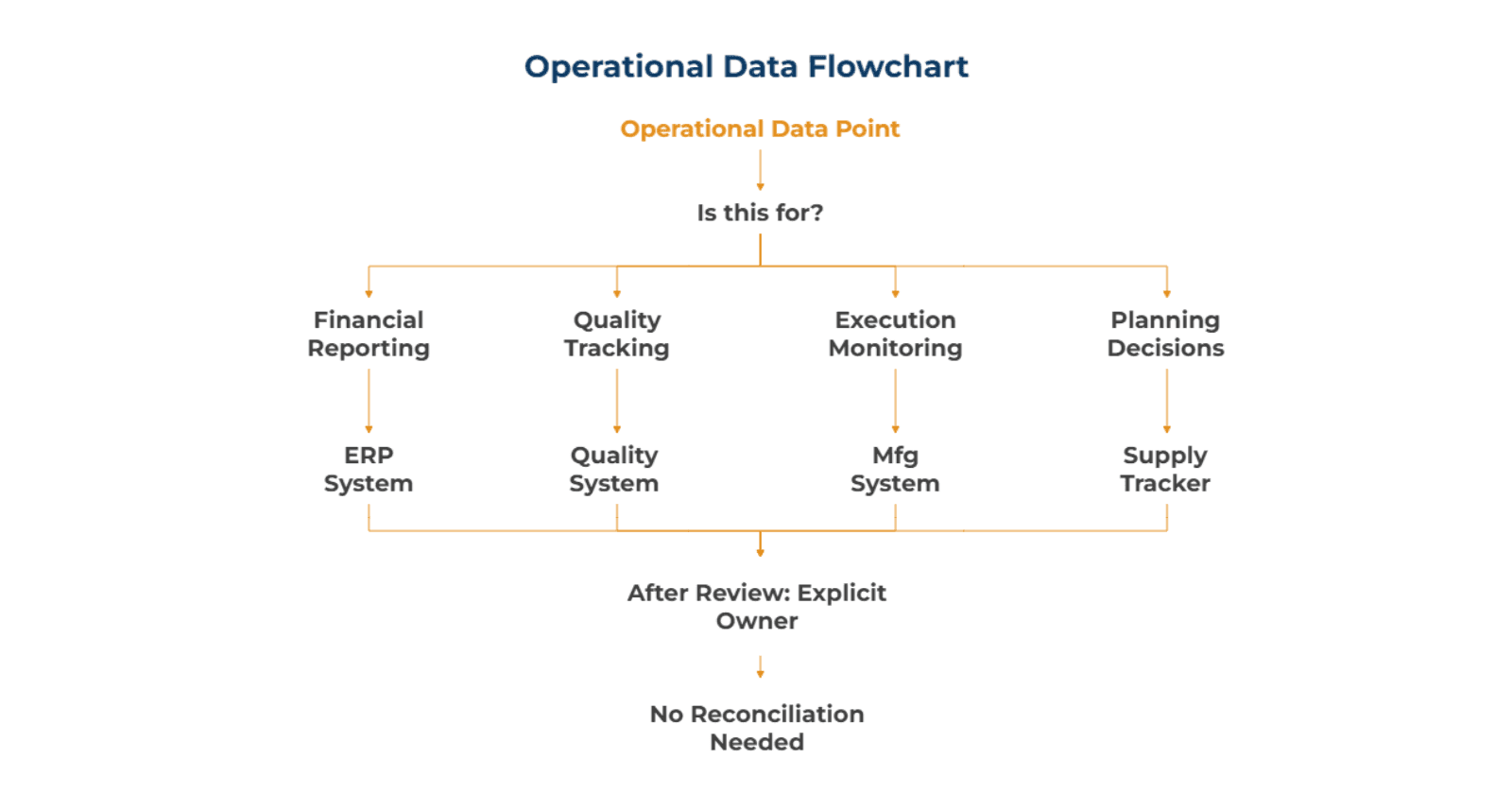
Instead, several reporting and reconciliation practices were clarified and simplified without system changes. Data ownership boundaries were documented and agreed upon across manufacturing, quality, and supply chain teams. A small number of targeted integration adjustments were identified as optional improvements, not urgent fixes. In multiple areas, the outcome was to formalize existing informal practices rather than change them.
Within weeks, reporting turnaround time improved measurably. Fewer reconciliation cycles were required before decision meetings, and teams reported higher confidence in shared operational views. Technology initiatives were postponed until clearer justification emerged. Leadership gained confidence that future changes would be based on operational clarity rather than reactive problem-solving.
Reflection
The engagement succeeded because it did not assume that systems needed to expand, automation would reduce friction, or new tools would resolve coordination issues. Starting with operational clarity allowed the organization to avoid unnecessary disruption while improving reliability and trust across functions. The most valuable outcomes were often decisions not to change systems, once responsibilities and expectations were made explicit.
What became clearer by the end was that operational friction in regulated environments often reflects misalignment between how work is done and how accountability is structured, not a lack of capability. Addressing that misalignment requires organizational agreement, not technology investment. The organization emerged with a clearer understanding of where systems ended and where coordination began.