

CDMO Operations Consulting
Fix CDMO Execution Gaps Across Clients, Batches, and Quality
Gyan Solutions assists CDMO teams in determining the mismatch between the client's requirements, tech transfer actions, batch progress, QA reviews, release checkpoints, capacity signals, and ERP/QMS/LIMS/MES workflows and then plans the right operational or tech transfer change with clarity.
Consulting and implementation are scoped separately.
Clarify how client requirements, SOPs, document formats, timelines, and quality expectations move across active programs.
Review how process knowledge, materials, documentation, validation needs, and ownership move from transfer into execution.
Find where batch status, QA review, deviations, release checkpoints, and documentation updates become unclear.
See where ERP, QMS, LIMS, MES, batch records, dashboards, portals, and manual trackers stop showing one trusted view.
Experience across pharmaceutical, manufacturing, quality, supply chain, and CDMO-style operational environments.
Awareness of GMP, FDA, Health Canada, MHRA, 21 CFR Part 11, EU GMP, data integrity, and quality expectations.
Client program visibility, tech transfer flow, batch documentation, QA handoffs, sponsor reporting, and system alignment.
Selected Industry
Experience
The difference with CDMO operations is that they are working on multiple sponsor programs concurrently. Client requirements, documentation requirements, requirements for tech transfer, requirements for the batch timeline, requirements for quality, requirements for release check points and reporting pressures may vary among clients.
We assist CDMO teams in identifying where work slows down after the sponsor request, tech transfer actions, batch records, ERP/QMS/LIMS/MES data, QA release handoff to capacity, and client reporting.
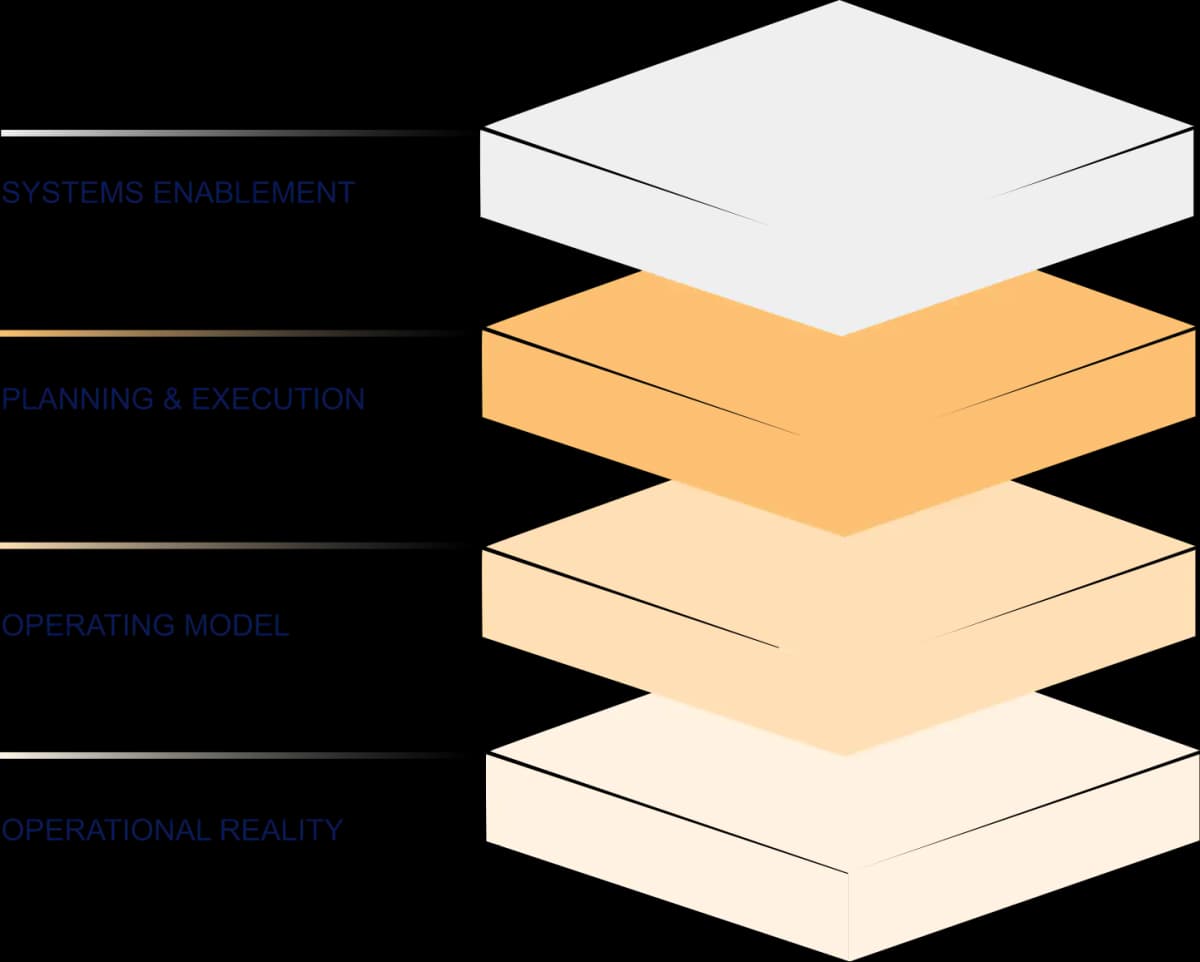




See How We Work
Clarify the Workflow Before Changing the System.
Talk through your SOPs, quality steps, reporting, systems, and handoffs before planning dashboards, automation, integrations, or AI-enabled tools.
Why CDMO Operations Are Different
A CDMO is not handling multiple product flows. It's overseeing many sponsor programs, batch paths, tech transfer requirements, quality standards, and reporting requirements in the same operation. Hence, the focus of CDMO Operations Consulting needs to be on client visibility, execution control, and system alignment.
You Manage Multiple Sponsor Workflows at Once
Each sponsor has their own requirements, documents, batch rules, timelines, and reporting requirements. The challenge comes in maintaining each program within control while maintaining the visibility of the operation.

Client rules
Batch paths
Capacity pressure
Tech Transfer Becomes Daily Operations
Tech transfer is not something that is occasional with CDMOs. A new program introduces process knowledge, materials, steps for validation, and ownership questions that need to be clearly translated into the program process.
Process handoff
Material readiness
Ownership gaps
Client Trust Depends on Real-Time Visibility
Sponsors require clear information regarding batch progress, QA review, deviations, release, and documentation. If there are a few differences between systems and teams, those differences can turn into client escalations.
Batch status
QA review
Release risk
Where Your CDMO Is in Its Operational Journey
CDMO operations change as sponsor work, batch volume, quality pressure, and reporting expectations increase. The gap is not always obvious at first. It usually appears when client programs grow faster than the workflows, systems, and ownership behind them. Find the stage your CDMO is in today and what needs to become clearer before delays turn into rework, release pressure, or sponsor escalations.
Early-Stage CDMO / Clinical Manufacturing Focus
At this stage, teams often rely on close communication, flexible problem-solving, and people who know how things move. That can work in the beginning, but it becomes risky when new sponsors, batch requirements, documentation expectations, and QA steps start increasing.
The Problem
Sponsor requirements, tech transfer notes, batch documents, material updates, and QA steps may still be managed through emails, shared files, meetings, and team memory. Work moves forward, but the process is not always repeatable.
How We Help
We map how sponsor work moves from intake to tech transfer, batch execution, QA review, and reporting. Then we identify where ownership, documentation, approval flow, and system visibility need to become clearer.
The Outcome
A more repeatable operating model that reduces dependency on individual knowledge and gives the CDMO a stronger foundation for future client work.
Not sure where the gap is?
Start with a CDMO operational review.
CDMO Operational Areas We Review
These are the workflow, documentation, system and ownership issues that often hinder the CDMO process in sponsor programs, tech transfer, batch execution, QA review, release, and client reporting.
Tech Transfer Readiness
Sponsor requirements, process knowledge, materials, documentation, validation needs, batch steps, and receiving-site execution are reviewed to strengthen transfer readiness before manufacturing activity begins at scale.
Sponsor Requirements to Daily Workflow
Quality agreements, documentation standards, transfer notes, manufacturing steps, QA expectations, reporting needs, and timelines are reviewed so sponsor requirements stay connected to daily execution confidently.
Multi-Client System Alignment
ERP, QMS, LIMS, MES, batch records, dashboards, portals, and trackers are reviewed against sponsor-specific workflows to improve coordination, visibility, and reporting confidence across active client programs.
Batch Documentation & Release Flow
Batch records, exceptions, review notes, corrections, QA updates, and release checkpoints are reviewed to strengthen documentation flow, status visibility, and sponsor-facing coordination across operating teams.
Deviation, CAPA & QA Follow-Up
Deviation, CAPA, investigation, approval, and QA follow-up workflows are reviewed to strengthen ownership, escalation paths, timing, documentation, and communication across sponsor updates and internal teams.
Operational Knowledge & Scalability
Experienced team knowledge is reviewed alongside workflows, systems, reporting, and operating routines so sponsor expectations, program history, and execution status can scale reliably with growth.
Start with CDMO Execution Clarity. Build When the Requirement Is Defined.
Gyan Solutions works with CDMO teams to make sure sponsors' needs, tech transfer, batch activity, QA review, documentation, capacity signals, release steps, and client reporting go together, before dashboards, automation, integrations, or portals are implemented.
Sponsor Program Advisory
For CDMO teams configuring a more robust operating structure for their sponsor programs, tech transfer, batch execution, quality review, documentation flow, release coordination, the visibility of capacity and ERP/QMS/LIMS/MES use. This can involve workflow auditing, sponsor requirement matching, tech transfer preparation, QA & release planning, reporting, system optimization, technology guidance, tool selection, and implementation.
Example: A CDMO could benefit from improved visibility of the batch status, QA review, release readiness and sponsor updates, but it will need to first gain clarity on how work flows between teams and systems.
Sponsor-Facing Technology Implementation
When a defined reporting, portal, automation, integration, or system alignment is required and is a need that must be delivered for all sponsor execution and regulated operations, a CDMO team is in need. This can encompass dashboard reporting capabilities by the sponsor, batch tracking software, ERP and QMS integration, workflow automation, client portals, data integration, AI readiness, AI governance, and AI-supported operational tools.
For example, a CDMO might already know that they should have a sponsor portal, batch visibility dashboard, QA workflow automation, or ERP/QMS integration, and require technical support to get it done correctly.
Operational Advisory and Technology & AI Implementation are scoped separately. Clients may engage us for consulting, technical delivery, or both.
Systems Review + Implementation
Align Existing CDMO Systems. Deliver Sponsor-Ready Capabilities.
CDMO teams manage ERP, QMS, LIMS, MES, batch records, sponsor portals, document systems, dashboards and email-based workflows to assist sponsors in quality control, documentation and release coordination as well as sponsor execution. Our expert team analyzes the movement of workflows, information, approvals, batch records, and sponsor reporting throughout the current system. If the requirement is specified, we assist with implementing the requirement within the tools available.
This can encompass workflows for tech transfer, batch tracking dashboards, sponsor portals, deviation/CAPA automation, ERP/QMS integration, document control, AI-powered CDMO operational tools, and KPI dashboards.
Talk Implementation Services→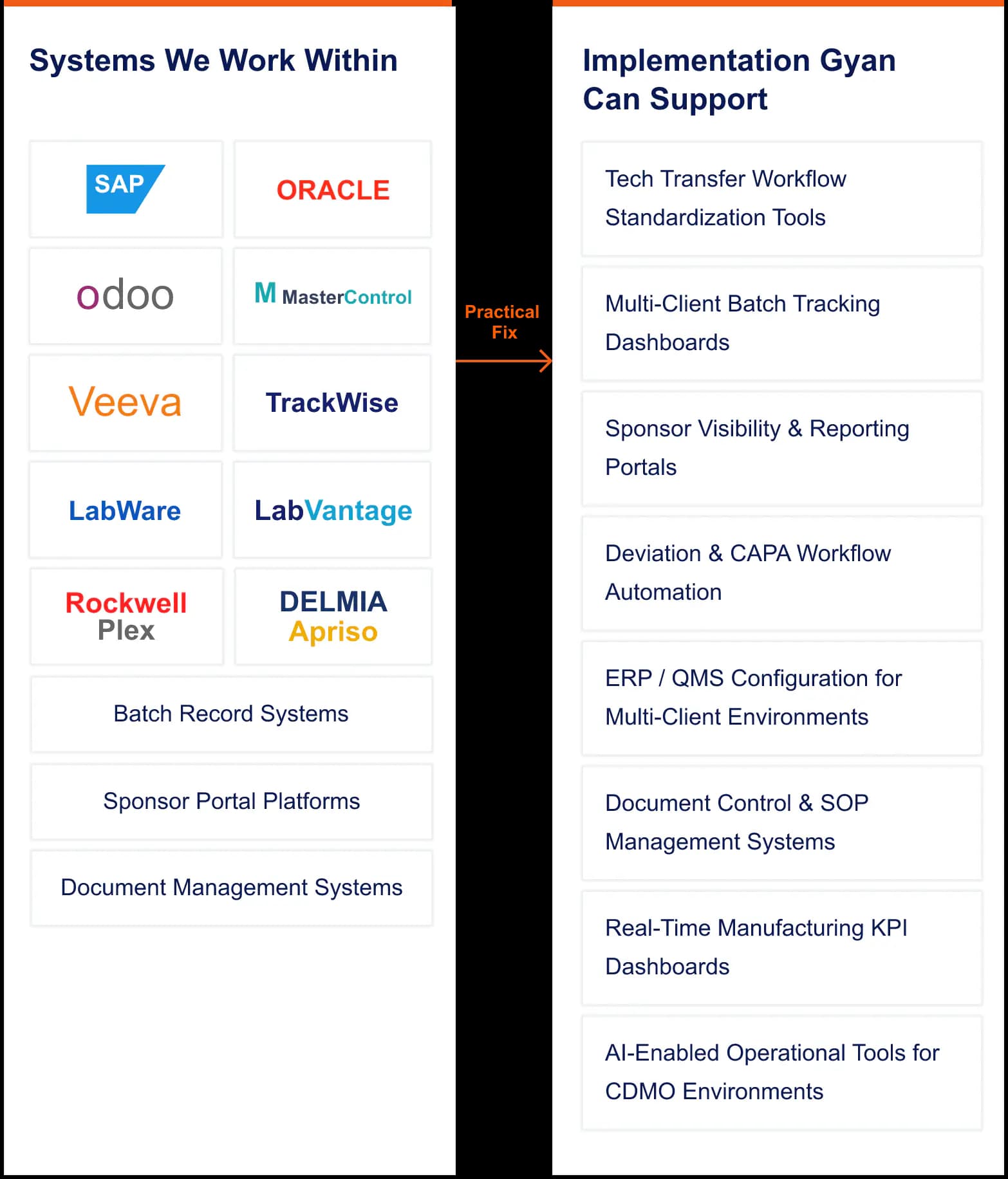
How a CDMO Engagement Works
We first understand the CDMO operating environment, then define the right path: advisory, technology implementation, or both.
Operations Fit Call
Our team talks about the various needs of our sponsor programs, how to coordinate QA, reporting requirements, what systems are in place and what priorities might be set for implementation.
Engagement Scope
We discuss Operational Advisory or Technology & AI Implementation or a combination of both and concur on outcomes and delivery priorities.
Advisory, Implementation, or Both
We provide promised work ranging from sponsor workflow improvements to QA and release visibility to system alignment to dashboards, portals, integrations, automation, and AI-powered CDMO applications.
Consulting and implementation are scoped separately.
Healthcare & Life Sciences Engagement Experience


Selected Case Studies
Real outcomes from our operations consulting and implementation engagements.
Watch Our Solutions in Action
Find the Real CDMO Gap First.
Start with a practical review of client programs, tech transfer, batch visibility, QA handoffs, reporting gaps, and system alignment.
Request a Free Operations Fit Call→

30-minute call

No obligation

Consulting and implementation scoped separately
Common Questions
What is covered in a CDMO operational review?
CDMO operational review examines the movement of sponsor requirements, tech transfer, batch status, QA review, release steps, documentation and reporting throughout your teams and systems. The objective is to identify areas of slowdown in work performance, areas of unclear ownership, and areas of systems that are not presenting the 'true picture' of the operation.
Do we need new software to fix these problems?
Not always. The lack of workflow clarity, manual follow-up, weak handoff, disconnected reporting or systems that are not multi-client configured are common root causes for CDMO problems. New software does nothing more than fill an empty hole, if there is no hole in the first place.
Can you help with tech transfer workflows?
Yes. We review how sponsor requirements move into documentation, materials, process readiness, manufacturing steps, QA expectations, and execution. This helps identify where transfer details are getting lost before they create batch delays, rework, or release pressure.
Can you improve batch and release visibility?
Yes. We identify where batch progress, QA review, deviations, release checkpoints, and documentation updates are unclear or spread across different systems. The goal is to help teams see what is moving, what is waiting, and what needs action.
Can you help align ERP, QMS, LIMS, and MES?
Yes. We examine how ERP, QMS, LIMS, MES, Batch Records, Dashboards, Portals and spreadsheets work together in real CDMO scenarios. Then we focus on improving connections between data, approvals, records and reporting.
Is the fit call a sales call?
No. The fit call is a real-world discussion regarding your CDMO operation, existing systems, identified gaps, and lost time or visibility in your team. The review scope or implementation scope is discussed if there is a fit.
Request a Free Operations Fit Call
Tell us a bit about your goals and challenges. We'll schedule a 30-minute Operations Fit Call to understand your needs and recommend the right next steps.
Focused on your goals
You decide the next step.
Consulting & implementation