

Biotech Supply Chain Consulting
Fix Planning, Inventory, and Visibility Gaps in Biotech Supply
Gyan Solutions assist biotech teams to identify where clinical supply planning, inventory status and expiry tracking, vendor and CMO handoffs, shipment status and release readiness are dropping out of the real supply chain, and take action before it happens at a site or studies.
Consulting and implementation are scoped separately.
Align study milestones, site demand, material readiness, forecast changes, and supply decisions before timelines start slipping.
Review how shipment status, handoffs, custody records, delivery updates, and site confirmations are tracked across the network.
Find where depot stock, expiry risk, allocation, reserved inventory, and site availability stop showing one trusted view.
Clarify how vendor updates, CMO readiness, release status, shipment timing, and partner reporting move across the network.
Experience across biotech supply networks, clinical programs, vendor coordination, material readiness, and operational visibility.
Understanding of release readiness, quality handoffs, shipment risk, documentation flow, and supply decision pressure.
Focused on biotech supply chain challenges where planning, inventory, vendors, shipments, and site readiness must stay aligned.
Selected Industry
Experience
Biotech supply chains carry a different type of pressure. Teams are often moving clinical materials, biologics, samples, or temperature-sensitive products across vendors, depots, CMOs, quality teams, clinical operations, and study sites. The risk is not only whether the material exists. The real question is whether the right material is available, released, in condition, allocated correctly, and moving toward the right site at the right time.
Gyan Solutions helps biotech teams find where the supply chain starts losing visibility between demand signals, inventory status, vendor updates, release readiness, shipment tracking, site needs, and leadership reporting.
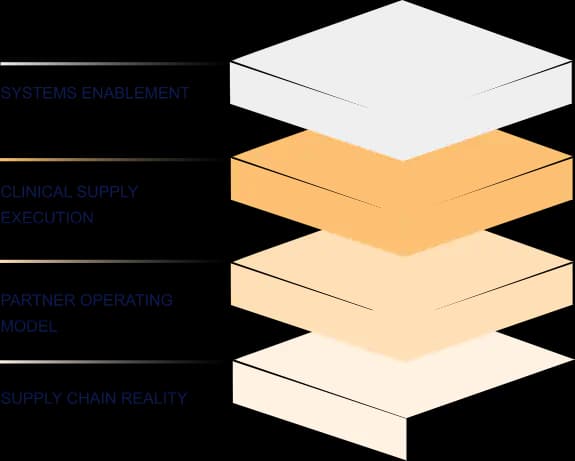




Why Biotech Supply Chains Are Different
Biotech supply chains move through uncertainty. Study timelines change, patient or site needs shift, material availability may change, and vendor updates often arrive later than teams need them.
Demand Shifts Faster Than the Plan
Protocol changes, enrollment movement, new sites, paused activity, and changing study assumptions can make yesterday’s supply plan unreliable. When demand signals are not updated quickly, teams either overprepare, underprepare, or chase corrections late.

Site demand
Forecast drift
Scenario planning
Material Readiness Depends on More Than Inventory
In biotech supply chains, available stock does not always mean usable stock. Material may still depend on release status, documentation, quality review, allocation rules, expiry limits, or partner updates. If those details are not visible, supply decisions become slower and less reliable.
Release status
Usable inventory
Material readiness
Sites, Vendors, and Internal Teams Need the Same View
Clinical operations, supply, quality, vendors, CMOs, depots, and sites may all hold different parts of the answer. When those updates are scattered, teams spend more time checking status than making decisions.
Shared visibility
Vendor updates
Aligned decisions
Core Biotech Supply Chain Review Areas
Biotech supply chain problems usually do not begin with one missing report. They begin when planning, inventory, release status, vendor communication, and site needs stop moving together. Each review area below focuses on a real point where biotech supply chains lose visibility, slow down, or become too dependent on manual follow-ups.
Clinical Supply Readiness
Making sure study supply is ready before timelines are at risk
Clinical programs move quickly, but supply planning often depends on changing study assumptions, site activation dates, enrollment movement, protocol updates, and material availability.
The Problem
Teams may know a study is moving forward, but they may not have a clear view of what material is needed, what is available, what is released, what is reserved, and what still depends on vendors, CMOs, depots, or quality review.
What We Review
We reviewed clinical supply planning, site demand, material readiness, depot availability, release status, vendor updates, and the reporting rhythm used to support supply decisions.
The Outcome
A clearer clinical supply view that helps teams see readiness earlier, reduce last-minute checking, and make stronger decisions before study timelines are affected.
Not Sure Where the Supply Chain Gap Is?
Start with a focused biotech supply chain review.
Who This Is For
This work is built for biotech teams that need clearer planning, inventory visibility, vendor coordination, shipment readiness, release visibility, and supply chain reporting.
This tends to be a strong fit if
You are managing clinical supply across vendors, depots, CMOs, or sites.
Your forecasts change often because programs, sites, or study assumptions change.
Your inventory, expiry, release, or shipment status is not visible in one place.
Your team spends too much time chasing partner updates or rebuilding reports.
Your shipment tracking, custody records, or site delivery updates sit outside planning decisions.
Your ERP, inventory tools, dashboards, and spreadsheets do not match how the supply chain actually runs.
This may not be the right fit if

You only need a simple software task without reviewing the supply chain workflow behind it.
You are looking only for general supply chain consulting without a biotech operating context.
You do not want to examine how planning, vendors, inventory, shipments, release, and reporting actually work.
You expect dashboards or AI tools to fix unclear data, ownership, or partner handoffs.
Common Supply Chain Gaps We Find in Biotech Teams
These are the planning, inventory, partner, system, shipment, quality, and reporting gaps that often slow biotech supply chains as programs move from early planning into execution and scale-up.
Seeing These Gaps in Your Supply Chain?
Start With Clarity. Build Only When the Need Is Clear
Before adding dashboards, automation, integrations, or AI tools, your biotech supply chain needs a clear view of where the real gap is. The issue may not be the software. It may be how demand signals, inventory, vendors, release readiness, shipment updates, and reporting move across the network.
Start with a Biotech Supply Chain Review
This path is for teams that know supply visibility is breaking down, but need clarity before deciding what to change, build, automate, or integrate.
 Demand and forecast updates
- Clinical supply readiness
- Inventory, allocation, and expiry visibility
- Vendor, CMO, depot, and courier reporting
- Shipment status and site delivery updates
- Release readiness and quality handoffs
- ERP, inventory, quality, and shipment system gaps
- Manual reporting, dashboard, and data ownership needs
Move to Implementation When the Need Is Clear
This path is for teams that already understand the supply chain gap and need help implementing the practical fix around the way the operation actually runs.
- Clinical supply visibility dashboards
- Inventory, allocation, and expiry tracking views
- Vendor, CMO, depot, and courier reporting workflows
- Shipment status and site delivery visibility
- Release readiness and quality handoff dashboards
- ERP, inventory, quality, and shipment data alignment
- Partner reporting portals and operating workflows
- AI-enabled reporting operational support
Consulting and implementation are scoped separately, so the first step is not to sell a system.
The first step is to understand what the supply chain actually needs.
Planning Systems. Visibility That Matches the Operation.
ERP, inventory tools, shipment tracking platforms, quality systems, partner updates, spreadsheets, and dashboards often show different pieces of the biotech supply chain. Gyan Solutions reviews how demand signals, inventory status, vendor updates, release readiness, shipment status, shipment status, and site needs move across those systems.
The goal is not to replace systems first. The goal is to make planning, supply decisions, and reporting match the real operation.
Review Your Supply Chain Systems →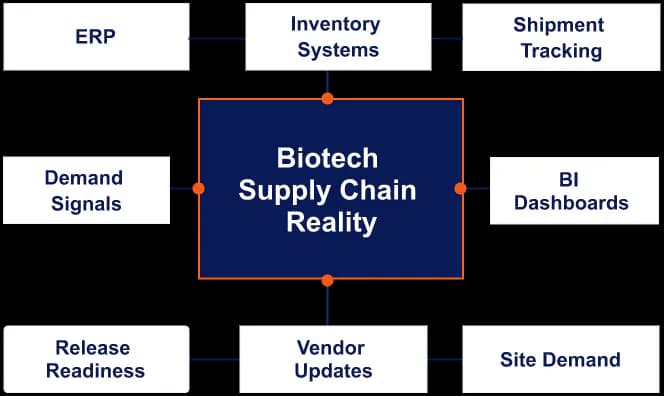
Review Existing Systems. Implement the Practical Fix.
Biotech supply chains often run across ERP, inventory systems, quality tools, shipment tracking, depot data, dashboards, partner updates, and spreadsheets.
Gyan first reviews how planning, inventory, release readiness, vendor reporting, shipment status, site needs, and reporting move across your current environment. When the gap is clear, we help implement the practical fix around the supply chain already in place.
Schedule a Call to Review Systems→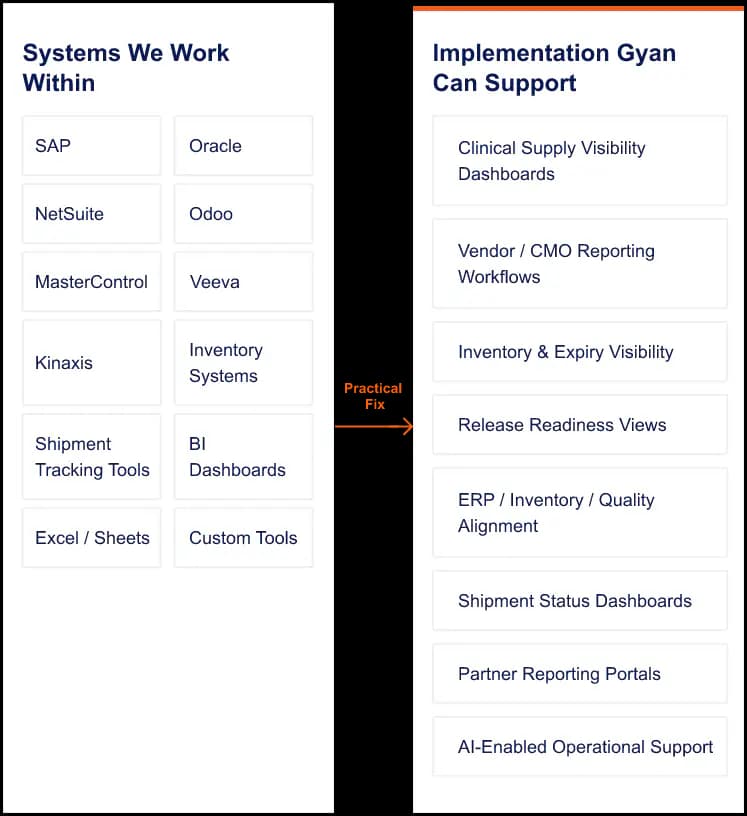
How a Biotech Supply Chain Engagement Works
We start by understanding how the supply chain actually runs before recommending process changes, dashboards, automation, system work, or implementation. The review is a complete first step. Implementation is scoped separately only when the need is clear.
Understand the Supply Chain
We discuss your programs, vendors, CMOs, depots, sites, systems, shipment risks, inventory concerns, and where your team is losing time or visibility.
Review the Workflow
We review how demand signals, inventory, expiry, release readiness, vendor updates, shipment tracking, site needs, and reporting move across teams and systems.
Scope the Practical Fix
We scope the practical fix only when the gap is clear. This may include dashboards, ERP/inventory/quality alignment, vendor reporting, shipment visibility, automation, or AI-enabled support.
Consulting and implementation are scoped separately.
Selected Case Studies
Real outcomes from our operations consulting and implementation engagements.
Watch Our Solutions in Action
Find Supply Gaps Before They Affect the Study.
Review where planning, inventory, vendors, shipments, site readiness, release status, and reporting stop matching the real biotech supply chain.
Book a Supply Chain Review Call →

30-minute call

No obligation

Consulting and implementation scoped separately
Common Questions
What does a biotech supply chain review cover?
A biotech supply chain review looks at how demand signals, inventory, expiry risk, release readiness, vendor updates, CMO coordination, shipment visibility, site readiness, and reporting move across your teams and systems. The goal is to find where visibility breaks down and what should be fixed first.
Do we need new software to improve supply chain visibility?
Not always. Many biotech supply chain issues come from unclear ownership, manual reporting, delayed partner updates, disconnected inventory data, or workflows that are not fully defined. New software only helps when the real operational gap is clear.
Can you help with shipment tracking and site delivery visibility?
Yes. We review how shipment status, handoffs, custody records, courier updates, delivery confirmation, site readiness, and supply planning updates are captured and used in daily supply decisions.
Can you improve inventory and expiry visibility?
Yes. We identify where inventory, expiry dates, reserved stock, release status, and allocation decisions are unclear or spread across vendors, depots, spreadsheets, and systems.
Can you help align ERP, quality, and supply data?
Yes. We look at how ERP, inventory tools, quality systems, shipment tracking, dashboards, and partner reports support real biotech supply chain work. Then we identify where data and reporting need better connection.
Is the fit call a sales call?
No. The fit call is a practical conversation about your biotech supply chain, current systems, known gaps, and where your team is losing time or visibility. If there is a fit, the review or implementation scope is discussed separately.
Request a Free Operations Fit Call
Tell us a bit about your goals and challenges. We'll schedule a 30-minute Operations Fit Call to understand your needs and recommend the right next steps.
Focused on your goals
You decide the next step.
Consulting & implementation