
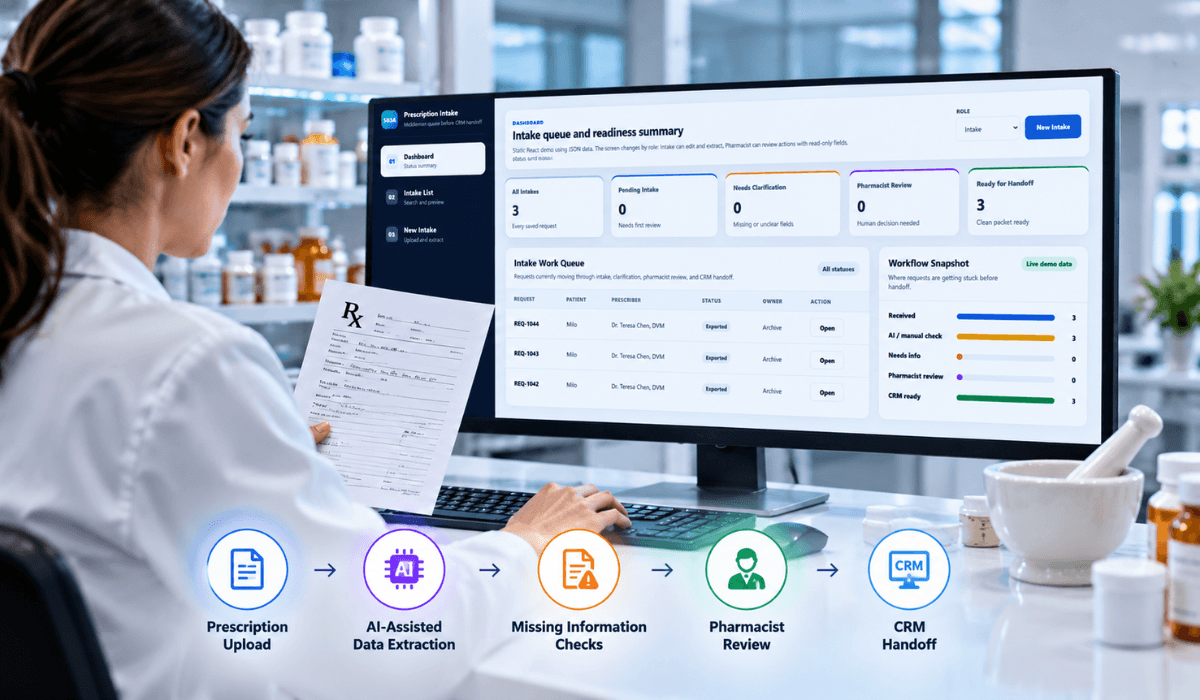

Executive Summary
Prescription intake in 503A compounding pharmacies involves more than entering information into a system. Staff must capture patient-specific details, resolve missing information, and prepare prescriptions for pharmacist review. Gyan Solutions developed an AI-assisted workflow demonstration that connects these activities, helping illustrate how pharmacies could reduce administrative effort while maintaining professional oversight.
What the Review Needed to Clarify
The central question was how AI could assist prescription intake without replacing the judgment of pharmacy professionals. The design needed to establish which information could be extracted automatically, how missing details would be flagged, and when a prescription package could safely progress to pharmacist review and downstream systems.
Background
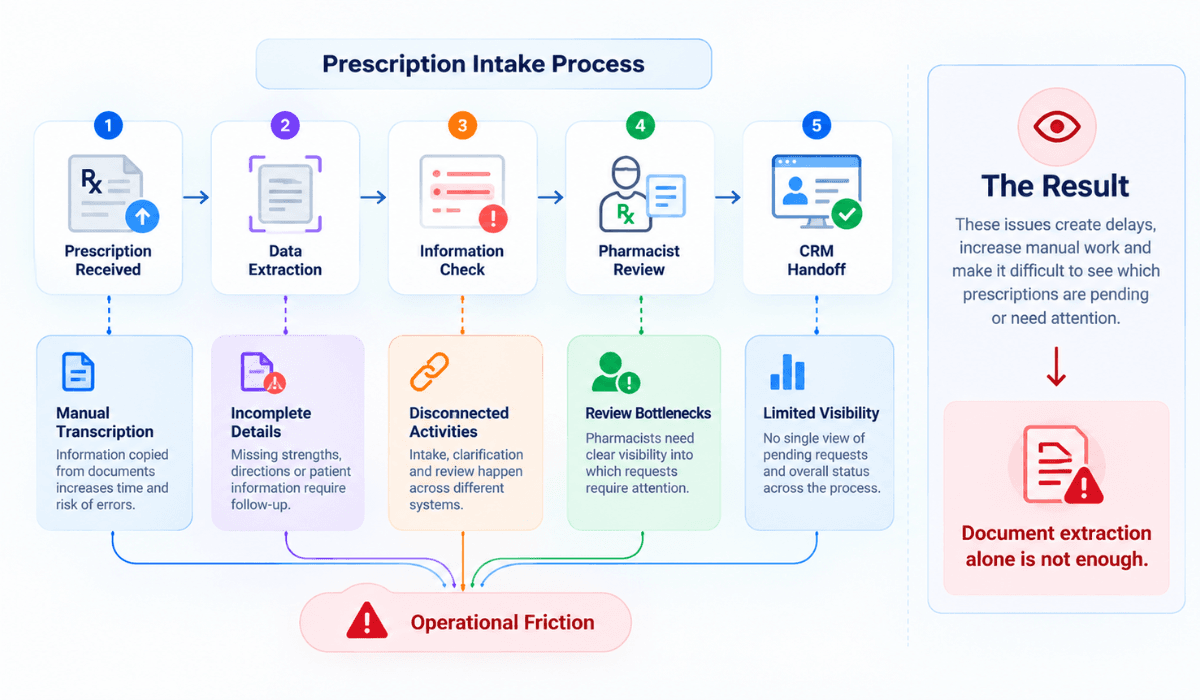
Compounding pharmacies frequently handle prescriptions involving individualized formulations, strengths, and patient-specific instructions. Processing these requests can require careful document review, information verification, and coordination between staff members. When information is incomplete or spread across multiple systems, administrative work can increase and processing can become more complicated.
Why the company sought outside help
Introducing AI into pharmacy operations requires more than selecting a document extraction tool. Pharmacies must consider existing systems, staff responsibilities, review requirements, and integration challenges. Gyan Solutions developed this independent demonstration to show how a technology partner could address these interconnected needs through structured workflow design.
Initial Observations
The design process identified several potential sources of operational friction, including manual transcription, incomplete prescription details, disconnected review activities, and limited visibility into pending requests. These challenges suggested that improving document extraction alone would be insufficient. A more effective approach would connect information capture, validation, and review within one process.
Review & Design Approach
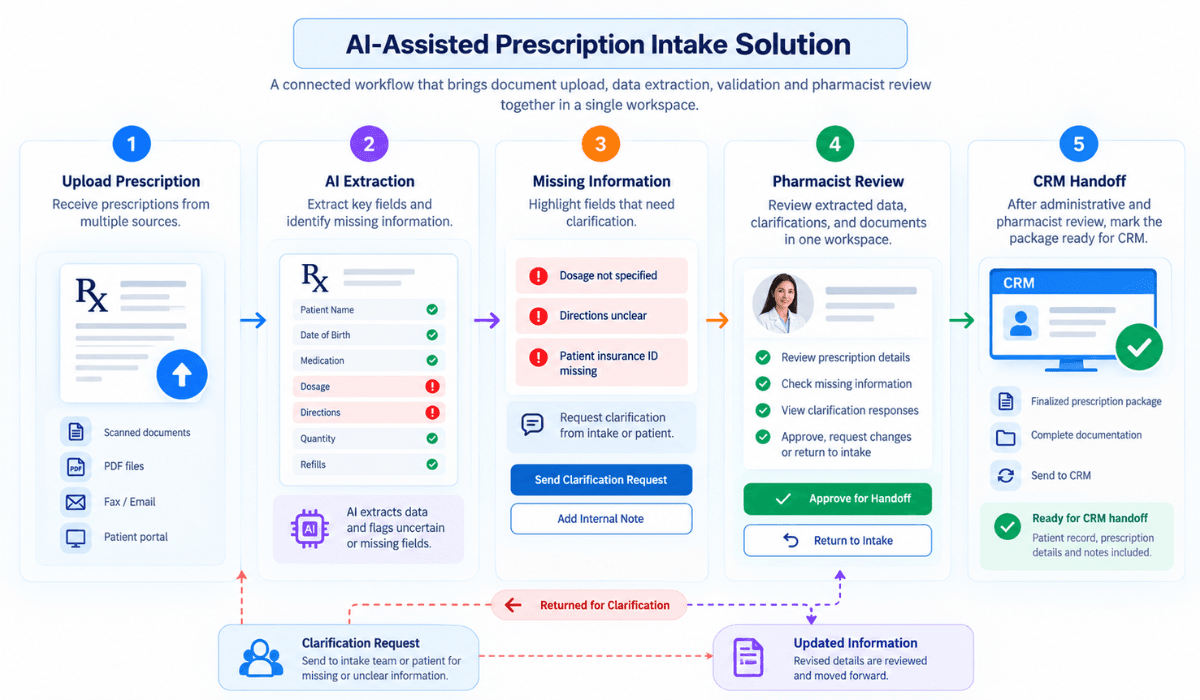
Gyan Solutions designed the workflow around the people and decisions involved in prescription intake. The approach separated administrative preparation from professional review, allowing AI to assist with information capture while keeping staff responsible for verification. Clear workflow stages were introduced to support clarification requests, pharmacist review, and controlled handoff.
Key Findings
The design highlighted that AI extraction is most useful when supported by structured validation and exception handling. Confidence indicators can help identify uncertain fields, but they cannot establish prescription accuracy independently. A connected review process was therefore essential to prevent incomplete information from progressing without appropriate attention.
Decisions & Solution
The proposed solution combines prescription upload, AI-assisted field extraction, missing-information indicators, and pharmacist review in one workspace. Pharmacists can review prepared packages, request clarification, or return records to intake. Once the administrative review is completed, the package can be marked ready for CRM handoff.
Implementation
Gyan Solutions developed a functional demonstration showing the workflow from document upload through pharmacist review. The prototype includes structured prescription fields, review indicators, workflow statuses, and a CRM-ready handoff stage. The demonstration illustrates the proposed process, while production integrations and pharmacy-specific validation remain separate implementation requirements.
Change management
Successful adoption would require intake personnel and pharmacists to understand their responsibilities within the new workflow. Staff would shift from primarily entering information to reviewing AI-prepared records and resolving exceptions. Training, defined approval responsibilities, and clear escalation procedures would be important before introducing the system into live pharmacy operations.
Impact
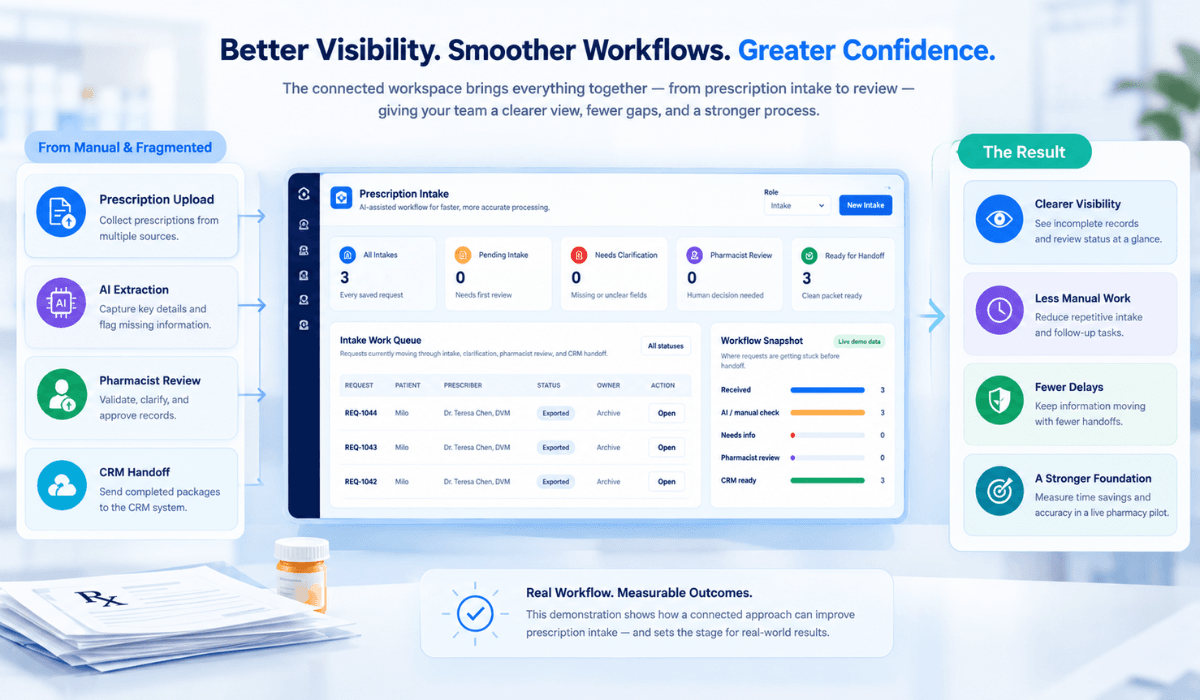
The demonstration illustrates how prescription intake activities can be organized within a connected workspace, with greater visibility into incomplete records and review status. It also establishes a foundation for evaluating potential reductions in manual work and administrative delays. Actual time savings and accuracy improvements would require measurement in a live pharmacy pilot.
Why This Worked
The design addressed the complete administrative intake process rather than treating AI extraction as an isolated feature. By connecting document processing with clarification handling and pharmacist review, the demonstration presents a practical model for controlled automation. Its principal strength is supporting operational efficiency without removing professional judgment from the workflow.