


Quick Summary
Traditional ERP upgrades usually improve speed and automation, but they do not help teams make better decisions. AI changes this by helping businesses predict problems earlier, understand data faster, and respond to changes more quickly. This is why many companies are now adding AI features to their ERP systems.
Late shipments rarely begin as transportation failures. More often, the issue starts earlier in procurement delays, supplier bottlenecks, or shifting demand signals that traditional ERP dashboards cannot interpret in time. Operations teams frequently spend hours tracing the source of disruptions across disconnected systems before identifying the real cause.
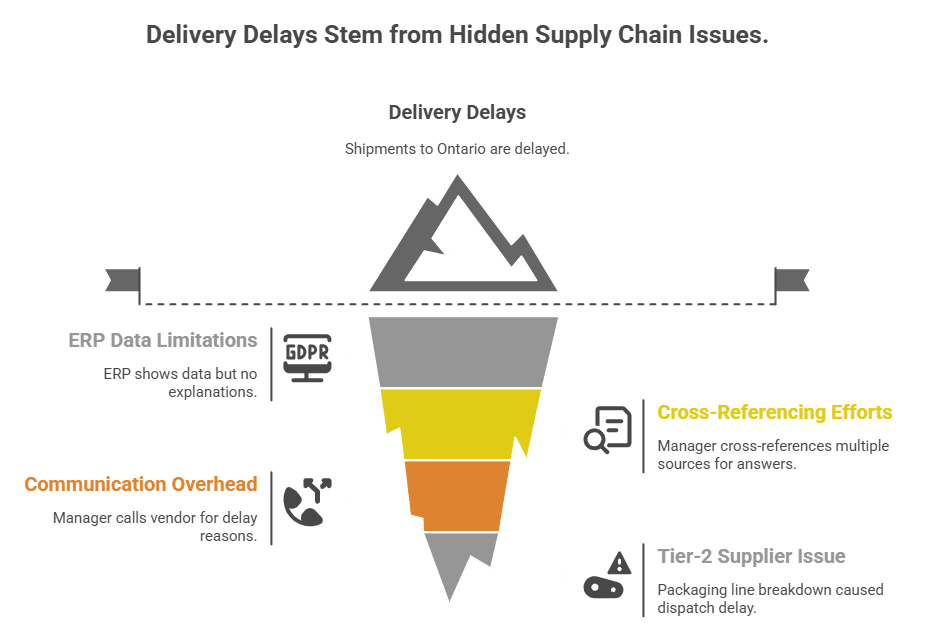
This gap exists because conventional ERP platforms are designed to record activity rather than interpret operational patterns. AI integration changes that role by turning ERP data into forward-looking insights instead of static transaction histories.
The Problem with Traditional ERP Upgrades
Enterprise resource planning (ERP) upgrades have always been associated with new modules, a better user interface or a better workflow integration. The essence did not change, however: well-organized databases that reflect transactions with pre-determined rules. Workflows with cloud ERPs however are just as smart as the rules that were determined during implementation.
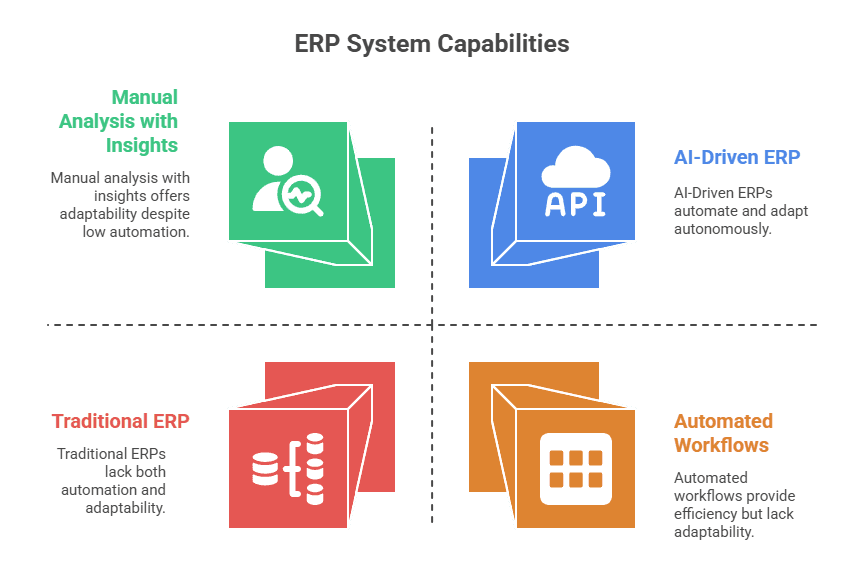
In 2023, Deloitte study revealed that 70% of the users of the ERP continue utilizing manual analysis or third-party tools to perform operational decisioning despite the upgrade to systems within the past five years. Why? Because ERPs of the past do not learn. They robotize, however they do not evolve. They retain information, but they do not learn by themselves.
How AI Integration Changes the Game
Consider an ERP that not only has displayed a stockout warning but given a pretext that demand has skyrocketed of a particular part because of a regional promotion, and delay in a load shipment of a supplier in Mexico is estimated to lengthen the shortage by three days. Better still it would be optimal redistribution of stocks already on the ground to eliminate lost sales.
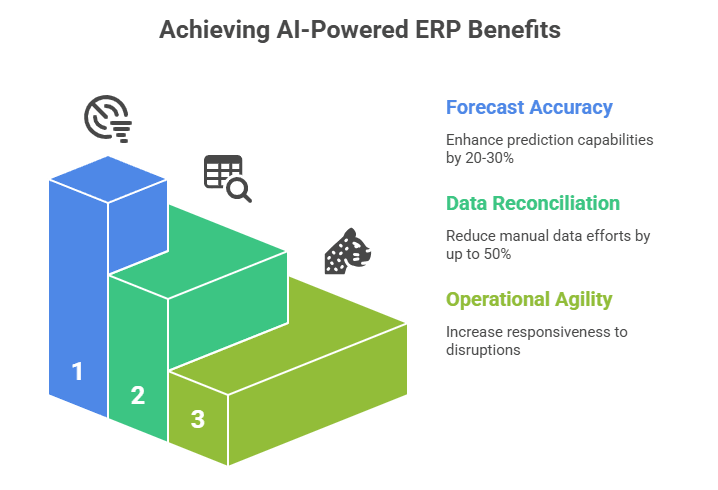
This is what Artificial intelligence (AI) will do to ERPs: McKinsey indicated in 2024 that companies incorporating AI into EPR functions experienced a 20-30% increase in forecast accuracy, eliminated up to 50% of work on manual reconciliation of data and dramatically improved their ability to agilely handle any disruption. AI-driven ERPs can interpolate the past trends, identify outliers, forecast the bottlenecks, and even produce prescribed recommendations automatically.
Real Examples: AI-Integrated ERP in Action
One of the major producers of automotive parts in Canada implemented AI algorithms into its ERP when it came to production schedules. Earlier on, line supervisors would occupy 2-3 hours per day in sequence the jobs according to machines available, skills of the spontaneous order and urgent order. The AI module compared thousands of scenarios of the production in a night and provided the best schedule in the morning. The reduction in the number of scheduled times was 80% and there was an improvement of 18% on-time delivery performance within two months.
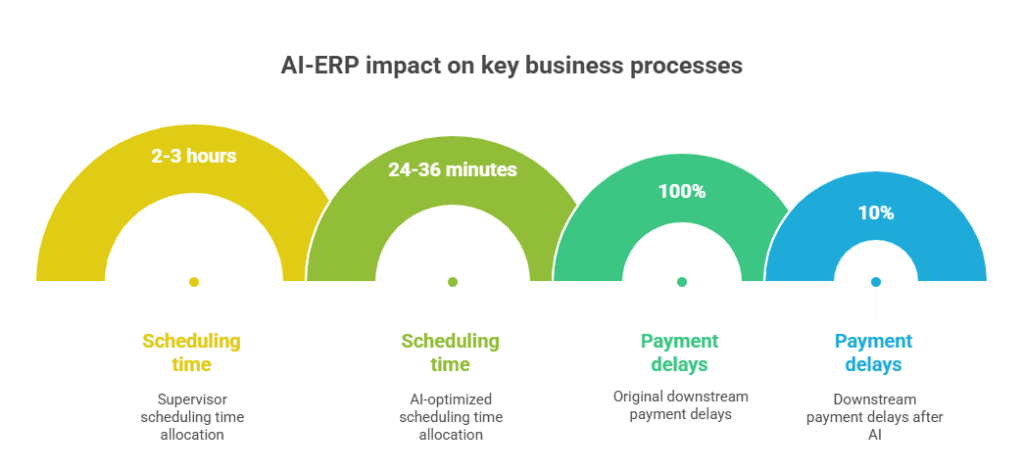
Likewise, an international consumer goods company with the help of AI-integrated ERP found their way to compare patterns to spot errors in invoice and purchase order data entries. Their finance department indicated that the downstream payment delays and manual correction were reduced by 90%.
Why AI is the Logical Next Step for ERP
The data is already centralized using ERPs. By using that information, AI gains the ability to learn operational patterns without pre-programmed rules, come up with proactive suggestions instead of single-time reports, and adjust endlessly in ways that traditional, fixed designs do not.
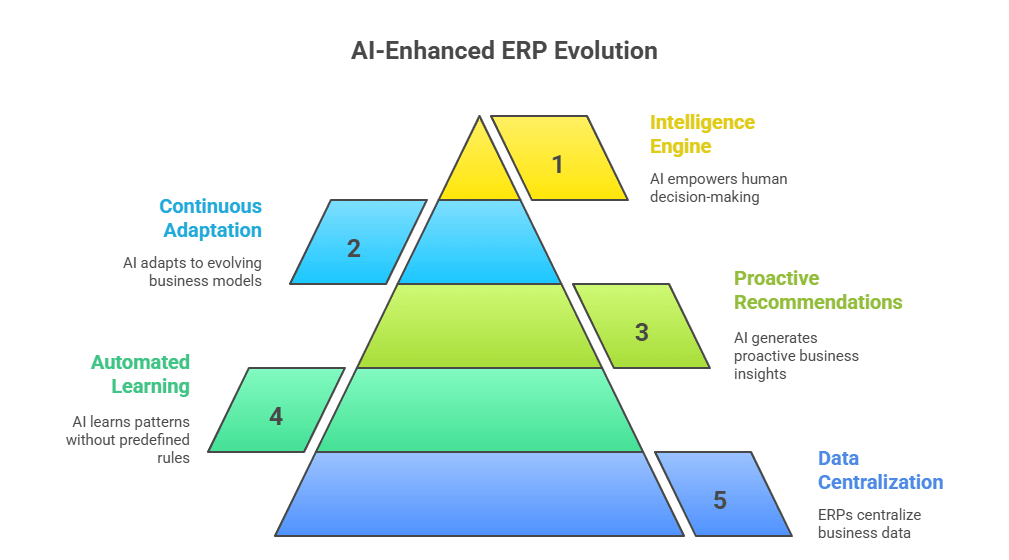
It converts ERP into an intelligence machine that strengthens human decision-making. Dynamic businesses are struggling with complicated chains of supply, volatile and changing markets and customer behaviors, and thus, no matter how reliable and effective a system is, it will always be left behind by the actual reality. AI fills such a gap with haste, context, and the ability to learn.
The Future: AI Copilots Embedded in ERP Workflows
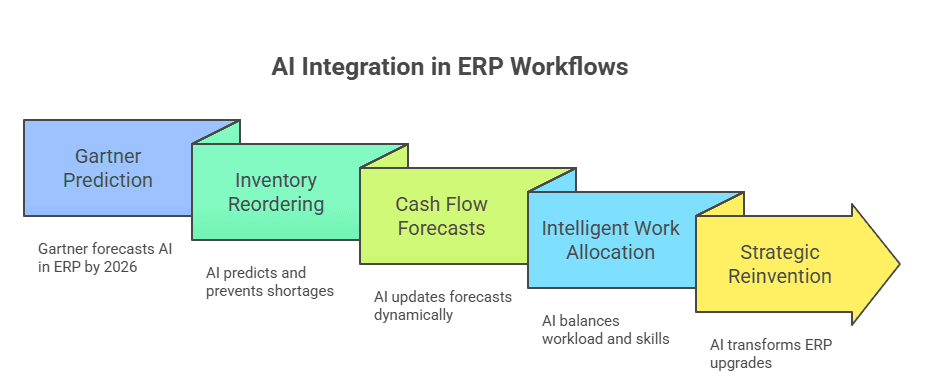
According to Gartner, 50% of ERP installations will have AI capabilities embedded in it by 2026 and this will allow supporting real-time decision-making in normal work processes. It may include inventory reorder algorithms detecting shortages in advance, cash flows forecasted by AI, dynamically updated to reflect changing invoicing and procurement plans, and smart allocation of work in production or service delivery due to balancing of skills and work load. Essentially, AI changes the ERP upgrade process, demanding no more addition of features to an effective reinvention.
Conclusion and Summary: ERP Upgrades Need AI to Stay Relevant
ERP systems are no longer just tools for storing business data. With AI, they can help teams predict risks, improve planning, and reduce manual work across departments. This makes daily operations smoother and more reliable.
Companies that upgrade ERP with AI can respond faster to market changes and manage complex workflows more easily. Over time, this creates stronger coordination across the entire organization.

SUKHPREET SINGH
I'm Sukhpreet Singh, Director of Innovation & Technology at Gyan Solutions, specializing in generative AI, AI chatbots, and ERP integration. I design AI solutions that integrate seamlessly into existing systems without disruption. I build conversational chatbots that improve decision speed and agentic AI systems that automate complex workflows. Over 8+ years, I've deployed AI-powered decision-support platforms that improve visibility and planning accuracy. My approach centers on alignment: AI works best when designed around your business, not when your business is forced around the AI. I believe intelligent systems should be invisible they simply improve decisions and outcomes.





