


Quick Summary
AI models are getting cheaper, but that does not necessarily mean AI applications will be cheaper to run. As companies move from simple chatbots to agents that reason, use tools and work through multiple steps, the cost of completing a task can rise even while the price of individual tokens falls.
We have seen something similar before. In the early days of cloud computing, AWS looked cheap and simple. Companies could avoid buying servers, scale quickly and pay only for what they used. But as they grew, costs became harder to control. Servers stayed running, databases were oversized, storage piled up and engineering decisions often created financial consequences that were not immediately visible.
Dropbox is a good example. It had relied heavily on Amazon S3, but as its storage needs grew into hundreds of petabytes, the economics changed. In 2015, Dropbox began moving most user data onto infrastructure built specifically for its own needs.
The impact was significant. Dropbox said its infrastructure changes reduced costs by about $74.6 million over two years, while its gross margin increased from 54% in 2016 to 67% in 2017. Cloud cost management eventually became important enough to develop into its own discipline: FinOps.
Reference: Dropbox SEC filings and the FinOps Foundation.
The price of a token is falling. The price of the workflow may not be
AI models are becoming cheaper to run, so it is natural to assume AI applications will become cheaper too. That may be true for a simple chatbot, but the economics change when you move to an AI agent.
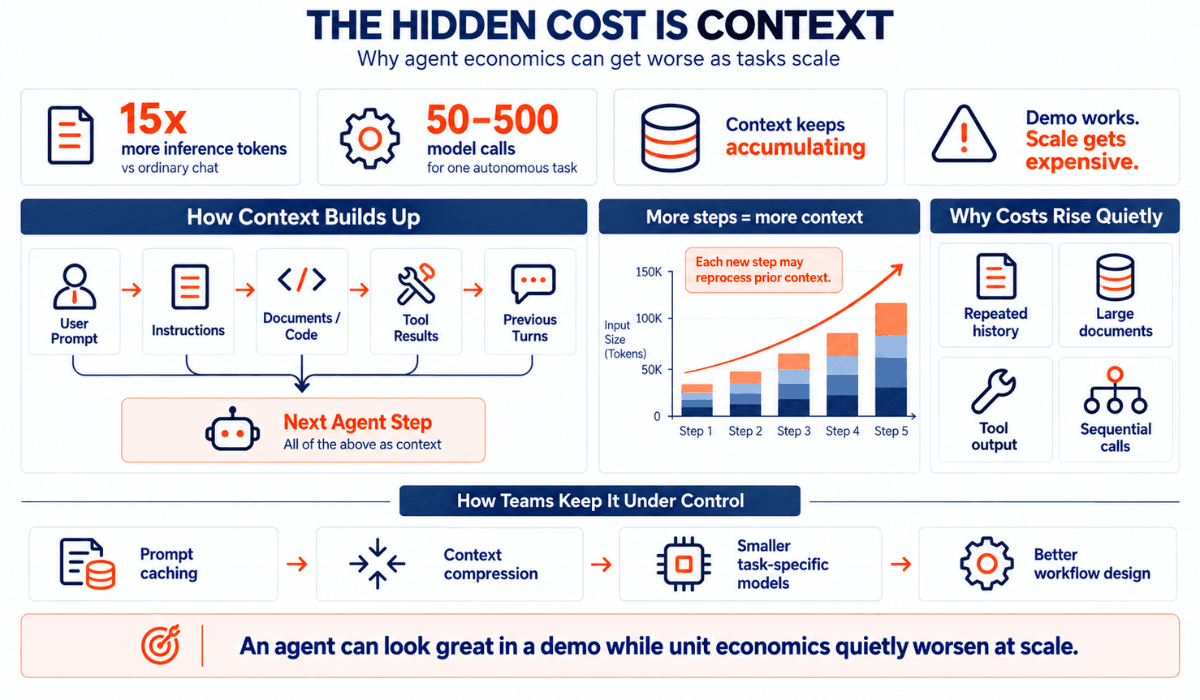
A chatbot may receive a question, generate an answer and stop. An agent can reason through a task, call a tool, inspect the result, search for more information, correct a mistake and continue working. Each step may require another model call and another round of context processing.
Gartner calls this the “Inference Paradox.” In August 2026, it predicted that inference costs per agentic workflow will increase more than fivefold through 2028, even as individual tokens become cheaper. Gartner says more advanced workflows consume far more tokens and often use more expensive reasoning models.
The point is simple: cheaper tokens do not automatically mean cheaper AI. If lower prices encourage us to build agents that reason longer, use more tools and make more model calls, the total cost of completing the task can still rise.
We can already see this in real AI systems
NVIDIA recently analyzed a real Claude Code session that lasted just 33 minutes. During that time, the system made 283 inference requests, including 58 main-agent turns and 225 sub-agent calls. The main agent's context grew from about 15,000 tokens to 156,000 tokens before being compressed.
That is where agent costs can start to add up. As an agent works, it may repeatedly process conversation history, code, tool results and other context. NVIDIA points to techniques such as caching, context compression and better workload design as ways to control those costs.
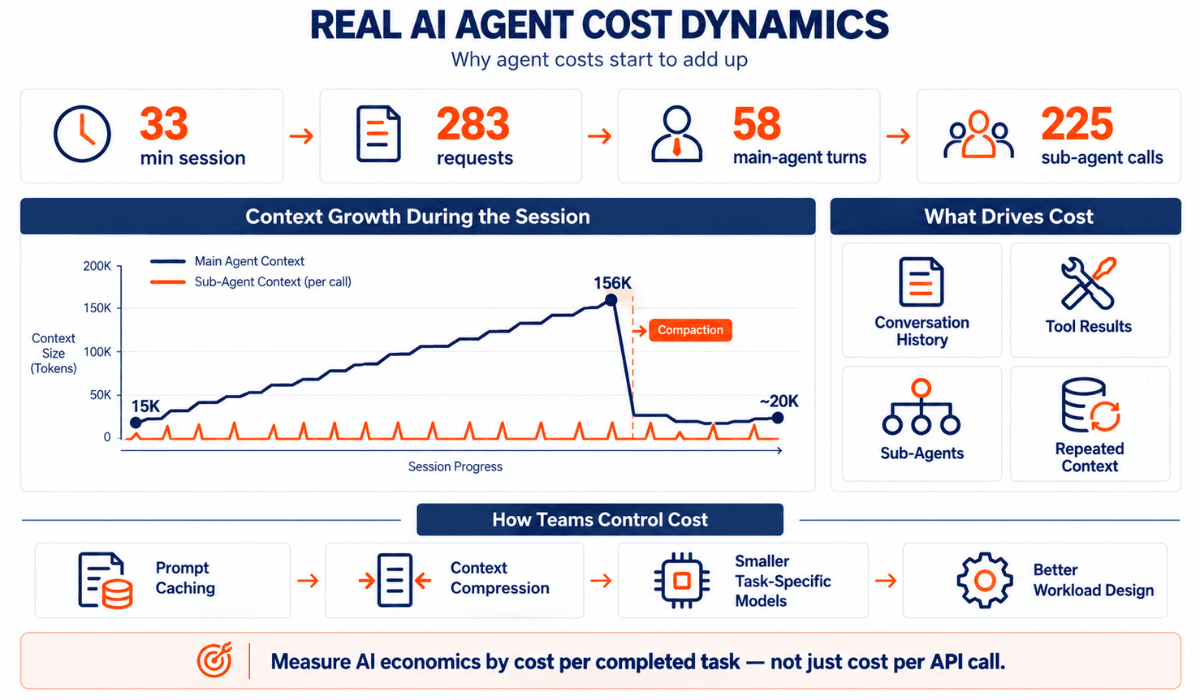
Reference: NVIDIA, Building for the Rising Complexity of Agentic Systems with Extreme Co-Design, May 2026.
This changes how AI economics should be measured. Cost per API call and cost per million tokens still matter, but companies increasingly need to know how much it costs to complete the actual task.
Anthropic spent almost $20,000 on one autonomous coding experiment
In February 2026, Anthropic used 16 Claude Opus 4.6 agents to build a C compiler. Over two weeks, the agents produced about 100,000 lines of code while consuming nearly 2 billion input tokens and 140 million output tokens. The total API cost was just under $20,000.
That sounds expensive, but the better question is what the money produced. Anthropic's researcher said the project cost only a fraction of what producing the compiler himself or with a team would have cost. In that case, $20,000 of AI usage may represent very good economics.
The problem is when the spending comes from unnecessary retries, excess context or expensive models doing work that a cheaper model could handle. Two $20,000 AI bills can therefore mean very different things.
Reference: Anthropic, Building a C Compiler with a Team of Parallel Claudes, February 5, 2026.
Coding platforms are already changing their pricing
The economics are already affecting commercial AI products. Cursor said its hardest agent requests can consume an order of magnitude more tokens than simple requests, making fixed pricing per request increasingly difficult. The company moved toward usage-based pricing because a quick syntax question and asking an agent to complete an entire pull request can have very different underlying costs.
Replit ran into a similar problem. As its Agent became capable of longer autonomous tasks, the company said some 20-minute runs could cost it more than $10 in underlying compute. Replit responded with effort-based pricing, where the price more closely reflects the computing resources used to complete the request.
References: Cursor's pricing explanation and Replit's Effort-Based Pricing announcement.
These companies are not simply changing subscription prices. They are responding to a deeper problem: two requests that look similar to the customer can require very different amounts of computing power behind the scenes.
Developers are starting to feel the same thing
The same issue is appearing in developer communities. In February 2026, developer Marc-André Moreau posted on X that he had burned about $120 in 24 hours using Cursor. He also reported a sudden spike of 57.3 million tokens within minutes while working on a difficult coding task.
Replit users have shared similar experiences. One Reddit user said a small hobby project reached $74.19 in charges in about a week, with some Agent requests costing between $2 and $9. Another user later reported spending around $700 in a month, including repeated attempts to repair features the user said the Agent had previously broken. These are individual experiences rather than representative averages, but they show how unpredictable agent spending can become.
References: Marc-André Moreau on X and user reports from r/Replit.
There is an important difference from traditional software here. When normal software fails, it may simply return an error. When an agent fails, it can reason about the error, inspect files, try a fix, test the fix, discover another problem and start again. You can end up paying for the failure itself.
This is where AI starts looking a lot like FinOps
The comparison is already appearing in the AI community. In a LinkedIn discussion, Ratan Das described “Tokenomics” as the new FinOps, pointing to practices such as model routing, caching, prompt reuse, context compression and better retrieval as ways to control AI spending.
The name may change. It could become AI FinOps, TokenOps, inference economics or something else. The important idea is that AI cost has to become part of system design rather than something companies investigate after the bill arrives.
That is also consistent with where FinOps itself is going. In 2026, the FinOps Foundation broadened its mission from managing the value of cloud to managing the value of technology, and reported that 98% of FinOps practitioners now manage AI spend.
References: Ratan Das on LinkedIn and the FinOps Foundation's 2026 mission update.
Don't put a $20 brain on a five-cent problem
The cloud era taught companies to use the right amount of infrastructure for the job. AI systems need the same discipline, because not every task requires the most powerful reasoning model available.
The basic cost controls are straightforward:
- Route models by task: use smaller models for simple work and frontier models for difficult reasoning.
- Control context: avoid repeatedly sending information the model does not need.
- Cache repeated work: do not pay to generate the same answer again when a reliable result already exists.
- Limit unnecessary loops: agents should know when to retry, escalate or stop.
This is the AI equivalent of not provisioning a huge server for a tiny workload. The goal is not to use the cheapest model everywhere; it is to use the least expensive approach that can reliably complete the job. That same principle matters when designing AI systems for real operational work, where model choice, context and workflow design directly affect both cost and reliability.
The metric that matters is cost per useful outcome
McKinsey reported in July 2026 that 93% of qualified respondents in its Enterprise AI FinOps Survey had exceeded their AI budgets. It also noted that enterprise spending on large language models had tripled over the previous year. The survey included 120 enterprise participants, of whom 75 were qualified respondents, so the figure should be read as a strong signal rather than a universal measure of every enterprise.
This can happen even while models become cheaper because the real cost depends on how they are used. A cheap model called hundreds of times may cost more than a powerful model used once.
The better question is what the spending produces. If an agent costs $4 to complete a business process worth $500, the economics may be excellent. If the same $4 is spent doing work worth 30 cents, cheaper tokens do not solve the problem.
The metric that matters is cost per useful outcome, not simply cost per token.
We've seen this movie before
Cloud computing did not fail because companies received large AWS bills. Instead, companies became better at managing cloud economics. They monitored usage, shut down idle resources, right-sized infrastructure and eventually developed FinOps practices around those decisions.
AI appears to be entering the same stage. It is easy to build an agent that looks impressive in a demo by giving it a huge context window, connecting every available tool and using the most powerful model. The problem comes later, when thousands of customers begin using it and the invoice grows with them.
The companies that manage this transition well may not be the ones with access to the cheapest models. They will be the ones that treat inference, context and agent behavior as design constraints from the beginning, especially when building AI systems that need to work reliably at scale.
Cloud taught us to think about cost per workload. AI may teach us to think about cost per useful outcome. This time, the workload thinks for itself.

NATHAN ALLEN
I'm Nathan Allen, Director of Artificial Intelligence at Gyan Solutions. With 8+ years building AI systems, custom software, and cloud-native platforms, I deliver applications that scale reliably and drive measurable business outcomes.





