



Short Summary
Strapi SEO with Next.js depends on how content is rendered, delivered, and discovered. Indexing problems often come from missing metadata, stale caching, weak internal links, sitemap gaps, or incomplete content reaching Google.
You've published an article in Strapi, checked your Next.js website, and everything appears to be working. The page loads, the content is visible, and the URL works correctly. Yet days or weeks later, Google still hasn't indexed it.
For businesses using Strapi with Next.js, this can be frustrating. Both technologies are capable of supporting excellent SEO, but connecting them doesn't automatically make content accessible to search engines. The issue often lies in how information moves between the content management system, the frontend, and Google.
Understanding where that process breaks down is more useful than repeatedly requesting indexing or rewriting content that may already be perfectly adequate.
How Strapi and Next.js Affect Google Indexing
Strapi manages content without controlling how the public website displays it. Next.js retrieves that content through APIs and generates the pages users visit. This separation creates flexibility, but also adds important indexing responsibilities.
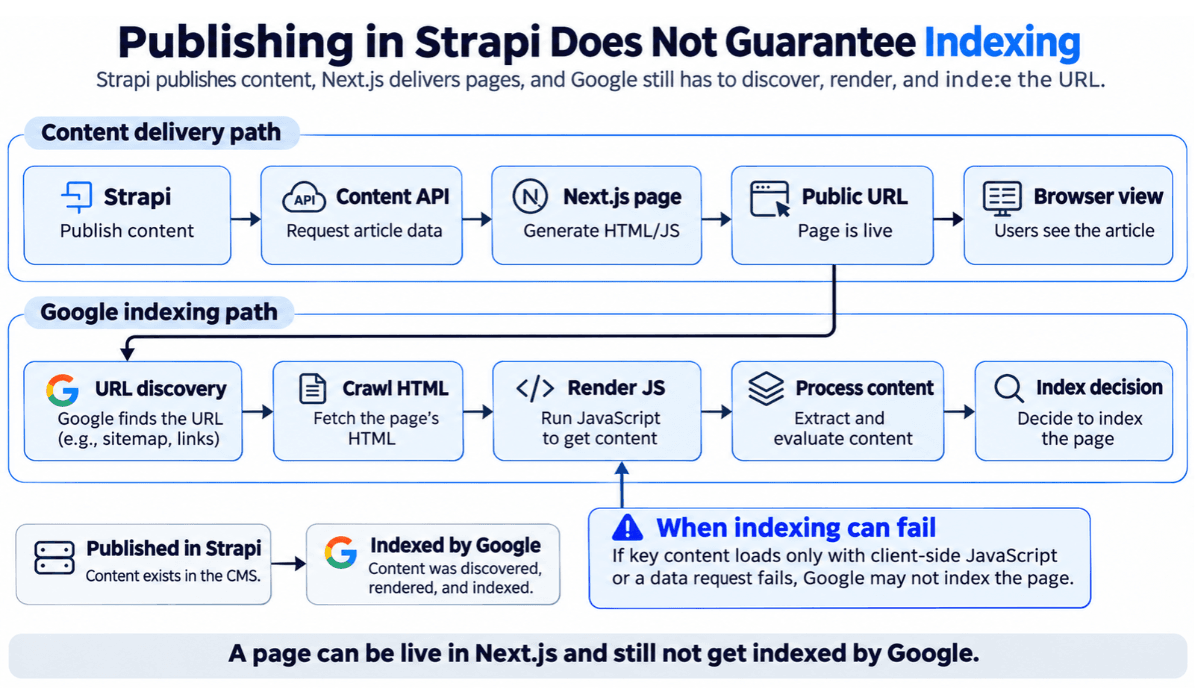
Publishing in Strapi does not guarantee Next.js has generated the latest page. Google must still discover, crawl, process, and evaluate that URL. A browser-ready page can therefore fail during Google’s indexing process.
For example, 100 published Strapi articles may load content only after JavaScript runs. If that request fails during rendering, Google may receive incomplete content. Visitors may still see the complete article in their browsers.
Four Technical Problems That Can Prevent Strapi Pages From Being Indexed
JavaScript rendering and missing content
Next.js supports different rendering approaches, including static generation, server rendering, and client-side rendering. When important content depends entirely on browser-side JavaScript requests, search engines may encounter additional processing requirements or errors.
Google can render JavaScript, but its JavaScript SEO documentation explains that crawling, rendering, and indexing are separate processes. Making article content available through server rendering or static generation can reduce unnecessary dependencies on client-side execution.
Missing metadata and incorrect canonical URLs
Strapi may contain the SEO title, description, and canonical URL for an article, but Next.js must retrieve and apply that information correctly.
For example, Strapi's REST API does not return components and related content by default. If SEO fields are stored in a component and the frontend doesn't request it using populate, the information may be missing from the API response.
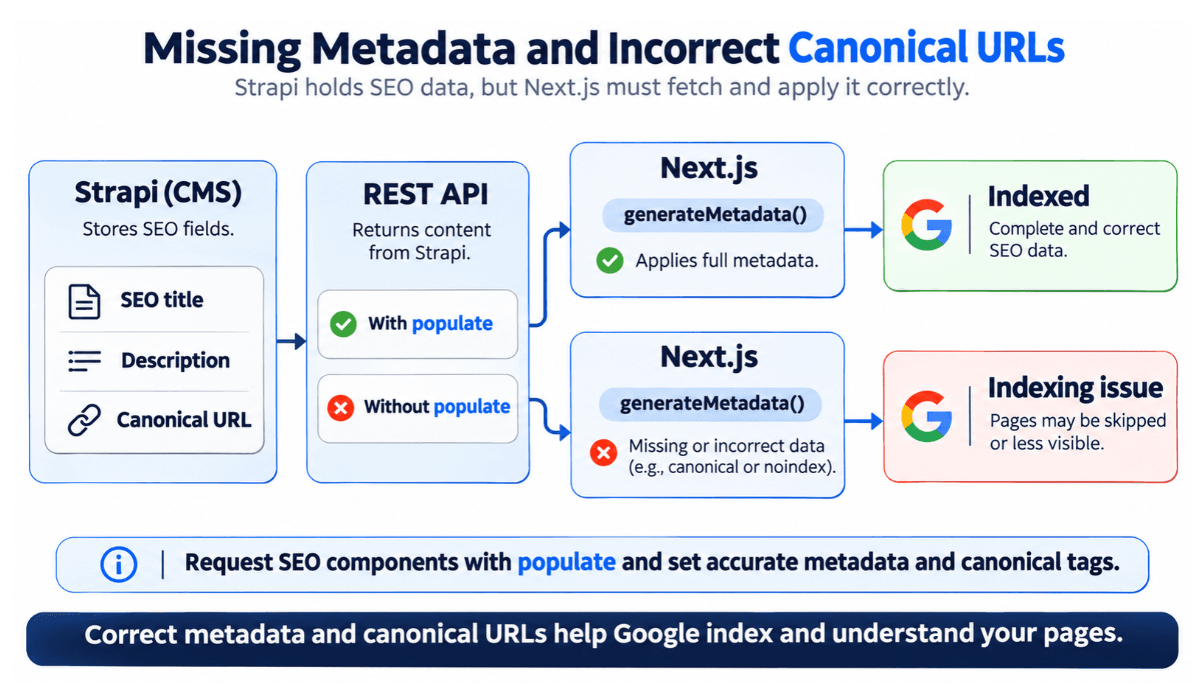
Next.js provides the generateMetadata function to create page-specific metadata. Incorrect canonical tags or unintended noindex directives can cause indexing problems, while missing descriptions or generic titles can make pages less informative in search results. {Source}
Outdated content caused by caching
Caching improves website performance, but it can also prevent newly published content from appearing immediately. An editor might update an article in Strapi while Next.js continues serving an older cached version. Depending on the application's configuration, time-based or on-demand revalidation may be needed to refresh the affected pages.
A publishing webhook can help connect Strapi updates to the appropriate Next.js revalidation process. However, refreshing the website does not mean Google will immediately recrawl it.
Missing sitemap entries and internal links
New articles should be discoverable through a current sitemap and relevant links from other website pages. If the sitemap was generated before new content was published, or articles aren't accessible from blog archives and category pages, Google may have fewer opportunities to discover them.
Google confirms that sitemaps support URL discovery, but submitting a URL does not guarantee that Google will crawl or index it.
A Real Developer's Experience With Next.js Indexing
A November 2026 r/TechSEO discussion showed this problem in practice. A Next.js developer reported blog content missing from Google’s rendered HTML. The content was loaded through a client-side useEffect request in production.
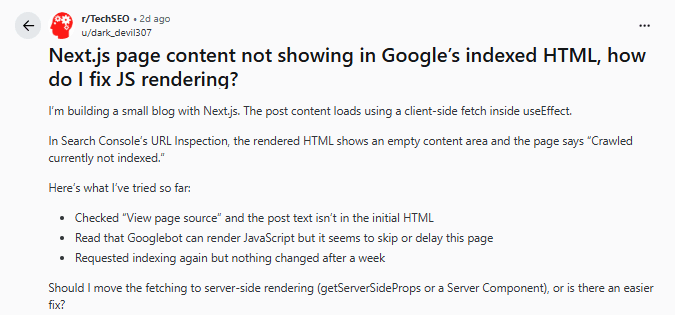
Search Console showed Crawled – currently not indexed despite another indexing request. Developers suggested checking failed API requests and using server-side or static rendering. Missing rendered content could indicate fetching or execution failures, not delay.
The discussion does not prove JavaScript caused Google’s indexing decision alone. It shows why Google’s rendered output matters more than browser appearance. That distinction is especially important when Strapi and Next.js operate separately.
How to Diagnose and Fix Strapi Indexing Problems
Start with Google Search Console’s URL Inspection tool before changing architecture or content. Check discovery, crawl status, canonical selection, and whether Google renders the complete article. Then compare those findings with Strapi content and Next.js delivery.
| Problem | What to check |
|---|---|
| Content exists in Strapi but not on the website | Publication status, API response, Next.js routing |
| Google sees an empty or incomplete page | Rendering method, JavaScript errors, API requests |
| Incorrect page title or canonical | SEO components, populate, generateMetadata |
| Recently published content is missing | Caching, revalidation, sitemap, internal links |
| Crawled but not indexed | Content usefulness, duplication, canonicalization, technical errors |
The goal is to locate the issue across Strapi, APIs, Next.js, or Google. Incomplete rendered content usually points toward frontend or delivery problems requiring correction. If everything works correctly, review originality, usefulness, duplication, and indexing signals instead.
Conclusion: Fix the Publishing Process, Not Just the Content
Strapi and Next.js can support strong SEO for modern content-driven websites. However, publishing articles and adding metadata alone does not ensure indexability. Search engines still need complete pages, working URLs, and consistent technical signals.
Content must move correctly from Strapi through APIs into Next.js rendering. It must remain discoverable through internal links and reliable indexing signals. When indexing fails, identify where that delivery process breaks before changing content.
At Gyan Solutions, Strapi development focuses on dependable content delivery and frontend integration. Clear architecture helps content reach users and search engines consistently. That foundation supports websites that remain accessible, scalable, and technically sound.

NATHAN ALLEN
I'm Nathan Allen, Director of Artificial Intelligence at Gyan Solutions. With 8+ years building AI systems, custom software, and cloud-native platforms, I deliver applications that scale reliably and drive measurable business outcomes.





