


Quick Summary
ERP implementations fail not because of bad software, but because of poor data, weak leadership, scope creep, and ignored adoption signals. This guide breaks down the root causes, real-world case studies, and practical steps to help you implement ERP successfully.
ERP projects are associated with enormous expectations, streamlined processes, coherent data, and improved decisions. However a considerable number of them never fulfill it. Some collapse visibly. Other ones drag their heels, drain resources, waste years on miserable teams. The first step to prevent ERP project failure is to understand the actual causes of the failure.
What Does ERP Implementation Failure Actually Mean?
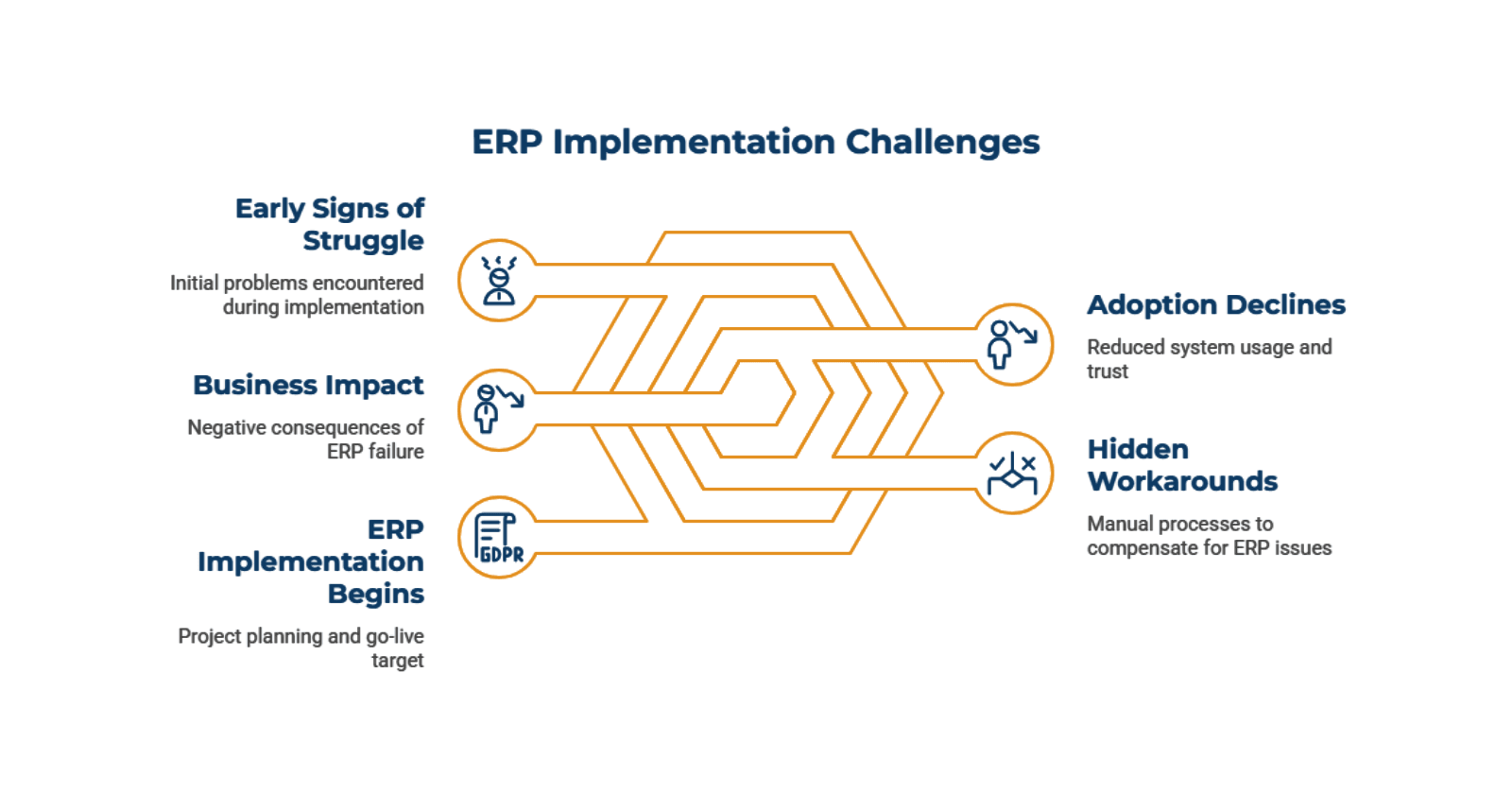
Failure isn't always a dramatic shutdown. It is more often a gradual fading away, lost deadlines, and old-fashioned departments, reports that no one believes, etc. There is a question of what failure actually looks like in practice before diagnosing the causes of ERP implementations failure, since the distinction between failing and struggling is alarmingly vague.
Failed vs. Struggling - Why the Line Is Blurry
ERP failure is not formally announced in most organizations. Rather, they just roll the casualty by stretching the timelines silently, introducing more consultants, scoping it down and calling it a phased approach. A system that has been put live and still needs three shadow spreadsheets to work is not a success. It is a loser who sports a go-live badge.
The risk with this one is that the faltering implementations usually end up being treated as complete since leadership does not wish to recognize the difference between the promised and the delivered. This hides the actual risk of erp abandonment and postpones the required corrective intervention by months or years.
Go-Live Failure vs. Post Go-Live Failure
Go-live failure is observable: the system fails, transactions are not processed, users are unable to log in. Post go-live failure is less noticeable and costly. Technically, the system works, yet adoption is small, data is not reliable, and the business has not altered the way it does business in any significant manner.
Failures during post go-live frequently emerge between six and twelve months following the launch, when the initial euphoria cools and staff members discover that the ERP is not addressing the issues it purportedly addressed. That is where a big part of the actual cost is concealed into rework, workarounds, and frustrated workers who never had confidence in the system to start with.
The Real ERP Failure Rate - What Data Shows
The statistics of failure rate are carelessly quoted in the context of ERP, as the real figures are highly dependent on the definition of the failure. When you add budget overruns, schedule extensions, and post-implementation dissatisfaction to the list, the picture is much more dire than vendors like to make us believe.
Global Failure Rate Statistics 2024 - 2025
Gartner has historically estimated that 55-75% of ERP projects fail to meet their original objectives. A 2024 Panorama Consulting report found that over 50% of ERP implementations exceeded their planned budget, and roughly 60% ran past their original timeline. These aren't edge cases, they reflect systemic patterns across industries and geographies.
The most interesting part is that the same teams that spearheaded the implementation are the ones who report achievement of the objectives. After post implementation audits that are often independent, they often tell a different tale, adoption rates are lower, ROI was never achieved and workarounds continue to occur that were never planned to.
Why Budget and Timeline Overruns Are Undercounted
Direct implementation costs are undercounted as organizations only monitor the direct costs of the budget but not the indirect costs that are lost productivity during transition, excessively incurred overtime in data migrations rework, and the cost of supporting the legacy systems in parallel. A project that was completed within a budget through scope reduction is not a financial success.
The same applies to timeline overruns. When the five year ERP implementation turns out to be 3 years with silent extensions of phases, no one would write a report that it is a delay. The old timeline slowly fades away into a nonexistence, and the new one joins as the new standard. This is the way implementation costs get out of control and are not officially recognized.
Top Reasons Why ERP Implementations Fail
The majority of ERP failures have familiar patterns. Their underlying causes are not opaque, but organizational, behavioral and structural. Their difficulty to prevent is that they are not often visible when a project is kicked off. They occur slowly, worsening one another until it becomes hard to repair the damage.
1. Weak Leadership and Missing Executive Sponsorship
ERP involves all departments, and this implies that it is bound to cause conflict regarding the ownership of data, changes in processes, and resource availability. There is no actual executive sponsorship and so those conflicts are not resolved. They are avoided and avoidance is compounded into scope drift and organizational paralysis.
The problem of the steering committee is real. In most unsuccessful implementations, the committee is on paper but never meets and when there is a meeting decisions are postponed. Buy-in cannot be a kick-off speech on the part of leadership, it has to be a continuous process. It is needed to ensure that department heads do not guard their territory, and the ERP is being set up on a political basis instead of a process basis.
2. Poor Data Migration and Data Hygiene
The failure of data migration is among the least regarded risks of ERP projects. Three to six months to go-live, teams too often find out that their legacy data is much more messy than presumed duplicate vendors, mismatched product codes, incomplete customer records. At this point, it is too late to correct it.
Bad data in the legacy data does not get cleaned by transferring them to the new system. It gets amplified. The master data management should not be a last minute thing, rather it should be initiated at the early stages of the project. Companies that do not take this step usually launch on data they do not have confidence in, thus resulting in users' lack of confidence in the system and they move back to spreadsheets.
3. Inadequate Planning and Scope Creep
Scope creep does not usually declare itself. It comes in the form of logical demands "can we add this report?", "can we include this workflow?" smaller than it can be to pass separately, but larger than it can be to bust the schedule. Costs of implementation are hidden after them, since none of these additions was included in the initial plan.
It is aggravated by timeline compression. Organizations can react to falling behind schedule of projects by cutting tests or cutting back the training period instead of rescheduling the go live date. This is a false economy. A crunchy timeline that bypasses UAT in the right way is a present to post-implementation issues and post-implementation issues are expensive to address at a level that a late launch would not have been.
4. Ineffective Change Management and Employee Resistance
ERP training, which occurs two weeks prior to go-live, does not alter management instruction. The real change management begins with the project kickoff and answers the underlying question that employees are, in fact, asking: How does this change my job, and will I still know what I’m doing?
They are not irrational but rational employee resistance. When one was satisfied with the old system in performing their daily work and the new system fails to do so, it is only natural to resist. Those organizations that brush this off as being a sign of resistance to change also fail to receive the message. The key to user adoption is that the new system has to be genuinely easier, and it has to tell you that, and not only with the zeal of the initial launch.
5. Wrong Vendor or Implementation Partner
Industry practices include vendor overpromising of the sales cycle. In some cases, the implementation partners are awarded contracts based on optimistic timelines and low prices and subsequently make up the margin during change orders after the project has begun. One of the more certain indicators of a problematic implementation is SI selection using price as the initial criterion.
The cost is not the only problem with the partner mismatch. A company that has already had a successful manufacturing ERP experience can face difficulties in the implementation of a complex financial service. Fit in the industry, reference checks with similar projects and straight forward discussions on resource availability all count. The most passionate demo and the cheapest partner are hardly the correct selection criteria.
6. Over-Customization and Technical Architecture Mistakes
ERP customization risk is real and compounding. Every modification made to standard functionality is code that needs to be maintained through every upgrade. Organizations that heavily customize their ERP in phase one often find themselves unable to upgrade two years later without rebuilding those customizations from scratch.
The configuration vs. customization distinction matters enormously. Configuration works within the system's design. Customization fights it. When business processes can't adapt to standard ERP workflows, it's worth asking whether the process needs to change or whether a different product is a better fit. UAT gaps often reveal these mismatches too late.
7. Undefined Outcomes and Missing KPIs
Starting an ERP implementation without defined, measurable outcomes is like renovating a building without knowing what it will be used for. "Better visibility" and "streamlined operations" aren't KPIs, they're aspirations. ERP KPI failure often traces back to the planning stage, where nobody forced the hard conversation about what success actually looks like numerically.
When outcomes aren't defined, strategic value can't be measured, which means it rarely gets delivered. Eighteen months after go-live, leadership asks whether the ERP was worth it. Without baseline metrics and defined targets, the honest answer is that nobody can tell. That ambiguity is its own form of failure.
8. Resource Overload and Skill-Set Gaps
ERP implementations typically run in parallel with normal business operations. The internal champions, the people who know the business processes deeply enough to guide configuration are also the people running daily operations. Asking them to do both, without backfill or timeline adjustment, is a structural problem, not a motivation problem.
Skill-set gaps compound the resource overload. Organizations often underestimate how much internal technical capability is needed to manage integrations, support testing, and eventually own the system post-implementation. When those skills don't exist internally, the organization becomes permanently dependent on external consultants which was never part of the business case.
Real-World ERP Failure Case Studies
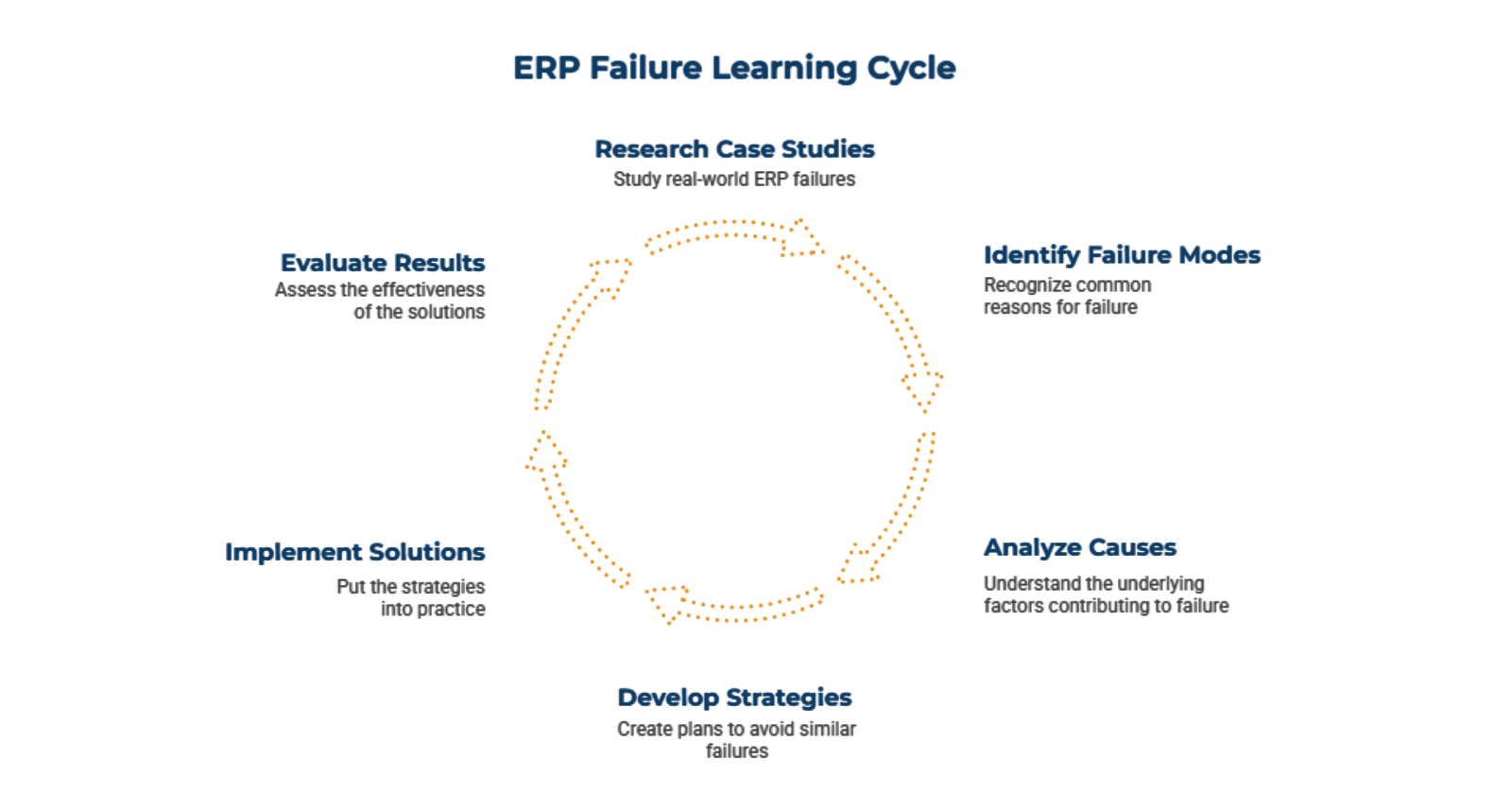
When you can see theory in action in companies whose names you know, it goes down more easily. Each of these three cases has been researched in detail and each demonstrates various failure modes not as a warning of what not to repeat, but as an example to study before you can start your own implementation.
Nike - $400M Supply Chain Collapse
In 2000, Nike implemented a demand-planning ERP module that generated wildly inaccurate supply forecasts. The result was $400 million in excess inventory for slow-moving products and simultaneous shortages for popular items like Air Jordan sneakers. Nike's CEO famously called it a "disaster."
The root cause wasn't the software itself, it was inadequate testing and a rushed rollout that didn't account for the complexity of Nike's global supply chain. The system was technically live, but operationally broken. This is a classic post go-live collapse scenario: the go-live happened on schedule, and the damage emerged over the following months.
Hershey - Timeline Compression Disaster
Hershey attempted to implement SAP, Manugistics, and Siebel simultaneously in 1999, compressing an 18-month project into 14 months to hit a target completion date before the peak Halloween season. The go-live happened as planned. The ability to process orders did not.
During the peak candy-buying period, Hershey couldn't fulfill $100 million in orders. Retailers ran out of products. The stock price dropped 8% in a single day. The lesson isn't that ERP is risky, it's that timeline compression in service of arbitrary deadlines is one of the more reliable ways to create a very public failure.
Target Canada - 70% Data Entry Error Rate
Target Canada's 2013 ERP implementation is studied in supply chain programs as a masterclass in data migration failure. When product data was migrated from legacy systems, an estimated 70% of SKU records contained errors, wrong dimensions, incorrect weights, missing fields. The ERP technically functioned. The data inside it did not.
Shelves were either overstocked or empty, because the system couldn't generate accurate replenishment orders. Customers encountered phantom inventory. Target Canada closed all 133 stores in 2015. Master data governance, treated as an afterthought rather than a foundation, turned an ambitious expansion into a $2 billion write-off.
Early Warning Signs Your ERP Is Failing
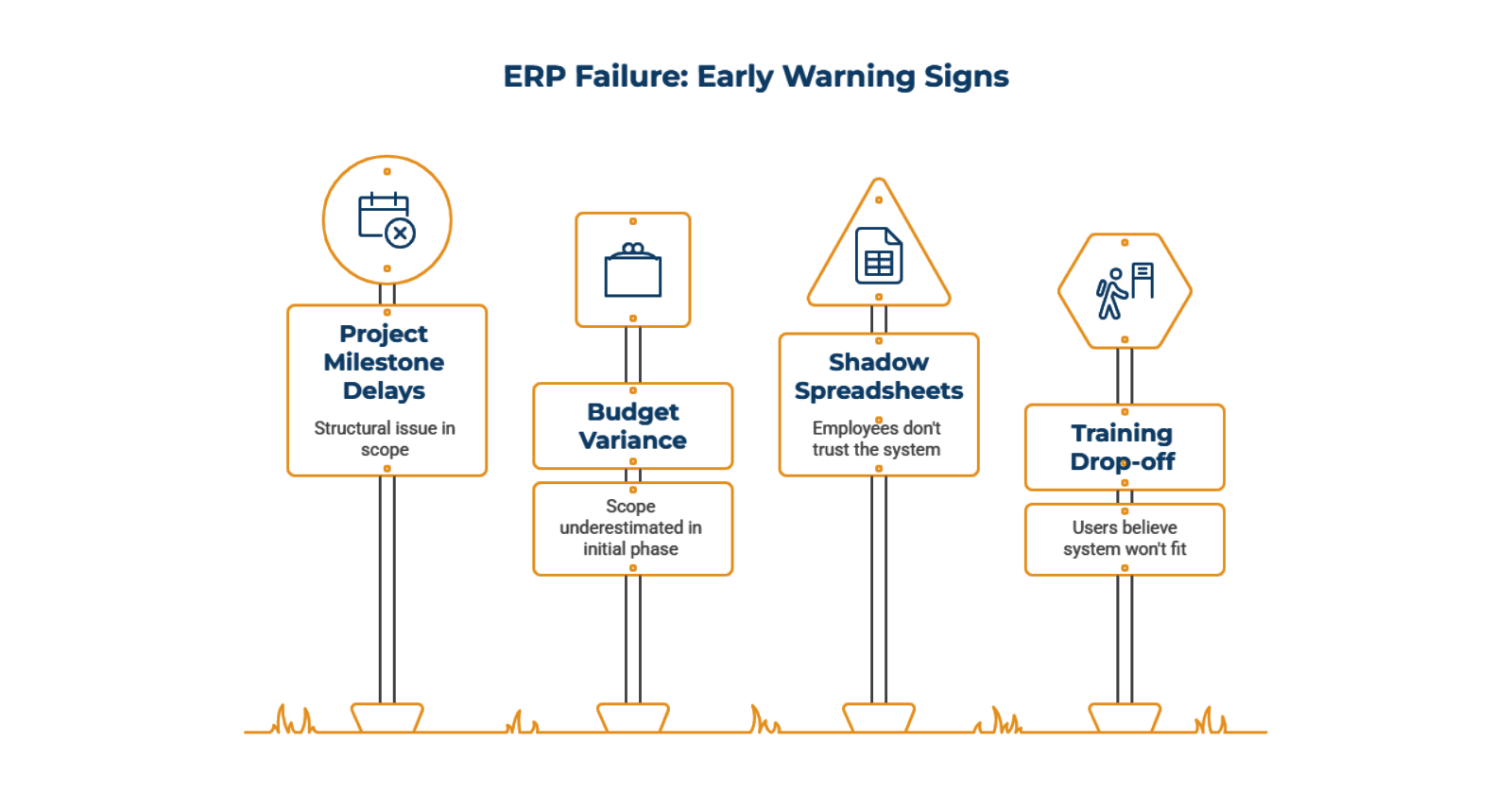
Issues do not manifest themselves in the short term. They give warnings several weeks or months before it turns into a crisis of missed milestones, behavioral workarounds, and disengagement with an organization. The distinction between course correction and post-mortem is the acknowledgment of such ERP red flags in time.
Project Milestone Red Flags
The most obvious early warning is the occurrence of constant milestone delays. One of the delays is a schedule problem. Three sequential delays represent a structural issue, typically, scope that has not been defined correctly, resources that have been over-allocated, or dependencies that have not been charted. Loss of communication of milestone status by the project team is in itself a red flag when the project team ceases to proactively communicate the status.
Budget variance is also eloquent. When change orders seem to be piling up in the first quarter of a multi-year implementation, the initial scope was definitely underestimated. Unless organisations can monitor the implementation costs in relation to the initial business case, they lose the capacity to intervene when the overrun begins, and it is too late.
User Adoption and Behavioral Signals
The best behavioral indicator of adoption failure is the shadow spreadsheets. Parallel tracking systems (employees are operating outside the ERP) implies that employees do not trust the data provided by the system or its capability to assist them in their work. This is not idleness, it is a logical reaction to the tool that is not serving them.
Earlier indicators are attendance at training and engagement drop-off. When users fail to attend training sessions or disconnect with it, it is typically an indication that they are already convinced that the system will not fit their job. Adoption indicators such as these can be seen weeks before go-live when somebody wants them and they are worth acting on before they become part of the permanent workarounds.
How to Avoid ERP Implementation Failure
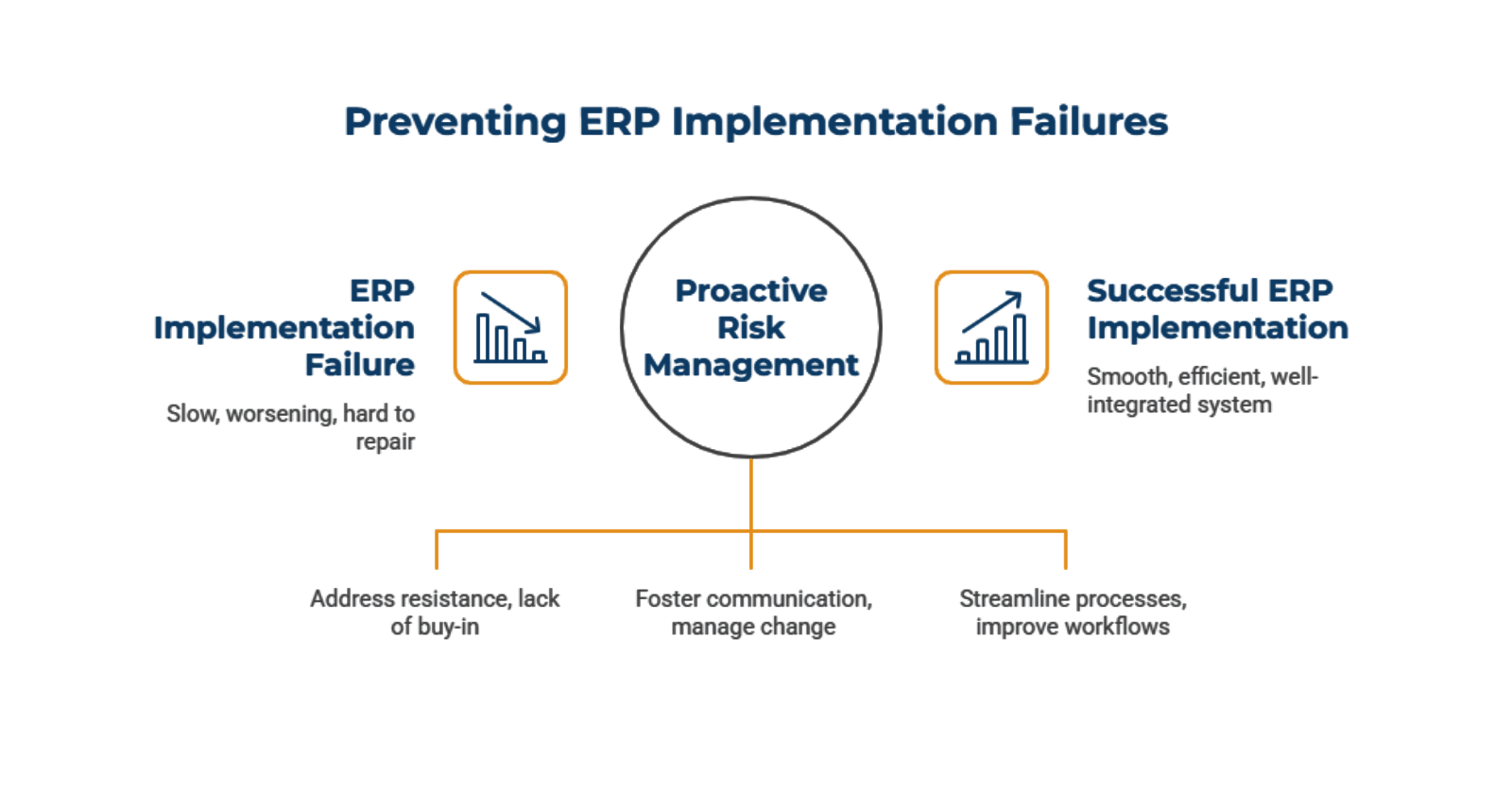
Avoiding failure isn't about finding the perfect software or the cheapest partner. It's about organizational readiness, disciplined governance, and treating data as a foundational concern rather than a last-mile task. The organizations that implement ERP successfully tend to do the boring things well consistently, from the beginning.
Pre-Implementation Readiness Checklist
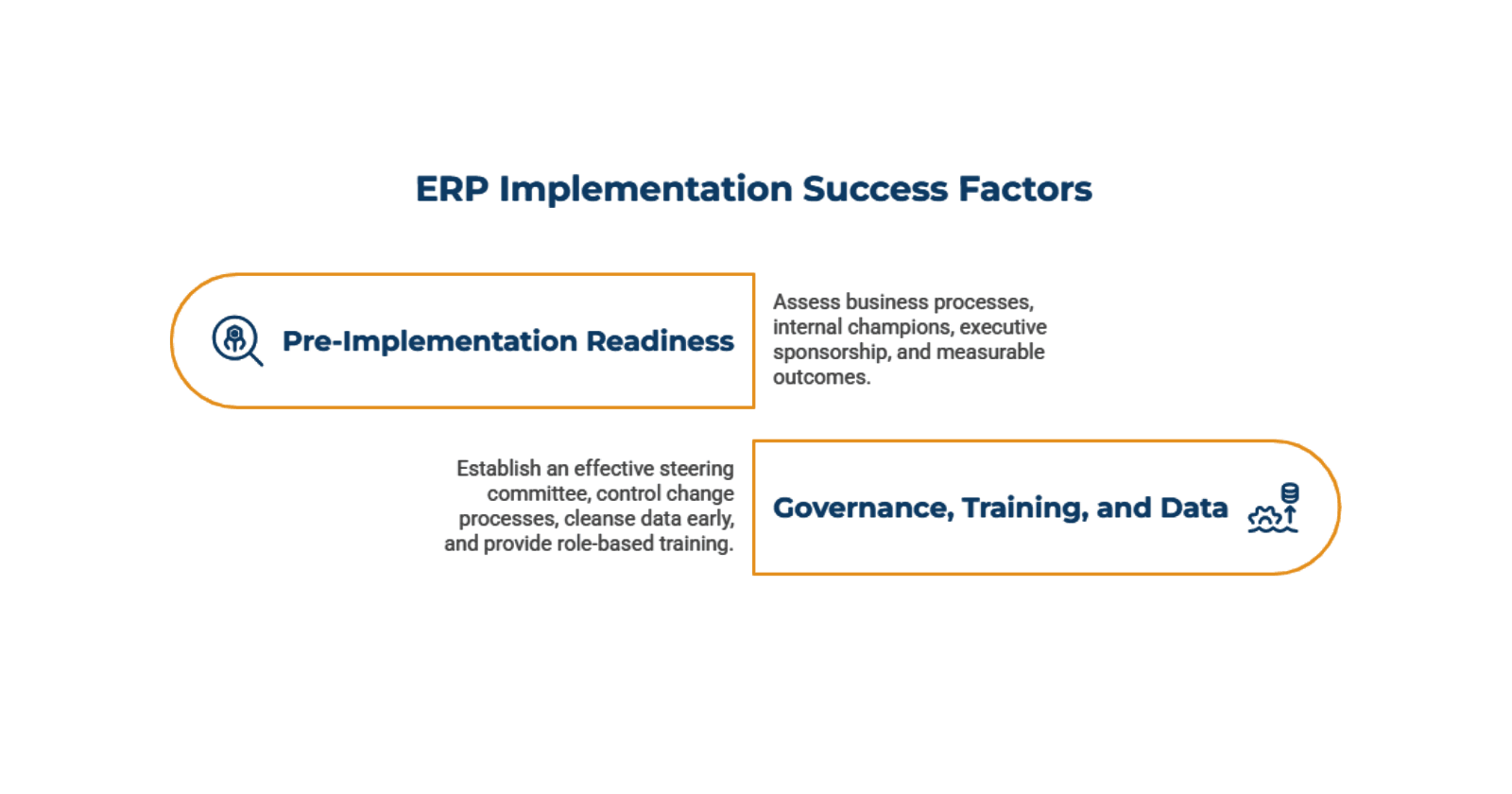
Before selecting a vendor, assess your organization's actual readiness: Are your business processes documented? Do you have internal champions with both process knowledge and available time? Is executive sponsorship active, not ceremonial? Have you defined measurable outcomes with baseline data to compare against post-implementation?
Assessment of organizational readiness is not a red tape, it is a valid predictor of the success of implementation. Companies that do candid preparation assessments prior to entering into contracts are better choices of vendors, establish practical timelines, and recognize skill shortfalls in time to mitigate them. The ones which overlook it are likely to find out about the gaps at the most inopportune time.
Governance, Training, and Data Framework
Governance implies the existence of an effective steering committee that gathers regularly, responds quickly to escalations, and is empowered to take decisions, as opposed to monitoring. Processes of controlling change require teeth. Scopes additions need to be formally approved and their impact on costs and timelines documented, not a casual agreement between the project managers.
The framework of data cleansing must start in the first month rather than the eighth month. Domain ownership, quality standards, and early migration pilots on real legacy data. Training must be role-based, and must be repeated and must be delivered as near to go-live as possible so as to be retained, but not so tightly packed that it produces anxiety instead of competence.
Conclusion
The failures of ERP implementations are quite predictable and avoidable. Poor leadership, bad data, tight schedules, and unaddressed adoption indicators are all familiar trends within industries. Those organizations that do not fail in these ways are not prepared in a superior way, they are prepared with clear governance, honest relationship with complexity and superior software. By far the most practical thing to do before starting an ERP implementation is to understand why they failed.
Listen to the Podcast: Why Do ERP Implementations Fail?

PAUL LUCKI
I'm Paul Lucki, Head of Business Development at Gyan Solutions, specializing in business automation, ERP implementation, and operational reporting. I partner with C-suite leaders to diagnose coordination failures and design systems that align teams, data, and processes. I've helped organizations reduce operational delays by 30-40% through integrated systems and decision-support infrastructure. My expertise focuses on automating manual processes, developing ERP implementations that reflect operational reality, and building reporting systems that drive real decisions. I believe operational excellence begins with systems that reflect reality, not theory.





