


Quick Summary
Moving from Shopify to Medusa makes sense when growing complexity across inventory, pricing, fulfillment, POS, and integrations becomes harder to manage through apps and workarounds. Medusa offers greater control over the commerce architecture, while Shopify remains a strong fit when operations are simpler and existing systems work well.
A retailer came to us because their Shopify store was getting harder to manage. The website itself was fine. Orders were coming in, customers could check out, and nobody was suggesting Shopify was suddenly a bad ecommerce platform.
The problems were happening behind the storefront.
The retailer had a POS system, inventory that changed outside the website, different fulfillment requirements, and pricing that was becoming more complicated. Over time, they had added apps and integrations to deal with each new requirement. Individually, most of those decisions made sense. Together, they had created a system that was becoming difficult to change.
The retailer wanted to know whether they should keep improving what they had or consider moving away from Shopify.
We thought that was the right question. We just did not think the answer should start with choosing another platform.
First, We Looked at What Was Actually Going Wrong
One of the easiest mistakes in a replatforming project is blaming the ecommerce platform for problems that really come from poor integrations or an overly complicated internal process.
So we started with inventory.
The retailer could sell products through more than one part of the business. That meant the quantity displayed online could not simply live independently inside Shopify. If the last unit sold somewhere else, the website needed to know. The business also had to decide when inventory should be reserved and which system should ultimately be trusted when two systems disagreed.
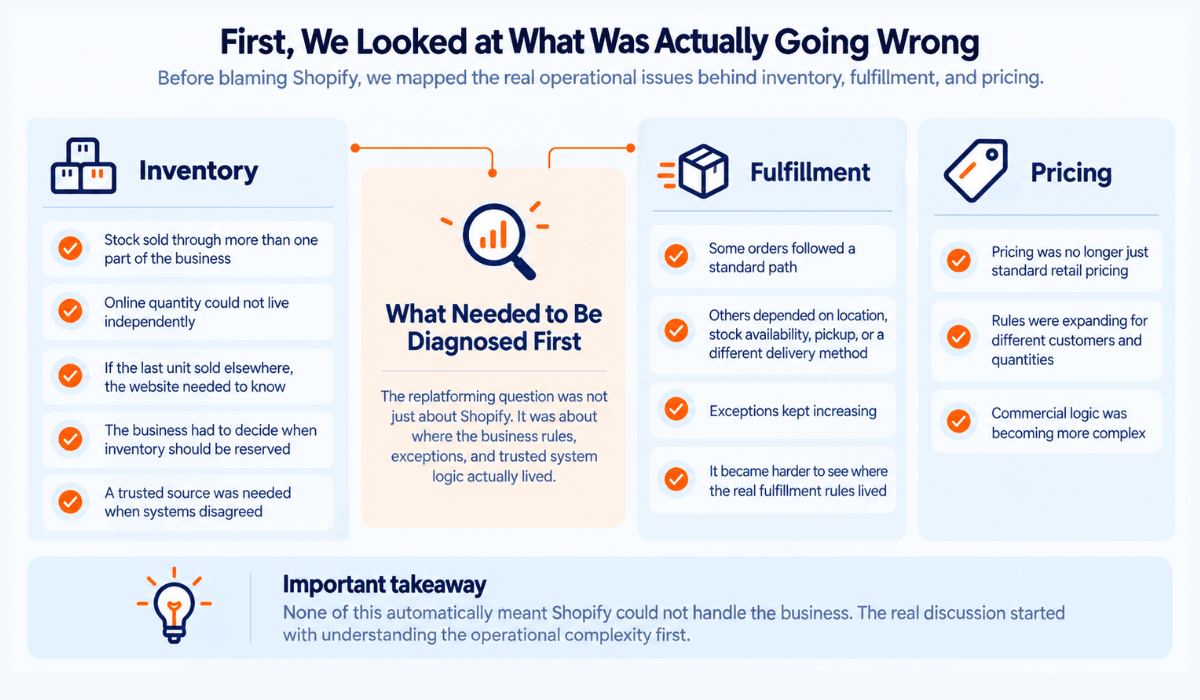
Then we looked at fulfillment. Some orders followed the normal process, while others depended on location, inventory availability, pickup, or a different delivery method. The more exceptions they added, the harder it became to understand where the actual fulfillment rules lived.
Pricing was developing the same problem. What started as standard retail pricing was moving toward different rules for different customers and quantities.
None of this meant Shopify could not handle the business. In fact, that point became important in our discussion.
Staying on Shopify Was a Real Option
There is a good reason Shopify is difficult to replace. It takes responsibility for a lot of things a retailer would otherwise have to worry about.
Payments work. Checkout is maintained. Hosting and infrastructure are largely somebody else's problem. There is a huge app ecosystem. Staff can usually learn the admin without becoming technical users.
Those advantages are easy to undervalue when a development team is focused on what it cannot customize.
We found a useful example in a March 2026 r/ecommerce discussion titled “Migrating from a Shopify store to a custom made ecommerce/prebuilt solution - Advice needed.” The retailer described multiple physical stores, substantial order volume, location-based delivery, capacity management, variable-weight inventory, and plans for a marketplace. Several people responding advised against rushing into a custom platform because Shopify already handles a large amount of ecommerce infrastructure and because custom builds bring their own edge cases.
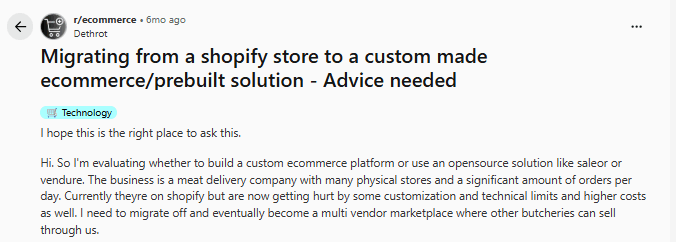
Source :- Reddit discussion, “Migrating from a Shopify Store to a Custom-Made Ecommerce/Prebuilt Solution - Advice Needed” - r/ecommerce
That was close to our position as well. The existence of limitations is not enough reason to migrate. The limitations have to matter enough to justify everything you take responsibility for after leaving.
The Real Warning Sign Was the Number of Workarounds
What changed our view was not any single Shopify limitation. It was the pattern.
A new inventory requirement needed another connection. A pricing requirement needed another solution. A fulfillment change affected several systems. Developers increasingly had to ask what an existing app or integration would do before changing something somewhere else.
At that point, we stopped looking only at the monthly cost of the apps.
The larger cost was complexity.
There is nothing inherently wrong with running ten Shopify apps. Ten independent tools that rarely interact can be perfectly manageable. Five applications controlling interconnected parts of inventory, pricing, and fulfillment can be much harder to operate.
That distinction mattered much more than the app count.
That Is When We Started Looking at Medusa.js
Medusa interested us because it approaches ecommerce differently. Rather than giving the retailer a largely managed platform and asking developers to extend it, Medusa provides commerce components that developers can build around.
That sounds attractive, but it is only an advantage if the business actually needs that control.
For this retailer, inventory was a good example. Medusa's documentation supports inventory across locations and reservations against specific inventory locations.
Its pricing system also supports rule-based pricing and quantity tiers. Medusa's own pricing example shows a product priced differently once defined quantity thresholds are reached.
Fulfillment can also be tied to different providers and locations, which was relevant because this retailer did not always have one simple fulfillment path.
Those features were useful, but they were not really the reason we leaned toward Medusa.
The bigger reason was that we could decide where the retailer's business rules should live.
Instead of continuing to add another layer whenever Shopify did not match the company's process, we could design the commerce architecture around the company's inventory, POS, pricing, and fulfillment requirements from the beginning.
That is a very different reason for choosing a platform than saying one has more features than another.
There Was Also a Reason Not to Choose Medusa
The retailer would now own more technology.
That point deserves more attention than it normally gets in headless-commerce discussions.
A September 2026 post in r/medusajs titled “Migrating Live Revenue Store Shopify To Medusa” illustrated the issue well. The merchant described moving a Shopify business that had been operating for approximately ten years, averaging around 130 orders per day and containing roughly 130,000 customers and 150,000 historical orders.
The new setup used Medusa Cloud for the backend, Next.js on Vercel for the storefront, Payload for content, and Meilisearch for search.
The merchant's concern after building the system was revealing. It was not whether the new storefront could display products or process an order. It was uptime. After years on Shopify, reliability had largely been something the merchant did not have to think about. The new architecture depended on several services, so the company now had to consider what would happen if one component failed.
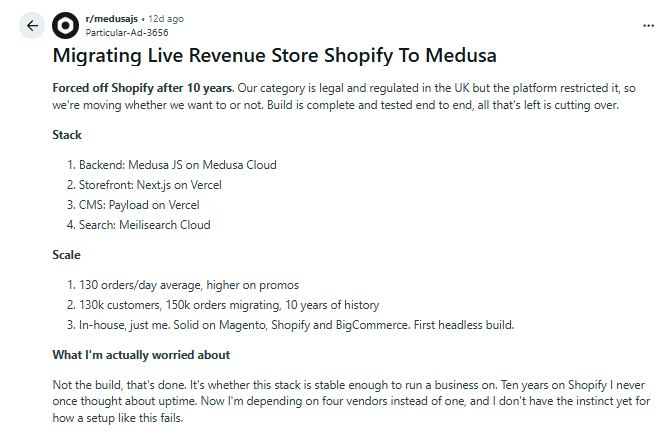
Source:- Reddit discussion, “Migrating a Live Revenue Store from Shopify to Medusa” - r/medusajs
That is the other side of “more control.” You control more because you are responsible for more.
We Also Did Not Assume Moving Would Automatically Save Money
It is tempting to compare Shopify fees and app subscriptions with an open-source platform and conclude that the open-source option will be cheaper.
That comparison is incomplete.
With Medusa, development becomes part of the operating cost. So do hosting, monitoring, maintenance, and integration work. A feature that takes a Shopify merchant fifteen minutes to install through an app could require development in a custom stack.
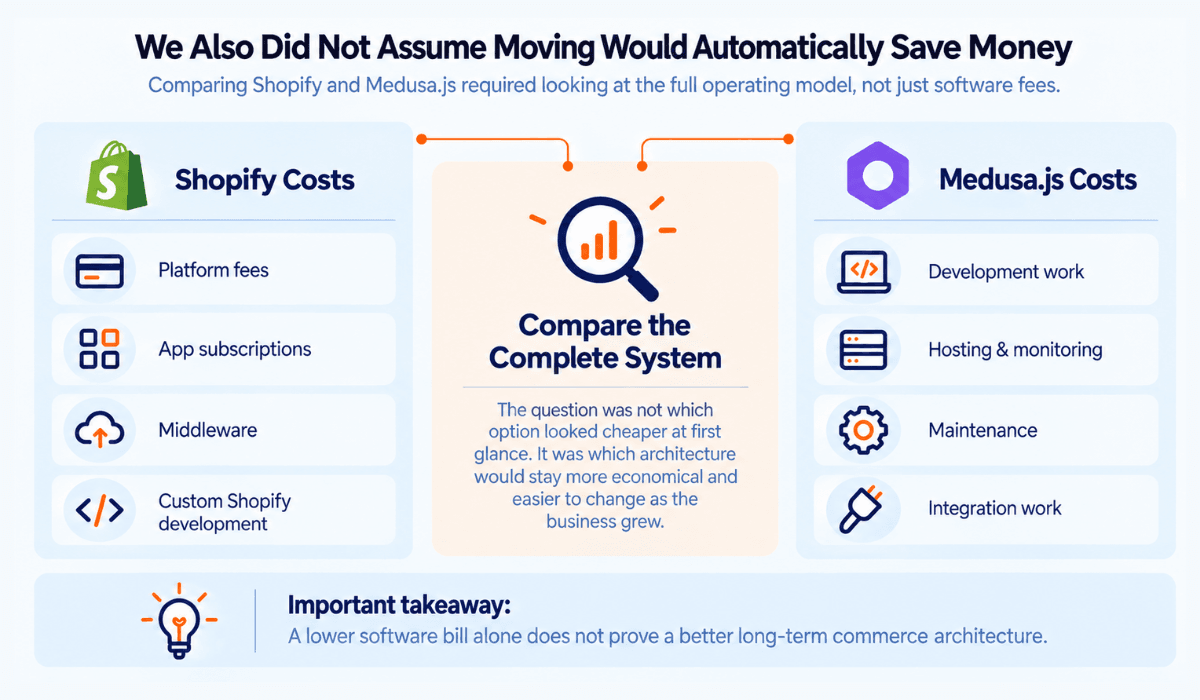
On the other hand, a retailer spending heavily on apps, middleware, and custom Shopify development may eventually find that maintaining its own commerce architecture becomes economically reasonable.
You have to compare the complete systems.
For this retailer, we were less interested in whether Medusa could save a certain amount each month in software fees. The more important question was whether the existing architecture would become increasingly expensive and difficult to change as the business grew.
Shopify Has Its Own Customization Boundaries
We also looked at where Shopify itself places limits around customization.
For example, Shopify's developer documentation states that Checkout UI Extensions in the information, shipping, and payment steps are available only to Shopify Plus stores.
That does not mean Shopify checkout is inflexible. It means the level of customization available depends partly on the Shopify plan and the extension points Shopify exposes.
For some retailers, those boundaries are perfectly reasonable. For others, especially businesses with highly specific workflows, they can become part of the case for owning more of the commerce stack.
What About the Migration Itself?
Moving products is not the part that would worry us most.
Products, variants, prices, and inventory can be moved. Medusa now provides specific documentation and tooling for Shopify migrations, including products, variants, prices, images, inventory levels, collections, and categories. The migration process can also be extended to data such as customers and orders.
The harder work is everything connected to those records: customer accounts, order history, redirects, SEO, analytics, payment flows, fulfillment logic, email, POS connections, and the internal processes staff already understand. We would treat those as part of the migration from the beginning rather than assuming they could be cleaned up after launch. This is another reason we would not recommend moving simply because the current Shopify setup feels messy. A badly planned migration can replace one complicated system with another complicated system.
So, Would We Move?
For this retailer, we leaned toward Medusa, but not because we thought Medusa was a better ecommerce platform in general.
The retailer had reached a stage where inventory, fulfillment, pricing, and system integration were becoming part of its own operating model. The business needed enough exceptions that continuing to adapt Shopify around those exceptions was beginning to look less attractive than controlling more of the commerce layer directly.
We would reach a different conclusion for many other retailers.
If Shopify is handling your operation cleanly, your apps are manageable, your integrations are stable, and most of your requirements are standard ecommerce requirements, we would be reluctant to recommend rebuilding the platform just to gain technical freedom.
The warning sign is not that Shopify occasionally tells you “no.” Every platform has limits.
The warning sign is when your team repeatedly says, “We can do it, but…” and everything after the “but” involves another app, another synchronization process, another middleware connection, or another exception to the way your business actually works.
For this retailer, there were enough of those conversations that we felt the architecture deserved another look. That is when Medusa.js became worth the extra responsibility.

SUKHPREET SINGH
I'm Sukhpreet Singh, Director of Innovation & Technology at Gyan Solutions. With 8+ years in generative AI and ERP integration, I build AI-powered decision-support systems that adapt to real operational complexity without replacing existing infrastructure.



