
Ecommerce Brands
Direct-to-consumer and digital-first companies connecting growth, customers, orders, fulfillment, service, reporting, and systems.
Explore Ecommerce Brands →
ECOMMERCE & RETAIL / MULTI-LOCATION RETAIL
As a retail network grows, small differences in workflows, inventory handling, transfers, reporting, and store management can become network-wide gaps in visibility and control. Gyan Solutions helps multi-location retailers align the operations, ownership, data, and systems that should work consistently across locations while preserving local flexibility where it matters.
Advisory and implementation engagements are scoped separately.
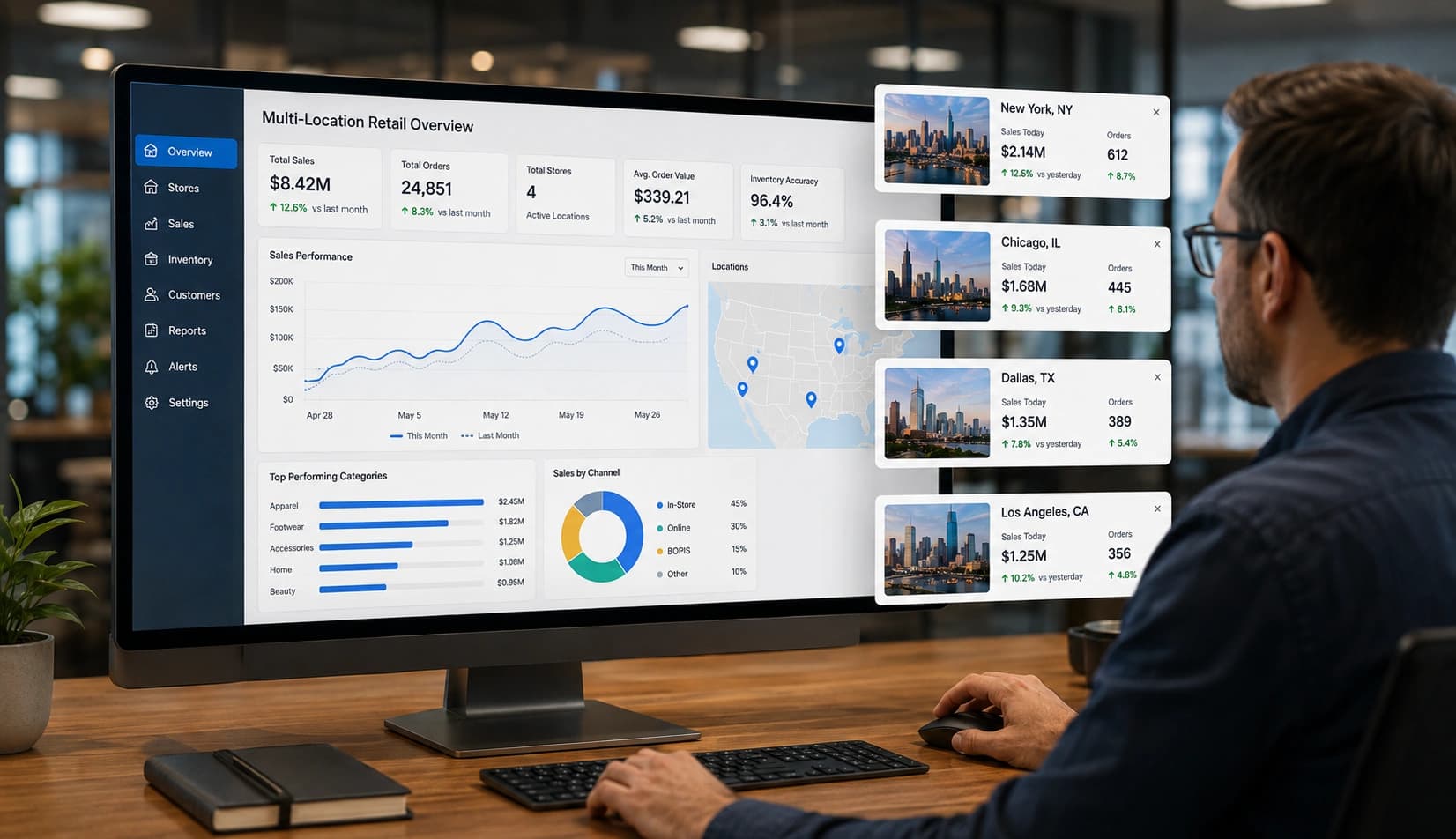
Improve consistency across the workflows, responsibilities, controls, and exceptions that matter at every location.
See what inventory exists, where it sits, how it moves, and where demand and availability stop aligning.
Give leadership clearer evidence about location performance, operating differences, exceptions, and priorities.
Connect POS, ecommerce, ERP, CRM, inventory, reporting, automation, and AI across the retail network.
A retailer may add customers, stores, products, and revenue while location practices, inventory confidence, customer experience, and reporting consistency move in different directions.
The warning signs appear locally, but they may come from the same gap across the multi-location operating model.
Receiving, adjustments, transfers, returns, reporting, and escalation are handled differently depending on the store or manager.
One location repeatedly stocks out while another carries excess, slow-moving, or unavailable inventory.
Requests, approvals, picking, movement, receiving, and inventory updates depend on messages, spreadsheets, and repeated checks.
Leadership sees totals, but not the store-level exceptions and operating differences producing the result.
Availability, promotions, returns, pickup, service, and issue resolution feel inconsistent across the same retail brand.
New locations inherit systems and targets without a complete operating model for workflows, ownership, reporting, and controls.
Not sure where growth is reducing consistency, inventory confidence, or control? Start by identifying the network-level constraint.
Locations naturally differ in customer demand, product mix, store size, staffing, layout, sales volume, and regional conditions. Some local variation is necessary and commercially useful.
The objective is to define which workflows, controls, measures, and information must remain consistent and where store teams need room to respond locally.
That is why we examine the retail network as one connected operating system.
Key insight
The goal is not identical stores. The goal is enough consistency, evidence, and control to manage the network without removing appropriate local judgment.
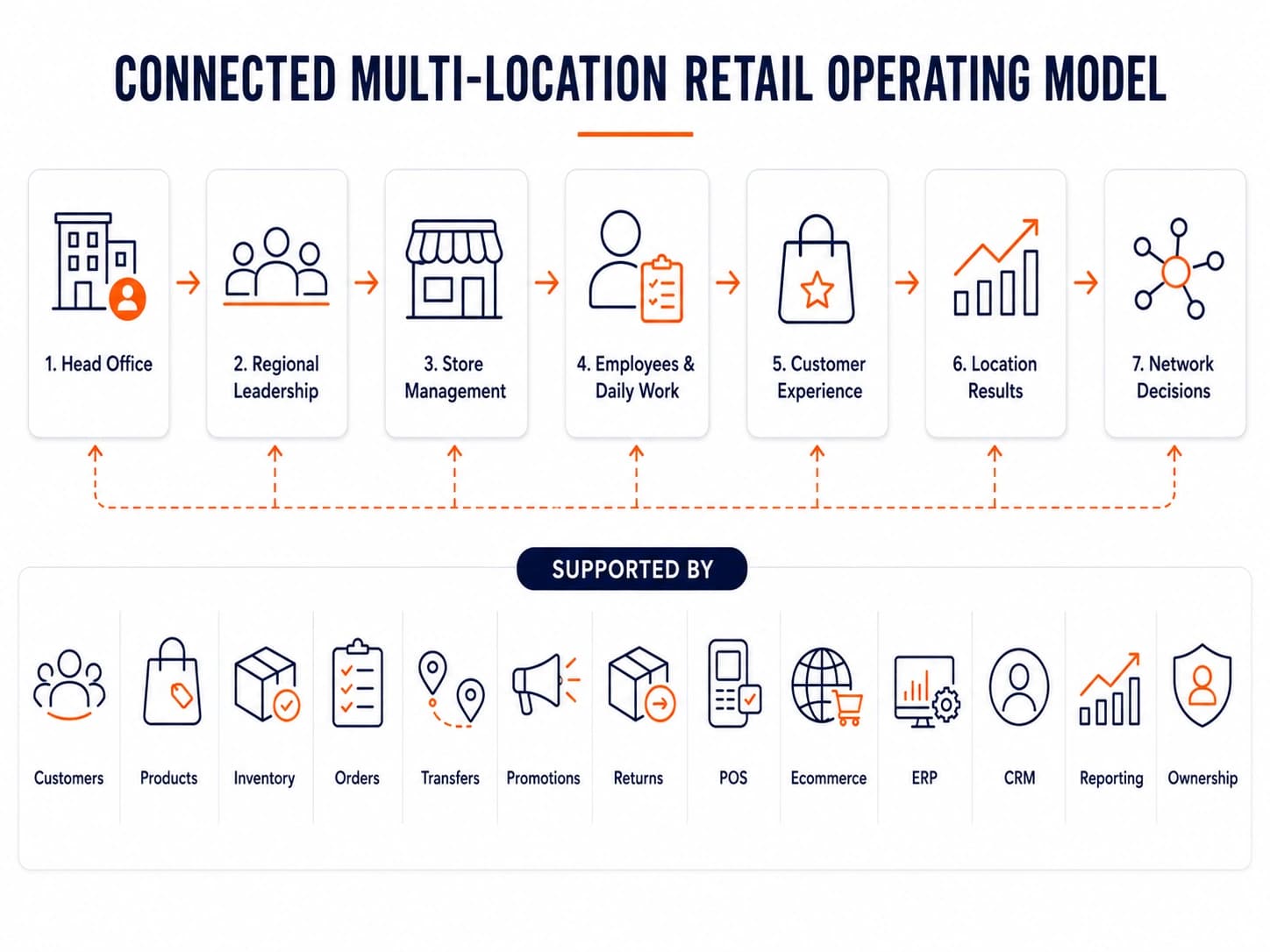
Head Office → Regional Leadership → Store Management → Employees & Daily Work → Customer Experience → Location Results → Network Decisions
Some retailers need clarity about what is limiting network performance. Others already know what they need built, connected, or automated.
For retailers seeing friction across stores, inventory, transfers, customer experience, reporting, or systems but needing a clearer view of the underlying issue.
 Map how head-office priorities move through managers, employees, inventory, customer workflows, reporting, and location outcomes.Identify where variation, ownership, measures, system use, exceptions, or manual work limit visibility and execution.Prioritize practical improvements across workflows, responsibilities, reporting, controls, system use, and store operations.
Clarify what should be standardized, what can vary, and where management needs better visibility.
For retailers with a defined need for integrations, dashboards, automation, portals, data alignment, custom software, or AI-enabled tools requiring implementation support.
Turn the defined requirement into a practical implementation plan with clear outcomes and responsibilities.Align workflows and data across POS, ecommerce, ERP, CRM, inventory, finance, stores, and reporting.Build integrations, dashboards, portals, automation, applications, or AI-enabled tools around actual store operations.Move forward with a defined integration, dashboard, portal, automation, software, or AI requirement.
Our multi-location work is shaped by how retailers manage store workflows, inventory, transfers, replenishment, shared fulfillment, pricing, promotions, returns, employee responsibilities, customer experience, new-location readiness, and head-office oversight.
We examine how POS, ecommerce, ERP, CRM, inventory systems, loyalty, finance, dashboards, automation, and AI support daily work and whether location revenue, margin, inventory accuracy, stockouts, transfers, returns, labour, fulfillment, and customer activity provide reliable evidence for decisions. This reveals where consistency, ownership, measurement, systems, or focused implementation need to improve.
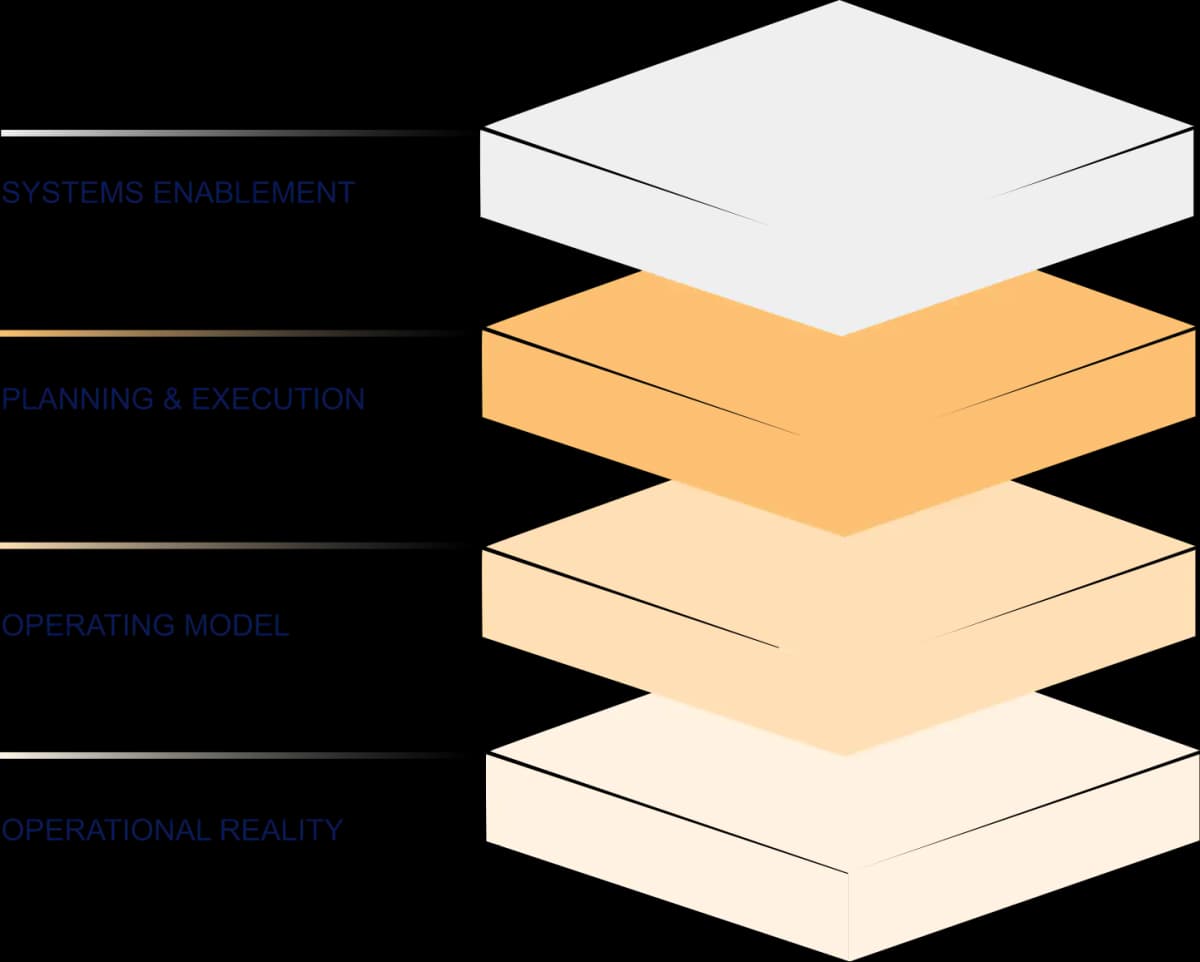
We focus on the parts of the retail network where store execution, inventory, customer experience, financial performance, and technology depend on one another.
Growth becomes harder to manage when every location develops its own process.
Employees and managers naturally adapt their work. Some variation is appropriate, but unnecessary differences in core workflows make performance and control harder to compare.
Standardize the work that needs consistency while preserving appropriate flexibility for local conditions.
Total inventory is not enough when products sit in the wrong locations.
The network may hold sufficient stock overall while individual stores experience stockouts, excess inventory, inaccurate availability, or slow-moving products.
Show whether inventory is reliable, available, and positioned where demand actually exists.
Moving inventory should solve availability problems not create new uncertainty.
Transfers can respond to uneven demand, but weak request, approval, movement, and receiving controls create discrepancies and unclear ownership.
Create clearer accountability and visibility from transfer request through destination receipt.
Each location needs inventory that reflects its actual demand pattern.
Customer mix, seasonality, promotions, geography, and store size can make the same product behave differently across the network.
Give purchasing and operations stronger evidence for deciding what each location needs and when.
Central commercial plans must still be executed correctly in every store.
Customers experience one brand, even when pricing, promotions, loyalty, returns, service, and communication depend on different employees and systems.
Improve consistency between commercial intent and what customers experience across locations.
Managers need clear priorities not more administrative work.
Store teams can become the manual connection between disconnected systems, head-office requests, local exceptions, employee tasks, and customer needs.
Give managers clearer ownership while making proven operating practices easier to extend to new locations.
Comparing stores requires more than ranking them by sales.
Location revenue alone does not explain the effects of product mix, inventory, labour, returns, customer demand, store size, fulfillment, or operating exceptions.
Help leadership see which locations require attention, why they differ, and where to act.
Technology should make a growing store network easier to manage not create more boundaries between locations, head office, ecommerce, inventory, and reporting.
Connect product, pricing, inventory, order, transfer, customer, return, and location data across POS, ecommerce, ERP, CRM, finance, and reporting systems.
Create reliable views of store performance, inventory, stockouts, transfers, returns, margins, customer activity, fulfillment, and operational exceptions.
Reduce repetitive work across transfer approvals, replenishment alerts, store tasks, exception escalation, return routing, notifications, and reporting preparation.
Give authorized teams clearer access to tasks, inventory, transfers, approvals, procedures, exceptions, reporting, and head-office communication.
Support location analysis, inventory investigation, exception triage, employee knowledge, customer service, and management reporting within defined boundaries.
Build specialized manager, transfer, inventory, task, approval, exception, or reporting tools when packaged retail platforms do not fit the requirement.
Have a defined retail integration, dashboard, portal, automation, software, or AI requirement?
AI can help management retrieve information, compare locations, identify patterns, classify exceptions, and prepare analysis. Its usefulness depends on whether the workflow, data, operating rules, oversight, and decision boundary are clear.
Help leadership investigate why a location behaves differently from comparable stores while keeping intervention decisions with accountable managers.
Identify unusual stockouts, excess inventory, transfer activity, shrink, or location-level demand patterns for human review.
Categorize and prioritize store, inventory, transfer, fulfillment, return, or service exceptions so the appropriate team can respond sooner.
Help managers and employees retrieve procedures, policies, product information, and operating guidance without searching across disconnected sources.
Help leaders examine changes across stores, customers, inventory, returns, labour, and performance without replacing accountable decision-making.
Before recommending AI, Gyan assesses the workflow, data quality, operating rules, decision boundary, oversight requirement, and system context.
Core store workflows vary more than leadership can reliably explain.Inventory accuracy, stockouts, or excess stock differ significantly by location.Transfers, reporting, or exception follow-up depend on manual coordination.Customer experience or promotion execution changes between stores.Leadership cannot see which locations need attention or why.POS, ecommerce, ERP, CRM, inventory, or reporting data must connect.Location, inventory, transfer, margin, or exception dashboards are required.Store tasks, approvals, transfers, alerts, or reporting need automation.A store-manager, inventory, transfer, or operations portal is already defined.A specialized retail application or AI-enabled workflow needs implementation.Choose the right starting point without committing to a preset sequence.
We discuss your store network, inventory, transfers, customer experience, reporting, systems, and any defined technology requirement.
We agree on the outcomes, representative locations, responsibilities, timeline, and delivery approach for Operational Advisory, Technology & AI Implementation, or both.
We deliver the agreed work from workflow and reporting improvement to integrations, dashboards, portals, automation, custom software, or AI-enabled support.
30-minute call
No obligation
Advisory and implementation scoped separately
This practice is designed for retailers where growing numbers of physical locations make consistency, inventory visibility, customer experience, reporting, or operational control harder to maintain.
Regional and national retail chains
Specialty and category-focused retail networks
Retailers expanding from one store into several
Multi-store ecommerce and omnichannel businesses
Retailers managing stores, warehouses, and location-based inventory
Organizations opening new locations or entering new regions
You only need advertising, social-media management, or basic website work.
The requirement is limited to POS hardware installation or an isolated coding resource.
You want every store forced into identical processes regardless of legitimate operating differences.
Direct-to-consumer and digital-first companies connecting growth, customers, orders, fulfillment, service, reporting, and systems.
Explore Ecommerce Brands →
Retailers connect stores and ecommerce through shared inventory, pickup, delivery, returns, customer data, and channel reporting.
Explore Omnichannel Retail →
Retailers manage fast-changing inventory, picking, substitutions, staging, pickup, delivery, waste, and narrow margins.
Explore Grocery & Food Commerce →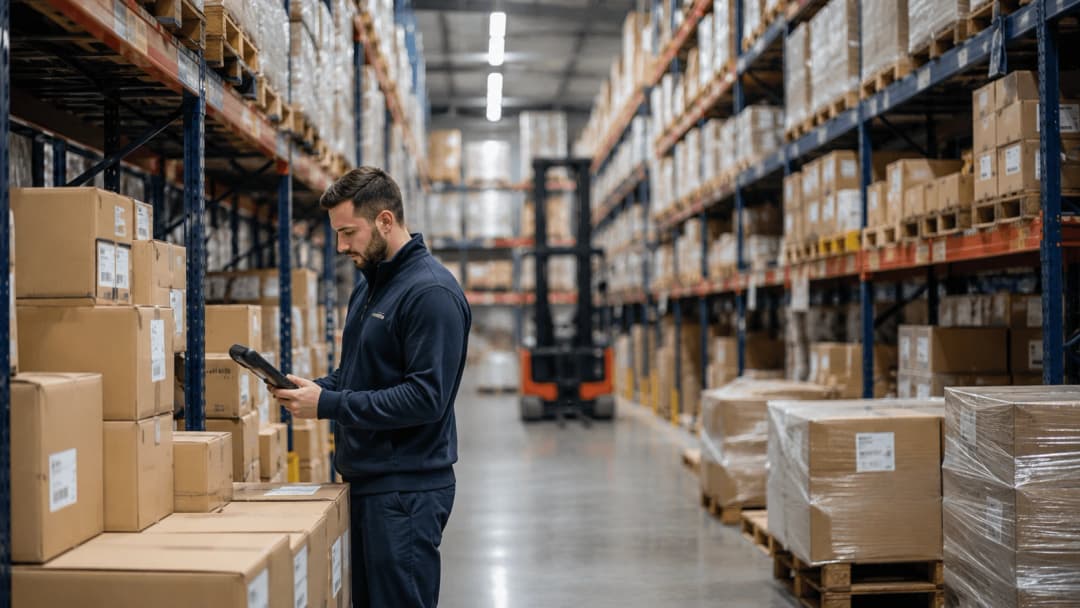
Companies manage account pricing, quotes, purchase orders, inventory, warehouses, fulfillment, finance, and repeat purchasing.
Explore B2B Ecommerce & Distribution →Review your locations, inventory, workflows, reporting, and systems to identify the right next step.
Request a Free Multi-Location Retail Fit Call→


Multi-location retail consulting examines how operating processes, inventory, stores, customer experience, reporting and systems work across a network of retail locations.The objective is to identify where unnecessary variation, weak visibility or disconnected systems are making the network harder to manage.
No.Some variation is legitimate because locations differ in size, customer demand, product mix or operating conditions.The objective is to determine which processes and controls need to remain consistent and where local flexibility is appropriate.
Yes.An engagement can examine location-level inventory accuracy, replenishment, stockouts, excess inventory, transfers and the systems supporting inventory visibility.[BUSINESS NEED LINK: Inventory & Fulfillment → /ecommerce/inventory-fulfillment/][ECOMMERCE TECHNOLOGY LINK: Commerce Systems Integration → /ecommerce/commerce-systems-integration/]
Yes.We can review transfer requests, approvals, inventory movement, receiving, exceptions and reporting.[BUSINESS NEED LINK: Inventory & Fulfillment → /ecommerce/inventory-fulfillment/][ECOMMERCE TECHNOLOGY LINK: Commerce Automation → /ecommerce/commerce-automation/]
Yes.Reporting can be designed around the operational and commercial questions leadership needs to answer across locations.The objective is not simply to rank stores, but to explain important differences and surface locations that require attention.[BUSINESS NEED LINK: Reporting & Decision Support → /ecommerce/reporting-decision-support/][ECOMMERCE TECHNOLOGY LINK: Commerce Dashboards & Decision Support → /ecommerce/commerce-dashboards-reporting/]
Potentially, depending on the systems involved and available integration methods.The requirement may include POS, ERP, ecommerce, inventory, CRM, finance and reporting information.[ECOMMERCE TECHNOLOGY LINK: Commerce Systems Integration → /ecommerce/commerce-systems-integration/]
Yes, where the challenge involves defining repeatable operating processes, system requirements, reporting and management controls for new locations.
Yes, where packaged systems cannot adequately support the required workflow.Potential applications include store-manager portals, inventory tools, transfer systems, task management, exception handling and location reporting.[ECOMMERCE TECHNOLOGY LINK: Custom Commerce Software → /ecommerce/custom-commerce-software/]
Potentially.AI may help management investigate location performance, inventory patterns, exceptions and recurring operational issues, provided the underlying data and workflow are sufficiently reliable.[ECOMMERCE TECHNOLOGY LINK: AI for Ecommerce & Retail → /ecommerce/ai-for-ecommerce-retail/]
Tell us where the retail network is experiencing friction across locations, inventory, transfers, customer experience, reporting or systems. We'll use the initial conversation to understand the situation and determine whether the appropriate starting point is operational advisory, technology implementation—or a combination.
Focused on your goals
You decide the next step.
Consulting & implementation