
Ecommerce Brands
Connect acquisition, orders, inventory, fulfillment, returns, reporting, and systems around digital-first growth.
Explore Ecommerce Brands →
ECOMMERCE & RETAIL / OMNICHANNEL RETAIL
Gyan Solutions helps omnichannel retailers connect stores, ecommerce, inventory, fulfillment, customer handoffs, reporting, and systems. We identify where channels stop aligning and define the right operational or implementation path.
Advisory and implementation engagements are scoped separately.
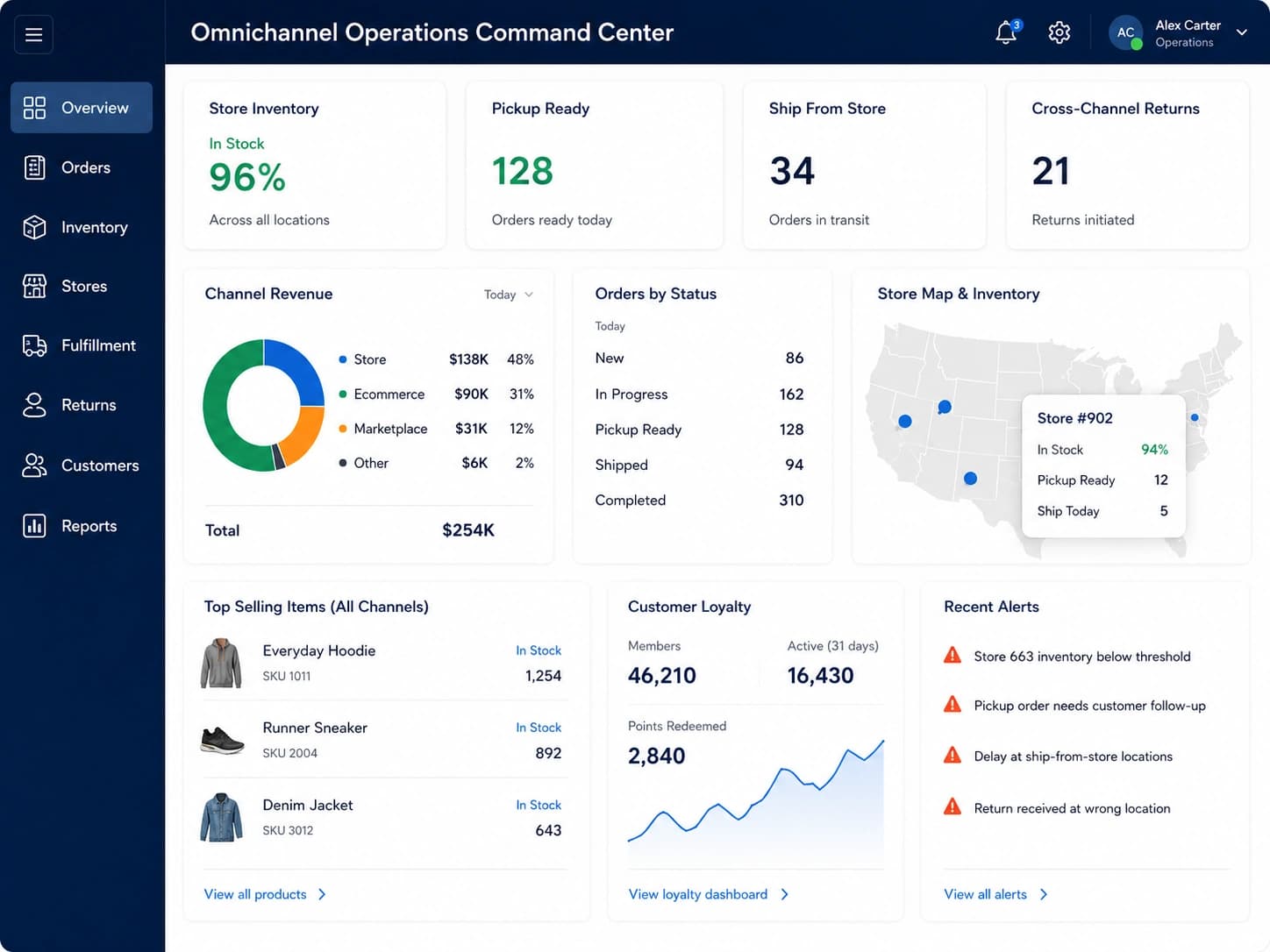
Connect customer identity, product information, purchases, service, and loyalty across physical and digital channels.
Improve visibility into where inventory sits and what each channel or location can reliably promise.
Align pickup, ship-from-store, transfers, returns, and the store workflows supporting digital orders.
Connect POS, ecommerce, ERP, OMS, WMS, CRM, reporting, automation, and AI around retail operations.
Customers move between stores and digital channels without thinking about the systems behind the experience. Internally, the same journey may cross separate teams, platforms, inventory views, and operating rules.
The warning signs often appear in different places, but they may come from the same disconnect across the omnichannel operating model.
Customers see inventory online, but store teams cannot find it, reserve it, or confidently promise it.
Store selection, reservation, picking, staging, notification, and verification depend on repeated manual coordination.
Employees switch between systems, messages, and spreadsheets to complete digital orders, transfers, returns, or exceptions.
Online purchases returned in-store create uncertainty across payment, inventory, customer records, finance, and ownership.
Purchase history, loyalty activity, service records, and account information do not consistently follow the customer.
Store and ecommerce reports look complete, but leadership cannot see how channels affect inventory, labour, margin, and customer value.
Adding ecommerce, pickup, ship-from-store, loyalty, or store inventory visibility does not automatically create one connected retail operation.
Each customer promise depends on product information, pricing, inventory, order ownership, store capacity, fulfillment, service, and system data moving together. A feature may appear simple to the customer while creating several operational handoffs behind it.
That is why we examine omnichannel retail as one connected operating system.
Key insight
The goal is not to add more channel features. The goal is to make customer promises, store execution, inventory, systems, and decisions work together.
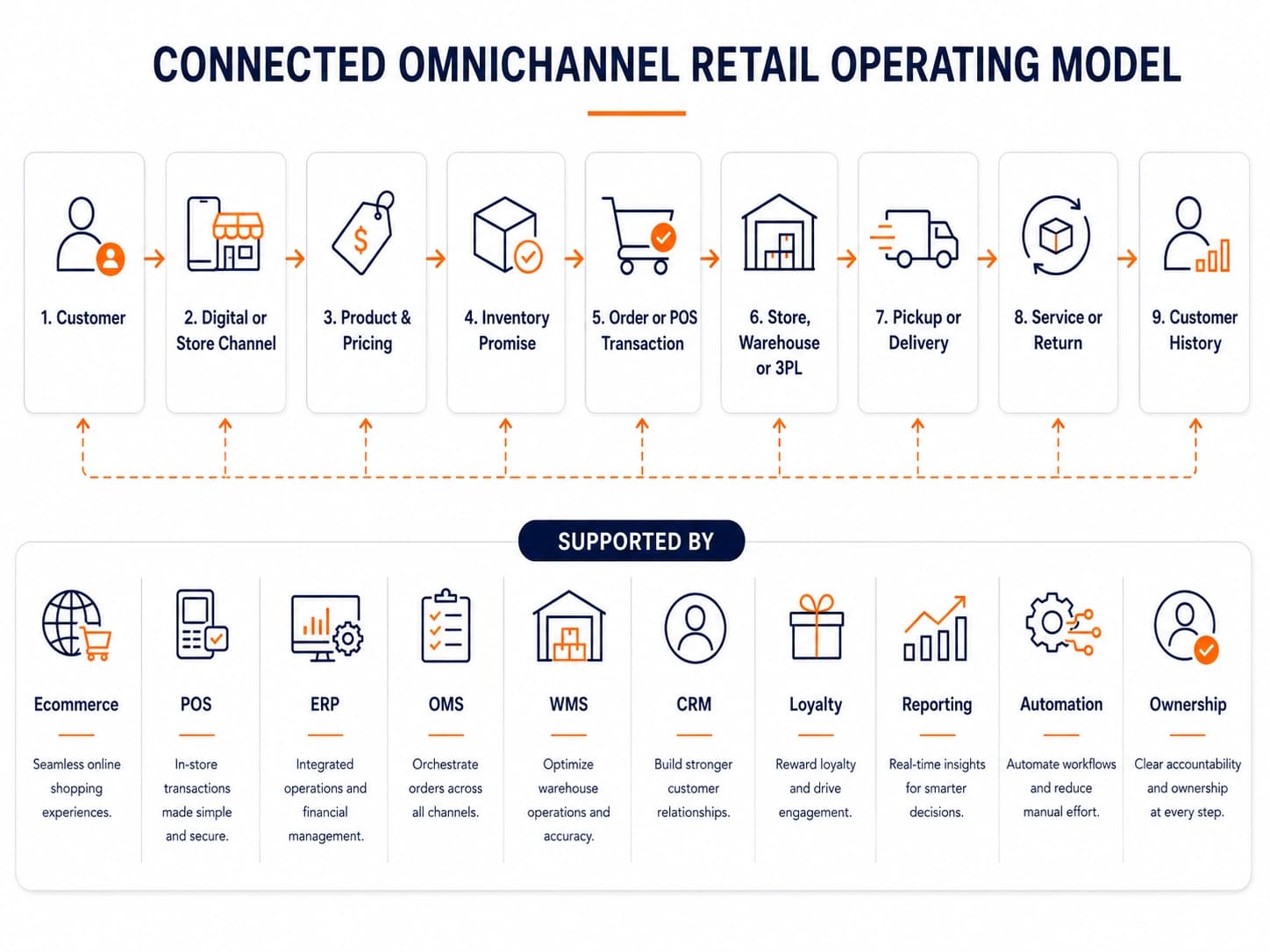
Connected Channels. Reliable Inventory. Clear Store Workflows. Better Retail Decisions.
Some retailers need clarity about what is limiting performance. Others already know what they need built, connected, or automated.
For retailers that see customer or operating problems but need clarity across channels, workflows, ownership, reporting, data, or systems before deciding what should change.
 Map how customers, orders, inventory, stores, fulfillment, returns, reporting, and financial outcomes connect.Identify where handoffs, ownership, measures, system use, exceptions, or manual work limit execution.Prioritize practical improvements across workflows, responsibilities, reporting, system use, and daily store operations.
Operational Review can stand alone from assessment and redesign through prioritized operational improvements.
For retailers with a defined need for integrations, dashboards, automation, portals, data alignment, custom software, or AI-enabled tools requiring implementation support.
Turn the defined requirement into a practical implementation plan with clear outcomes and responsibilities.Align data and workflows across ecommerce, POS, ERP, OMS, WMS, CRM, loyalty, and reporting.Build integrations, dashboards, automation, portals, applications, or AI-enabled tools around actual retail operations.Technology & AI Implementation can begin independently or work alongside Operational Review & Improvement.
Our omnichannel work is shaped by how retailers plan and execute pricing, promotions, allocation, reservations, routing, pickup, delivery, transfers, and service across customer journeys, stores, inventory, fulfillment, and returns.
We examine how ecommerce, POS, ERP, OMS, WMS, CRM, loyalty, 3PL, dashboards, automation, and AI support daily operations and whether channel revenue, customer value, inventory, store capacity, fulfillment, returns, and margin provide reliable evidence for decisions.
This reveals where workflows, ownership, measurement, systems, or focused implementation need to improve.
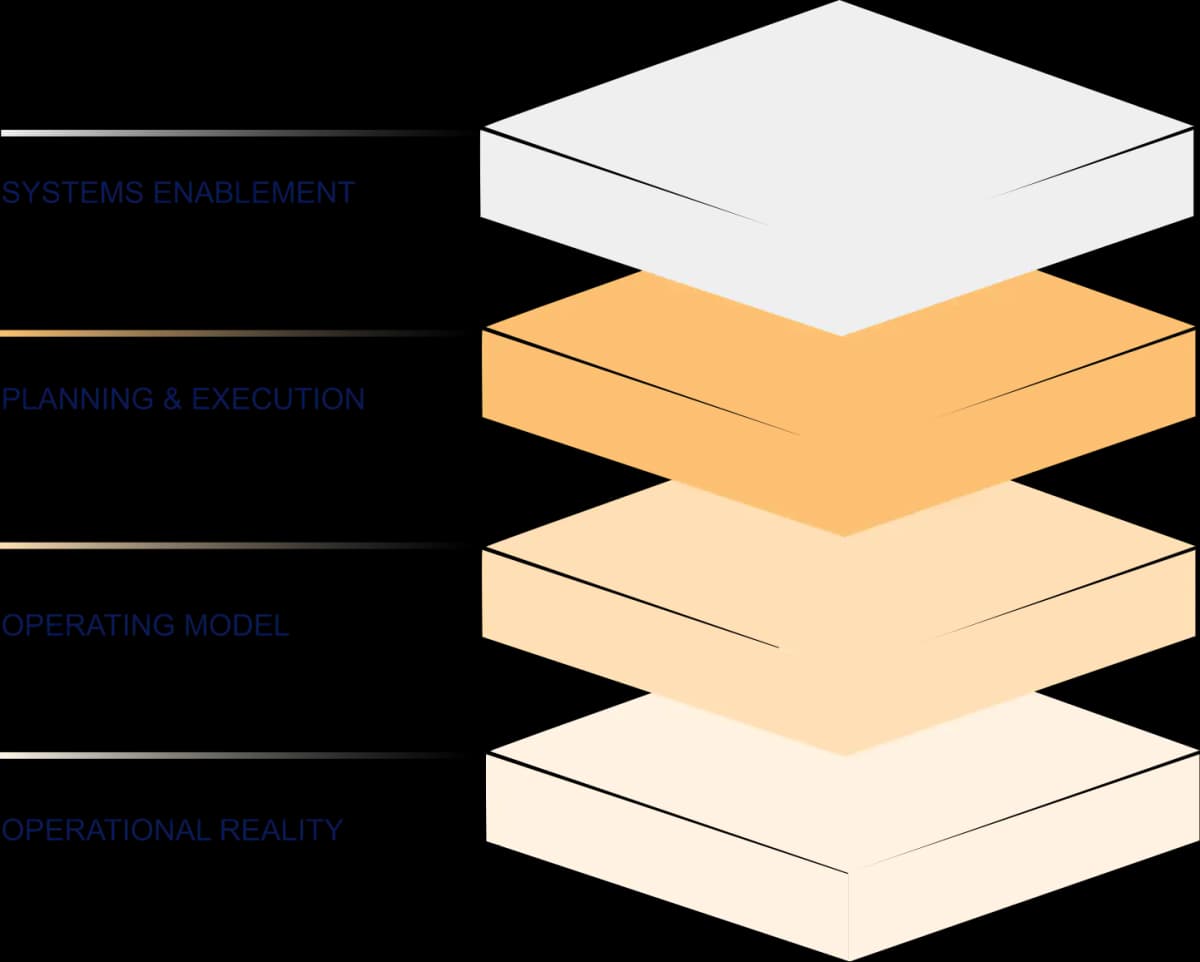
We focus on the parts of retail where customer experience, store execution, inventory, commercial performance, and technology depend on one another.
Customers move between channels. Their context should move with them.
A customer may research online, visit a store, purchase through an app, collect an order, and return it through another channel. The experience becomes fragmented when identity, product, inventory, order, or service context does not follow.
Create a more consistent customer experience as people move between physical and digital retail channels.
Customers should not need to understand the retailer’s channel architecture.
Product records, pricing, promotions, and availability can become inconsistent when stores and ecommerce depend on different systems, definitions, or update processes.
Improve consistency in the product, price, promotion, and availability information supporting customer and employee decisions.
Omnichannel promises depend on knowing what inventory is truly available.
Inventory may exist across stores, warehouses, distribution centres, 3PL locations, marketplaces, and in-transit movements. Ownership alone does not show what can be reliably promised to a customer now.
Give customers, employees, and systems a more reliable view of what inventory can be promised through each channel and location.
Pickup is simple for the customer only when the store workflow is clear.
A pickup order moves through payment, reservation, store notification, picking, staging, customer communication, verification, and completion. Weakness at any handoff can affect the promise before the customer arrives.
Create a pickup workflow that is reliable for customers and practical for the store teams responsible for fulfilling it.
A store can become a fulfillment node only when it is ready to operate like one.
Ship-from-store can improve inventory utilization and delivery options, but it also adds picking, packing, carrier, inventory, and exception responsibilities to the store environment.
Use distributed fulfillment without creating uncontrolled store workload or unreliable customer commitments.
One location can stock out while another carries excess inventory.
Without trusted location-level information, transfers become reactive, approvals remain manual, and inventory spends more time unavailable or moving without clear ownership.
Improve visibility and control over inventory movement between stores, warehouses, and other fulfillment locations.
A cross-channel return should not create cross-functional confusion.
Online purchases returned in-store can affect payment, tax, inventory, customer history, finance, and disposition. Store employees also need clear ownership for pickup, fulfillment, transfers, adjustments, and exceptions.
Make cross-channel returns practical for customers while reducing unnecessary store work and reconciliation problems.
The customer and the business should not become fragmented by channel.
Customer records may be divided across ecommerce, POS, CRM, loyalty, service, and returns systems. Channel reports can also hide how stores and digital activity affect one another.
Give employees and leadership a connected view of customer relationships, channel performance, store execution, and operational impact.
Technology should support a defined customer or operating requirement. Once the need is clear, Gyan can plan, build, connect, or improve the relevant retail technology layer.
Connect ecommerce, POS, ERP, OMS, WMS, CRM, loyalty, 3PL, customer service, finance, and reporting systems.
Connect customer, channel, store, inventory, fulfillment, return, and financial measures around management decisions.
Reduce repetitive coordination across reservations, routing, store notifications, transfers, returns, alerts, and exception handling.
Give customers, employees, locations, partners, or suppliers access to the information and actions relevant to their roles.
Apply AI where it can support a defined employee task, operational exception, analysis need, or management decision.
Build specialized store, customer, inventory, fulfillment, or exception tools when packaged platforms cannot support the workflow.
AI can help retail teams retrieve information, organize evidence, identify patterns, prioritize exceptions, and prepare decisions. Its value depends on reliable data, clear ownership, defined business rules, and human oversight.
Bring product, inventory, order, policy, and customer information together so employees can complete omnichannel tasks while retaining control of final actions.
Connect order, delivery, product, return, loyalty, and policy context so service teams can respond consistently across channels while retaining communication responsibility.
Identify and prioritize inventory, pickup, fulfillment, transfer, delivery, or return exceptions so the appropriate retail team can review them sooner.
Connect inventory, demand, stockout, transfer, fulfillment, and location signals so leaders can investigate unusual patterns while remaining accountable for decisions.
Help leaders examine customer, channel, store, inventory, fulfillment, return, and financial performance without replacing accountable operational or commercial judgment.
Use the call to clarify an operating problem or discuss a defined implementation requirement.
Online inventory repeatedly differs from store reality.Pickup, fulfillment, transfers, or returns require manual follow-up.Store teams switch between systems to complete one workflow.Customer and channel reports show different performance figures.Automation or AI is being considered without a clear starting point.Ecommerce, POS, ERP, OMS, WMS, CRM, or loyalty systems need integration.Leadership needs connected store, digital, inventory, and financial dashboards.Store notifications, routing, transfers, returns, or exceptions need automation.A store tool, portal, integration, or custom application is required.A defined AI use case needs workflow integration and human oversight.We discuss the customer experience, store network, digital channels, inventory, fulfillment, returns, reporting, current systems, and any defined technology requirement.
We define whether the work should focus on Operational Advisory, Technology & AI Implementation, or both. Outcomes, responsibilities, priorities, timeline, and delivery approach are agreed before work begins.
We deliver the agreed work from workflow review and operating improvement to integrations, dashboards, portals, automation, AI-enabled support, or custom retail software.
30-minute call
No obligation
Advisory and implementation scoped separately
This practice is designed for retailers where physical locations and digital commerce increasingly depend on the same customers, inventory, workflows, and systems.
Retailers operating ecommerce and physical stores
Chains offering pickup or ship-from-store
Businesses exposing store inventory online
Retailers using stores and warehouses for fulfillment
Ecommerce brands expanding into physical retail
Retailers operating loyalty across multiple channels
You only need advertising, SEO, or social-media management
You need a basic storefront or POS hardware deployment
You want technology without defining the operating requirement
Your requirement does not involve stores, operations, data, or systems
Different commerce models create different operational, reporting, fulfillment, and technology requirements. Explore the environment closest to your business.
Connect acquisition, orders, inventory, fulfillment, returns, reporting, and systems around digital-first growth.
Explore Ecommerce Brands →
Improve perishable inventory, replenishment, substitutions, pickup, delivery, and store-to-customer coordination.
Explore Grocery & Food Commerce →
Align product catalogs, account pricing, customer portals, orders, inventory, fulfillment, reporting, and ERP workflows.
Explore B2B Ecommerce & Distribution →
Connect location-level inventory, fulfillment, returns, store performance, customer service, and centralized reporting.
Explore Multi-Location Retail →Discuss your stores, digital channels, operations, and systems to identify the right next step.
Request a Free Omnichannel Retail Fit Call→


Omnichannel retail consulting examines how physical stores, ecommerce, inventory, fulfillment, customers, reporting and technology work together.The objective is to identify where separate channels or systems are creating customer friction, manual work, unreliable inventory information or weak management visibility.
A retailer can sell through several channels without those channels operating as one connected business.Omnichannel places greater emphasis on the ability for customer, inventory, order and service activity to move between channels in a coordinated way.
Yes.A BOPIS engagement can examine inventory reservation, store notification, picking, staging, customer communication, pickup verification, exceptions and the systems supporting those activities.[BUSINESS NEED LINK: Order Operations → /ecommerce/order-operations/][ECOMMERCE TECHNOLOGY LINK: Commerce Automation → /ecommerce/commerce-automation/]
Yes.We can review order routing, inventory confidence, store workload, picking, packing, carrier handoffs, exceptions and reporting.[BUSINESS NEED LINK: Inventory & Fulfillment → /ecommerce/inventory-fulfillment/]
Where there is a defined requirement, Gyan can support integration involving POS, ecommerce, ERP, inventory, CRM, finance and other relevant systems.[ECOMMERCE TECHNOLOGY LINK: Commerce Systems Integration → /ecommerce/commerce-systems-integration/]
We can help review the data and workflow requirements required to improve inventory visibility across stores, warehouses, ecommerce and other fulfillment locations.The appropriate architecture depends on the systems and operating model already in place.[BUSINESS NEED LINK: Inventory & Fulfillment → /ecommerce/inventory-fulfillment/][ECOMMERCE TECHNOLOGY LINK: Commerce Systems Integration → /ecommerce/commerce-systems-integration/]
Yes, where the relevant systems and data permit it.This may involve ecommerce accounts, POS customer records, CRM, loyalty, service and purchase history.[BUSINESS NEED LINK: Customer Journey & Lifecycle → /ecommerce/customer-journey-lifecycle/][ECOMMERCE TECHNOLOGY LINK: Commerce Systems Integration → /ecommerce/commerce-systems-integration/]
Yes, where the requirement falls within Gyan's technical capabilities.Implementation may include:Commerce systems integration Retail workflow automation Omnichannel dashboards AI-supported workflowsCustom retail applications[ECOMMERCE TECHNOLOGY LINK: Commerce Systems Integration → /ecommerce/commerce-systems-integration/][ECOMMERCE TECHNOLOGY LINK: Commerce Automation → /ecommerce/commerce-automation/][ECOMMERCE TECHNOLOGY LINK: Commerce Dashboards → /ecommerce/commerce-dashboards-reporting/][ECOMMERCE TECHNOLOGY LINK: AI for Ecommerce & Retail → /ecommerce/ai-for-ecommerce-retail/][ECOMMERCE TECHNOLOGY LINK: Custom Commerce Software → /ecommerce/custom-commerce-software/]
Tell us where the retail operation is experiencing friction across stores, ecommerce, inventory, fulfillment, customer experience or systems. We'll use the initial conversation to understand the situation and determine whether the appropriate starting point is operational advisory, technology implementation—or a combination.
Focused on your goals
You decide the next step.
Consulting & implementation