
Ecommerce Brands
Connect acquisition, orders, inventory, fulfillment, returns, reporting, and systems around digital-first growth.
Explore Ecommerce Brands →
ECOMMERCE & RETAIL / GROCERY & FOOD COMMERCE
Gyan Solutions helps grocery and food retailers connect digital ordering, inventory, picking, substitutions, fulfillment, customer service, reporting, and systems. We identify where operations stop aligning and define the right operational or implementation path.
Choose the path that fits your current need for operational clarity or defined implementation.
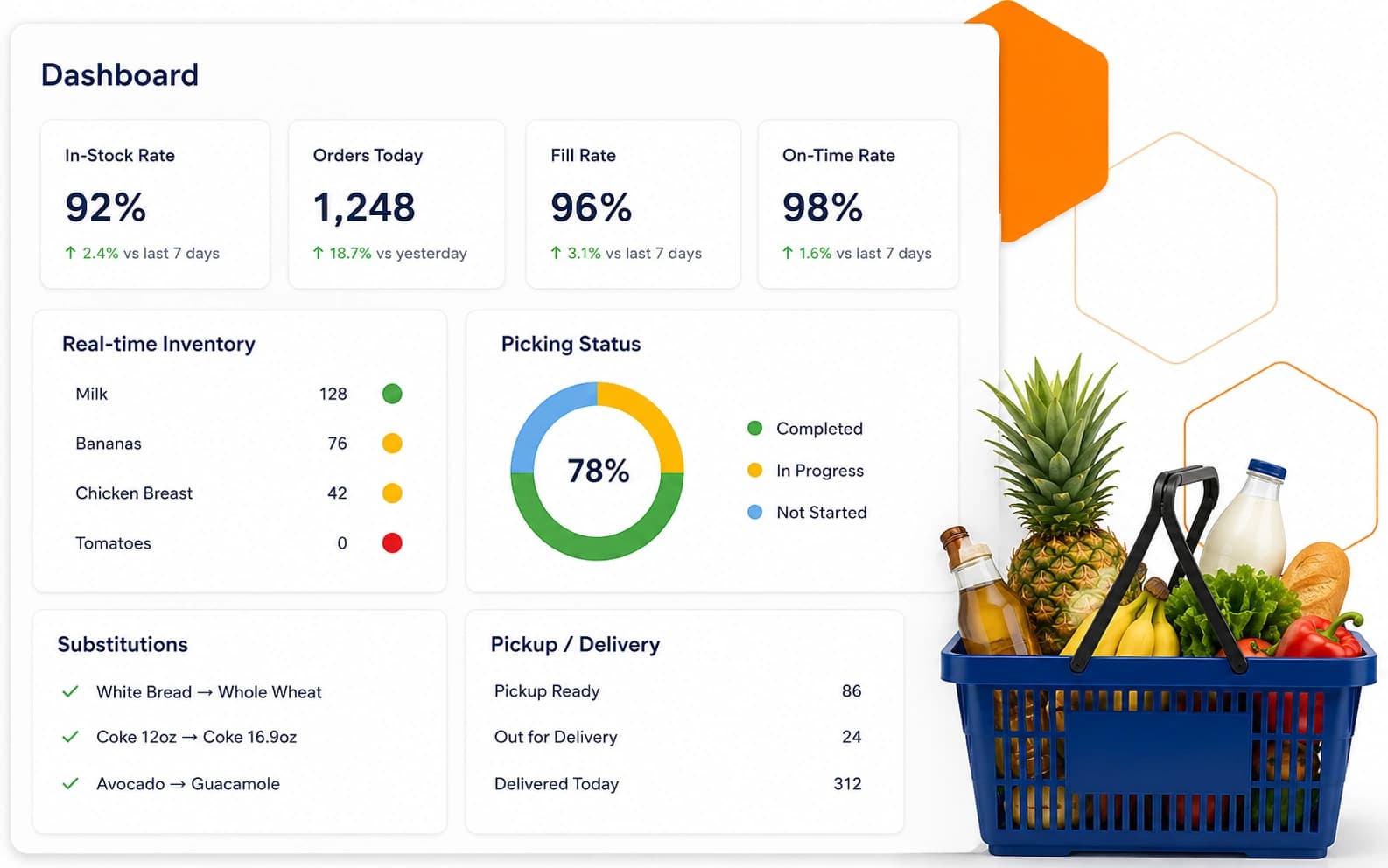
Improve visibility into what is available, where it sits, and what can realistically be promised.
Align picking, substitutions, staging, pickup, delivery, and the store workflows supporting digital orders.
Reduce friction across product selection, substitutions, order updates, service, refunds, and repeat purchasing.
Connect ecommerce, POS, ERP, inventory, delivery, CRM, reporting, automation, and AI around grocery operations.
A customer may see one basket and one order confirmation. Behind that order, the retailer may need to manage dozens of rapidly changing product, inventory, picking, substitution, pricing, staging, delivery, and service decisions.
The warning signs appear in different teams, but they may come from the same disconnect across the grocery commerce operating model.
Products appear available during checkout but cannot be found, reserved, or reliably supplied when picking begins.
Employees travel inefficient routes, search for products, handle missing items, and make repeated decisions without clear guidance.
Preferences, acceptable alternatives, price differences, approvals, refunds, and communication are not handled through one consistent workflow.
Ambient, refrigerated, and frozen items require different handling while pickup slots, customer arrival, and delivery readiness continue changing.
Expired, damaged, missing, or unsellable products reduce actual availability while systems may continue showing stock.
Revenue looks visible, but picking labour, substitutions, refunds, delivery expense, waste, and service effort remain separated.
Not sure where grocery orders are losing time, margin, or customer confidence? Start by identifying the operational constraint.
The storefront is only the beginning of a grocery order. Availability may change while the customer is shopping, picked weights can affect the final price, and missing items can create customer decisions after checkout.
Every order depends on product information, inventory, store capacity, employee workflows, fulfillment timing, customer communication, and system data moving together.
That is why we examine grocery commerce as one connected operating system.
Key insight
The goal is not simply to take grocery orders online. The goal is to make every promise behind the order operationally reliable and commercially sustainable.
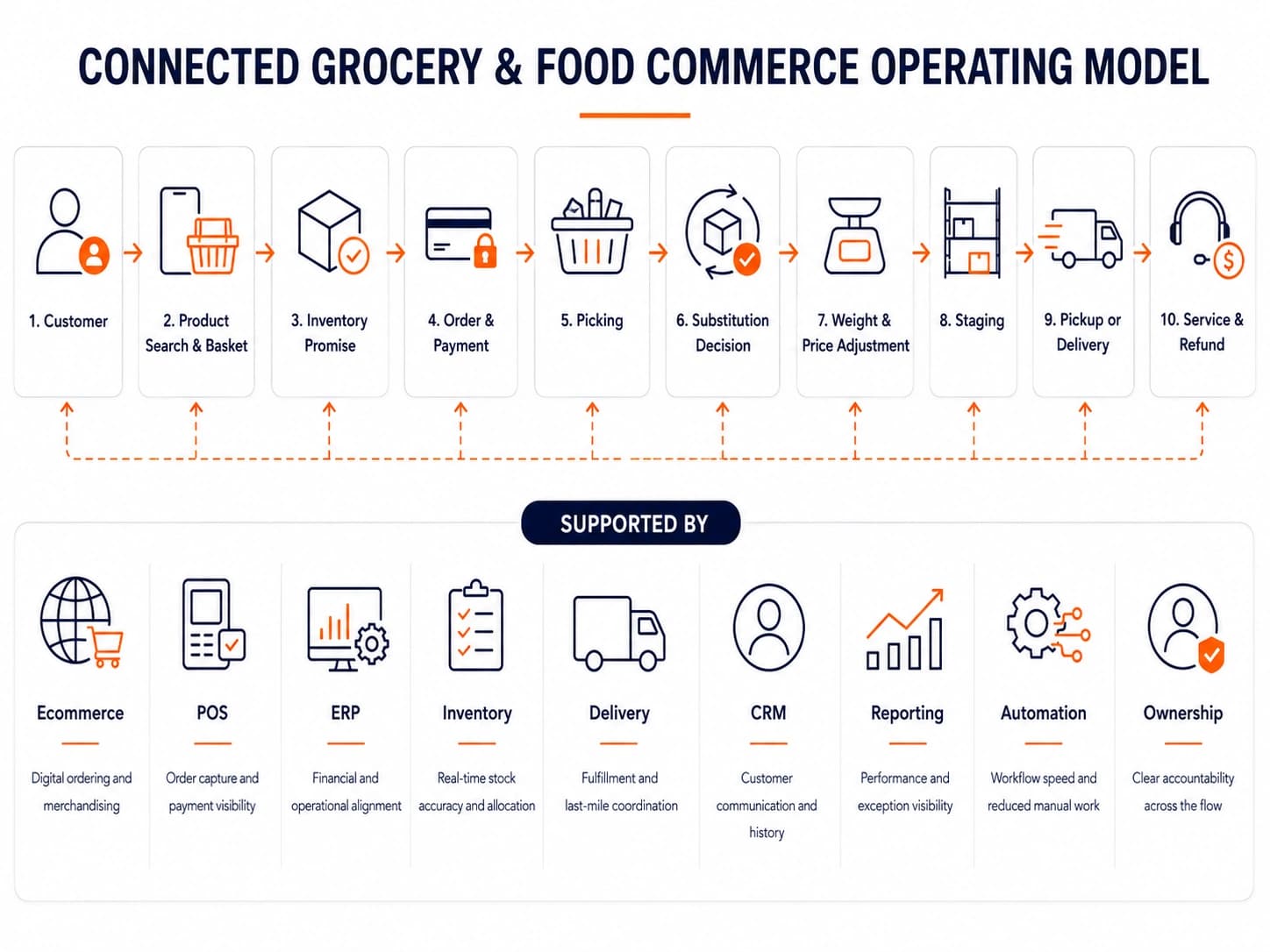
Customer → Product Search & Basket → Inventory Promise → Order & Payment → Picking → Substitution Decision → Weight & Price Adjustment → Staging → Pickup or Delivery → Service & Refund
Some retailers need clarity about what is limiting performance. Others already know what they need built, connected, or automated.
For grocery retailers that see customer or operating problems but need clarity across inventory, workflows, ownership, reporting, data, or systems before deciding what should change.
 Map how products, inventory, orders, picking, substitutions, fulfillment, service, reporting, and financial outcomes connect.Identify where handoffs, ownership, measures, system use, exceptions, or manual work limit daily execution.Prioritize practical improvements across workflows, responsibilities, reporting, system use, and grocery store operations.
Operational Review can stand alone from assessment and redesign through prioritized operational improvements.
For grocery retailers with a defined need for integrations, dashboards, automation, portals, data alignment, custom software, or AI-enabled tools requiring implementation support.
Turn the defined requirement into a practical implementation plan with clear outcomes and responsibilities.Align data and workflows across ecommerce, POS, ERP, inventory, delivery, CRM, finance, and reporting.Build integrations, dashboards, automation, applications, or AI-enabled tools around actual grocery operations.Technology & AI Implementation can begin independently or work alongside Operational Review & Improvement.
Our grocery work is shaped by how retailers plan and execute product setup, pricing, availability, picking, substitutions, staging, pickup, delivery, service, and replenishment across stores, customers, inventory, and fulfillment.
We examine how ecommerce, POS, ERP, inventory systems, delivery platforms, CRM, dashboards, automation, and AI support daily work and whether revenue, margin, inventory accuracy, picking productivity, fulfillment, waste, refunds, and customer value provide reliable evidence for decisions.
This reveals where workflows, ownership, measurement, systems, or focused implementation need to improve.
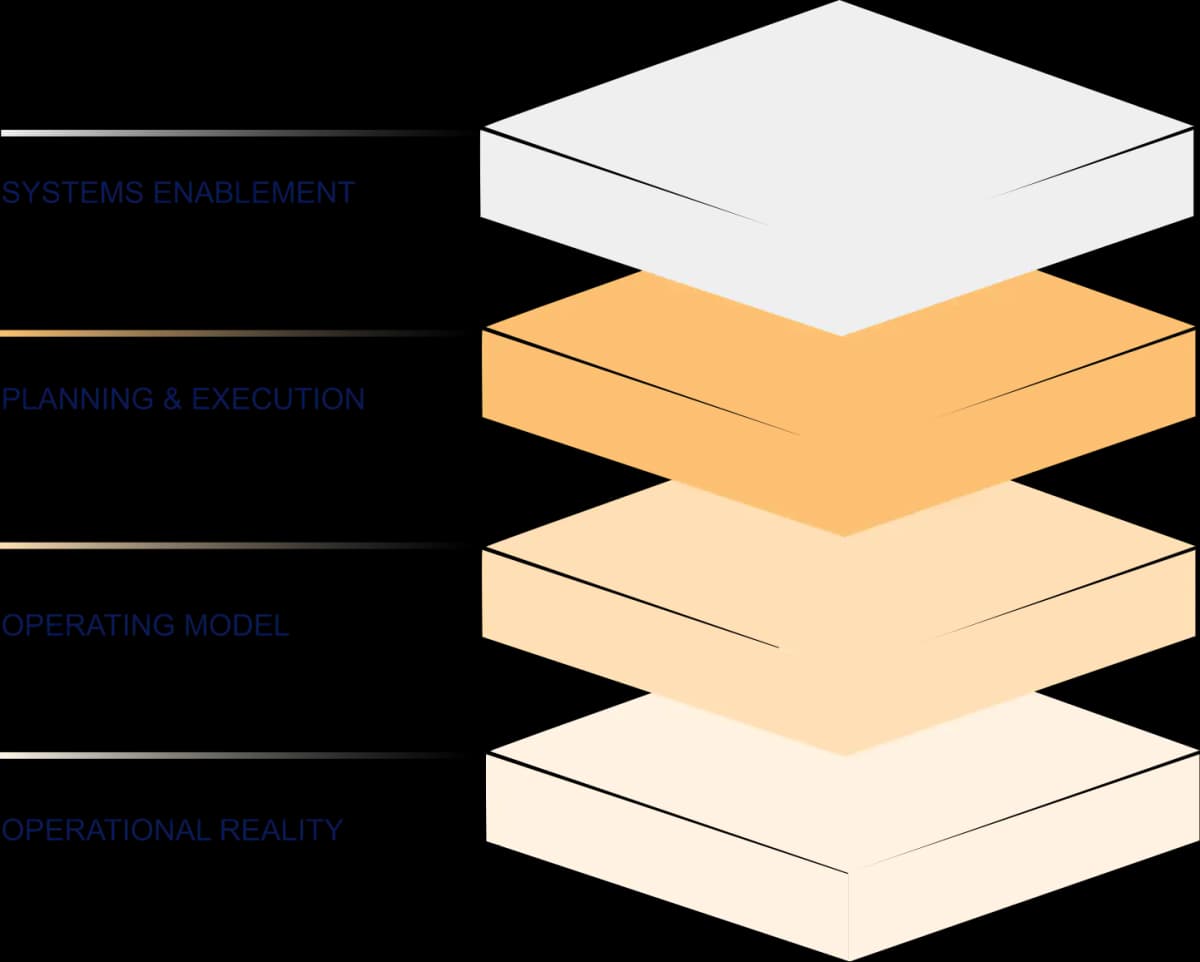
We focus on the parts of grocery commerce where customer expectations, store execution, inventory, margin, and technology depend on one another.
Products shown online must have a reasonable chance of being available.
Inventory changes quickly as in-store and digital customers purchase from the same stock. Damage, expiry, shrink, reservations, and misplaced items can make system quantities different from what pickers can actually supply.
Improve the reliability of inventory information used by customers, pickers, systems, and management.
Not every grocery product behaves like a fixed ecommerce SKU.
Products may be sold by unit, weight, package, case, grade, or variable quantity. The final picked amount can affect price, payment, inventory, customer expectations, and order reconciliation.
Create product and pricing information that supports both customer decisions and the operational reality of picking and fulfillment.
Picking efficiency can determine whether grocery ecommerce is sustainable.
Orders may contain dozens of products distributed across a store. Weak assignment, sequence, item-location, confirmation, and exception workflows create unnecessary movement, labour expense, delays, and mistakes.
Reduce unnecessary movement and decision friction while protecting order accuracy and customer expectations.
A missing product creates a customer decision inside fulfillment.
When a picker finds an unavailable item, the operation needs clear rules for alternatives, customer preferences, approval, price differences, communication, refunds, and final order adjustment.
Give employees clearer guidance while preserving appropriate customer control over substitution decisions.
The order is not complete when picking ends.
Completed orders may need separate ambient, refrigerated, and frozen staging while pickup times, customer arrival, capacity, and order status continue changing.
Create a clear, temperature-aware workflow from completed picking through reliable customer handoff.
Delivery adds another operational layer after picking is complete.
Internal drivers, third-party providers, marketplaces, scheduled windows, and same-day delivery models each create different capacity, status, accountability, and customer communication requirements.
Improve the flow of information and accountability between the store, delivery provider, customer, and service team.
Grocery inventory can lose value without ever being sold.
Expiry, slow movement, poor rotation, damage, and shrink affect margin and actual availability. Systems may continue showing stock after the product has become unavailable or unsellable.
Give management better visibility into where inventory value is being lost and how that affects availability and margin.
Customer complaints and operational reports should point toward the cause.
Missing items, poor substitutions, quality concerns, late orders, weight adjustments, failed delivery, and unclear refunds are operational evidence not isolated service events.
Connect recurring customer problems and operational measures to the workflows, products, locations, or systems that need attention.
Technology should support a defined grocery operating requirement. Once the need is clear, Gyan can plan, build, connect, or improve the relevant commerce technology layer.
Connect ecommerce, POS, ERP, inventory, delivery, CRM, loyalty, finance, customer service, and reporting systems.
Connect revenue, margin, inventory, picking, substitutions, fulfillment, waste, refunds, and customer measures around decisions.
Reduce repetitive coordination across order release, picking, substitutions, notifications, pickup, delivery, refunds, and exceptions.
Give customers, employees, locations, or delivery partners access to the information and actions relevant to their roles.
Apply AI where it can support a defined substitution, product, employee, exception, analysis, or management need.
Build specialized picking, substitution, pickup, delivery, inventory, or exception tools when packaged platforms cannot support the workflow.
Turn the requirement into a practical implementation plan.
AI can help grocery teams retrieve information, organize evidence, identify patterns, prioritize exceptions, and prepare decisions. Its value depends on reliable data, clear rules, defined ownership, and human oversight.
Surface relevant alternatives using product attributes, inventory, preferences, and defined rules while preserving customer or employee approval for final substitution decisions.
Assist with product categorization, units, attributes, descriptions, normalization, and completeness checks while keeping publication and pricing changes under employee control.
Identify and prioritize missing items, order delays, substitutions, refunds, pickup, or delivery exceptions so the appropriate grocery team can respond sooner.
Connect stockouts, adjustments, expiry, waste, shrink, availability, and location signals so leaders can investigate unusual patterns and potential causes.
Help store teams retrieve product, policy, picking, substitution, staging, and fulfillment guidance without searching across disconnected documents and systems.
Before recommending AI, Gyan assesses the workflow, data quality, business rules, decision boundary, oversight requirement, and connected systems.
Use the call to clarify an operating problem or discuss a defined implementation requirement.
Online availability repeatedly differs from store reality.Picking, substitutions, staging, or delivery require manual follow-up.Waste, refunds, or service volume are becoming harder to explain.Reports do not connect revenue, margin, labour, and fulfillment.Automation or AI is being considered without a clear starting point.Ecommerce, POS, ERP, inventory, delivery, or CRM systems need integration.Leadership needs connected inventory, fulfillment, and financial dashboards.Picking, substitution, notification, refund, or exception workflows need automation.A picker tool, portal, integration, or custom application is required.A defined AI use case needs workflow integration and human oversight.Start with Operational Advisory, Technology & AI Implementation, or both based on what your grocery operation needs.
We discuss online ordering, products, inventory, picking, substitutions, fulfillment, customer service, reporting, current systems, and any defined technology requirement.
We define whether the work should focus on Operational Advisory, Technology & AI Implementation, or both. Outcomes, responsibilities, priorities, timeline, and delivery approach are agreed before work begins.
We deliver the agreed work from workflow review and operational improvement to integrations, dashboards, automation, applications, custom software, or AI-enabled support.
30-minute call
No obligation
Advisory and implementation scoped separately
This practice is designed for grocery and food retailers where digital ordering, inventory, store operations, and fulfillment increasingly depend on one another.
Independent grocery stores and chains
Supermarkets and fresh-food retailers
Specialty and international food retailers
Retailers offering online grocery ordering
Businesses offering pickup or local delivery
Multi-location food and grocery retailers
You only need advertising, SEO, or social-media management
You need a basic website or POS hardware installation
You want technology without defining the operating requirement
Your requirement does not involve operations, data, or systems
Different commerce models create different operational, reporting, fulfillment, and technology requirements. Explore the environment closest to your business.
Connect acquisition, orders, inventory, fulfillment, returns, reporting, and systems around digital-first growth.
Explore Ecommerce Brands →
Connect stores, ecommerce, inventory, fulfillment, customer information, reporting, and systems around one retail operation.
Explore Omnichannel Retail →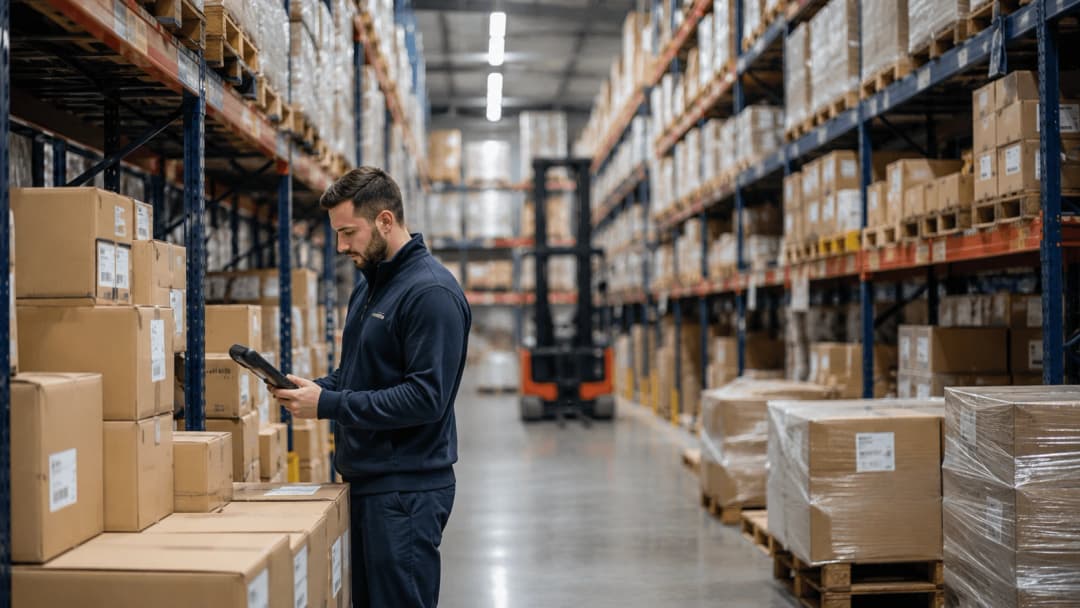
Align product catalogs, account pricing, customer portals, orders, inventory, fulfillment, reporting, and ERP workflows.
Explore B2B Ecommerce & Distribution →
Connect location-level inventory, fulfillment, returns, store performance, customer service, and centralized reporting.
Explore Multi-Location Retail →Discuss your inventory, picking, substitutions, fulfillment, reporting, and systems to identify the right next step.
Request a Free Grocery Commerce Fit Call→


Grocery ecommerce consulting examines how digital ordering interacts with product data, inventory, picking, substitutions, pickup, delivery, customer service, reporting and technology.The objective is to identify where operational friction is affecting customer experience, cost, margin or management visibility.
Yes.The work may involve reviewing inventory processes, available-to-sell rules, stock adjustments and the flow of inventory information between ecommerce, POS, ERP and other relevant systems.[BUSINESS NEED LINK: Inventory & Fulfillment → /ecommerce/inventory-fulfillment/][ECOMMERCE TECHNOLOGY LINK: Commerce Systems Integration → /ecommerce/commerce-systems-integration/]
Yes.A review can examine customer preferences, substitution rules, picker decisions, approvals, price adjustments, communications and exception handling.[BUSINESS NEED LINK: Order Operations → /ecommerce/order-operations/][ECOMMERCE TECHNOLOGY LINK: Commerce Automation → /ecommerce/commerce-automation/]
Yes.We can review picking workflow, assignment, item location, missing-item handling, substitutions, order staging and related employee workflows.Where technology is required, Gyan can support automation or custom tools.[BUSINESS NEED LINK: Inventory & Fulfillment → /ecommerce/inventory-fulfillment/][ECOMMERCE TECHNOLOGY LINK: Custom Commerce Software → /ecommerce/custom-commerce-software/]
Yes, where there is a defined business requirement and the relevant systems support the necessary integration.[ECOMMERCE TECHNOLOGY LINK: Commerce Systems Integration → /ecommerce/commerce-systems-integration/]
Yes.An engagement can examine order readiness, staging, pickup, delivery handoffs, customer notifications, exceptions and performance reporting.[BUSINESS NEED LINK: Order Operations → /ecommerce/order-operations/][ECOMMERCE TECHNOLOGY LINK: Commerce Automation → /ecommerce/commerce-automation/]
Yes, where a defined requirement cannot be adequately supported by existing packaged systems.Examples may include picker workflows, substitutions, pickup coordination, inventory exceptions and internal operational tools.[ECOMMERCE TECHNOLOGY LINK: Custom Commerce Software → /ecommerce/custom-commerce-software/]
Potentially.AI may be useful for defined activities such as product-data assistance, substitution support, exception classification, operational analysis and employee knowledge access.We first determine whether the workflow and underlying data are appropriate.[ECOMMERCE TECHNOLOGY LINK: AI for Ecommerce & Retail → /ecommerce/ai-for-ecommerce-retail/]
Tell us where the operation is experiencing friction across online ordering, inventory, picking, substitutions, pickup, delivery, reporting or systems. We'll use the initial conversation to understand the situation and determine whether the appropriate starting point is operational advisory, technology implementation or a combination.
Focused on your goals
You decide the next step.
Consulting & implementation