
Omnichannel Retail
Connect inventory, orders, customers, fulfillment, returns, and reporting across online stores, marketplaces, and physical locations.
Explore Omnichannel Retail →
ECOMMERCE & RETAIL / ECOMMERCE BRANDS
Gyan Solutions helps ecommerce and retail teams uncover the workflow, system, reporting, and technology gaps limiting performance. We connect orders, inventory, fulfillment, customer handoffs, and revenue data then define the right operational or implementation path.
Advisory and implementation engagements are scoped separately.
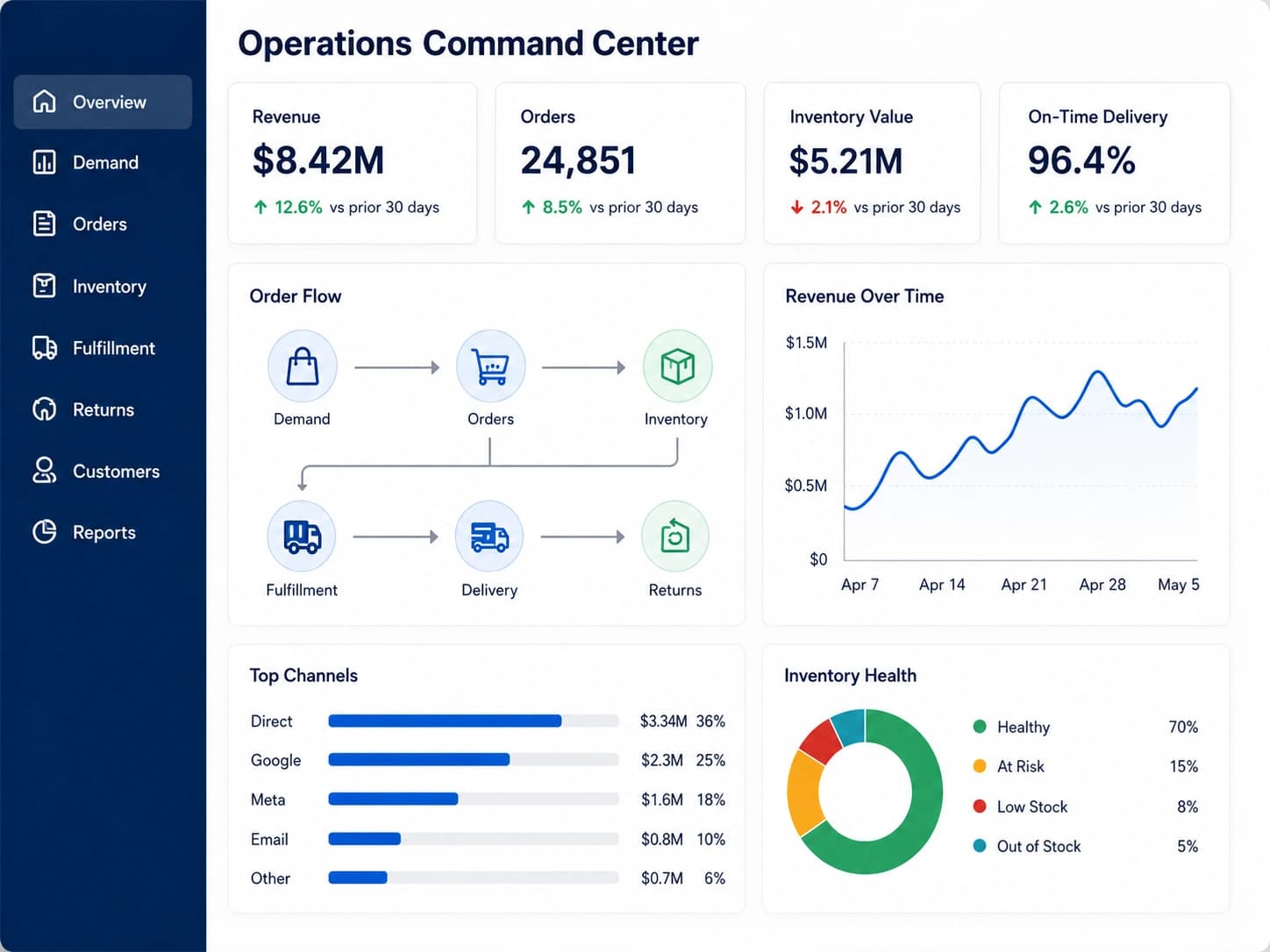
Connect acquisition and conversion activity to customer quality, repeat purchase, margin, and downstream operational impact.
Improve how orders, inventory, fulfillment, returns, and customer-service handoffs move as volume increases.
Bring commercial, operational, and financial evidence together around the decisions leadership needs to make.
Implement integrations, dashboards, automation, AI support, portals, or custom tools when the requirement is clear.
Traffic, conversion, and revenue may be rising while margin, inventory confidence, fulfillment performance, customer experience, and reporting clarity move in the opposite direction.
The warning signs often appear in different teams, so they are treated as separate problems. In reality, they may come from the same disconnect across the ecommerce operating model.
Sales increase, yet discounting, acquisition cost, fulfillment expense, return impact, and product contribution are not visible together.
Campaigns create demand, but storefront availability, warehouse inventory, marketplace stock, and replenishment signals do not stay aligned.
Teams use spreadsheets, messages, and repeated checks to route orders, confirm status, resolve exceptions, or coordinate with a 3PL.
Support teams repeatedly answer delivery, order, refund, and return questions because customers and internal teams cannot see reliable status.
Marketing, finance, operations, and leadership use different definitions, sources, and timeframes to explain the same performance.
The storefront, CRM, ERP, OMS, WMS, 3PL, marketplaces, support tools, and dashboards each hold part of the answer but not one usable operating view.
Not sure what is limiting ecommerce performance? Start by clarifying the workflow, reporting, system, or ownership gap.
A completed checkout is an important milestone. It is not the final measure of whether growth is commercially useful or operationally sustainable.
A customer acquired at an attractive cost can still become unprofitable when the order carries excessive discounting, fulfillment expense, service effort, or returns. A high-converting campaign can create operational pressure when inventory, allocation, warehouse capacity, or customer communication cannot support the demand.
That is why we examine ecommerce as one connected operating system.
Key insight
The goal is not to optimize one stage while moving cost, delay, or confusion into another. The goal is to make growth, operations, and decision-making work together.
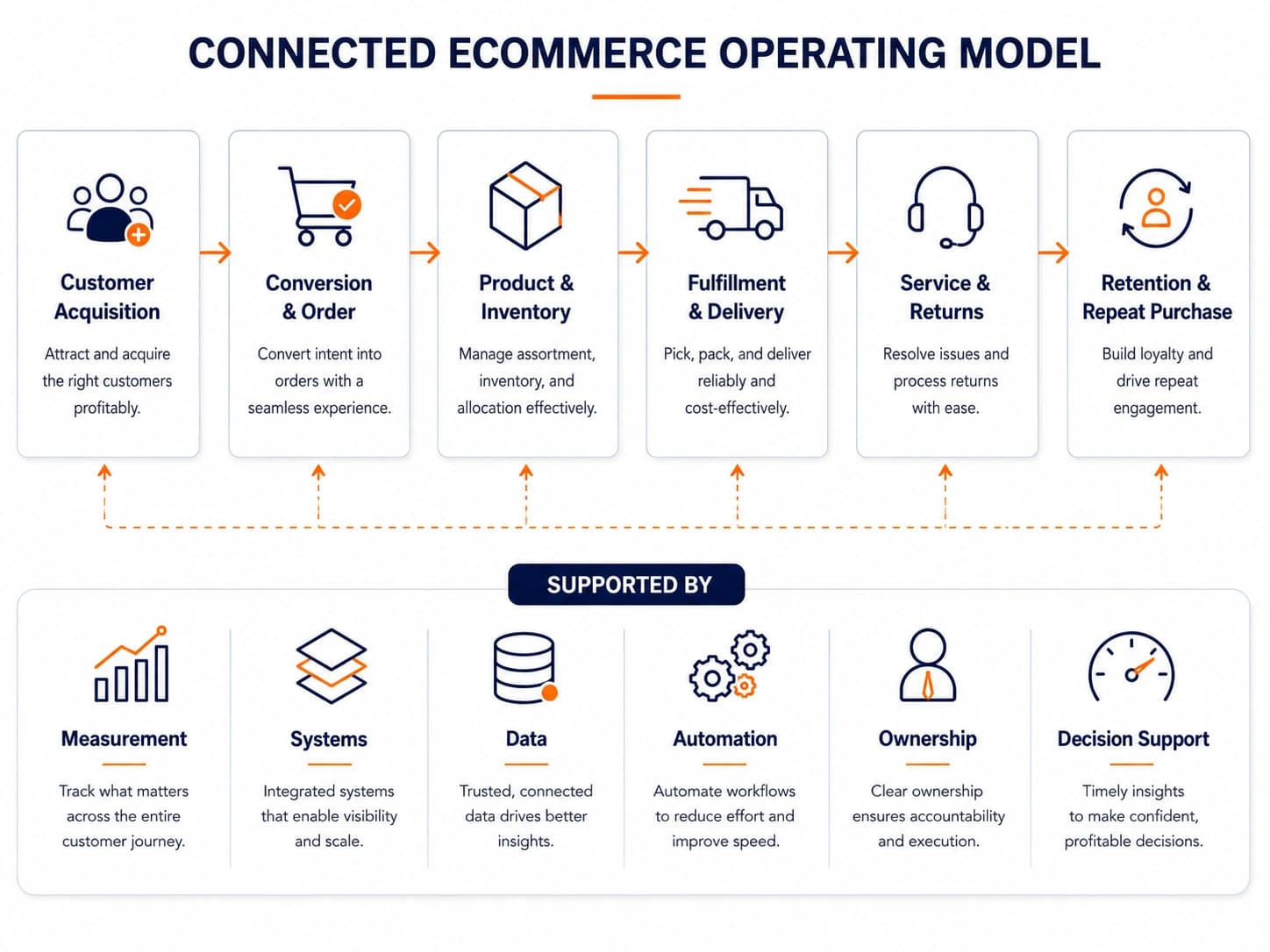
One connected system. Aligned Teams. Smarter Decision. Sustainable Growth.
Some brands need clarity about what is limiting performance. Others already know what they need built, connected, or automated.
For ecommerce brands that see performance problems but need clarity across workflows, ownership, reporting, data, or systems before deciding what should change.
 Map how demand moves through orders, inventory, fulfillment, returns, service, reporting, and financial outcomes.Identify where handoffs, ownership, measures, system use, exceptions, or manual work are limiting execution.Prioritize practical improvements across core workflows, reporting, responsibilities, system use, and daily operating processes.
Operational Review can stand alone from assessment and redesign through prioritized operational improvements.
For ecommerce brands with a defined need for dashboards, integrations, automation, portals, data alignment, custom software, or AI-enabled tools requiring implementation support.
Turn the defined requirement into a practical implementation plan with clear outcomes and responsibilities.Align workflows and data across ecommerce, CRM, ERP, OMS, WMS, marketplaces, 3PL, and reporting.Build dashboards, integrations, portals, automation, custom applications, or AI-enabled tools around real daily operations.Technology & AI Implementation can begin independently or work alongside Operational Advisory.
Our ecommerce work is shaped by how growing brands operate across customer acquisition, conversion, orders, inventory, fulfillment, returns, reporting, and the systems supporting each step.
We use that experience to identify where customer demand, operating execution, financial evidence, and technology stop aligning then determine whether the right response is a workflow improvement, clearer ownership, better measurement, system optimization, or focused implementation.
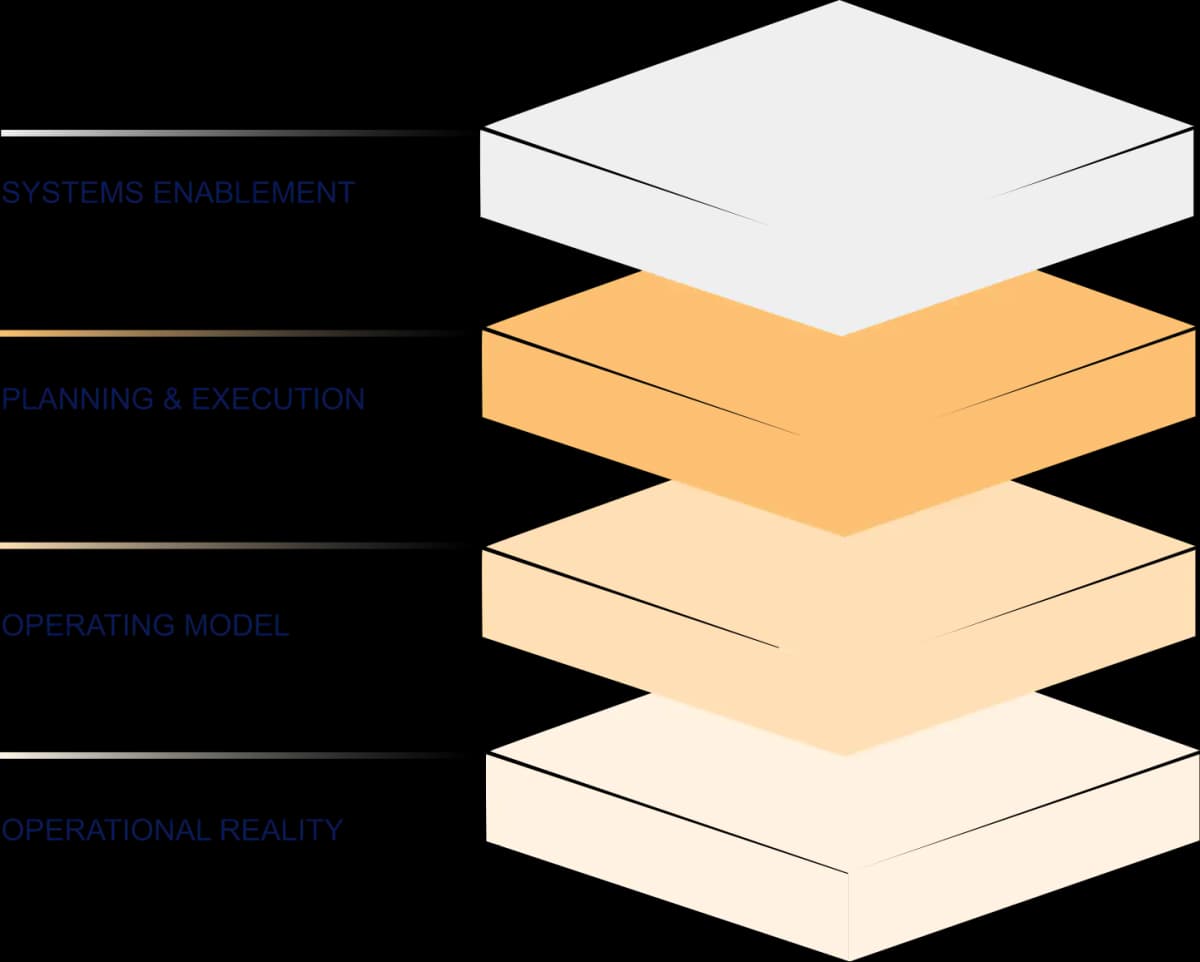
We focus on the parts of the business where growth activity, operational execution, customer experience, financial impact, and technology depend on one another.
More revenue does not automatically mean better growth.
An ecommerce team can improve traffic, conversion, and campaign revenue while still lacking a reliable view of customer quality, product contribution, discount impact, retention, or downstream operating cost.
Clarify which customers, products, channels, and commercial activities are producing growth the business can support and sustain.
The value of a click depends on what happens after it.
Traffic and conversion data can show what happened in the funnel, but not always whether the resulting customer, order, margin, return behavior, and lifetime value support the business objective.
Connect acquisition and conversion activity to the customers and orders the organization actually wants to scale.
Customer value develops after the first transaction.
Customer history is often divided across the ecommerce platform, CRM, lifecycle tools, support system, advertising platforms, and spreadsheets. That makes one continuous customer relationship difficult to see.
Connect how a customer was acquired, what they purchased, what happened after the order, and whether they returned.
You cannot confidently scale demand for products you cannot reliably supply.
Stockouts suppress conversion, overselling damages trust, excess inventory ties up cash, and conflicting stock information forces teams to verify availability manually.
Give commercial and operational teams a more reliable view of what is selling, what is available, and where inventory may constrain growth.
Every completed checkout creates an operational commitment.
After purchase, payment, allocation, routing, warehouse activity, shipping, communication, and exceptions must move together. Processes that worked at lower volume can become dependent on manual intervention as the brand grows.
Reduce unnecessary coordination between completed checkout and operationally completed order.
Growth becomes real to the customer through fulfillment.
Customers judge the experience by whether the right product arrives when expected and whether they receive useful communication when something changes.
Improve coordination between the digital transaction and the physical delivery of the customer commitment.
Customer-service volume can reveal problems elsewhere in the operation.
Repeated "Where is my order?" requests, refunds, return reasons, delivery issues, and product complaints are operational evidence. When those signals remain inside the support platform, the business loses an opportunity to address the cause.
Connect recurring customer-facing issues to the workflow, product, information, or ownership problem that can be improved.
The problem is often not missing data. It is disconnected evidence.
Each platform can report accurately within its own boundary while leadership still lacks one consistent explanation of commercial performance, operating execution, and financial impact.
Replace disconnected reports with a smaller set of reliable signals that help leadership understand what changed, why it changed, and where action is required.
Technology should support a defined operating requirement. It should not be added simply because another tool, dashboard, automation, or AI feature is available.Once the need is clear, we can plan, build, connect, or improve the relevant commerce technology layer.
Connect ecommerce platforms with CRM, ERP, OMS, WMS, 3PL, marketplaces, customer service, finance, and reporting systems.
Connect commercial, operational, and financial measures around the questions leaders and operating teams need to answer.
Reduce repetitive coordination after the workflow, ownership, exception rules, and system boundaries are understood.
Give customers, wholesale accounts, partners, vendors, or internal teams direct access to the information and actions relevant to their role.
Apply AI where it can assist a defined decision or workflow with appropriate data quality, boundaries, escalation, and human oversight.
Build specialized internal or customer-facing tools when packaged platforms cannot adequately support the required workflow.
We will discuss your goals, workflows, systems, reporting needs, priorities, and implementation requirements.
AI can help ecommerce teams retrieve information, organize evidence, identify patterns, classify exceptions, and prepare decisions. Its usefulness depends on whether the underlying workflow, data, business rule, and human decision boundary are clear.
Bring relevant customer, order, delivery, product, policy, and return information together so service teams can respond faster while remaining responsible for the final communication.
Support product classification, attribute normalization, content enrichment, completeness checks, and channel consistency before information is published or updated.
Identify, categorize, and prioritize order, inventory, fulfillment, delivery, payment, and return exceptions so the appropriate team can review them sooner.
Help leaders examine changes across revenue, customers, products, inventory, fulfillment, returns, and operational performance while keeping business decisions with accountable people.
Help employees find product information, operating procedures, policies, business rules, and system guidance without searching across disconnected documents and platforms.
Before recommending AI, Gyan assesses the workflow, data quality, decision boundary, oversight requirement, and system context.
Use the call to clarify an operational problem or discuss a defined implementation requirement.
Revenue is growing, but margin or customer value is harder to explain.Marketing, operations, and finance report different performance figures.Inventory, fulfillment, returns, or service require repeated manual follow-up.Reports exist, but leaders cannot clearly see where to act.Automation, dashboards, or AI are being considered without a clear starting point.Ecommerce, CRM, ERP, OMS, WMS, or 3PL systems need integration.Leadership needs connected operational and financial dashboards.Manual approvals, alerts, reporting, or exception handling need automation.A portal, internal tool, integration, or custom application is required.A defined AI use case needs workflow integration and human oversight.We start with clarity before recommending process changes, automation, software, or implementation work.
We discuss your ecommerce model, growth objectives, customer journey, order and inventory flow, fulfillment and return challenges, reporting needs, current systems, and any defined technology requirement.
We define whether the work should focus on Operational Advisory, Technology & AI Implementation, or a combined engagement. Outcomes, responsibilities, priorities, timeline, and delivery approach are agreed before work begins.
We deliver the agreed work from workflow review, measurement alignment, and operational improvement to integrations, dashboards, portals, automation, AI-enabled support, or custom commerce software.
30-minute call
No obligation
Consulting and implementation scoped separately
Direct-to-consumer and digital-first brands
Brands selling through storefronts and marketplaces
Subscription and replenishment-based commerce
Specialty or high-value ecommerce
Brands expanding into new sales channels
Ecommerce companies adding wholesale or B2B revenue
You only need advertising, SEO, or social-media management
You need a basic ecommerce website or isolated coding support
You want automation without reviewing the workflow behind it
Your requirement does not involve operations, reporting, systems, or data
Different commerce models create different operational, reporting, fulfillment, and technology requirements. Explore the environment closest to your business.
Connect inventory, orders, customers, fulfillment, returns, and reporting across online stores, marketplaces, and physical locations.
Explore Omnichannel Retail →
Improve perishable inventory, availability, replenishment, substitutions, pickup, delivery, and store-to-customer coordination.
Explore Grocery & Food Commerce →
Align product catalogs, account pricing, customer portals, orders, inventory, fulfillment, reporting, and ERP workflows.
Explore B2B Ecommerce & Distribution →
Connect location-level inventory, fulfillment, returns, store performance, customer service, and centralized reporting.
Explore Multi-Location Retail →Talk through your growth, orders, inventory, fulfillment, reporting, and systems—and determine the right next step.
Request a Free Operations Fit Call→


Ecommerce brand consulting examines how customer acquisition, conversion, lifecycle, orders, inventory, fulfillment, service, reporting and technology work together as a business grows.Gyan focuses particularly on situations where problems cross departmental or system boundaries and management needs to identify the underlying cause before determining what should change.
No.Commercial and growth expertise can form part of an ecommerce engagement where acquisition, conversion, lifecycle or measurement affect the broader business problem.Gyan's focus is the relationship between growth, operations, data and technology.[BUSINESS NEED LINK: “growth” → /ecommerce/revenue-growth/]
Yes, where it relates to a broader revenue, customer or commerce requirement.This can include customer acquisition, funnel performance, segmentation, lifecycle activity, KPI architecture and measurement.[BUSINESS NEED LINK: Revenue & Growth → /ecommerce/revenue-growth/]
Yes.An engagement can involve the existing ecommerce platform alongside ERP, CRM, WMS, OMS, 3PL, marketplaces, reporting, finance and internal systems.[ECOMMERCE TECHNOLOGY LINK: Commerce Systems Integration → /ecommerce/commerce-systems-integration/]
Not necessarily.If the existing platform can support the business requirement, workflow improvement, integration, automation or better reporting may be preferable to replacement.[ECOMMERCE TECHNOLOGY LINK: “integration” → /ecommerce/commerce-systems-integration/][ECOMMERCE TECHNOLOGY LINK: “automation” → /ecommerce/commerce-automation/]
Yes, where the requirement involves order flow, inventory visibility, fulfillment information, customer communication or systems integration between the ecommerce operation and 3PL.[BUSINESS NEED LINK: “Inventory & Fulfillment” → /ecommerce/inventory-fulfillment/][ECOMMERCE TECHNOLOGY LINK: “systems integration” → /ecommerce/commerce-systems-integration/]
Yes, where the requirement falls within Gyan's implementation capabilities.Implementation can include: Commerce systems integration Operational dashboards Commerce automation AI-supported workflows Custom commerce software [ECOMMERCE TECHNOLOGY LINK: Commerce Systems Integration → /ecommerce/commerce-systems-integration/][ECOMMERCE TECHNOLOGY LINK: Commerce Dashboards → /ecommerce/commerce-dashboards-reporting/][ECOMMERCE TECHNOLOGY LINK: Commerce Automation → /ecommerce/commerce-automation/][ECOMMERCE TECHNOLOGY LINK: AI for Ecommerce & Retail → /ecommerce/ai-for-ecommerce-retail/][ECOMMERCE TECHNOLOGY LINK: Custom Commerce Software → /ecommerce/custom-commerce-software/]
No.If the requirement is already sufficiently defined, the conversation can begin directly with implementation.A review is more useful when management sees symptoms but cannot confidently determine whether the underlying issue is commercial, operational, data-related or technical.
Tell us what you are trying to improve and where the business is experiencing friction. We'll use the initial conversation to understand the situation and determine whether the appropriate starting point is commercial advisory, operational review, technology implementation—or a combination.
Focused on your goals
You decide the next step.
Consulting & implementation