
Ecommerce Brands
Direct-to-consumer and digital-first companies connecting growth, customers, orders, fulfillment, service, reporting, and systems.
Explore Ecommerce Brands →
ECOMMERCE & RETAIL / B2B ECOMMERCE & DISTRIBUTION
B2B ecommerce must support customer-specific pricing, payment terms, approvals, repeat orders, and fulfillment requirements. Gyan Solutions connects customer ordering with inventory, distribution, reporting, and the systems behind each transaction so digital convenience does not create more operational complexity.
Advisory and implementation engagements are scoped separately.
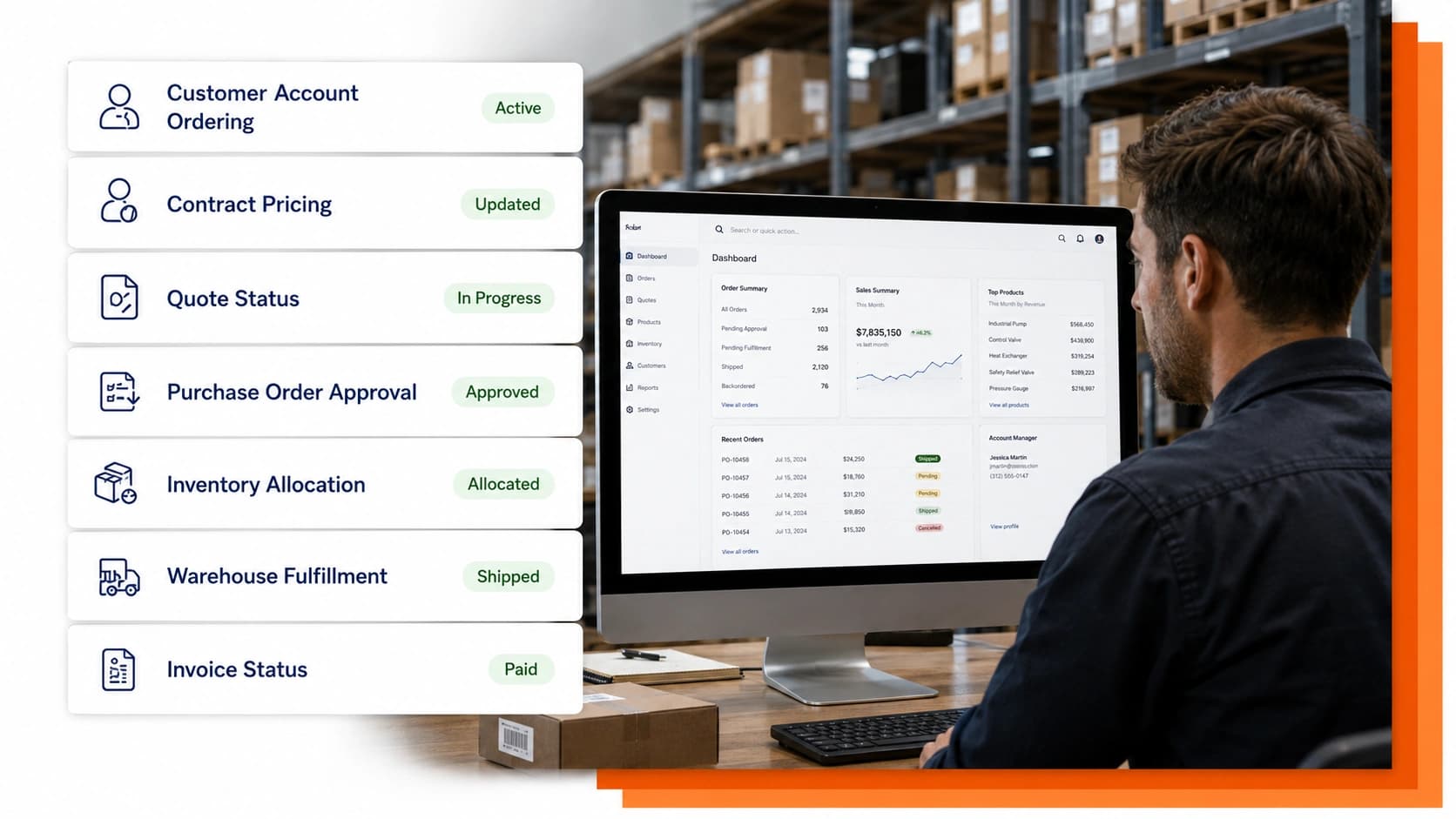
Support customer-specific pricing, approvals, locations, permissions, and repeat purchasing without unnecessary buying friction.
Improve visibility across availability, allocation, warehouses, backorders, replenishment, and fulfillment commitments.
Connect quotes, purchase orders, approvals, fulfillment, invoicing, claims, and commercial handoffs.
Align ecommerce, CRM, ERP, OMS, WMS, finance, reporting, automation, and AI around B2B operations.
A customer may expect contract pricing, payment terms, purchase orders, approvals, multiple locations, and reliable availability to work naturally online.
Internally, each order may still require coordination across sales, operations, inventory, warehouse, finance, and customer service. The warning signs appear in different teams, but they often come from the same disconnect across the B2B commerce operating model.
Customers repeat familiar purchases, yet employees must collect details, confirm terms, and re-enter orders manually.
Contract prices, volume tiers, discounts, and overrides do not remain consistent across ecommerce, CRM, ERP, and sales workflows.
Requests, revisions, approvals, purchase orders, and ERP entry move through disconnected messages, documents, and spreadsheets.
Customers and sales teams cannot reliably see available quantities, lead times, backorders, allocation, or expected shipment dates.
Holds, approvals, shortages, partial shipments, claims, and invoice questions depend on manual checks across several teams.
The storefront accepts orders, but employees still reconcile account, pricing, inventory, fulfillment, and finance information afterward.
Not sure where B2B orders are losing time, margin, or customer confidence? Start by identifying the operational constraint.
A portal can make ordering easier for the customer while creating more internal work when account rules, pricing, approvals, inventory, ERP, warehouse, and finance remain disconnected.
Every transaction depends on the customer relationship, commercial terms, product information, operational capacity, and system data moving together.
That is why we examine B2B commerce as one connected operating system.
Key insight
The goal is not simply to move orders online. The goal is to make digital buying easier while preserving the commercial and operational rules behind each account.
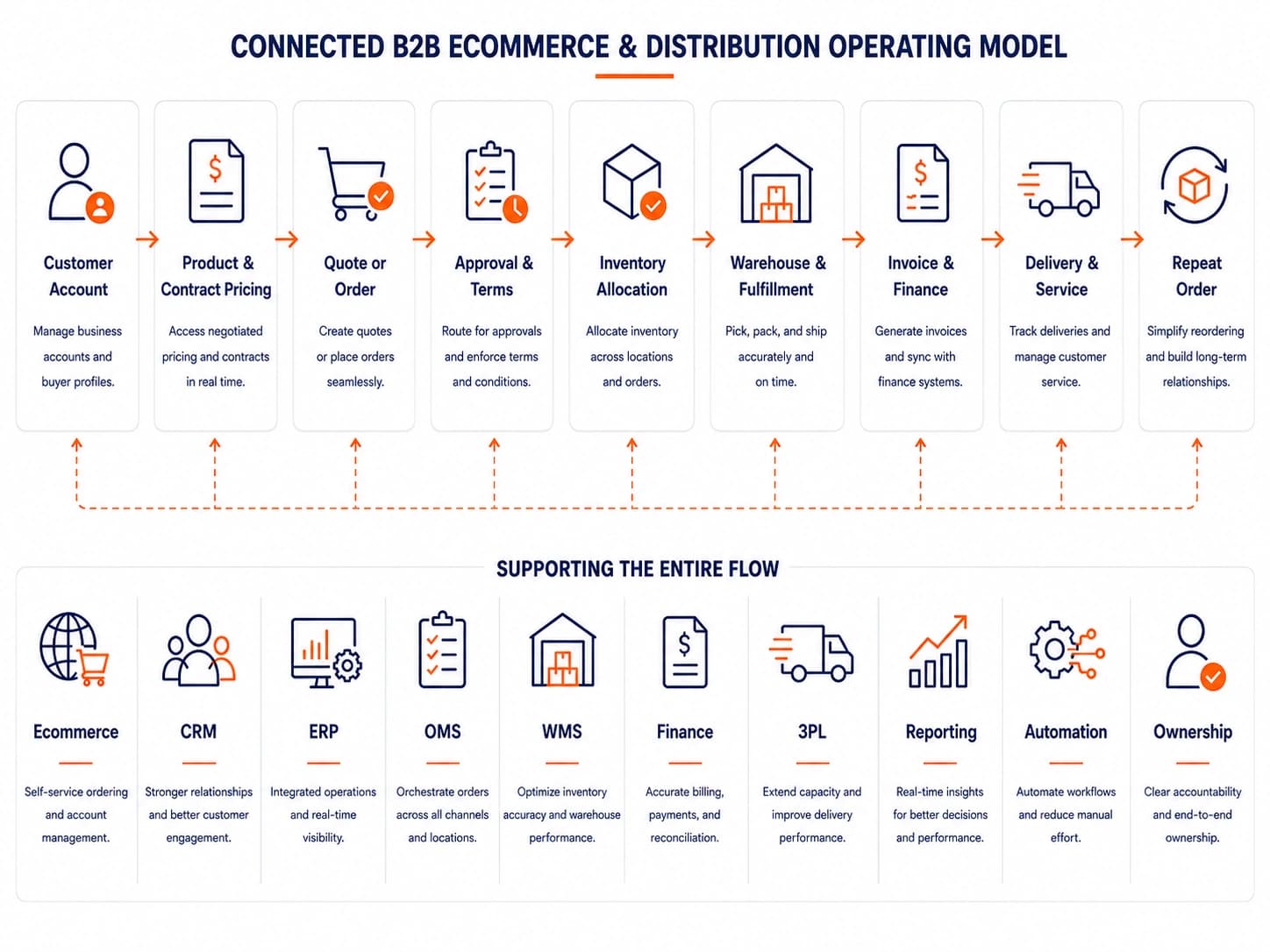
Customer Account → Product & Contract Pricing → Quote or Order → Approval & Terms → Inventory Allocation → Warehouse & Fulfillment → Invoice & Finance → Delivery & Service → Repeat Order
Some companies need clarity about what is limiting customer and operational performance. Others already know what they need built, connected, or automated.
For B2B companies seeing friction across accounts, pricing, quotes, orders, inventory, fulfillment, claims, reporting, or systems but needing a clearer view of the underlying issue.
 Map how customer requirements become prices, orders, inventory commitments, fulfillment activity, invoices, and financial outcomes.Identify where handoffs, ownership, measures, system use, exceptions, or manual work limit customer service and execution.Prioritize practical improvements across workflows, responsibilities, reporting, system use, and distribution operations.
Operational Review can stand alone from assessment and redesign through prioritized operational improvements.
For B2B companies with a defined need for integrations, dashboards, automation, portals, data alignment, custom software, or AI-enabled tools requiring implementation support.
Turn the defined requirement into a practical implementation plan with clear outcomes and responsibilities.Align workflows and data across ecommerce, CRM, ERP, OMS, WMS, finance, 3PL, service, and reporting.Build integrations, dashboards, portals, automation, applications, or AI-enabled tools around actual B2B operations.Technology & AI Implementation can begin independently or work alongside Operational Review & Improvement.
Our B2B commerce work is shaped by how companies manage customer accounts, pricing, catalogues, quotes, purchase orders, approvals, inventory, allocation, warehouse execution, fulfillment, invoicing, claims, and repeat purchasing.
We examine how ecommerce, CRM, ERP, OMS, WMS, finance, 3PL platforms, dashboards, automation, and AI support daily work and whether account revenue, margin, quote conversion, order cycle time, fill rate, backorders, fulfillment, claims, and cost to serve provide reliable evidence for decisions.
This reveals where workflows, ownership, measurement, systems, or focused implementation need to improve.
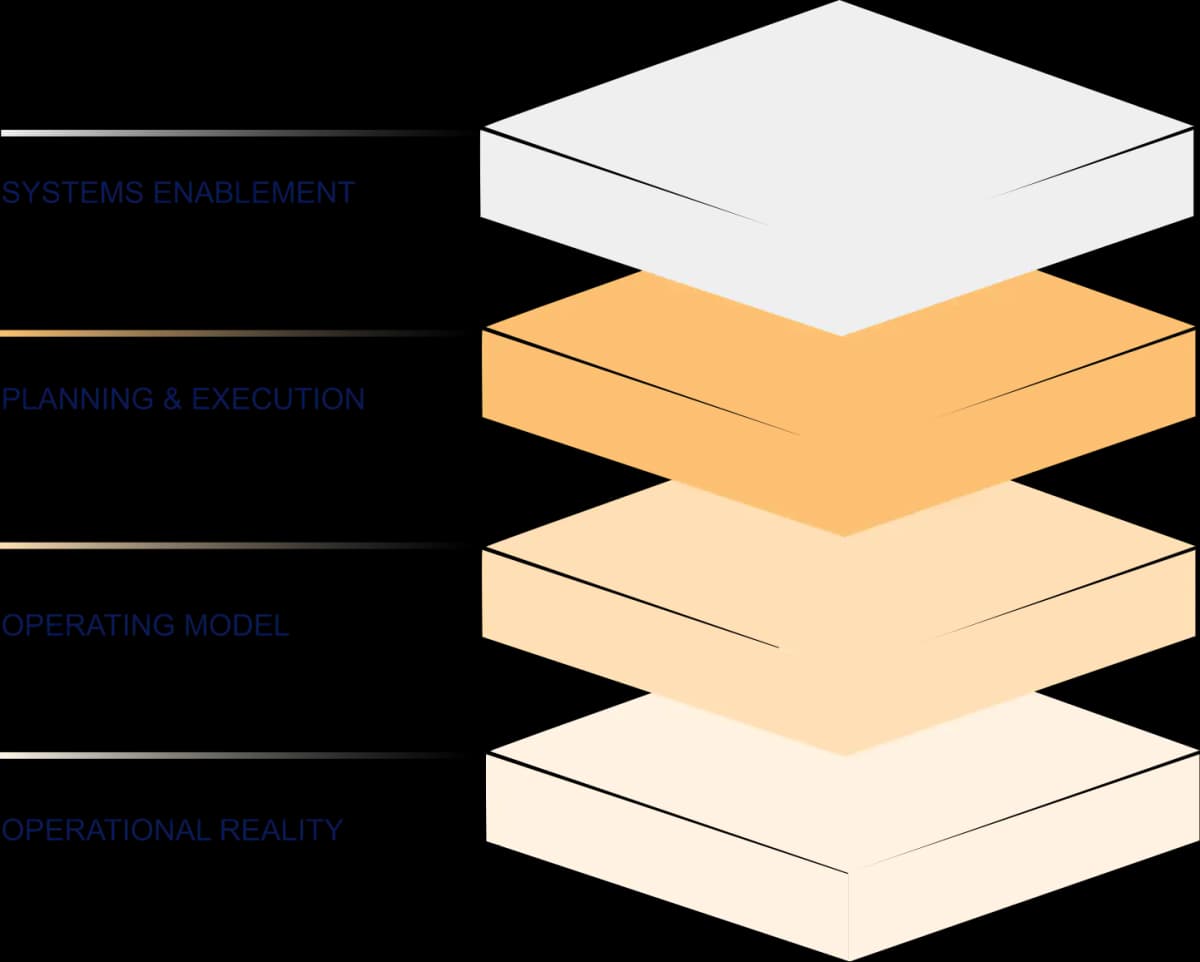
We focus on the parts of B2B commerce where customer relationships, commercial rules, inventory, distribution, finance, and technology depend on one another.
Business customers need convenience within the rules of their account.
Customers may have different buyers, locations, permissions, catalogues, order histories, and purchasing requirements. A consumer-style checkout rarely reflects that complexity.
Make it easier for customers to buy without removing the controls governing the relationship.
The digital offer must reflect the agreement behind the account.
Pricing and product access may depend on contracts, volume, customer tier, location, assortment, quantity, promotions, and other negotiated conditions.
Present the right products and prices while reducing manual correction and duplicate product work.
Not every B2B transaction begins with Add to Cart.
Some purchases move from inquiry to quote, revision, approval, purchase order, and sales order. Each transition can add delay when status, ownership, and information are unclear.
Reduce administrative work between customer intent and an executable sales order.
Customers need to know whether the business can meet the commitment.
Inventory may be distributed across warehouses, branches, stores, 3PL facilities, suppliers, and in-transit stock while existing orders compete for available quantities.
Provide customers, sales, and operations with more reliable availability and commitment information.
A submitted order may still require several decisions before fulfillment.
Orders may need validation, allocation, splitting, routing, approval, release, or prioritization before warehouse activity can begin.
Create clearer ownership and execution from order submission through distribution.
Established customers should not rebuild the same purchase every time.
Many B2B customers are replenishing known products. Digital self-service should reduce repetitive effort while strengthening—not competing with—the account relationship.
Make repeat purchasing easier while keeping sales and account teams connected to customer activity.
Post-order issues should be traceable to their operational cause.
Short shipments, damaged goods, incorrect products, invoice differences, warranties, and return authorizations may involve service, warehouse, finance, sales, and ERP.
Resolve customer issues through a clearer workflow and identify recurring causes sooner.
Revenue alone does not show whether B2B commerce is working.
Leadership needs connected evidence across accounts, quotes, orders, inventory, distribution, margin, claims, and cost to serve—not separate reports that explain only one part.
Connect commercial and operational evidence so leaders can see where to act.
Technology should support the customer relationship and the operation behind it—not force account-specific requirements into a generic consumer checkout.
Connect customer, product, pricing, quote, order, inventory, fulfillment, invoice, and claims data across ecommerce, CRM, ERP, OMS, WMS, finance, and 3PL platforms.
Create reliable views of account revenue, digital adoption, quotes, orders, availability, fulfillment, margin, claims, and cost to serve.
Reduce repetitive work across quote approvals, order validation, credit handoffs, releases, backorders, notifications, claims, and reporting preparation.
Give authorized users clearer access to account catalogues, pricing, quotes, orders, invoices, availability, documents, and service workflows.
Support product information, employee knowledge, quote preparation, exception triage, account analysis, and management reporting within defined boundaries.
Build specialized ordering, quoting, reordering, dealer, distribution, claims, or internal sales tools when packaged platforms do not fit the requirement.
Move forward with a portal, integration, dashboard, automation, software, or AI requirement.
AI can help teams retrieve information, organize evidence, identify missing details, classify exceptions, and prepare analysis. Its usefulness depends on whether the account rules, workflow, data, oversight, and decision boundary are clear.
Bring account, order, product, policy, and service information together so teams can respond faster while remaining responsible for customer communication.
Support product classification, attribute normalization, technical-information retrieval, completeness checks, and catalogue consistency across customer channels.
Help employees gather relevant account and product information or identify missing details before quotes and orders move forward.
Identify and prioritize holds, backorders, fulfillment issues, claims, and invoice exceptions so the appropriate team can review them sooner.
Help leaders examine changes across customers, orders, inventory, margin, service, and distribution while keeping decisions with accountable people.
Before recommending AI, Gyan assesses the workflow, data quality, commercial rules, decision boundary, oversight requirement, and system context.
Use the call to clarify a business or operating problem or discuss a defined implementation requirement.
Routine orders still depend heavily on email, phone calls, or re-entry.Pricing, availability, or order status differs between systems and teams.Quotes, approvals, backorders, or claims require repeated follow-up.Digital orders create additional work across sales, warehouse, or finance.Reporting does not connect account performance with cost to serve.A B2B customer, dealer, or distributor portal is already defined.Ecommerce, CRM, ERP, OMS, WMS, finance, or 3PL data must connect.Quote, approval, order, backorder, or claims work needs automation.Account, inventory, order, margin, or distribution dashboards are required.A specialized B2B application or AI-enabled workflow needs implementation.Choose the right starting point without committing to a preset sequence.
We discuss your customer model, pricing, ordering, inventory, distribution, reporting, systems, and any defined technology requirement.
We agree on the outcomes, responsibilities, timeline, and delivery approach for Operational Advisory, Technology & AI Implementation, or both.
We deliver the agreed work from workflow and reporting improvement to integrations, dashboards, portals, automation, custom software, or AI-enabled support.
30-minute call
No obligation
No mandatory advisory stage
This practice is designed for B2B companies where digital ordering must work alongside established accounts, sales, inventory, distribution, finance, and service processes.
Wholesalers and multi-warehouse distributors
Manufacturers selling directly to business customers
Industrial and commercial supply companies
Dealer, reseller, or distributor networks
Businesses serving recurring commercial accounts
Companies moving phone or email ordering toward digital self-service
You only need advertising, lead generation, or a basic online catalogue.
The requirement is limited to a template, plugin, or isolated coding resource.
You want to digitize a workflow without clarifying the supporting rules, data, or ownership.
Direct-to-consumer and digital-first companies connecting growth, customers, orders, fulfillment, service, reporting, and systems.
Explore Ecommerce Brands →
Retailers connecting ecommerce, stores, POS, shared inventory, pickup, delivery, returns, customer data, and reporting.
Explore Omnichannel Retail →
Retailers managing fast-changing inventory, picking, substitutions, staging, pickup, delivery, waste, and narrow margins.
Explore Grocery & Food Commerce →
Retailers coordinating inventory, employees, customer service, execution, and performance across several physical locations.
Explore Multi-Location Retail →Talk through your customer accounts, pricing, quotes, orders, inventory, distribution, reporting, and systems and determine the right next step.
Request a Free B2B Commerce Fit Call→


B2B ecommerce consulting examines how digital customer ordering interacts with account pricing, quotes, approvals, inventory, ERP, warehouse, fulfillment, finance and customer service.The objective is to create a buying experience that is easier for customers without creating additional operational complexity internally.
Yes.Depending on the requirement, a portal may support customer accounts, pricing, product catalogues, quotes, orders, repeat purchasing, invoices, order status and other account-specific functionality.[ECOMMERCE TECHNOLOGY LINK: Custom Commerce Software → /ecommerce/custom-commerce-software/]
Yes, where the business rules and underlying systems support customer-specific pricing.An engagement can examine how contract pricing, tiers, discounts or other pricing logic should flow between ERP and ecommerce.[ECOMMERCE TECHNOLOGY LINK: Commerce Systems Integration → /ecommerce/commerce-systems-integration/]
Yes.This may include quote requests, pricing approvals, revisions, customer acceptance, purchase orders and conversion into executable sales orders.[BUSINESS NEED LINK: Order Operations → /ecommerce/order-operations/][ECOMMERCE TECHNOLOGY LINK: Commerce Automation → /ecommerce/commerce-automation/]
Yes, where there is a defined integration requirement and the relevant systems support it.Potential data may include customers, pricing, products, inventory, orders, fulfillment, invoices and returns.[ECOMMERCE TECHNOLOGY LINK: Commerce Systems Integration → /ecommerce/commerce-systems-integration/]
Potentially.The appropriate workflow depends on customer account rules, approval requirements, credit terms and how the transaction needs to flow into ERP and finance.[BUSINESS NEED LINK: Order Operations → /ecommerce/order-operations/]
Yes.Potential approaches include order history, quick reorder, saved lists, order templates, recurring orders or custom account workflows.[BUSINESS NEED LINK: Customer Journey & Lifecycle → /ecommerce/customer-journey-lifecycle/][ECOMMERCE TECHNOLOGY LINK: Custom Commerce Software → /ecommerce/custom-commerce-software/]
Yes, where the requirement falls within Gyan's technical capabilities.Implementation may include: Commerce systems integration B2B workflow automation Commerce dashboardsAI-supported workflowsB2B customer or dealer portals Custom commerce software[ECOMMERCE TECHNOLOGY LINK: Commerce Systems Integration → /ecommerce/commerce-systems-integration/][ECOMMERCE TECHNOLOGY LINK: Commerce Automation → /ecommerce/commerce-automation/][ECOMMERCE TECHNOLOGY LINK: Commerce Dashboards → /ecommerce/commerce-dashboards-reporting/][ECOMMERCE TECHNOLOGY LINK: AI for Ecommerce & Retail → /ecommerce/ai-for-ecommerce-retail/][ECOMMERCE TECHNOLOGY LINK: Custom Commerce Software → /ecommerce/custom-commerce-software/]
Tell us where the business is experiencing friction across customer accounts, pricing, quoting, ordering, inventory, distribution, reporting or systems. We'll use the initial conversation to understand the situation and determine whether the appropriate starting point is commercial and operational advisory, technology implementation—or a combination.
Focused on your goals
You decide the next step.
Consulting & implementation