


Executive Summary
The initial conversation began through Gyan Solutions' 30-minute Operations Fit Call. The company's leadership did not arrive with a detailed technical specification. Their concern was much simpler:
Customer-service demand was increasing faster than the team could comfortably absorb it.
Order volume had grown. But customer contacts had grown with it. The business was seeing recurring questions around:
- order status
- delayed shipments
- address changes
- cancellations
- returns
- exchanges
- refund status
- lost shipments
- replacement orders
- inventory availability
- product information
The initial assumption inside the business was understandable:
Perhaps the company needed better customer-service automation.
An AI chatbot had already been discussed internally. But before recommending any technology, we needed to know whether automation was actually the right problem to solve. Our position during the initial call was straightforward:
If the problem could be solved through clearer ownership, workflow changes, better policies, configuration changes, or better use of the systems the business already owned, we would not recommend adding another platform.
The next step was therefore not an AI implementation. It was an operational review.
We Started by Following a Customer Request From Beginning to End
The review focused on what actually happened after a customer asked for help. We selected several recurring request types and followed each one through the operation.
Consider a common question:
“Where is my order?”
From the customer's perspective, that is one question. Inside the company, answering it could require an agent to determine:
- Who is the customer?
- Which channel did they order through?
- Which order are they asking about?
- Was payment successfully completed?
- Was the order released for fulfillment?
- Which fulfillment location received it?
- Has the warehouse processed it?
- Has a shipping label been generated?
- Has the carrier received the package?
- Has tracking updated?
- Is the shipment delayed?
- Does the situation qualify for replacement, escalation, or another action?
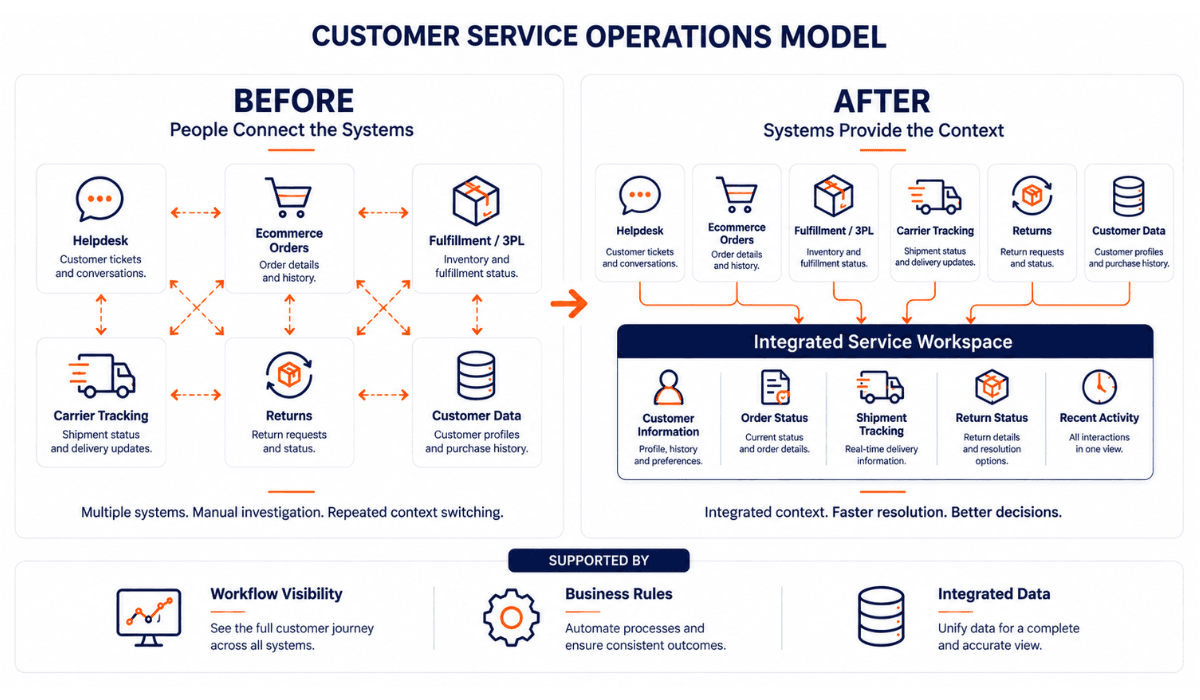
The answer did not live in one place. It was assembled by the customer-service agent.
The Existing Workflow
A typical interaction could look like this:
Customer Message → Helpdesk → Agent identifies customer → Ecommerce Platform → Check order → Fulfillment / 3PL → Check warehouse status → Carrier → Check tracking → Return to helpdesk → Interpret information → Write response → Update ticket.
For another request such as a return, the workflow changed again:
Customer → Helpdesk → Order lookup → Check return eligibility → Returns platform → Create authorization → Generate label → Customer receives instructions.
And for a refund:
Customer → Helpdesk → Find return → Verify warehouse receipt → Check inspection/status → Check payment/order → Initiate or investigate refund → Update customer.
The support team was not simply answering questions. It was manually orchestrating ecommerce operations one customer conversation at a time.
What the Operational Review Found
The review identified five problems.
1. Information existed, but context did not
The company already had much of the data agents needed.
The problem was fragmentation.
Customer information lived in the helpdesk and ecommerce environment.
Order information lived in commerce.
Fulfillment information came from the 3PL.
Shipping status came from carrier systems.
Returns had another workflow.
Policies lived in documentation.
Some exceptions depended on employee knowledge.
No single system understood the entire customer situation.
The business therefore did not primarily have an information problem.
It had a context assembly problem.
2. The team was performing work that software could perform safely
Experienced agents had developed an informal operating procedure.
For example:
If an order hasn't shipped, check when it was created.
Then check fulfillment.
If fulfillment has not started, determine whether the requested change is still possible.
If fulfillment has started, follow another path.
The procedure existed.
But it existed largely in:
- training
- documentation
- macros
- employee experience
- repeated manual behavior
Software was not executing the workflow.
People were.
3. The existing automation could answer but not resolve
Basic automation could respond to simple questions.
But there was an important difference between:
answering
and
resolving.
A chatbot might tell a customer:
“You can return eligible products within the return window.”
A resolution system needs to determine:
- who the customer is
- which product was purchased
- when it was delivered
- whether the SKU qualifies
- whether the order has already been refunded
- whether the return window is still open
- which return method applies
- which warehouse should receive it
and then perform the allowed action.
That required more than conversational AI.
It required operational integration.
4. Business rules were not formalized enough for automation
Before AI could take action, rules that humans understood informally had to become explicit.
Examples included:
- When can an address be changed?
- When can an order be cancelled?
- When can a refund be issued automatically?
- When does a return require manual review?
- When should a lost shipment trigger replacement?
- When should an AI interaction immediately escalate to a person?
Without defined rules, adding AI would have automated ambiguity.
5. The business measured tickets but not enough of the work behind them
Ticket volume showed that support was busy.
It did not show why.
We needed visibility into:
- contact reason
- number of systems accessed
- manual handling time
- repeat contacts
- escalation
- first-contact resolution
- exception rate
- percentage of work that was rule-based
- percentage requiring human judgment
That changed the question.
Instead of asking:
“How many tickets can AI answer?”
we asked:
“Which customer requests can the operation safely resolve without requiring a person to assemble information manually?”
We Did Not Recommend Replacing the Existing Stack
The operational review did not conclude that the business needed:
- a new ecommerce platform
- a new CRM
- a new helpdesk
- a new ERP
- an entirely new returns platform
Those systems were generally doing their respective jobs.
Replacing them would have added cost, migration risk, retraining, and disruption without addressing the root cause.
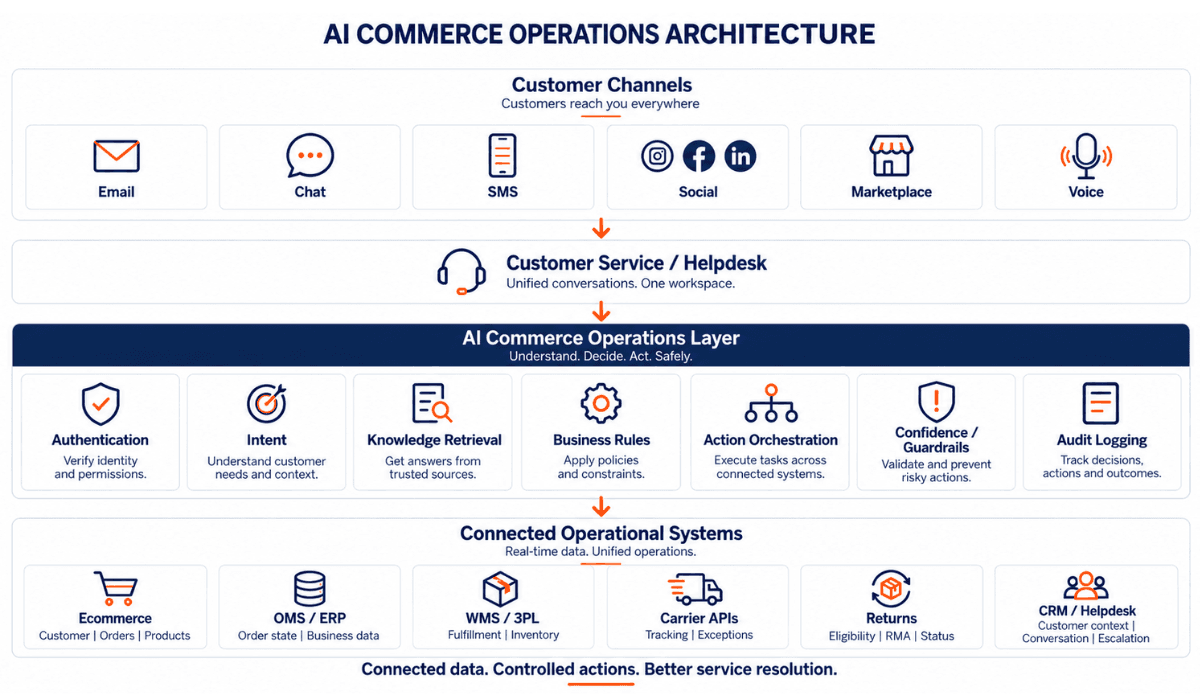
Instead, we recommended creating a controlled operational layer between customer conversations and the systems required to resolve them.
The technology recommendation followed the diagnosis.
Not the other way around.
What We Designed
The solution was designed around one principle:
AI should not be given unrestricted access to the business. It should receive only the context and actions required for a specific customer request, with defined business rules controlling what it can and cannot do. The architecture therefore had several layers.
Layer 1 - Customer Identity
Before accessing order or account information, the system needed confidence that it knew who it was helping. Identity checks were designed around the channel and action being requested. Higher-risk actions required stronger verification.
Layer 2 - Intent Detection
Incoming conversations were classified into operational intents such as: ORDER_STATUS DELIVERY_DELAY CHANGE_ADDRESS CANCEL_ORDER RETURN_REQUEST EXCHANGE_REQUEST REFUND_STATUS LOST_SHIPMENT PRODUCT_AVAILABILITY PRODUCT_QUESTION ESCALATE Intent classification determined which data and actions were available.
Layer 3 - Operational Context
The system assembled only the information needed for the request. For order tracking: Order → Fulfillment status → Shipment → Tracking. For a return: Customer → Order → Order line → Delivery date → Return policy → Previous return/refund activity. For an exchange: Product → Inventory → Return eligibility → Replacement availability. This became the foundation for accurate responses.
Layer 4 - Knowledge Retrieval
Policies, product information, shipping rules, return requirements, sizing guidance, and customer-service procedures were converted into a controlled knowledge layer. The AI could retrieve relevant information rather than depend purely on model memory. That reduced the risk of invented policies or unsupported answers.
Layer 5 - Controlled Actions
The most important part of the project was not generating better responses. It was enabling controlled actions. Depending on the verified customer, request, business rule, and risk level, the system could be permitted to: retrieve an orderretrieve shipment statusretrieve inventorycheck return eligibilityinitiate a returngenerate return instructionsgenerate a labelcheck refund statusupdate approved order informationcreate an escalationcreate or update the support case Actions requiring financial discretion, unusual policy exceptions, fraud judgment, high-value adjustments, or insufficient confidence remained human-controlled.
We Built the Workflow Around Resolution, Not Conversation
Consider the earlier customer:
“My order hasn't shipped and I'm travelling Friday. Can you tell me what's happening?”
Before: Agent opens ticket → Agent searches order → Agent checks fulfillment → Agent checks tracking → Agent interprets delay → Agent decides what can be done → Agent responds.
After implementation: Customer identified → Order retrieved → Fulfillment retrieved → Shipment checked → No carrier scan identified → Business rule evaluated → Valid options identified → Customer receives resolution → Interaction recorded.
If the situation fell outside approved rules, the system did something equally important:
it stopped.
The interaction was transferred to a person with the context already assembled.
The agent did not need to restart the investigation.
How We Implemented It
The implementation was deliberately phased.
Phase 1 - Establish the Baseline
Before automation, we classified existing customer conversations by:
- intent
- frequency
- complexity
- systems required
- handling time
- business risk
- automation suitability
This prevented the team from automating low-value requests simply because they were easy.
Phase 2 - Fix the Underlying Workflows
We documented and standardized:
- order-status logic
- cancellation rules
- address-change rules
- return eligibility
- exchange rules
- lost-shipment handling
- refund escalation
- human-approval thresholds
Some improvements required no AI at all. They were workflow improvements. Those were implemented first.
Phase 3 - Connect the Required Systems
We built the integration layer needed to retrieve operational context securely. Connections were implemented around specific use cases rather than creating broad, unnecessary access to every system.
Logging and error handling were included so a failed integration did not silently produce an incorrect customer response.
Phase 4 - Deploy Read-Only AI First
The first production workflows focused on retrieving and explaining information.
For example:
- order status
- shipment status
- policy questions
- product questions
- refund status
This allowed the team to test:
accuracy, tone, retrieval, confidence, escalation, latency, and customer response.
Phase 5 - Introduce Controlled Actions
After the read-only workflows were stable, action-based use cases were enabled gradually.
Higher-volume, lower-risk workflows were prioritized.
Each action included: Validation → Business-rule check → Permission check → Execution → Confirmation → Audit log.
Phase 6 - Measure and Expand
Automation was not treated as “finished” after launch.
We reviewed:
- unresolved intents
- unnecessary escalations
- incorrect classifications
- policy gaps
- repeated contacts
- new customer behaviors
- failure conditions
The operating model was then refined.
What Changed in the First Month
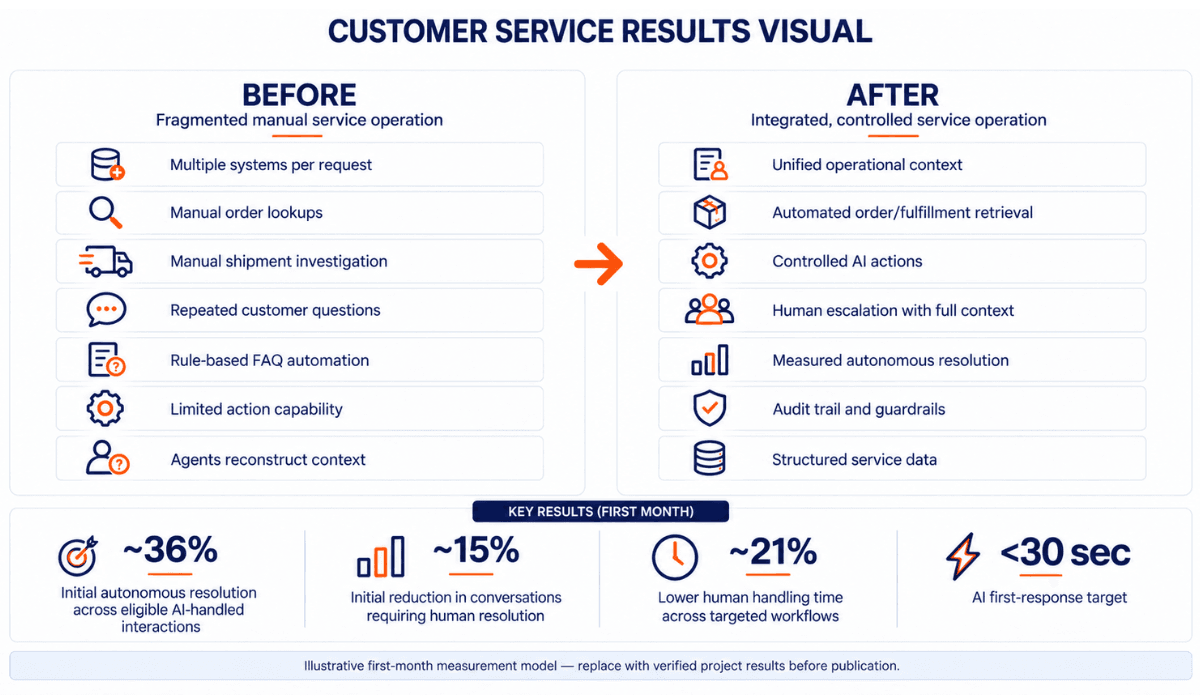
Draft measurement model these figures are illustrative and must be replaced with verified client data before this is published as a completed Gyan engagement.
For the composite scenario, assume an operation processing approximately 14,000 customer conversations per month before implementation.
The first production release intentionally covered only a limited set of high-volume post-purchase intents rather than attempting to automate everything.
First 30 Days
14,200
customer conversations in the measurement period
5,900
conversations fell within the initial AI-enabled intent set
2,100+
were resolved end-to-end without requiring a human response
~36%
autonomous resolution among eligible AI-handled conversations
~15%
reduction in total conversations requiring human resolution during the first month
Under 30 seconds
typical first response for AI-handled workflows
~21%
reduction in average human handling time for the remaining supported post-purchase cases because order, fulfillment, and customer context was already assembled
5 core workflows
moved into controlled production automation during the initial release. The goal of the first month was not maximum automation. It was proving that the system could resolve defined requests accurately, safely, and consistently.
Why We Would Not Target 80–90% Automation
Customer support includes ambiguity. A damaged order involving a high-value customer is different from a simple tracking request. A suspected fraud case is different from a standard return.
A customer threatening a chargeback requires different judgment than a customer asking when their package will arrive. Pushing every interaction through AI would have increased risk. Instead, we established three categories.
Automate
High-confidence, repeatable, low-risk.
Assist
AI retrieves context and prepares the next action, but a person approves or communicates it.
Human
Complex, emotional, financially sensitive, unusual, or policy-exception cases.
That operating model mattered more than chasing a headline automation number.
Gorgias' 2026 production research provides useful external context: its median brand resolves about 45% of AI-touched support tickets without human handoff, while the top quartile reaches approximately 65%. Those benchmarks make gradual improvement toward higher autonomous resolution a more defensible goal than assuming near-total automation from launch.
Next-Stage Opportunity
With the initial workflows established, the next opportunity was to expand automation carefully into additional areas such as:
- returns and exchanges
- lost-shipment investigation
- approved order modifications
- replacement workflows
- proactive shipment communication
- deeper product assistance
The same operational layer could also support agent assistance, returns intelligence, customer insights, conversational commerce, and operational reporting.
Expansion would continue only where accuracy, policy compliance, customer experience, and escalation quality remained within acceptable thresholds. The goal was not to automate more for the sake of automation.
It was to extend the operating model wherever automation could safely remove repetitive work and improve the customer experience.
The Outcome Was a More Scalable Service Operation
The engagement changed how the company approached customer service.
Instead of requiring agents to manually reconstruct order, fulfillment, shipping, return, and customer context for routine requests, the operation could assemble that information automatically and apply defined business rules to determine the next step.
Routine, lower-risk requests gained a controlled path to resolution.
Complex, sensitive, or unusual cases remained with human agents but those agents received the operational context needed to act without restarting the investigation.
The result was not simply faster customer responses.
It was a service operation better equipped to scale as ecommerce volume and complexity increased.
What This Engagement Changed
Before
- Customer contacts increased alongside order volume.
- Agents moved between multiple systems to resolve routine requests.
- Operational context had to be assembled manually.
- Business rules depended partly on documentation and employee knowledge.
- Existing automation could answer questions but had limited ability to resolve them.
- Escalations often reached agents without complete context.
- Leadership could see ticket volume but had limited visibility into what was creating the work.
After
- Customer requests were classified by operational intent.
- Relevant order, fulfillment, shipment, return, and customer data could be assembled automatically.
- Business rules defined which actions could be automated, assisted, or escalated.
- AI could support controlled resolution rather than simply generate responses.
- Human agents received escalations with the investigation already completed.
- Performance could be measured against resolution, handling time, escalation quality, risk, and customer outcomes.
- The underlying architecture could expand as new workflows and operational needs emerged.
The Larger Lesson
At first, the business appeared to have a customer-service capacity problem. The operational review revealed something deeper:
customer-service agents had become the manual connection between ecommerce systems. That changed the order of the solution. First, understand the workflow.
Then define the rules. Then connect the required data. Then automate the work that is predictable and safe. And use AI only where it improves the operation.
That sequence turned a potential chatbot project into a broader ecommerce operations improvement initiative.
Technology Followed the Operational Requirement
Gyan Solutions works with ecommerce companies where growth has created increasing complexity across orders, inventory, fulfillment, customer service, returns, systems, and reporting.
We begin by understanding where the operation is actually breaking. Sometimes the answer is clearer ownership, better workflows, stronger business rules, or improved use of existing systems.
When the root cause requires integration, automation, custom software, data infrastructure, or AI, the technology is implemented around that operational requirement. Request a Free 30-Minute Operations Fit Call - Start with the problem.
Then determine what actually needs to change.
Client name withheld in accordance with the confidentiality terms of the signed engagement agreement.