



Executive Summary
A North America-based footwear and apparel retailer outgrew its content workflows on Shopify. Our team implemented Sanity CMS to remove publishing bottlenecks and speed up launches.
Launches moved from taking days to roughly twenty minutes, per Sanity’s published customer story. Reported development speed improved fivefold, and routine content updates generated zero developer tickets. Shopify continued to run commerce, while Sanity handled content and merchandising.
Project Requirements
The retailer needed content workflows that could support faster product launches and growing business demands. Although Shopify handled commerce, existing content processes slowed publishing and merchandising.
The project focused on improving content management, automating product data workflows, and giving merchandising teams more control without replacing Shopify.
Background
The client was a North America-based e-commerce brand selling footwear, apparel, and accessories. As its online business grew, managing product information and website content became harder.
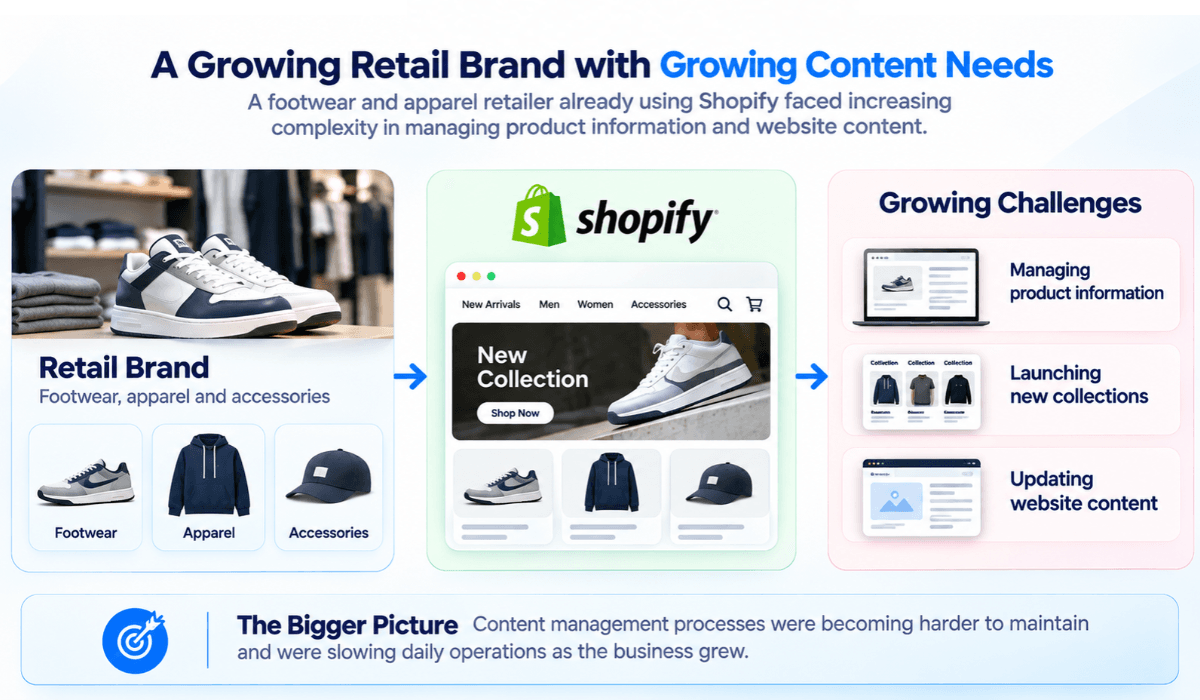
The company already used Shopify to sell its products to customers online. Managing product information, launching collections, and updating website content had become increasingly difficult for teams. Content management processes were slowing daily operations across the entire business.
Why the company sought outside help
The company needed more than a basic, standalone content management system. It wanted a structured platform to automate product information and give merchandisers greater control.
Even small content changes needed developers, because content was hardcoded into the Shopify theme. Product data also moved from NetSuite into Shopify through manual spreadsheets. These dependencies slowed teams and led the company to seek a more structured content platform.
Initial Observations
Shopify supported online sales, but the content workflows around the store created clear limits. Publishing new products took days, which held back launches of new products.
Marketing and merchandising teams could not easily preview or schedule content updates. They depended on developers and spreadsheets for routine publishing and product updates. Together, these gaps showed the business could sell products but could not move content quickly.
Key Findings
The core problem was that content workflows could not support the speed and scale needed. Shopify handled commerce, but content processes limited how quickly teams could work.
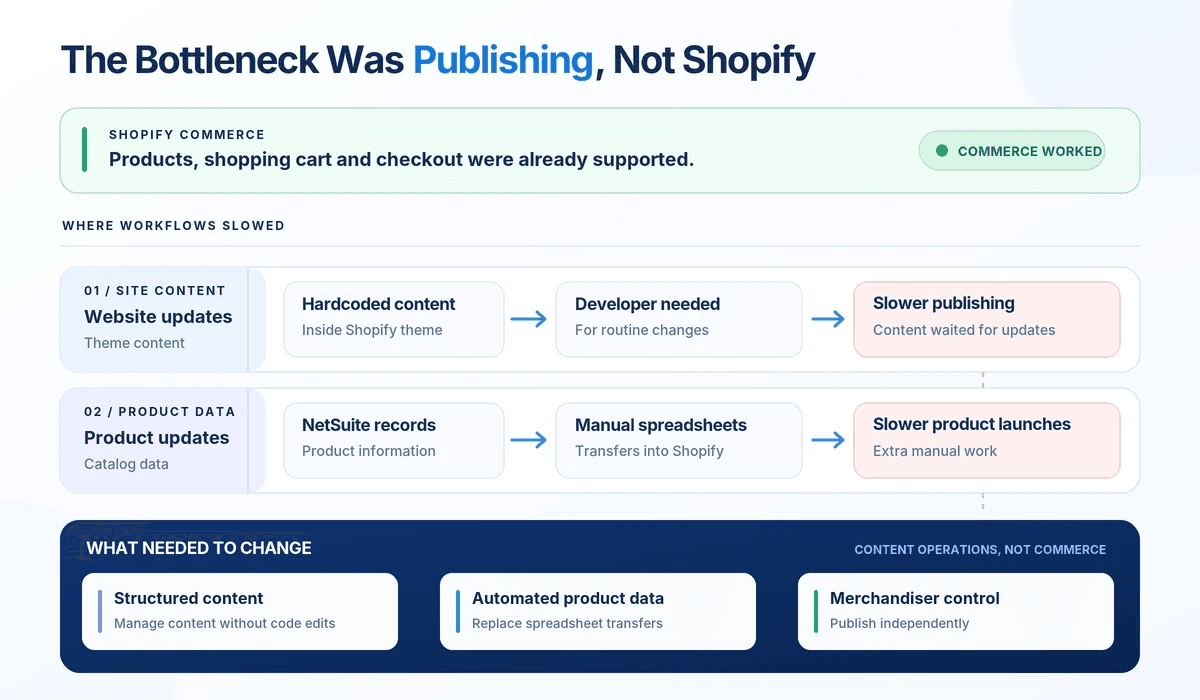
Hardcoded theme content tied even simple website changes to developer work. Manual spreadsheet transfers between NetSuite and Shopify added extra work to product updates. The business needed structured content, automated product data, and tools that let merchandisers publish independently.
Decisions & Solution
The company chose Sanity as its structured content platform for the storefront. Sanity offered customizable content schemas, reusable website components, live previews, scheduled publishing, and API integrations.
Shopify and Hydrogen continued to support the company’s commerce operations and its headless storefront. Sanity Studio gave merchandising teams a place to edit, preview, and publish content independently. A NetSuite integration automated product data flowing through Sanity into Shopify.
Implementation
Our team rebuilt the e-commerce content architecture around Sanity CMS and Shopify. Sanity was used to manage structured product content, campaigns, and reusable storefront components.
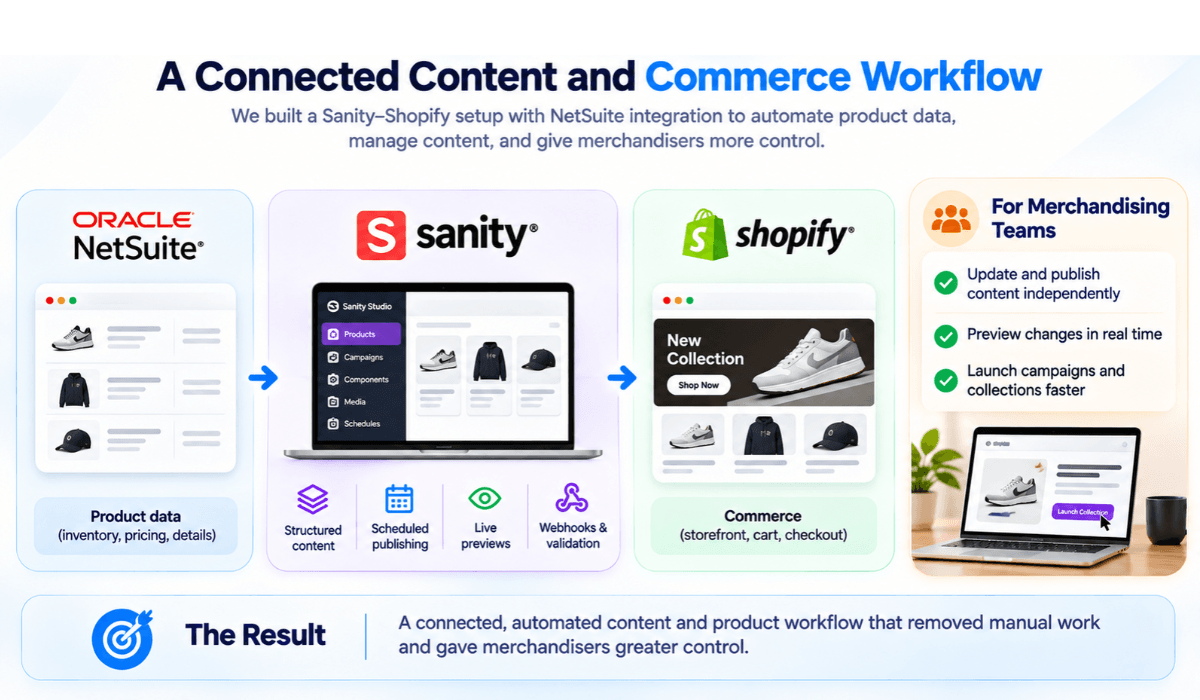
The implementation also introduced validation rules, webhooks, and custom product workflows. Product data from NetSuite flowed through Sanity into Shopify, replacing manual spreadsheet transfers. Merchandising teams gained live previews, scheduled publishing, and more control over everyday content work.
Impact
The Sanity CMS implementation accelerated product launches, reduced manual work, and improved developer and merchandising efficiency.
- 20-minute product launches: Reduced publishing time from days to minutes.
- 144× faster launches: Eliminated manual publishing bottlenecks.
- 5× developer velocity: Accelerated development and reduced repetitive tasks.
- 10,000 SKUs in 30 seconds: Enabled rapid bulk updates during Black Friday.
- Zero developer tickets: Empowered merchandisers to manage content independently.
With Sanity CMS, Shopify, and NetSuite automation, the retailer achieved faster publishing, streamlined workflows, and greater merchandising independence.
Why This Worked
The approach addressed the content operations problem without replacing the existing commerce platform. Shopify continued to run the commerce experience while Sanity handled content and merchandising.
Structured content, automation, and preview tools targeted the publishing bottlenecks the company faced. Giving merchandisers direct control reduced their reliance on developers for routine updates. Growing Shopify businesses may need better content operations, not a replacement commerce platform.