


Quick Summary
Strapi is better suited to teams that want more control over hosting, backend customization and development. Contentful is a better fit for companies that prefer a managed SaaS platform with stronger built-in editorial and enterprise tools.
Strapi and Contentful may look similar on the surface. Both let you manage content once and use it across websites, apps and other digital channels. But once you start building, the experience is very different.
With Strapi, your developers have much more control. You can host it yourself, choose the database, change backend logic and build around your own systems. Contentful takes the opposite approach. It manages the platform for you, while your team works within its APIs, apps and extension framework.
From our experience building and evaluating headless systems, that difference matters more than most feature comparisons. It eventually affects cost, flexibility, maintenance, development effort and how much control your team actually wants to own.
Strapi vs Contentful at a glance
Strapi generally has a lower entry cost than Contentful, especially for teams that can self-host. But the more important comparison is total cost of ownership, including hosting, maintenance, developer time, upgrades and the amount of infrastructure your team wants to manage.
The biggest difference is control
The main difference between Strapi and Contentful is how much control your team wants.Strapi lets developers self-host, choose the database and infrastructure, and customize backend logic. Contentful is more managed, with your team working inside its platform and APIs.
A frontend developer on LinkedIn who had deployed Strapi said it gives teams more backend and infrastructure control, while Contentful is easier when a client wants a managed platform.
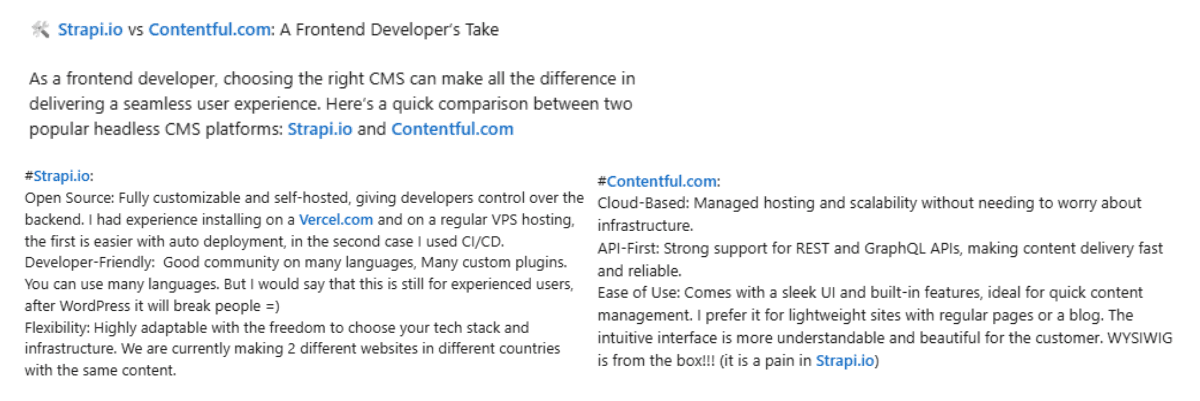
Source: Teo Vlasov’s Strapi vs Contentful comparison on LinkedIn
A Reddit developer made a similar point after realizing Strapi Cloud still required their team to maintain and deploy a Strapi codebase.
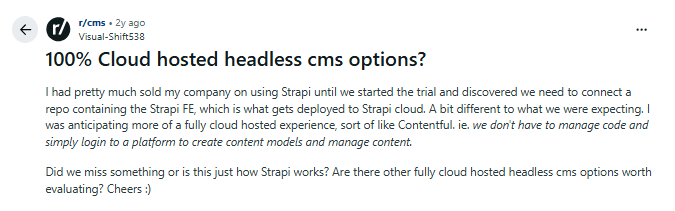
Source: r/cms discussion on cloud-hosted headless CMS options
Strapi gives you more control, but more responsibility. Contentful manages more for you, but with less control.
Migrating from Contentful to Strapi for cost and control
One useful example is hochzeitsplaza.de. In a case study about its move from Contentful to Strapi, the team explains that it had used Contentful for years before switching in 2025. The main reasons were lower costs, more control and less dependence on a proprietary platform.
What makes the example useful is that Contentful had worked well for the team. The decision changed when the economics and level of control no longer matched what the business wanted.
But companies also move toward Contentful for the opposite reason
A Contentful case study on a company shows the other side of the decision. It moved more than 800 pages onto Contentful while consolidating several legacy systems. The company expected the move to save about $42, 000 a year in hosting costs alone.
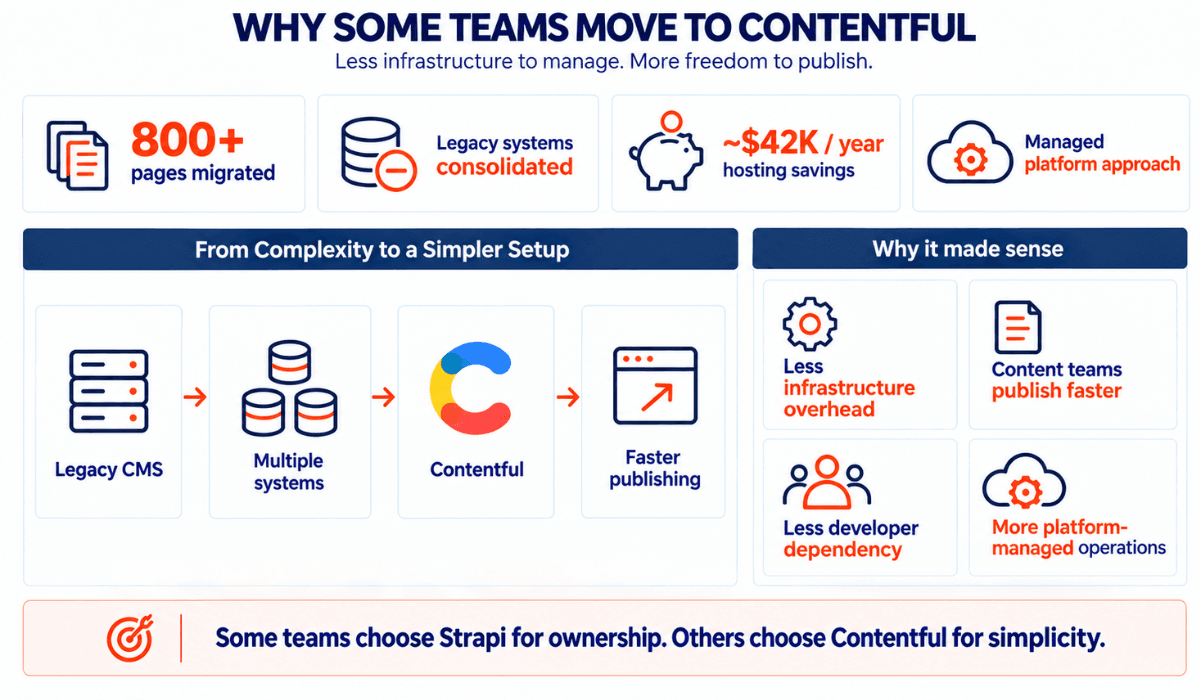
The value was not more control. It was having less infrastructure to manage, while giving content teams more freedom to publish without relying on developers.
That is why both choices can make sense. Some companies move to Strapi for more ownership and flexibility. Others move to Contentful because they want more of the platform managed for them.
Is Strapi actually cheaper than Contentful?
Strapi can be cheaper, especially because you do not have to use Strapi Cloud. The Community edition can run on your own cloud, VPS or existing infrastructure. If you use Strapi Cloud, costs can rise with more environments, higher usage and premium CMS features. Contentful starts at a higher platform price, but more of the infrastructure management is included.
The better question is which features you need, where you want to host them and how much of the platform you want to manage yourself.
Contentful is stronger when the editorial team is the priority
Contentful offers useful editorial tools such as scheduled publishing, collaboration, localization and Live Preview. That can reduce how often marketers and editors need developer help.But those benefits scale with the plan. The Lite plan is limited to 20 users, 3 roles and 3 locales, while larger teams that need custom roles, more users, broader governance or team management generally move into Premium or Enterprise pricing.
So Contentful's advantage is not simply that it is better for large teams. It is that it offers a more managed editorial environment if the business is willing to pay for the level of governance and scale it needs.
Strapi is stronger when the CMS becomes part of the application
Strapi becomes more attractive when the CMS needs to connect deeply with other systems. Teams building around more complex requirements often need more control over how Strapi is configured and extended, especially when content has to connect with Shopify, an ERP, a PIM, inventory software or internal applications.
The trade-off is simple: Contentful manages more of the platform for you. Strapi gives you more control, but also more responsibility.
Strapi vs Contentful: which should you choose?
For most companies, the decision comes down to four things:
- Control: Strapi gives you more ownership of the backend, hosting and customization.
- Editorial needs: Contentful is often a better fit when large marketing or content teams are the main users.
- Maintenance: Self-hosted Strapi requires more technical ownership, while Contentful manages more of the platform for you.
- Total cost: Compare hosting, developer time, maintenance, licences and support not just the monthly CMS price.
There is no universal winner. A company building a highly customized application may prefer Strapi, while a larger content organization may value Contentful's managed environment more.
The real question is not simply “Which CMS is better?” It is where you want the complexity to live. That decision usually becomes clearer when you look at how the CMS fits into the wider content architecture, including frontends, integrations, publishing workflows and the systems around it.
SUKHPREET SINGH
I'm Sukhpreet Singh, Director of Innovation & Technology at Gyan Solutions. With 8+ years in generative AI and ERP integration, I build AI-powered decision-support systems that adapt to real operational complexity without replacing existing infrastructure.





