

HEADLESS CMS DEVELOPMENT
Headless CMS Development Built Around Flexible Content Operations
Gyan Solutions designs, builds, integrates, and modernizes headless content platforms for organizations that need structured content delivered across websites, ecommerce, portals, mobile applications, and other digital experiences.
We define the content architecture, publishing workflow, system ownership, APIs, frontend requirements, and integrations before deciding how the headless CMS environment should be built.
Choose the path that fits your current need for architecture clarity or defined implementation.
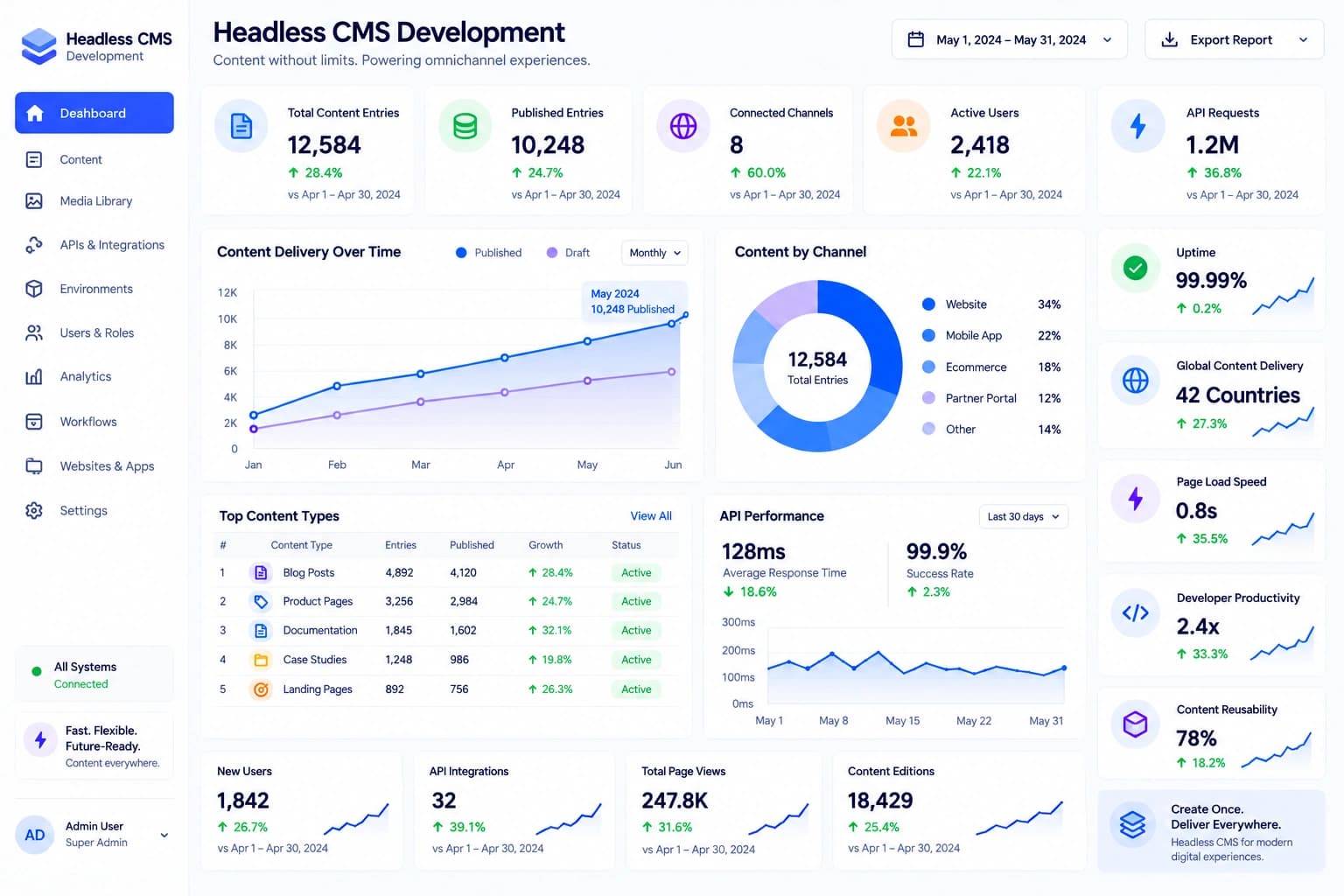
Design and configure the CMS around content models, reusable structures, users, permissions, workflows, and digital channels.
Connect structured content with Next.js, React, ecommerce storefronts, portals, mobile applications, and other frontend experiences.
Connect the content layer with ecommerce, PIM, DAM, CRM, ERP, search, authentication, databases, and other business systems.
Move legacy or tightly coupled CMS environments toward more flexible content architectures without carrying unnecessary complexity forward.
Headless CMS Problems Usually Begin With the
Architecture—not the CMS
Separating content from the frontend can create flexibility. It can also create unnecessary complexity when content ownership, structure, integrations, publishing workflows, and application responsibilities are not clearly defined.
Content Models Follow Individual Pages
Fields and structures are created around one website layout instead of reusable information the organization can manage across channels.
Editors Become Too Dependent on Developers
Routine content changes require technical support because preview, publishing, components, or editorial workflows do not match how the content team works.
The Same Information Exists in Several Systems
Products, locations, people, documents, pricing, or other data is copied into the CMS even though another platform already owns it.
Every Frontend Handles Content Differently
Websites, applications, ecommerce storefronts, and portals implement their own content logic instead of using a consistent content model.
Publishing Becomes Operationally Difficult
Drafting, review, approval, localization, scheduling, and governance happen outside the CMS because the implementation does not support the actual workflow.
Headless Architecture Adds Complexity Without Clear Value
The organization adopts headless technology without a meaningful need for multi-channel content, frontend flexibility, structured information, or application integration.
Technical Clarity
Not sure whether you need a headless CMS, a better implementation of your existing CMS, or a broader digital-platform modernization?
Headless CMS Should Separate Responsibilities—not Scatter Them
Headless architecture works best when each system has a clear role.
The CMS may own editorial content. The ecommerce platform may own products, pricing, inventory, customers, and orders. The PIM may own product information. The CRM may own customer relationships.
The application frontend should consume the information it needs without forcing every system to become a copy of every other system.
That is why Gyan starts with content and system ownership before choosing the technical architecture.
Key Insight
Decouple the presentation layer without losing clarity over where content and business information belong.
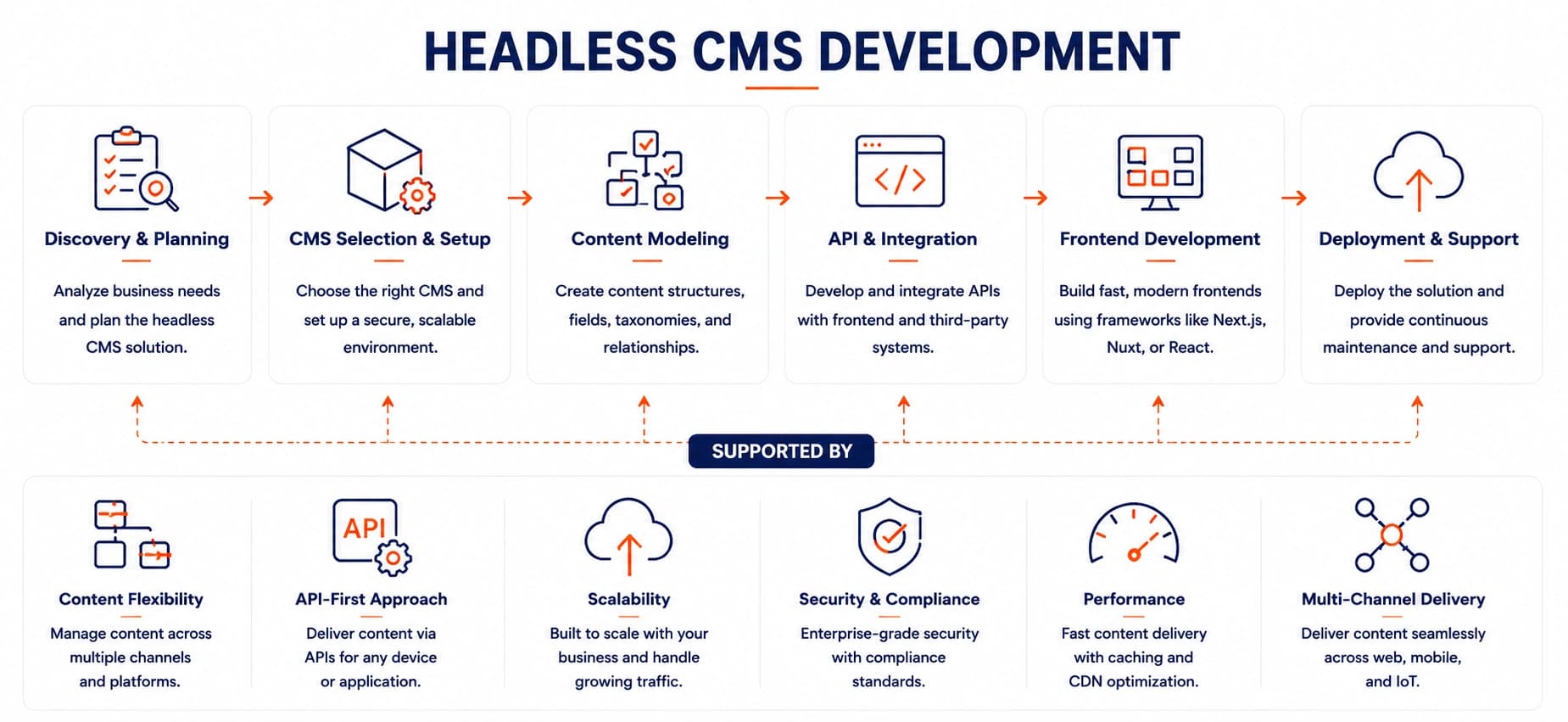
Content & Business Systems → APIs / Content Layer → Web / Commerce / Portal / Mobile → Users
Two Focused Ways to Improve a Headless Content Environment
Some organizations know their current CMS is limiting flexibility but are not yet certain whether headless architecture is the right answer. Others already have a defined headless CMS requirement and need implementation.
Operational Review & Improvement
For organizations that need clarity across content structure, publishing workflows, digital channels, system ownership, governance, and integration before selecting or redesigning a CMS architecture.
 Map how content is created, reviewed, approved, published, reused, and maintained across teams and digital experiences.
- Identify duplicate information, editorial friction, unclear ownership, frontend dependency, and disconnected systems.
- Define what the CMS should own, what should remain in other platforms, and whether a headless architecture provides meaningful operational value.

Operational Review & Improvement can stand alone from assessment and architecture definition through prioritized content-operation improvements.
Technology & AI Implementation
For organizations with a defined need for headless CMS implementation, custom development, frontend integration, migration, APIs, or systems integration.
- Turn the requirement into a practical content, application, and technical architecture.
- Build content models, APIs, frontend connections, permissions, integrations, workflows, and supporting functionality.
- Migrate, test, deploy, and support the agreed headless CMS environment.
Technology & AI Implementation can begin independently when the requirement is already clear.
Headless CMS
Development Experience
Our approach to headless CMS development is shaped by how content needs to move between editors, websites, applications, commerce platforms, portals, mobile experiences, and business systems.
We examine content architecture, frontend applications, source systems, APIs, permissions, publishing workflows, localization, hosting, integrations, and operational ownership.
This helps determine where headless architecture creates useful flexibility and where additional technology would simply introduce unnecessary complexity.
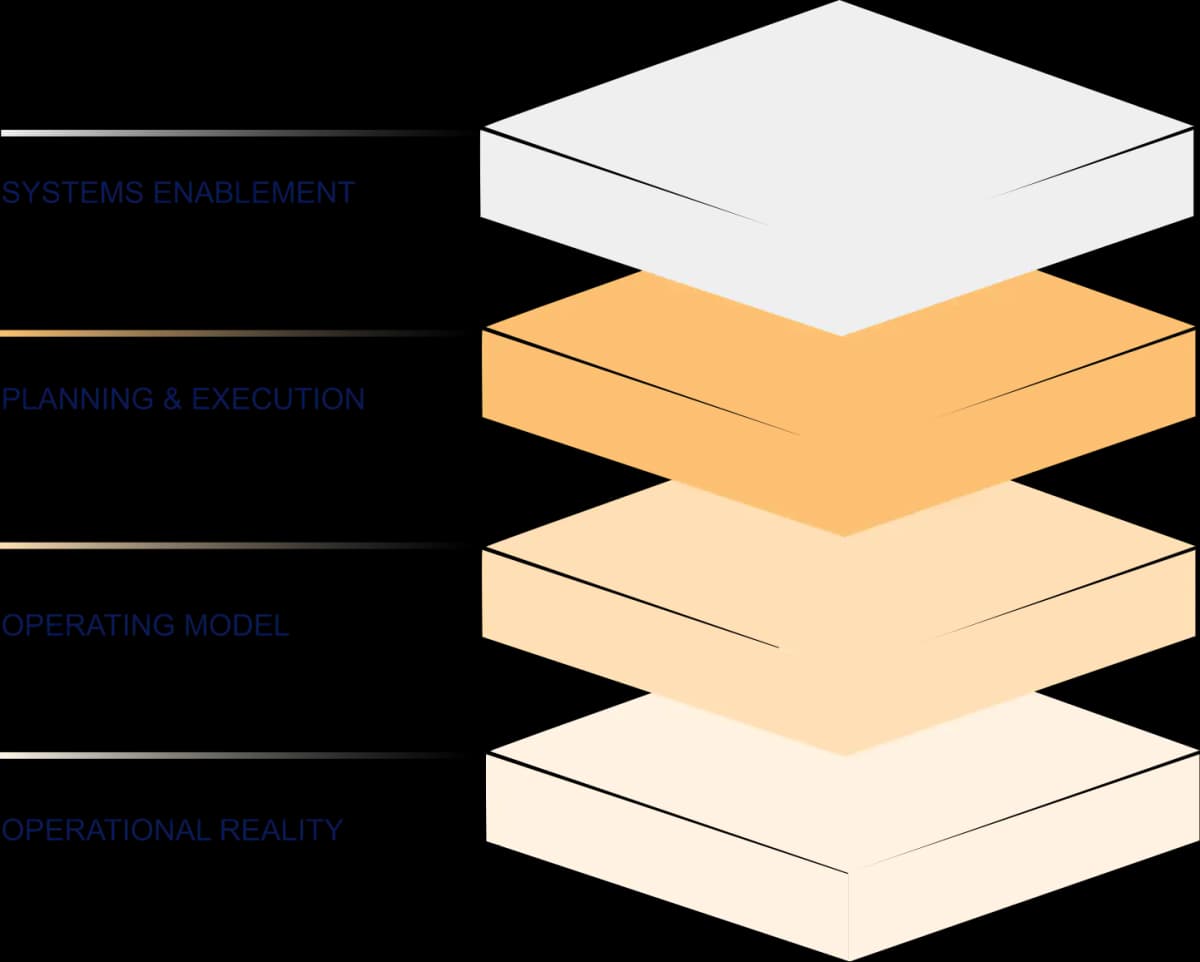
Where Headless CMS Architecture Becomes Connected
Content Architecture
Headless CMS implementation begins with the structure of the information—not the design of individual pages. Content types, components, relationships, taxonomies, and reusable fields should describe the information the organization manages.
What We Examine
- Content types
- Reusable components
- Structured fields
- Relationships
- Categories and taxonomies
- Metadata
- Media
- Content ownership
- Reuse requirements
- Application requirements
- Future channels
- Governance
Desired Outcome
Create a content model that remains reusable and understandable as websites, applications, teams, and content requirements grow.
Multi-Channel Publishing
One of the strongest reasons to use headless architecture is the ability to manage structured content once and use it across multiple digital experiences. That does not mean every piece of content should automatically appear everywhere.
What We Examine
- Websites
- Ecommerce storefronts
- Customer portals
- Employee portals
- Mobile applications
- Digital displays
- Channel-specific content
- Shared content
- Publishing rules
- Content variations
- API delivery
- Channel ownership
Desired Outcome
Reuse appropriate content across channels while preserving the differences required by each digital experience.
Frontend Applications
Headless CMS separates content management from the frontend application. That gives teams more flexibility over frontend technology but also makes integration, preview, performance, caching, and deployment more important.
What We Examine
- Next.js
- React
- Existing frontend frameworks
- Server-side rendering
- Static generation
- Dynamic rendering
- Routing
- Content retrieval
- Preview
- Caching
- SEO requirements
- Deployment architecture
Desired Outcome
Give digital applications reliable access to structured content without making routine content management dependent on frontend development.
Ecommerce & Content
Commerce experiences often require both transactional information and rich editorial content. The ecommerce platform does not necessarily need to become the editorial CMS, and the CMS should not unnecessarily become responsible for commerce transactions.
What We Examine
- Ecommerce platform
- Product information ownership
- Product-supporting content
- Category content
- Buying guides
- Landing pages
- Campaign content
- SEO content
- Storefront APIs
- Search
- Localization
- CMS-to-commerce relationships
- Content reuse
Desired Outcome
Combine flexible editorial content with commerce experiences while keeping transactional responsibilities inside the appropriate commerce systems.
APIs & Integrations
A headless CMS rarely operates alone. Content may need to interact with ecommerce, product systems, search, identity, CRM, DAM, translation, analytics, or custom applications.
What We Examine
- REST APIs
- GraphQL
- Webhooks
- Ecommerce integration
- PIM
- DAM
- CRM
- ERP
- Search
- Authentication
- Analytics
- Custom business systems
Desired Outcome
Connect the content layer with the wider technology environment while maintaining clear ownership of information.
Editorial Workflows
Headless architecture should improve flexibility without making content operations harder for the people managing them.
What We Examine
- Author roles
- Editor roles
- Review
- Approval
- Drafting
- Publishing
- Scheduling
- Preview
- Content ownership
- Regional responsibilities
- Permissions
- Governance
Desired Outcome
Give content teams a practical publishing workflow while maintaining appropriate control over what reaches each digital channel.
Localization & Multi-Site
Organizations managing multiple regions, languages, brands, or sites need to determine what content should be shared and what needs to vary.
What We Examine
- Languages
- Regions
- Brands
- Websites
- Shared content
- Local content
- Translation workflows
- Localization
- Regional permissions
- Content inheritance
- Market-specific metadata
- Publishing ownership
Desired Outcome
Reduce unnecessary content duplication while giving regions and brands the control required for their own digital experiences.
Migration & Modernization
Moving from a traditional CMS to headless architecture should not mean recreating every legacy structure inside a new platform. Migration creates an opportunity to simplify the content model and remove outdated dependencies.
What We Examine
- Existing CMS
- Content inventory
- Existing templates
- Legacy content structures
- Duplicate content
- Content mappings
- Media
- Metadata
- URLs
- Redirects
- Migration automation
- Validation
Desired Outcome
Move useful content into a cleaner architecture without carrying unnecessary legacy complexity into the new platform.
Implement the Headless Content Capability the Digital Platform Needs
Once the requirement is clear, Gyan can design, build, integrate, migrate, or improve the relevant content environment.
Headless CMS Architecture
Define content models, system ownership, APIs, users, workflows, digital channels, and integration boundaries.
Headless CMS Implementation
Configure and customize the selected CMS around the organization's content and application requirements.
Frontend Development
Build or connect Next.js, React, ecommerce, portal, mobile, and other frontend applications with the content layer.
CMS Integration
Connect content platforms with ecommerce, CRM, ERP, PIM, DAM, search, identity, databases, analytics, and custom applications.
CMS Migration
Move content from traditional or legacy CMS environments into a structured headless architecture.
Custom API & Backend Development
Build custom APIs, middleware, services, webhooks, and application logic where the standard CMS capabilities do not cover the requirement.
Already Know What Needs to Be Built?
Turn the headless CMS requirement into a practical implementation plan.
Choose the CMS After the Requirements Are Clear
Headless CMS platforms solve similar problems in different ways. The right choice depends on the content model, editor experience, customization requirements, hosting approach, technical ownership, integration needs, scale, and existing application environment.
Strapi
Open-source, API-driven CMS suited to organizations that want greater control over the backend environment and custom application development.
Contentful
Managed content platform suited to structured content and multi-channel digital experiences.
Sanity
Structured-content platform with flexible content modeling and customizable editorial experiences.
Storyblok
Headless CMS designed around structured content with visual editing capabilities.
Headless WordPress
Useful where organizations want to retain WordPress content management while separating it from the frontend experience.
Platform Principle
Choose the platform that fits the content and operating requirement—not the platform with the longest feature list.
AI Should Support Content Operations—not Replace Content Ownership
AI can assist with defined content workflows, but it still requires reliable source information, governance, permissions, and human review.
Content Classification
Assist with categorization, tagging, metadata, and structured content preparation.
Content Retrieval
Help users find approved information across structured CMS content and connected knowledge sources.
Content Operations Support
Assist editors with repetitive preparation, summaries, transformations, and defined workflow tasks.
Data Quality Support
Identify incomplete, inconsistent, or unusual content records for employee review.
Multi-Channel Adaptation
Assist with preparing approved source content for different channels while preserving required review and publishing controls.
Trust Statement
Before applying AI to content operations, Gyan defines the source content, approval workflow, permissions, publication boundaries, and human oversight required.
When a Headless CMS Fit Call Makes Sense
When You Need Architecture Clarity
- Your existing CMS is difficult to extend.
- Content needs to support several websites or applications.
- Frontend teams are constrained by the current CMS.
- Editors depend too heavily on developers.
- Content is duplicated across multiple systems.
- You are considering headless CMS but are not sure whether the additional architecture is justified.
- Multiple brands, regions, or channels need to reuse structured content.
When the Requirement Is Clear
- A new headless CMS needs to be implemented.
- The CMS needs to connect with Next.js or React.
- Content needs to support ecommerce and other applications.
- An existing CMS needs to be migrated.
- APIs or custom backend functionality are required.
- The CMS needs integration with PIM, DAM, CRM, ERP, search, or other systems.
- A multi-site or multi-channel content environment needs to be built.
A Clear Starting Point Without a Forced Sequence
Headless CMS Fit Call
We discuss the content, users, existing CMS, websites, applications, ecommerce environment, integrations, publishing workflows, and requirements already identified.
Engagement Scope
We define whether the work should focus on Operational Review & Improvement, Technology & AI Implementation, or both. The content architecture, CMS responsibilities, applications, APIs, integrations, migration requirements, users, priorities, and delivery approach are agreed before implementation begins.
Review, Build, or Both
We deliver the agreed work—from content architecture and CMS selection through implementation, frontend development, integrations, migration, testing, deployment, and rollout.
30-minute call
No obligation
Architecture and implementation scoped separately
Who This Is For
Headless CMS development is designed for organizations whose content needs extend beyond a simple website.
Typical Requirements
Multiple websites
Ecommerce storefronts
Customer portals
Employee portals
B2B applications
Mobile applications
Multi-language environments
Multiple brands or regions
Structured-content platforms
Organizations modernizing legacy CMS environments
Businesses delivering the same content across several digital channels
A Different Approach May Be Better If
You only need a small brochure website
Your current CMS already supports the required workflow effectively
Visual page-building is more important than structured content reuse
You have no meaningful multi-channel or application requirement
The organization does not have the technical ownership required for a headless environment
There is no operational or architectural reason to separate the CMS from the frontend
Build the Right Headless CMS Architecture
Clarify content, users, channels, workflows, systems, and future needs before defining the build.
Discuss Your Headless CMS Requirement→

30-minute call

No obligation

Consulting and implementation scoped separately
Find the Right Ecommerce Operational Starting Point
Headless architecture creates value when structured content supports a defined customer experience, commercial objective, and multi-channel requirement. Explore the business need or technology layer the content platform must serve.
Explore by Operational Focus
Ecommerce Customer Experience
Structure product, service, guidance, and supporting content around the information customers need throughout discovery, purchase, support, and repeat interactions.
Ecommerce Conversion & Revenue Performance
Identify whether content structure, product information, discovery, merchandising, or frontend experience is contributing to lost buying intent.
Ecommerce Growth Strategy
Connect content and digital experience requirements with acquisition, customer journeys, channels, retention, and the wider operating model supporting growth.
Ecommerce Analytics & Reporting
Define the performance evidence needed to understand how digital experiences contribute to customer, commercial, and wider ecommerce outcomes.
Explore by Technology & Integration
Strapi Development Services
Implement a Strapi-based content layer around structured models, APIs, permissions, publishing workflows, integrations, and frontend applications.
Ecommerce Mobile App Development
Reuse structured content across mobile shopping, account, service, and operational applications without creating a separate content environment for every channel.
Retail Software Development
Connect headless content with custom portals, applications, operational tools, and commerce experiences built around specialized business requirements.
ERP & Ecommerce Integration
Keep transactional and operational data in the systems responsible for it while allowing the content layer and commerce experience to use the information they require.
Common Questions
What is a headless CMS?
A headless CMS separates content management from the frontend presentation layer.Content is managed in the CMS and delivered through APIs to websites, ecommerce storefronts, mobile applications, portals, or other digital experiences.
What are headless CMS development services?
Headless CMS development can include content architecture, CMS implementation, customization, frontend development, APIs, systems integration, migration, publishing workflows, multi-site architecture, and ongoing improvement.
When should a business use a headless CMS?
Headless architecture can be useful when structured content needs to support multiple applications, channels, brands, regions, or frontend experiences.It may be unnecessary where a conventional CMS already supports the business requirement effectively.
Which headless CMS platforms can Gyan work with?
Depending on the requirement and existing technology environment, the architecture may use platforms such as Strapi, Contentful, Sanity, Storyblok, headless WordPress, or another appropriate headless CMS.
Can a headless CMS work with Next.js?
Yes.A headless CMS can supply structured content through APIs while Next.js handles the frontend application.
Can a headless CMS be used with ecommerce?
Yes.A headless CMS can manage editorial and structured content while an ecommerce platform remains responsible for products, pricing, customers, inventory, orders, payments, and other transactional functions as appropriate.
What is the difference between headless CMS and headless commerce?
A headless CMS separates content management from presentation.Headless commerce separates commerce functionality from the storefront presentation layer.The two architectures can be used together, but they solve different problems.
Can Gyan migrate an existing CMS to a headless platform?
Yes.Migration can include content inventory, architecture design, data mapping, migration automation, media transfer, metadata, redirects, validation, and coordination with the new frontend.
Can one headless CMS support multiple websites?
Yes, where the content architecture is designed appropriately.Shared content can be reused while site, brand, region, or channel-specific information remains separately controlled.
Can a headless CMS support mobile applications and portals?
Yes.The same content APIs can potentially support websites, mobile applications, portals, ecommerce experiences, and other authorized applications.
Do we need a separate Strapi page if Strapi is already mentioned here?
Yes.Headless CMS Development addresses the broader architecture, CMS selection, content-modeling, multi-channel, migration, and integration requirement.Strapi Development Services addresses organizations that already use Strapi or specifically want Strapi implementation, customization, integration, migration, or development.
Do we need an Operational Review before implementation?
No.If the CMS, content architecture, applications, integrations, users, and implementation requirements are already clearly defined, Gyan can move directly into Technology & AI Implementation.Operational Review & Improvement is useful when the appropriate architecture or platform still needs to be determined.
Discuss Your Headless CMS Requirement
Tell us what content, websites, ecommerce experiences, applications, users, publishing workflows, or business systems the content platform needs to support. We'll use the initial conversation to understand the architecture, current environment, content operations, integrations, and whether the appropriate starting point is architecture review, implementation, or a combination.
Focused on your goals
You decide the next step.
Consulting & implementation