

ECOMMERCE CUSTOMER EXPERIENCE
Improve the Customer Experience Across the Entire Ecommerce Journey
Customers experience one business. Behind that experience, product information, ecommerce platforms, inventory, payments, fulfillment, delivery, customer service, returns, CRM, and reporting may all operate separately.
Gyan Solutions reviews how those workflows connect from first interaction through purchase, fulfillment, support, return, and repeat business—then identifies the operational, system, and implementation improvements required to create a more consistent customer experience.
Review and implementation are scoped separately.
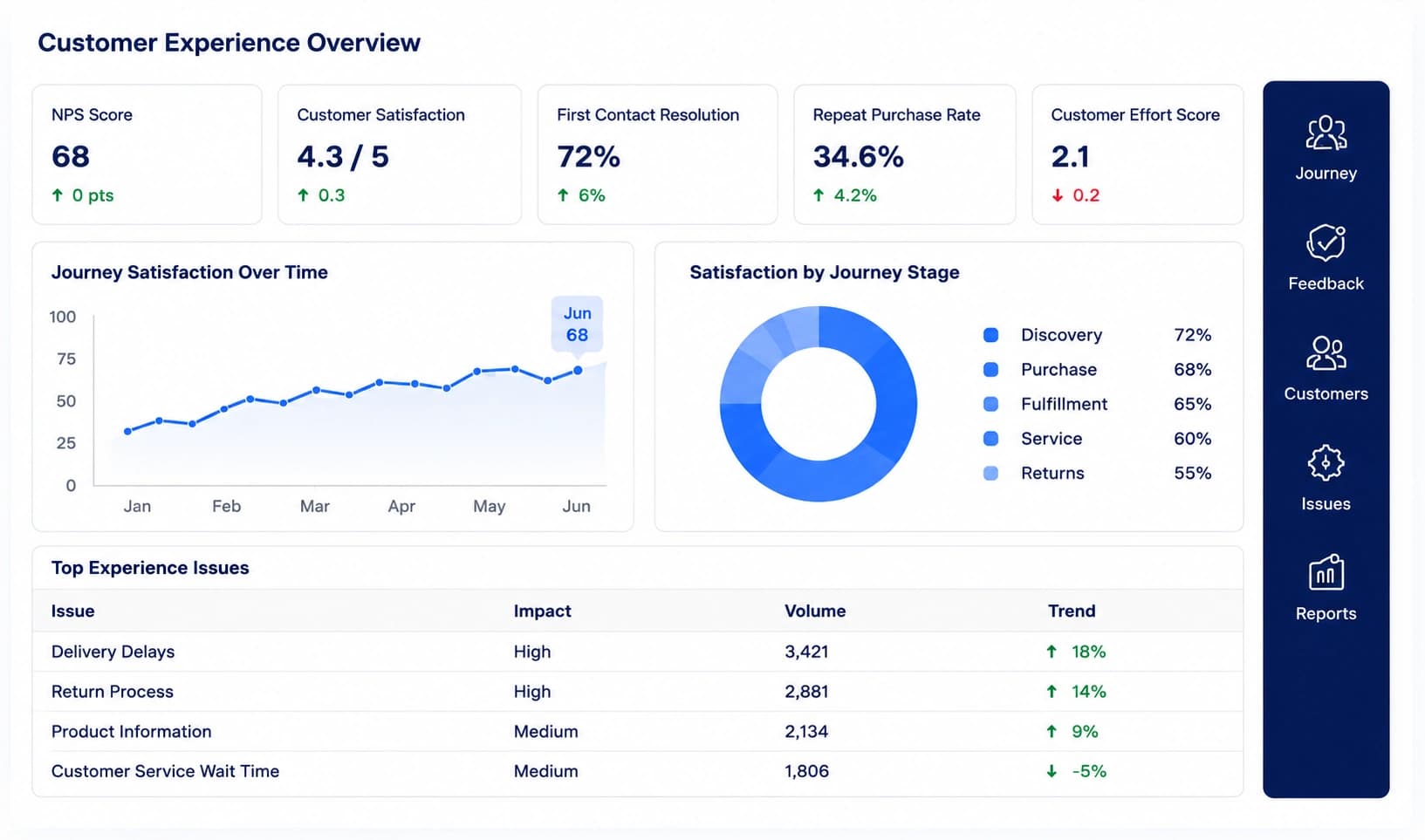
Customers cannot clearly see accurate order, delivery, return, or service status without contacting support.
Customer issues move between teams without shared context, clear ownership, or consistent resolution paths.
Customer, order, inventory, and service information differs across systems, creating conflicting answers for customers.
Simple customer requests require repeated contacts, manual coordination, or extra follow-up before reaching resolution.
Customer Experience Connected to the Operation Behind It
Full-Journey Review
We examine how customer interactions connect with orders, inventory, fulfillment, returns, support, systems, and reporting—not only what appears on the storefront.
Operational & Systems Perspective
Customer experience issues are reviewed across the workflows, teams, data, platforms, and handoffs responsible for delivering the experience.
Review Through Implementation
When improvement requires integration, automation, reporting, customer portals, CRM alignment, AI, or custom technology, Gyan can support implementation after the requirement is defined.
CONNECTED CUSTOMER EXPERIENCE
The Customer Sees One Journey. Your Operation Has to Deliver It.
Customers do not care which system owns the inventory record, which team controls fulfillment, or where a refund approval sits. They care whether the information is accurate, the order arrives as expected, and problems are resolved without unnecessary effort.
We follow those customer moments back into the operation across ecommerce, inventory, orders, fulfillment, service, returns, data, and ownership to identify where expectations and execution stop matching.
The goal is a customer experience that stays clear and consistent because the operation behind it works together.
Why This Matters
Better customer experiences are built through better operational execution not interface changes alone.
Where We Review the Ecommerce Customer Journey
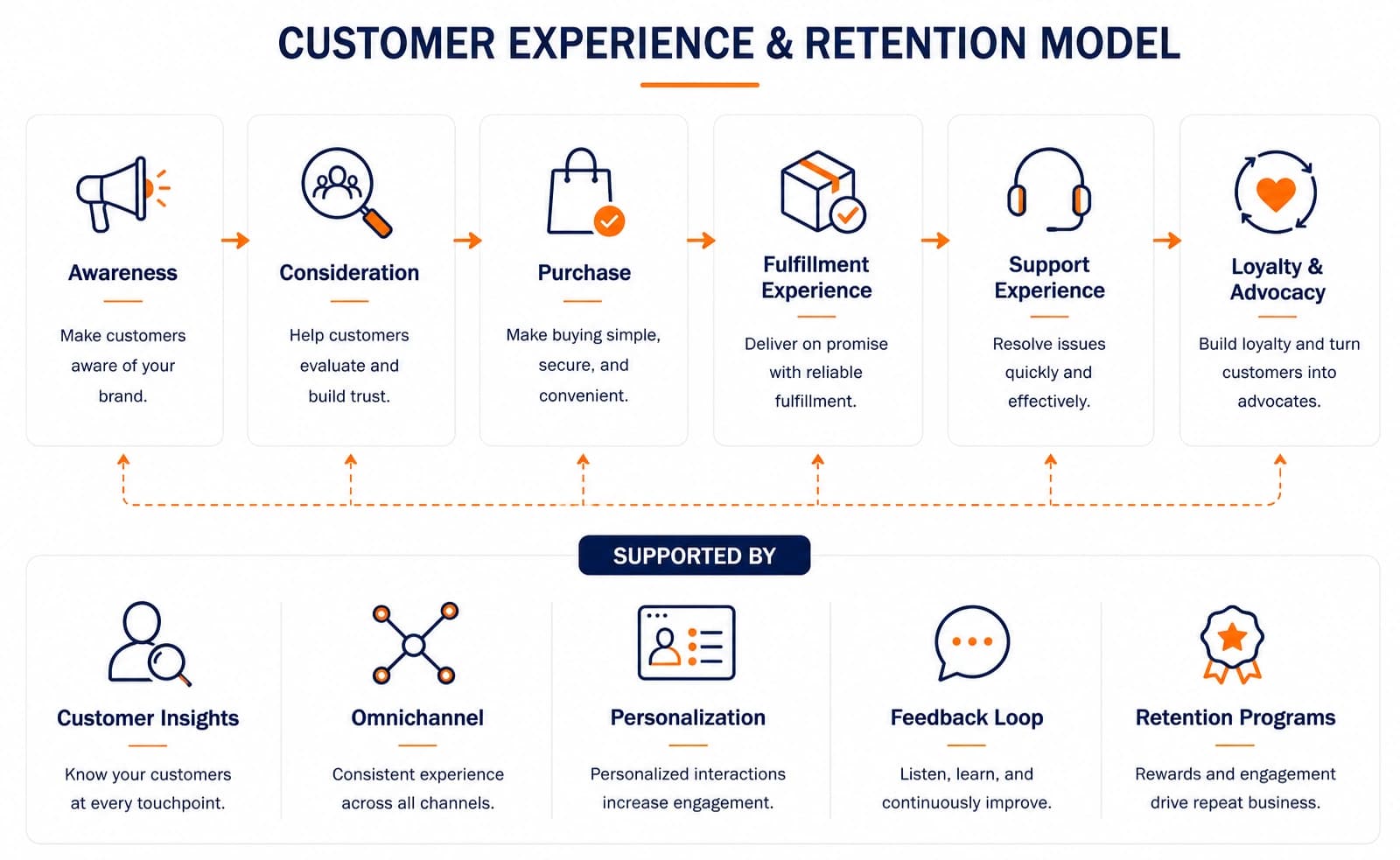
Review the complete customer experience across product information, checkout, orders, fulfillment, support, returns, self-service, channels, and customer data.
Product Discovery & Information
Review whether customers can find, understand, and confidently evaluate the products they need.
Review
- Site search
- Navigation
- Filtering
- Product categories
- Product information
- Specifications
- Pricing
- Inventory availability
- Product images
- Variants
- Bundles
- Related products
- Marketplace consistency
- Product-data accuracy
Outcome
Identify where incomplete, inconsistent, difficult-to-find, or inaccurate product information creates unnecessary customer effort or internal support requests.
Cart & Checkout
Review the operational and system issues affecting the path from purchase intent to completed order.
Review
- Cart behavior
- Checkout steps
- Guest checkout
- Account requirements
- Shipping options
- Pickup options
- Payment methods
- Taxes
- Discounts
- Promotional logic
- Inventory confirmation
- Address validation
- Checkout errors
- Order confirmation
Outcome
Identify where process, information, inventory, payment, or system friction creates avoidable difficulty during purchase.
Customer Accounts & Profiles
Review whether account information gives customers and internal teams a useful, consistent view of the relationship.
Review
- Account creation
- Login
- Saved information
- Addresses
- Order history
- Invoices
- Preferences
- Subscriptions
- Saved products
- Loyalty information
- Account-specific pricing
- B2B account details
- Duplicate customer records
Outcome
Create a clearer customer-account experience while improving how customer information is shared across ecommerce, CRM, service, and operational systems.
Order Communication
Review what customers are told from the moment an order is placed until it is completed.
Review
- Order confirmation
- Payment confirmation
- Inventory confirmation
- Fulfillment status
- Pickup readiness
- Shipping confirmation
- Tracking
- Delivery status
- Backorders
- Substitutions
- Partial shipments
- Delays
- Cancellations
- Exception communication
Outcome
Reduce customer uncertainty and avoid unnecessary inquiries caused by missing, late, inconsistent, or inaccurate order information.
Fulfillment & Delivery Experience
Review the operational execution behind the promises made to customers.
Review
- Inventory availability
- Warehouse/store allocation
- Picking
- Packing
- Substitutions
- Split orders
- Shipping
- Local delivery
- Store pickup
- Delivery windows
- Status updates
- Order exceptions
- Failed delivery
- Missing or damaged items
Outcome
Identify where fulfillment workflows create customer-facing delays, inaccurate updates, repeated contacts, or inconsistent service.
Customer Service Handoffs
Review whether support teams can see the information required to resolve customer issues without repeatedly contacting other departments.
Review
- Customer identity
- Order history
- Current order status
- Inventory information
- Fulfillment status
- Shipment information
- Returns
- Refunds
- Prior conversations
- Escalation paths
- Warehouse handoffs
- Finance handoffs
- CRM records
- Ticket ownership
Outcome
Give customer-facing teams clearer information, ownership, and escalation paths so issues can move toward resolution with less internal chasing.
Returns, Refunds & Exchanges
Review the complete post-purchase workflow when a customer needs to return, exchange, or receive a refund.
Review
- Return request
- Eligibility rules
- Return authorization
- Return labels
- Shipping or store return
- Product receipt
- Inspection
- Exchange
- Restocking
- Refund approval
- Refund processing
- Payment reconciliation
- Customer updates
- Exception handling
Outcome
Create clearer ownership and visibility across the customer, service team, warehouse/store, finance function, and supporting systems.
Self-Service Experience
Review which common customer needs can be handled without requiring manual staff intervention.
Potential Self-Service Areas
- Order status
- Shipment tracking
- Invoices
- Account information
- Reordering
- Quote/order history
- Returns
- Return status
- Subscription management
- Address updates
- Product information
- Support knowledge
- Service requests
- B2B account information
Outcome
Identify where customer portals, workflow improvements, integrations, automation, or approved AI support can make common requests easier to complete while reducing repetitive internal work.
Cross-Channel Customer Experience
Review whether customers receive consistent information when they move between ecommerce, marketplaces, stores, sales teams, customer service, and other channels.
Review
- Product information
- Inventory
- Pricing
- Promotions
- Customer records
- Order history
- Store/online handoffs
- Marketplace orders
- Returns
- Loyalty
- B2B accounts
- Support history
Outcome
Reduce situations where the customer's experience changes simply because they moved from one channel or team to another.
Customer Data & Experience Reporting
Review whether leadership can see where customer experience problems are occurring and what is driving them.
Potential Measures
- Customer inquiries
- Inquiry reason
- Order exceptions
- Late orders
- Cancellations
- Returns
- Refund time
- Support volume
- First-response time
- Resolution time
- Repeat contacts
- Product issues
- Fulfillment issues
- Channel issues
- Repeat purchase
- Customer feedback
Outcome
Create clearer operational visibility into the problems affecting customers instead of relying only on general satisfaction metrics.
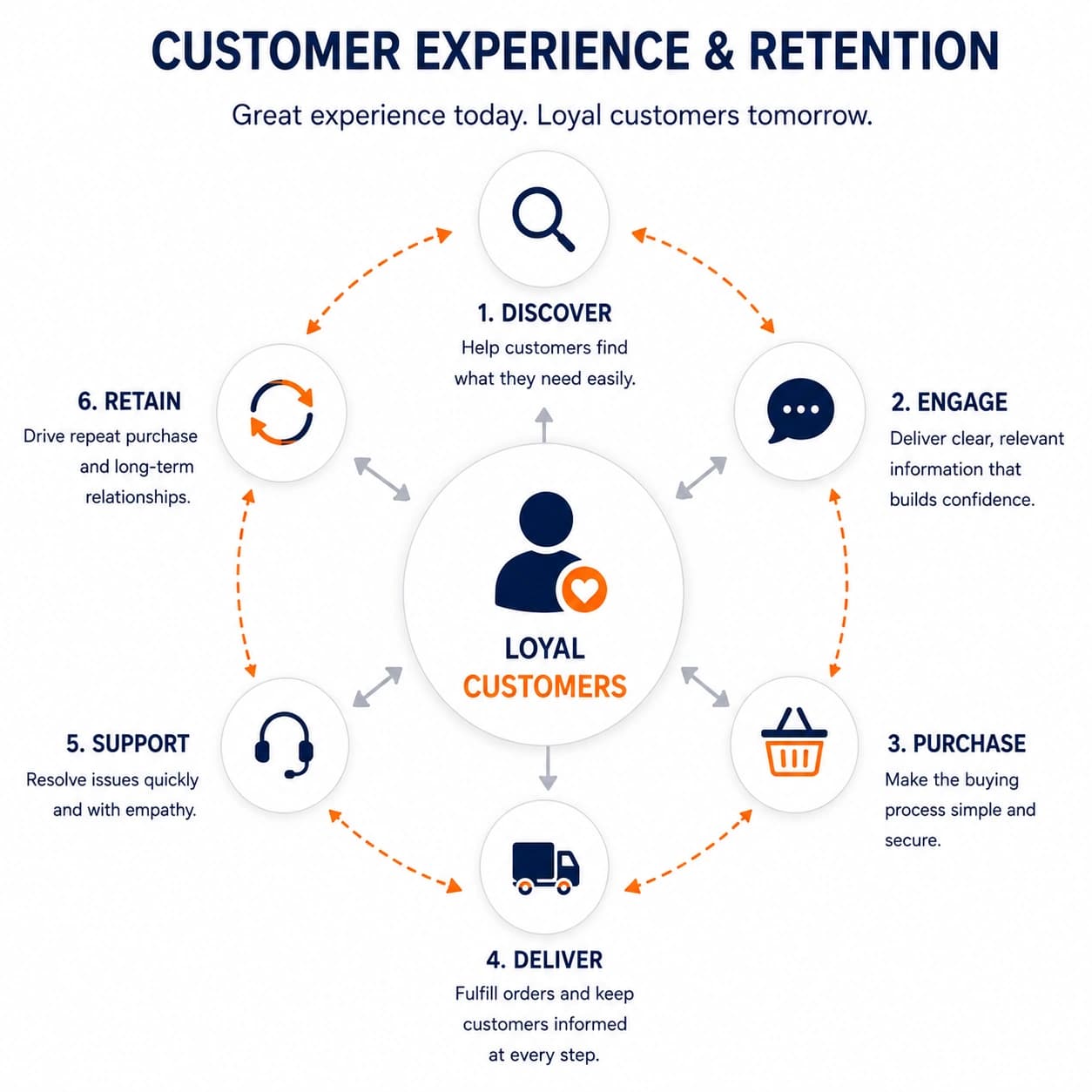
Follow the Experience From Discovery to the Next Purchase
Discover
Help customers find accurate products, pricing, availability, and information with less uncertainty.
Buy
Make cart, checkout, payment, and order confirmation clear, reliable, and easy to complete.
Track
Give customers timely visibility into order status, fulfillment progress, delivery, delays, and changes.
Receive
Deliver the order accurately and consistently across shipping, pickup, substitutions, and exceptions.
Resolve
Make service, returns, refunds, exchanges, and order issues easier to understand and complete.
Continue
Use connected account, order, and service history to make the next interaction easier and more consistent.
When Customers Start Feeling the Gaps Inside the Operation
Customer frustration is often the visible symptom of a deeper operational problem. Repeated questions, conflicting updates, slow resolutions, and difficult returns usually point to gaps in workflow, ownership, information, or system alignment behind the customer journey.
A closer review helps identify where those gaps begin so the business can improve the experience at the source instead of repeatedly managing the same customer-facing problems.
Signs the Customer Journey Needs Attention
 Customers repeatedly contact support for order, delivery, return, or refund updates.
- Service teams cannot see the current information needed to resolve customer issues quickly.
- Customers receive different answers depending on the channel, team, or system involved.
- Returns, refunds, or order changes require too many internal handoffs and follow-ups.
- Online availability, order status, or customer records do not match operational reality.
- The same complaints keep recurring because the underlying workflow problem remains unresolved.
Why This Matters
Repeated customer friction usually means the operation behind the experience needs attention.
Turn Customer Friction Into a Practical Improvement Plan
Customer Journey Map
Document how the customer experience moves across storefront, order, fulfillment, delivery, service, returns, and supporting systems.
Customer Friction Analysis
Identify where information, workflow, ownership, system, or operational gaps create unnecessary customer effort.
Service Handoff Model
Clarify how customer issues move between ecommerce, service, warehouse, operations, sales, and finance.
Systems & Data Recommendations
Identify where ecommerce, CRM, ERP, OMS, WMS, POS, marketplaces, customer-service systems, and reporting need better alignment.
Experience KPI Framework
Define the operational measures needed to track order exceptions, service demand, resolution, returns, fulfillment problems, and other customer-impacting activity.
Prioritized Improvement Roadmap
Organize workflow, reporting, systems, automation, self-service, and implementation opportunities by priority and dependency.
BEYOND THE STOREFRONT
A Better Interface Cannot Fix a Broken Customer Operation
Some experience problems appear on the website but begin somewhere else.
Incorrect availability can begin with inventory data. A missing delivery update can begin in fulfillment. Slow service can result from inaccessible order information. A delayed refund can come from unclear handoffs between returns and finance.
Gyan traces customer-facing friction back to the people, workflows, information, and systems responsible for creating it.
Improve the operation behind the experience not only the screen where the problem appears.
How an Ecommerce Customer Experience Engagement Works
Customer Experience Fit Call
We discuss the customer journey, order flow, fulfillment, support, returns, current systems, recurring customer issues, and the areas where your team believes the experience is breaking down.
Customer Journey & Operational Review
We review how customer interactions move across people, workflows, platforms, data, order operations, fulfillment, service, and returns to identify the underlying causes of friction.
Improvement Roadmap & Implementation Direction
We define the prioritized workflow, system, reporting, automation, self-service, or technology improvements needed to create a clearer and more consistent customer experience.
30-minute call
No obligation
Review and implementation scoped separately
Who We Work With
We work with ecommerce businesses where customer experience depends on multiple teams, channels, systems, and operational workflows working together.
This Tends to Be a Strong Fit If
Customers repeatedly experience gaps between ordering, fulfillment, delivery, service, or returns.
Customer-facing teams spend too much time finding information or coordinating routine requests.
Different channels or systems provide inconsistent customer, inventory, order, or status information.
You need operational clarity before investing in portals, automation, AI, integrations, or customer technology.
This May Not Be the Right Fit If
You only need a visual website or interface redesign.
You only need customer surveys, creative work, or standalone marketing execution.
You need a narrowly defined UX task without reviewing the operation behind it.
You want new customer technology without examining the workflow and information it needs to support.
Not Sure Where the Experience Is Breaking?
Start with a fit call. We'll help determine whether the issue sits in the customer journey, operation, systems or across them.
When the Customer Experience Requires Implementation
Customer Portals & Self-Service
Create customer account experiences for order history, tracking, invoices, returns, service requests, account information, and other defined workflows.
CRM & Customer Data Alignment
Connect customer, inquiry, order, support, sales, and account information across the systems responsible for the customer relationship.
Ecommerce Systems Integration
Connect ecommerce, ERP, OMS, WMS, POS, CRM, marketplaces, customer service, and reporting so customer-facing information is more consistent.
Ecommerce Workflow Automation
Automate defined order updates, support routing, return workflows, notifications, customer follow-up, and other repeatable processes.
AI for Ecommerce & Retail
Use AI for defined customer-support assistance, knowledge retrieval, inquiry classification, response preparation, order context, and internal service workflows.
Commerce Dashboards & BI
Create customer-experience and operational reporting across orders, fulfillment, service, returns, customer activity, and exceptions.
Custom Ecommerce & Retail Software
Build portals, service tools, account workflows, customer-facing applications, and internal systems where existing platforms do not adequately support the requirement.
Customer Experience and Growth Are Connected but
Solve Different Problems
They influence each other, but they begin with different questions. Customer Experience looks at how well the journey works for the customer. Growth Strategy looks at how effectively the business turns demand into sustainable growth.
Ecommerce Customer Experience
Focuses on what customers experience across discovery, checkout, order updates, fulfillment, service, returns, self-service, and channel handoffs then identifies where workflows, information, ownership, or systems are creating friction that makes the journey harder to complete.

Ecommerce Growth Strategy
Focuses on how acquisition, conversion, order value, repeat purchase, customer value, revenue performance, and operational capacity work together then identifies where growth is being created, where value is being lost, and what should improve next.
Selected Case Studies
Real outcomes from our operations consulting and implementation engagements.
See Customer & Commerce Workflows in Action
Where Is Customer Friction Really Beginning?
We review the customer journey to find where operational gaps are creating friction.
Request a Free Operations Fit Call→

30-minute call

No obligation

Consulting and implementation scoped separately
Find the Right Ecommerce Operational Starting Point
Customer experience problems often connect with growth, orders, inventory, systems, reporting, automation, or other operational requirements. Explore the area closest to the issue you are trying to improve.
Explore by Operational Focus
Returns Management & Customer Service
Improve how customer issues, returns, refunds, escalations, and resolution move across teams.
Ecommerce Order Management
Strengthen the order workflows, status visibility, ownership, and exceptions customers experience after purchase.
Inventory Management & Fulfillment
Address availability, fulfillment, delivery, and inventory issues that directly reach the customer.
Ecommerce Growth Strategy
Connect customer experience with retention, customer value, revenue performance, and sustainable growth.
Explore by Technology & Integration
AI Chatbot Solutions for Ecommerce
Support customer questions and self-service where automation can provide useful, reliable responses.
Software Development Services
Build customer and operational capabilities where standard retail systems cannot support the required experience.
Ecommerce POS Integration
Connect store and ecommerce information for more consistent customer, order, inventory, and return experiences.
Software Development for Ecommerce
Build portals, workflows, integrations, and customer-facing capabilities around clearly defined operational requirements.
Common Questions
What is ecommerce customer experience consulting?
Ecommerce customer experience consulting examines how customers interact with the business across product discovery, checkout, account information, order communication, fulfillment, customer service, returns, self-service, and repeat business.Gyan also reviews the workflows, systems, data, and team handoffs responsible for delivering that experience.
Is this a website UX design service?
No.Website usability can be part of the customer journey, but Gyan's focus is broader.We examine how the experience connects with inventory, orders, fulfillment, service, returns, customer data, reporting, and operational systems.
Can you help improve checkout experience?
Yes.The review can examine checkout workflow, required information, account requirements, payment handoffs, shipping options, inventory confirmation, errors, and surrounding operational issues.
Can you help with customer-service workflows?
Yes.We can review how customer inquiries move across support teams, order systems, fulfillment, warehouse operations, finance, CRM, and escalation workflows.
Can you help improve order-status communication?
Yes.We can review where order and fulfillment status originates, how it moves between systems, and how customers and internal teams receive updates.
Can you help improve returns and refunds?
Yes.The review can cover the full workflow from return request through authorization, product receipt, inspection, exchange or refund, inventory handling, finance reconciliation, and customer communication.
Can you build customer self-service tools?
Yes.When the requirement is defined, Gyan can implement customer portals and self-service workflows for areas such as order history, tracking, returns, invoices, account information, support requests, and other approved use cases.
Can AI be used in customer experience workflows?
Yes, where there is a defined use case.AI can assist with areas such as knowledge retrieval, inquiry classification, response preparation, support summaries, and internal customer-service workflows while appropriate business rules and human oversight remain in place.
Do we need to replace our ecommerce platform?
Not necessarily.Customer experience problems often originate between existing systems or workflows rather than in the ecommerce platform itself.The right improvement may involve integration, CRM alignment, workflow changes, automation, reporting, self-service, or extension of existing systems.
What is the difference between Ecommerce Customer Experience and Ecommerce Growth Strategy?
Ecommerce Customer Experience focuses on the customer's interaction with the business across buying, order communication, fulfillment, service, returns, and self-service.Ecommerce Growth Strategy focuses more heavily on acquisition, conversion, customer value, retention, revenue performance, and growth capacity.The two areas are connected but are reviewed from different starting points.
Request an Ecommerce Customer Experience Fit Call
Tell us where customers are experiencing friction across product information, checkout, order updates, fulfillment, service, returns, account information, or self-service. We'll use the first 30 minutes to understand the customer journey, the operation behind it, and where a closer review may be useful.
Focused on your goals
You decide the next step.
Consulting & implementation