

ECOMMERCE AI CHATBOT SOLUTIONS
AI Chatbots Built Around Real Ecommerce Customer Workflows
Gyan Solutions helps ecommerce and retail organizations design and implement AI chatbots that connect customer questions with product information, orders, shipping, returns, accounts, support workflows, and the systems behind them.
We define what the chatbot should handle, which information it can use, when it can take an approved action, and when the conversation needs to move to a person.
Choose the path that fits your current need for operational clarity or defined implementation.
Help customers find relevant products, compare options, understand specifications, and navigate large or complex catalogs.
Give customers access to approved order, shipment, pickup, and delivery information without requiring routine support contact.
Guide common return, refund, service, and account questions while routing exceptions to the appropriate team.
Connect approved business knowledge, ecommerce systems, CRM, orders, inventory, helpdesk tools, APIs, and AI around the customer conversation.
Ecommerce Chatbots Leave Little Room for Guesswork
A customer may see one chat window. Behind that conversation, the business may need to identify the customer, understand the request, retrieve accurate information, apply business rules, access a system, decide whether an action is permitted, and determine when human support is required.
The warning signs appear in the conversation, but the underlying problem may come from knowledge, workflows, ownership, data, or disconnected systems.
The Chatbot Gives Generic Answers
Customers receive broad responses because the chatbot cannot access the product, policy, order, account, or operational information required to answer the actual question.
Product Answers Are Inconsistent
Descriptions, specifications, availability, policies, and other product information differ across the website, product catalog, internal documents, or connected systems.
Order Questions Still Require a Human
Customers ask about order status, shipment, pickup, delays, or partial fulfillment, but the chatbot cannot retrieve the information required to help them.
Returns Become a Dead End
The chatbot can explain the return policy but cannot guide the customer through the actual workflow, retrieve return status, or route an exception correctly.
Customers Have to Repeat Themselves
The chatbot collects information, but when the conversation moves to customer service the employee receives little useful context and the customer starts again.
AI Is Added Without Clear Boundaries
The business wants the chatbot to answer, recommend, decide, and act without defining which information is authoritative, which actions are allowed, or where human judgment remains required.
Operational Clarity
Not sure whether the problem is the chatbot, the customer-service workflow, the knowledge behind it, or the connected systems?
An AI Chatbot Is a Customer Workflow—not Only a Chat Window
The conversation is only the visible part of the experience.
A useful ecommerce chatbot may need to understand intent, retrieve product or policy information, authenticate a customer, check an order, access account information, apply business rules, trigger an approved workflow, or prepare a human handoff.
Every response depends on knowledge, customer context, system access, permissions, operational rules, and ownership working together. That is why we examine the chatbot as part of the wider ecommerce customer-service operation.
Key insight
The goal is not simply to make the chatbot sound more human. The goal is to help customers reach a reliable answer, action, or person with less unnecessary effort.
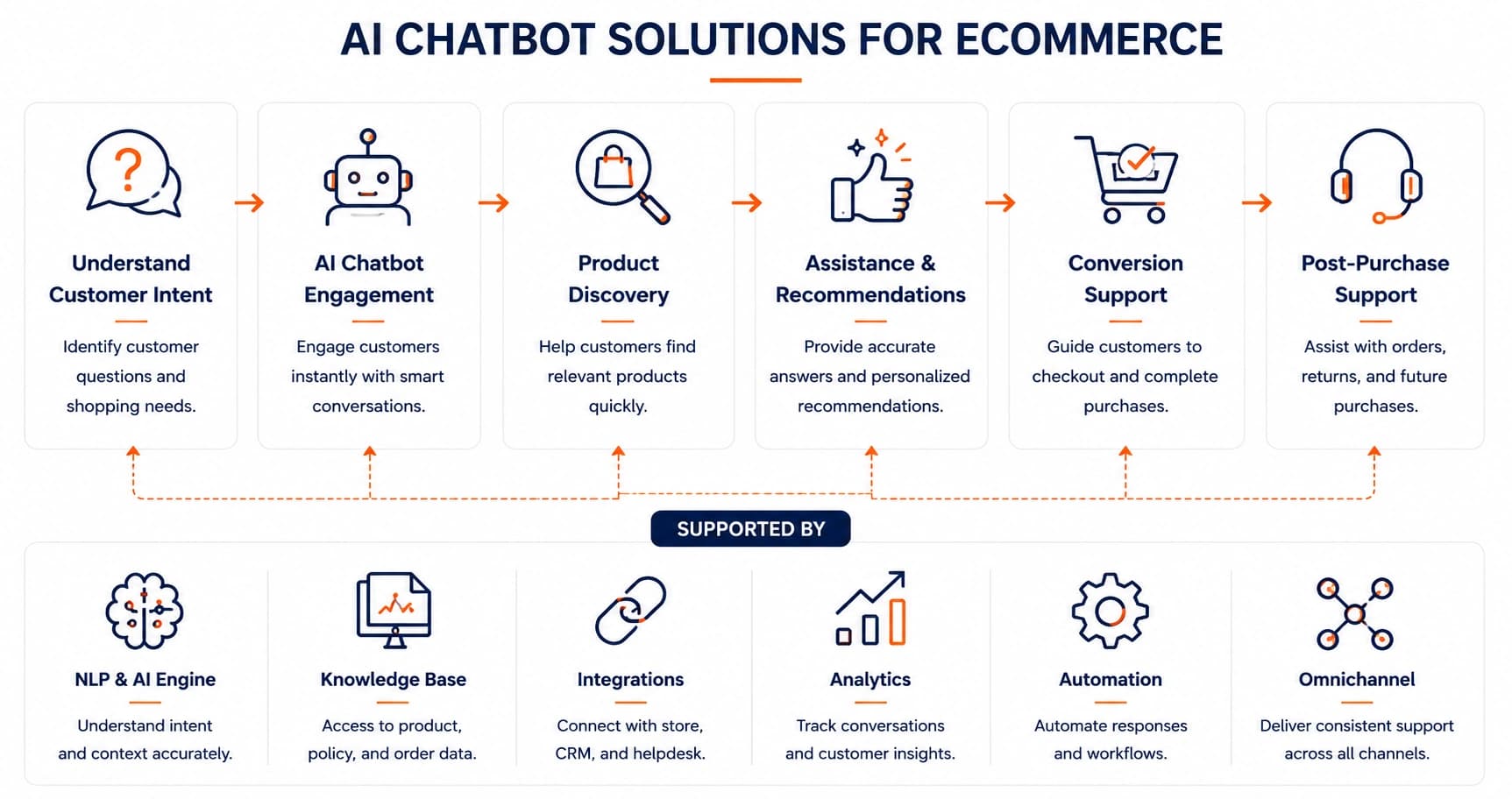
Customer Question → Intent → Approved Knowledge / System Context → Business Rules → Response or Action → Human Handoff When Required
Two Focused Ways to Improve Ecommerce AI Chatbot Operations
Some organizations know customer service is becoming repetitive or difficult but are not yet certain whether an AI chatbot is the right answer. Others already have a defined conversational AI requirement and need it designed, integrated, and implemented.
Operational Review & Improvement
For ecommerce teams that see repetitive customer questions, service bottlenecks, unclear self-service, or information problems but need clarity before deciding what should be automated or handled through AI.
 Map how customer questions currently move across ecommerce, service teams, product information, orders, returns, policies, systems, and escalation paths.
- Identify where poor knowledge, system access, ownership, manual handoffs, or workflow design is creating unnecessary service demand.
- Define which interactions should remain self-service, become automated, use AI assistance, or move directly to a human.

Operational Review & Improvement can stand alone from assessment and workflow redesign through prioritized customer-service improvements.
Technology & AI Implementation
For ecommerce teams with a defined need for an AI chatbot, customer assistant, product assistant, order-support workflow, knowledge assistant, or integrated conversational experience.
- Turn the defined chatbot requirement into a practical implementation plan with clear intents, information sources, actions, permissions, and escalation rules.
- Connect approved knowledge and workflows with ecommerce, CRM, order, inventory, helpdesk, account, shipping, or other required systems.
- Build the conversational AI experience, integrations, business rules, human handoff, monitoring, and supporting application components.
Technology & AI Implementation can begin independently or work alongside Operational Review & Improvement.
Ecommerce AI Chatbot
Operations Experience
Our approach to ecommerce AI chatbots is shaped by how customers actually ask questions, search for products, track orders, request service, manage returns, access account information, and move between automated support and employees.
We examine how ecommerce platforms, product catalogs, CRM, order systems, inventory, customer-service tools, knowledge sources, APIs, automation, and AI support those conversations and whether the customer can reach accurate information or an appropriate next step.
This reveals where knowledge, workflows, system access, permissions, handoff, or focused implementation need to improve.
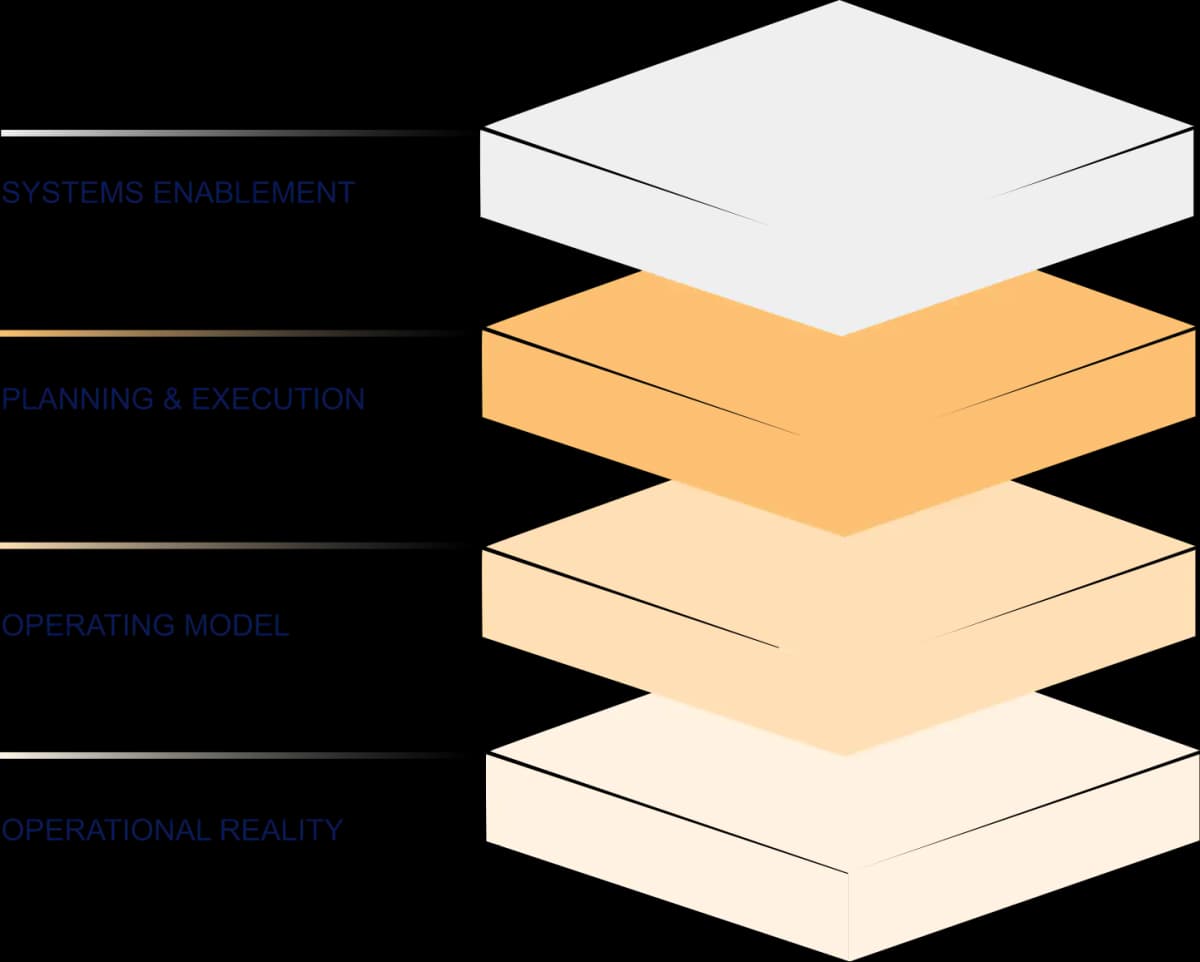
Where Ecommerce AI Chatbot Performance Becomes Connected
We focus on the parts of conversational ecommerce where customer expectations, business knowledge, systems, service operations, and AI depend on one another.
Product Discovery & Recommendations
Customers do not always know the category, filter, product name, or terminology required to find what they need. Conversational product discovery can help customers describe their requirement naturally and narrow relevant products using approved catalog information and defined business rules.
What We Examine
- Product catalog structure
- Product attributes and specifications
- Search and filtering requirements
- Customer questions and terminology
- Product comparison requirements
- Availability information
- Recommendation boundaries
- Related and compatible products
- Customer context where appropriate
- Product-data quality and completeness
Desired Outcome
Help customers move from a natural-language requirement toward relevant products without inventing specifications or unsupported product claims.
Product Questions & Knowledge
A chatbot can only answer company-specific questions reliably when the information behind the response is reliable. Product descriptions, FAQs, policies, help content, documentation, warranty information, shipping rules, and other knowledge may be distributed across several systems and documents.
What We Examine
- Product descriptions and specifications
- FAQs and help content
- Shipping information
- Return policies
- Warranty information
- Product documentation
- Approved customer-service knowledge
- Knowledge ownership
- Information freshness
- Conflicting or duplicate information
- Retrieval sources
- Response boundaries
Desired Outcome
Give customers clearer access to approved business information while reducing unsupported or inconsistent chatbot responses.
Order Status & Delivery
“Where is my order?” sounds like a simple question. A useful response may depend on customer authentication, order status, fulfillment state, shipment information, pickup readiness, partial fulfillment, backorders, or delivery-system data.
What We Examine
- Customer identification
- Order lookup
- Order-status definitions
- Payment status where relevant
- Fulfillment status
- Shipment and tracking information
- Pickup readiness
- Partial fulfillment
- Backorders and delays
- Customer notifications
- Ecommerce and OMS/ERP access
- Exception routing
Desired Outcome
Give customers useful order information while reducing repetitive support contacts and preserving appropriate access controls.
Returns & Refund Guidance
Returns combine customer policy with operational execution. The chatbot may need to explain eligibility, identify an order, guide the customer through the required steps, retrieve a return status, or recognize when the request requires an exception or human decision.
What We Examine
- Return-policy knowledge
- Return eligibility
- Customer and order context
- Return-request workflow
- Return authorization
- Return labels or instructions
- Exchange guidance
- Return status
- Refund status
- Policy exceptions
- Escalation requirements
- Customer communication
Desired Outcome
Make routine return questions easier to resolve while keeping exceptions, approvals, and restricted decisions within the appropriate workflow.
Customer Accounts & Self-Service
Customers may need help finding information that already exists inside their account or connected business systems. The chatbot can provide a conversational entry point where authentication, authorization, and system access are properly defined.
What We Examine
- Authentication requirements
- Customer identity
- Order history
- Account information
- Invoices
- Subscription information
- Loyalty information
- Saved information
- Reordering
- B2B account information
- Permission boundaries
- Account-system integrations
Desired Outcome
Expand useful customer self-service without exposing account-specific information outside the appropriate authentication and authorization controls.
Customer Service & Case Routing
Not every conversation should be completed by AI. The chatbot can still improve service by understanding the request, collecting useful information, retrieving context, categorizing the issue, and preparing the case before a person becomes involved.
What We Examine
- Customer intent
- Issue classification
- Required information
- Customer and order context
- Knowledge retrieval
- Case creation
- Helpdesk integration
- Routing rules
- Priority
- Escalation
- Conversation summary
- Agent handoff
Desired Outcome
Reduce repetitive intake and routing work while giving customer-service employees better context when human support is required.
B2B & Sales Assistance
B2B customers often ask questions that cross products, account information, order history, reordering, documents, quotes, and sales support. Conversational AI can assist with defined information and intake workflows without replacing authorized commercial decisions.
What We Examine
- Product and catalog questions
- Customer-account context
- Order history
- Reorder requests
- Quote-request intake
- Distributor or dealer questions
- Product-document retrieval
- Sales inquiry routing
- Customer classification
- CRM integration
- Human sales handoff
- Pricing and commercial-decision boundaries
Desired Outcome
Help business customers reach information or the appropriate sales workflow faster while keeping pricing, negotiation, and commercial approvals under defined ownership.
Human Handoff & Escalation
A customer should not become trapped inside an automated conversation. The workflow needs a clear point where AI stops, the appropriate employee takes ownership, and useful context moves with the customer.
What We Examine
- Customer-requested handoff
- Low-confidence responses
- Policy exceptions
- Customer disputes
- Sensitive or complex cases
- High-value customer workflows
- Unsupported questions
- Escalation rules
- Agent availability
- Conversation summaries
- Customer and order context
- Handoff status and ownership
Desired Outcome
Move the customer from AI to the appropriate employee without losing the information already collected or forcing the customer to restart the conversation.
Implement Around the Customer Workflow the Business Needs
Technology should support a defined customer-service requirement. Once the need is clear, Gyan can plan, build, connect, or improve the relevant conversational AI layer.
AI Chatbot Development
Build customer-facing conversational experiences around clearly defined intents, knowledge, workflows, rules, and escalation paths.
Ecommerce & Order Integration
Connect the assistant with approved ecommerce, order, shipment, inventory, return, or account information where the use case requires it.
Knowledge Retrieval
Ground responses in approved product information, policies, help content, documentation, databases, and other maintained business sources.
Customer Service Integration
Connect AI conversations with helpdesk, CRM, ticketing, case-routing, and human-support workflows.
Workflow Automation
Allow defined chatbot interactions to trigger approved actions, notifications, case creation, routing, or other controlled workflows.
Customer & B2B Assistants
Build specialized assistants around product discovery, customer accounts, B2B inquiries, sales intake, service, and other defined commerce requirements.
Already Know What the Chatbot Needs to Answer, Access, or Do?
Turn the requirement into a practical AI implementation plan.
AI Should Support a Defined Customer Interaction—not Replace Judgment
AI can help ecommerce teams interpret questions, retrieve information, summarize context, guide routine requests, and prepare customer-service actions. Its value depends on reliable knowledge, clear business rules, appropriate permissions, connected systems, and defined human oversight.
Product & Knowledge Assistance
Retrieve relevant product, policy, account, or support information from approved sources rather than relying on unsupported model knowledge.
Customer Intent & Request Triage
Identify the likely reason for contact and help route the conversation toward the appropriate self-service workflow, system information, or employee.
Order & Service Context
Bring together permitted order, shipment, return, customer, or case information to help answer routine operational questions.
Response & Handoff Preparation
Prepare useful responses, summaries, classifications, and conversation context while allowing employees to take ownership when judgment or approval is required.
Conversation Pattern Analysis
Use chatbot and escalation patterns to identify repeated customer questions, knowledge gaps, service demand, or operational issues that may require attention.
Trust Statement
Before implementing an ecommerce AI chatbot, Gyan assesses the customer workflow, information quality, system access, business rules, authentication requirements, action boundaries, escalation path, and human oversight.
When an Ecommerce AI Chatbot Fit Call Makes Sense
Use the call to clarify a customer-service problem or discuss a defined AI chatbot implementation requirement.
When You Need Operational Clarity
- Customer-service teams repeatedly answer the same questions.
- Customers struggle to find product, policy, shipping, return, or account information.
- Order-status questions create unnecessary support volume.
- Existing chat or self-service experiences do not resolve useful customer requests.
- AI is being considered but the business is not yet sure which customer interactions should be automated.
When the Requirement Is Clear
- A product-discovery or shopping assistant is required.
- The chatbot needs access to order, shipping, account, or return information.
- Approved business knowledge needs to be connected to conversational AI.
- The chatbot needs integration with ecommerce, CRM, helpdesk, OMS, ERP, or other business systems.
- Human handoff, case creation, workflow actions, or other defined automation needs to be implemented.
A Clear Starting Point Without a Forced Sequence
Start with Operational Review & Improvement, Technology & AI Implementation, or both based on how clearly the chatbot requirement is already defined.
Ecommerce AI Chatbot Fit Call
We discuss the customer conversations, support demand, product information, order and return questions, current self-service, knowledge sources, business systems, and any defined chatbot requirement.
Engagement Scope
We define whether the work should focus on Operational Review & Improvement, Technology & AI Implementation, or both. Outcomes, supported intents, knowledge, systems, permissions, actions, human handoff, priorities, timeline, and delivery approach are agreed before work begins.
Review, Implementation, or Both
We deliver the agreed work—from customer-workflow and knowledge review through chatbot development, retrieval, integrations, business rules, workflow automation, human handoff, testing, and rollout.
30-minute call
No obligation
Review and implementation scoped separately
Who This Is For
This service is designed for ecommerce and retail organizations where customer questions, product information, orders, service, and self-service increasingly depend on connected knowledge and systems.
Typical Environments
Ecommerce brands with meaningful customer-service volume
Retailers with large or complex product catalogs
Businesses receiving frequent order and delivery questions
Multi-channel and omnichannel retailers
B2B ecommerce and distribution businesses
Businesses expanding customer self-service
Retailers using multiple customer, order, inventory, or service systems
Organizations with a defined conversational AI requirement
A Different Provider May Be Better If
You only need a basic live-chat widget installed
You only need outsourced customer-service agents
You want a generic chatbot with no defined business workflow
You expect AI to answer company-specific questions without reliable source information
You want unrestricted automated pricing, refunds, commercial decisions, or other actions without appropriate controls
Your requirement does not involve customer workflows, business knowledge, systems, or implementation
Define What Your AI Chatbot Should Do
Clarify customer needs, data, workflows, actions, systems, and human handoff before implementation.
Discuss Your AI Chatbot Requirement→

30-minute call

No obligation

Consulting and implementation scoped separately
Find the Right Ecommerce Operational Starting Point
A useful ecommerce chatbot depends on the customer workflow and authoritative information behind the conversation. Explore the operating area or supporting system the AI experience needs to understand and connect with.
Explore by Operational Focus
Ecommerce Customer Experience
Identify the customer questions, handoffs, information gaps, and self-service opportunities that should shape where chatbot support begins and ends.
Returns Management & Customer Service
Clarify return, refund, exchange, policy, escalation, and service workflows before allowing AI to guide routine customer requests.
Ecommerce Order Management
Connect chatbot responses with reliable order status, fulfillment progress, delays, partial orders, cancellations, and operational exceptions.
Ecommerce Conversion & Revenue Performance
Examine where product questions, buying uncertainty, navigation, or checkout friction create opportunities for more useful conversational assistance.
Explore by Technology & Integration
Retail Software Development
Build supporting applications, APIs, workflow logic, or specialized tools when the chatbot needs capabilities beyond an existing commerce platform.
Ecommerce Mobile App Development
Extend approved conversational support into mobile shopping, account, order, loyalty, and service experiences where customers already interact.
Headless CMS Development
Give AI-enabled experiences access to structured, governed content for products, policies, guidance, and other information managed across digital channels.
ERP & Ecommerce Integration
Connect customer conversations with approved order, account, inventory, fulfillment, and transaction information held behind the storefront.
Common Questions
What is an AI chatbot for ecommerce?
An ecommerce AI chatbot is a conversational application that helps customers interact with approved product information, policies, orders, accounts, service workflows, and other defined commerce information using natural language.Depending on the requirement, it can also connect with business systems or route the customer into an approved workflow.
How is an AI chatbot different from traditional website chat?
Traditional chat often depends on fixed menus, keywords, or scripted responses.AI can interpret more natural customer questions and retrieve information from approved knowledge or connected systems. Business rules, permissions, and human escalation still need to be clearly defined.
Can an AI chatbot help customers find products?
Yes.A chatbot can help customers describe what they need, narrow product options, compare approved attributes, and retrieve relevant product information where the catalog data supports the use case.
Can the chatbot check order status?
Yes, where the appropriate ecommerce or order system provides the required access and customer authentication is implemented when needed.The assistant can use existing order information to support defined status, fulfillment, shipment, or pickup questions.
Can an AI chatbot help with returns and refunds?
Yes.The chatbot can explain approved policy, guide routine return steps, retrieve permitted return or refund status, and route exceptions to the appropriate team.It should not invent policy exceptions or make unauthorized decisions.
Can the chatbot access customer account information?
Yes, where the use case includes appropriate authentication, authorization, system access, and data-handling controls.The AI model itself should not determine whether a user is authorized to access protected information.
Can the chatbot connect with Shopify, CRM, ERP, OMS, or customer-service systems?
Yes, where there is a defined business requirement and the relevant platforms provide appropriate technical access.The implementation may connect ecommerce, CRM, order, inventory, account, helpdesk, knowledge, or other systems required by the workflow.
Can the chatbot transfer a customer to a person?
Yes.Human handoff can be designed so the employee receives useful conversation, customer, order, or issue context instead of requiring the customer to start over.
Can an AI chatbot replace customer-service employees?
Gyan does not position AI chatbots as a complete replacement for customer-service teams.AI can support defined repetitive interactions, information retrieval, intake, classification, and self-service while employees retain ownership of complex, sensitive, exceptional, or judgment-based situations.
Can Gyan use our existing product and support knowledge?
Yes.Approved product information, FAQs, policies, help content, documentation, databases, and other maintained business sources can be used to ground the chatbot where appropriate.
What happens when the chatbot does not know the answer?
The implementation should define fallback behavior.Depending on the workflow, the chatbot can request clarification, provide a limited approved response, direct the customer to the appropriate resource, or escalate the conversation to a human team.
Do we need an Operational Review before building the chatbot?
No.If the customer intents, knowledge sources, integrations, actions, and desired outcome are already clearly defined, Gyan can move directly into Technology & AI Implementation.Operational Review & Improvement is used when the underlying customer-service problem or appropriate AI use case still needs to be clarified.
Discuss Your Ecommerce AI Chatbot Requirement
Tell us which customer questions, product interactions, order inquiries, return workflows, account requests, service activities, or B2B conversations you want AI to support. We'll use the initial conversation to understand the customer workflow, knowledge sources, business systems, human handoff requirements, and whether the appropriate starting point is operational review, AI implementation, or a combination.
Focused on your goals
You decide the next step.
Consulting & implementation