

ECOMMERCE CONVERSION & REVENUE PERFORMANCE
Improve Conversion and Revenue Across the Buying Journey
Traffic can grow while revenue performance stays flat. Customers may be reaching the site but leaving before purchase, choosing lower-value baskets, encountering checkout friction, abandoning when inventory or delivery information is unclear, or failing to return after the first order.
Gyan Solutions reviews the customer-to-order journey, commercial performance, product and offer structure, checkout, order value, operational constraints, and supporting systems to identify where existing demand is being lost or underperforming.
Review and implementation are scoped separately.
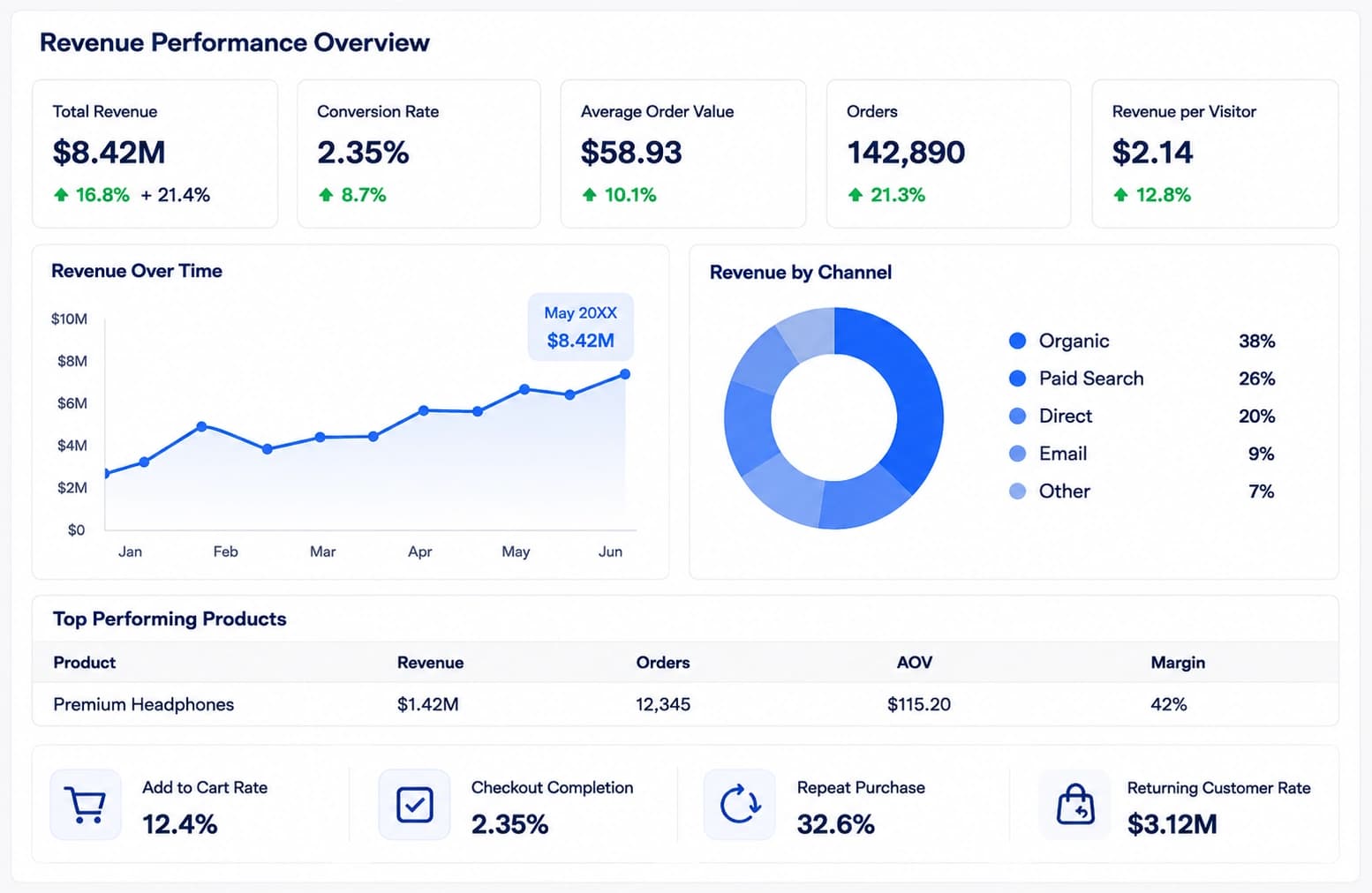
Traffic increases, but completed orders and realized revenue do not grow at the same rate.
Product, pricing, availability, cart, checkout, or payment friction causes customers with purchase intent to leave.
Customers are purchasing, but basket size, product mix, bundles, or complementary purchases are not creating expected value.
Failed payments, stockouts, cancellations, discounts, refunds, and returns reduce the revenue created from existing demand.
Conversion Reviewed Across the Full Buying Operation
Customer-to-Order Perspective
We review the full path from product discovery through cart, checkout, payment, order completion, and the operational factors affecting conversion.
Commercial & Operational Perspective
Conversion is examined together with inventory, pricing, promotions, order value, fulfillment, returns, and revenue realization—not only website behavior.
Review Through Implementation
When improvement requires reporting, integration, automation, ecommerce changes, customer workflows, AI, or custom technology, Gyan can support implementation after the requirement is defined.
REVENUE PERFORMANCE
A Customer Can Be Ready to Buy and Still Be Lost by the Operation
Conversion does not depend on the storefront alone. A customer can find the right product and still leave because availability is uncertain, delivery expectations are unclear, checkout creates friction, payment fails, or pricing changes unexpectedly.
We follow purchase intent through products, cart, checkout, payment, inventory, order completion, and post-order adjustments to understand where demand stops becoming revenue.
The goal is to remove the customer, commercial, and operational friction preventing existing demand from becoming completed and retained revenue.
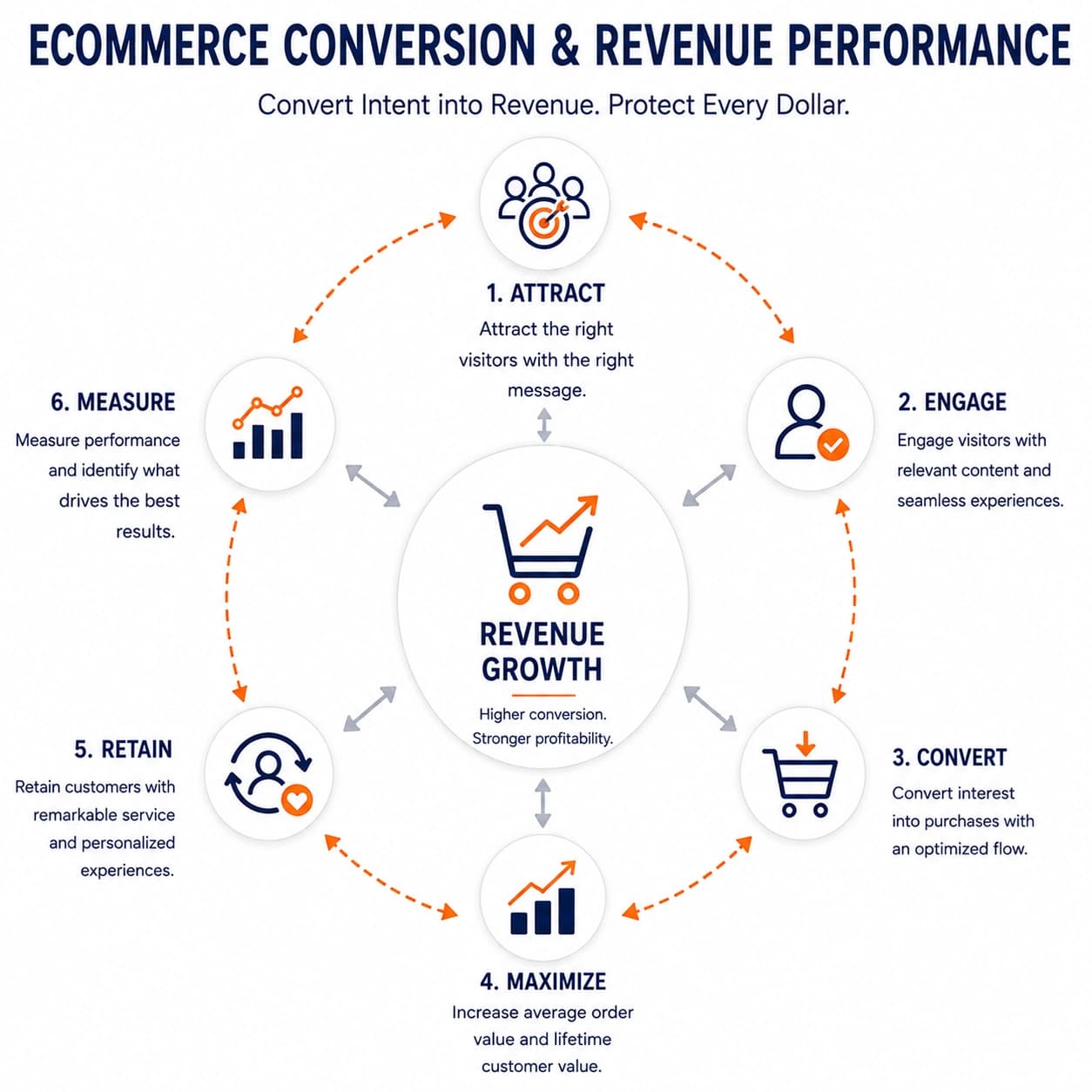
Why This Matters
More demand creates little value when the buying operation cannot convert and retain it efficiently.
Where We Review the Customer-to-Revenue Journey
Review how existing demand moves through product discovery, buying confidence, cart, checkout, payment, order value, availability, and realized revenue.
Product Discovery
Review whether customers can reach relevant products efficiently.
Review
- Navigation
- Categories
- Onsite search
- Filters
- Product sorting
- Recommendations
- Product collections
- Landing-page paths
- Category structure
- Merchandising
- Mobile discovery
- Search-result relevance
- Unavailable products
Outcome
Identify where customers with buying intent are failing to reach the products most likely to meet their needs.
Product Detail & Buying Confidence
Review whether product information gives customers enough confidence to move forward.
Review
- Product description
- Specifications
- Imagery
- Variants
- Dimensions
- Compatibility
- Pricing
- Availability
- Delivery information
- Return information
- Reviews where used
- Product comparison
- Related products
- B2B information where applicable
Outcome
Reduce hesitation caused by incomplete, inconsistent, or difficult-to-understand product information.
Cart Performance
Review what happens after a customer has already shown purchase intent.
Review
- Cart abandonment
- Unexpected costs
- Shipping estimates
- Product availability
- Quantity changes
- Promotions
- Coupon behavior
- Cart persistence
- Cross-sell
- Related items
- Free-shipping thresholds
- Mobile cart behavior
- Cart errors
Outcome
Identify friction between product selection and checkout before the business loses a customer who was already close to buying.
Checkout & Payment
Review whether customers can complete the transaction efficiently and with confidence.
Review
- Guest checkout
- Account requirements
- Checkout steps
- Form fields
- Shipping options
- Pickup options
- Delivery timing
- Address validation
- Tax display
- Discounts
- Payment methods
- Payment failures
- Fraud/risk review where applicable
- Order confirmation
- Mobile checkout
Outcome
Reduce unnecessary transaction friction and identify operational or system issues that prevent valid purchase intent from becoming a completed order.
Pricing & Promotions
Review how pricing and promotional rules affect conversion and realized revenue.
Review
- List price
- Promotional price
- Discounts
- Coupon rules
- Bundles
- Quantity discounts
- B2B pricing
- Customer-specific pricing
- Free-shipping thresholds
- Marketplace pricing
- Promotion eligibility
- Conflicting offers
- Margin implications where data is available
Outcome
Identify where pricing or promotional complexity is confusing customers, reducing order value, or creating unnecessary revenue leakage.
Average Order Value
Review opportunities to create more value from existing demand without creating unnecessary purchase friction.
Review
- Bundles
- Complementary products
- Cross-sell
- Upsell
- Product recommendations
- Quantity breaks
- Subscriptions
- Accessories
- Premium alternatives
- Cart thresholds
- Product combinations
- Customer segments
- Order patterns
Outcome
Identify practical ways to improve basket value while keeping the buying experience relevant to the customer.
Inventory & Availability
Review how product availability affects conversion and revenue.
Review
- Available-to-sell inventory
- Stockouts
- Backorders
- Low inventory
- Channel availability
- Location availability
- Substitutions
- Replenishment timing
- Inaccurate availability
- Overselling
- Preorder workflows
- Unavailable-product handling
Outcome
Identify revenue being lost because customer demand and actual inventory availability are not aligned.
Revenue Leakage
Review the gap between apparent demand and revenue that is actually retained.
Potential Sources
- Cart abandonment
- Failed payments
- Stockouts
- Order cancellations
- Partial fulfillment
- Discounts
- Promotion errors
- Refunds
- Returns
- Chargebacks where relevant
- Shipping adjustments
- Unavailable items
- Order exceptions
- Failed checkout sessions
Outcome
Create a clearer view of where revenue is being lost after customer intent has already been created.
Channel & Device Performance
Review whether conversion and order economics differ meaningfully across customer entry points.
Review
- Desktop
- Mobile
- Direct ecommerce
- Marketplaces
- B2B
- Retail/POS where connected
- Customer segments
- Geographic regions
- Product categories
- Traffic sources where relevant
- New vs repeat customers
Outcome
Identify where performance differences point to customer, product, workflow, system, or operational issues requiring a closer review.
Repeat Revenue Signals
Review whether customers who have already purchased are returning and whether post-purchase operations are supporting future revenue.
Review
- Repeat order rate
- Reorder timing
- Customer segments
- Purchase frequency
- Product replenishment cycles
- Subscriptions
- Customer-service issues
- Return activity
- Account experience
- Post-purchase communication
- Product/category patterns
Outcome
Identify where the post-purchase experience may be supporting or limiting future revenue.
Follow Existing Demand From Intent to Realized Revenue
Discover
Help customers reach relevant products, pricing, and offers without unnecessary search or confusion.
Consider
Give customers clear product, availability, delivery, and value information needed to buy confidently.
Commit
Preserve purchase intent as customers move from product selection into cart and checkout.
Complete
Reduce checkout, payment, account, shipping, or transaction friction before the order is confirmed.
Fulfill
Make sure completed orders can be supported by inventory, fulfillment, and accurate customer communication.
Retain Revenue
Understand how cancellations, refunds, returns, discounts, and other post-order events reduce realized revenue.
When Demand Exists but Too Little Becomes Revenue
A business can have healthy traffic and strong customer interest while still losing commercial value between product discovery and realized revenue.
A closer review helps identify whether the loss is coming from product decisions, buying friction, checkout, payment, inventory availability, order value, or post-order leakage.
Signs Revenue Performance Needs Attention
 Traffic grows without a proportional increase in completed orders.
- Customers reach products or carts but frequently leave before purchase.
- Mobile, channel, or product conversion differs without a clear reason.
- Payment failures or checkout friction interrupt valid purchase intent.
- Stockouts or inaccurate availability regularly prevent completed sales.
- Cancellations, refunds, or returns materially reduce realized revenue.
Why This Matters
Acquiring demand becomes more expensive when too much existing purchase intent is lost before revenue is retained.
Turn Revenue Questions Into a Practical Improvement Plan
Customer-to-Revenue Journey Map
Document the steps from product discovery through completed order and realized revenue.
Conversion Friction Analysis
Identify where customer, product, pricing, inventory, checkout, payment, or system issues are reducing completed orders.
Revenue Leakage Analysis
Identify where cancellations, stockouts, payment failures, returns, refunds, and other events reduce revenue after demand is created.
Commercial KPI Framework
Define the metrics required to monitor conversion, order value, completed revenue, leakage, and related performance.
Operational & Systems Recommendations
Clarify where ecommerce, CRM, ERP, inventory, payment, fulfillment, reporting, or other systems need stronger alignment.
Prioritized Improvement Roadmap
Organize customer, commercial, workflow, reporting, system, automation, and implementation improvements by priority and dependency.
CONVERSION BEFORE MORE ACQUISITION
More Traffic Amplifies Whatever Already Happens After the Click
Increasing traffic does not correct what happens after a customer arrives. If product discovery is difficult, availability is unreliable, checkout creates friction, payments fail, or orders are later cancelled or refunded, additional acquisition can simply send more customers into the same problems.
Understanding how efficiently existing demand becomes completed and retained revenue gives leadership a stronger basis for deciding whether the next investment should be acquisition or fixing what already happens after it.
Before paying for more demand, understand how much value the demand you already have is actually creating.
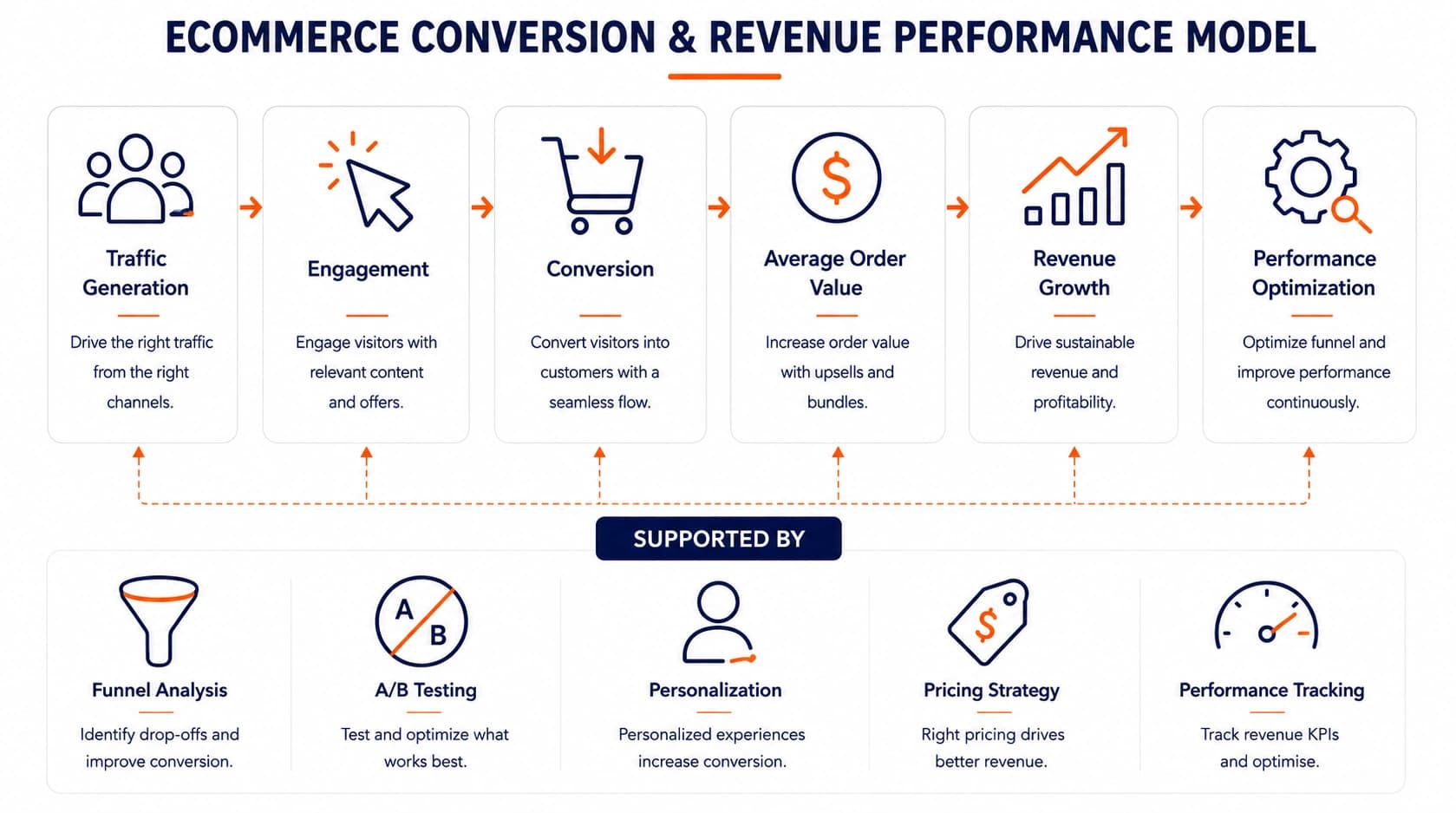
Follow Revenue Beyond the Order Confirmation
Customer Intent
A customer shows willingness to purchase.
Completed Order
The business successfully captures the order.
Fulfilled Order
The business has the inventory and operational capacity to complete it.
Realized Revenue
The order remains after cancellations, refunds, returns, discounts, and other adjustments.
A stronger revenue-performance model looks beyond gross order volume to understand where value is created and where it is lost.
This section is not presented as accounting advice.
One Conversion Rate Can Hide Several Different Problems
Overall conversion can look stable while important parts of the business perform very differently. The real issue may sit in a specific customer group, product set, channel, device, promotion, inventory condition, or fulfillment path. The goal is not to create endless segmentation. It is to find which part of the buying journey is actually underperforming and why.
Customer & Channel Differences
Compare performance across device, geography, customer type, new vs repeat buyers, marketplaces, and sales channels to see where purchase behavior changes.
Product & Offer Performance
Review products, categories, landing paths, promotions, and buying patterns to identify where customer intent is stronger, weaker, or being lost.
Operational Conditions
Look at inventory status, fulfillment method, availability, and other operational factors that may explain why similar customer demand produces different conversion outcomes.
Strong conversion analysis does not stop at the overall rate. It isolates the segment where the real commercial or operational constraint sits.
How an Ecommerce Conversion & Revenue Performance Engagement Works
Conversion & Revenue Fit Call
We discuss traffic, conversion, order value, products, checkout, payment, inventory, returns, revenue reporting, and the areas where leadership believes demand is being lost or underperforming.
Customer-to-Revenue Review
We review how customers move from product discovery through cart, checkout, payment, order completion, fulfillment, and realized revenue. We identify where customer friction, operational constraints, system problems, or commercial rules are reducing performance.
Improvement Roadmap & Implementation Direction
We define the prioritized customer, commercial, workflow, reporting, integration, automation, system, and implementation improvements required to improve conversion and realized revenue.
30-minute call
No obligation
Review and implementation scoped separately
Who We Work With
We work with established ecommerce businesses where meaningful customer demand already exists, but too much purchase intent or commercial value is being lost before revenue is fully realized.
This Tends to Be a Strong Fit If
Traffic is healthy but completed-order growth is weaker than expected.
Cart, checkout, or payment performance is creating unexplained revenue loss.
Inventory availability or operational constraints regularly interrupt customer purchases.
Leadership wants more value from existing demand before increasing acquisition spend.
This May Not Be the Right Fit If
You only need paid advertising or acquisition campaign management.
You only need SEO, creative, or landing-page production.
You only want isolated A/B testing without reviewing the wider buying operation.
You do not yet have enough meaningful traffic or transaction activity to evaluate performance.
Not Sure Where Revenue Is Being Lost?
Start with a fit call to identify whether the constraint sits in products, cart, checkout, payment, inventory, order value, or post-order leakage.
When Better Revenue Performance Requires Implementation
Ecommerce Systems Integration
Connect ecommerce, inventory, ERP, CRM, OMS, payment, fulfillment, marketplaces, and reporting where disconnected information is affecting conversion or revenue.
Ecommerce Workflow Automation
Automate defined checkout follow-up, order workflows, alerts, customer communication, payment-related workflows, and operational exceptions.
Commerce Dashboards & BI
Create reporting around conversion, order value, channel performance, revenue leakage, inventory, orders, fulfillment, refunds, and commercial performance.
Ecommerce Analytics & Reporting
Define KPI calculations, source data, revenue reporting, conversion reporting, management views, and operational measurement.
AI for Ecommerce & Retail
Use AI for defined product, customer, reporting, merchandising, support, and operational workflows where appropriate.
Custom Ecommerce & Retail Software
Build customer-facing or internal tools where existing ecommerce and business systems do not adequately support the required buying or revenue workflow.
Conversion & Revenue Performance and Growth Strategy Solve Different Problems
Ecommerce Conversion & Revenue Performance
Examines how existing demand moves toward completed and retained revenue, including where product, checkout, payment, inventory, or post-order issues reduce commercial value.

Ecommerce Growth Strategy
Looks across acquisition, conversion, retention, customer value, revenue performance, and operational capacity to determine what is supporting growth and what is limiting the next stage.
Conversion Is One Part of the Customer Experience
Ecommerce Conversion & Revenue Performance
Measures how effectively purchase intent becomes completed revenue and identifies where commercial, customer, or operational friction interrupts the buying journey before value is fully realized.
Ecommerce Customer Experience
Covers the wider customer journey across discovery, buying, fulfillment, service, returns, self-service, and channel handoffs to understand where the experience becomes difficult or inconsistent.
Performance Improvement Requires Reliable Measurement
Ecommerce Conversion & Revenue Performance
Identifies where demand and commercial value are being lost so teams can prioritize the buying, operational, or revenue issues that deserve attention first.
Ecommerce Analytics & Reporting
Creates a trusted view of performance by clarifying KPI definitions, source data, reporting structure, and management visibility across commercial and operational activity.
Selected Case Studies
Real outcomes from our operations consulting and implementation engagements.
See Ecommerce Conversion & Revenue Workflows in Action
Understand What Happens to Existing Demand
Review where customers, orders, fulfillment, returns, or revenue performance may be losing value.
Request a Conversion & Revenue Fit Call→

30-minute call

No obligation

Consulting and implementation scoped separately
Find the Right Ecommerce Operational Starting Point
Conversion and revenue problems can connect with customer experience, inventory, orders, reporting, systems, automation, or the broader growth model. Explore the area closest to the issue you are trying to improve.
Explore by Operational Focus
Ecommerce Growth Strategy
Connect conversion and realized revenue with acquisition, customer value, retention, and operational capacity.
Ecommerce Customer Experience
Identify customer-facing friction that may interrupt product discovery, buying, checkout, or repeat purchase.
Ecommerce Analytics & Reporting
Build trusted measurement around conversion, orders, revenue, customer segments, channels, and operational performance.
Inventory Management & Fulfillment
Understand where availability, fulfillment options, cancellations, or post-order problems affect realized revenue.
Explore by Technology & Integration
Ecommerce Analytics Dashboard
Monitor conversion, revenue, order value, customer segments, channels, and other decision-critical measures.
Ecommerce POS Integration
Connect store and online transactions where revenue and customer behavior span multiple buying channels.
Ecommerce Marketplace Integration
Bring marketplace conversion, orders, and revenue into a more complete view of commercial performance.
ERP and Ecommerce Integration
Connect completed ecommerce transactions with operational and financial information needed to understand realized revenue.
Common Questions
What is ecommerce conversion optimization?
Ecommerce conversion optimization is the process of improving how effectively customer demand becomes completed orders.Gyan reviews conversion across product discovery, product information, cart, checkout, payment, inventory availability, order value, and the operational or system issues affecting the buying journey.
Is this a conversion rate optimization agency service?
No.Gyan may review conversion behavior, but the engagement is broader than standalone CRO.We examine the customer journey together with inventory, systems, payments, order workflows, fulfillment, reporting, and commercial performance.
Can Gyan help improve checkout conversion?
Yes.The review can examine guest checkout, account requirements, payment methods, shipping options, address entry, taxes, discounts, inventory confirmation, mobile behavior, errors, and operational dependencies affecting checkout.
Can Gyan help improve average order value?
Yes.We can review product combinations, bundles, cross-sell, upsell, quantity offers, recommendations, free-shipping thresholds, subscriptions, and other relevant opportunities.
Can inventory problems reduce ecommerce conversion?
Yes.Inaccurate availability, stockouts, backorders, substitutions, and inconsistent channel inventory can prevent customers from completing purchases or create cancellations after the order.
Can Gyan identify revenue leakage?
Yes.Depending on available data, the review can examine failed payments, cancellations, stockouts, abandoned carts, refunds, returns, discounts, partial fulfillment, and other events that reduce realized revenue.
Is this the same as Ecommerce Growth Strategy?
No.Conversion & Revenue Performance focuses on turning existing demand into completed and retained revenue.Ecommerce Growth Strategy is broader and includes acquisition, retention, customer growth, channel direction, and operational growth capacity.
Is this the same as Ecommerce Analytics & Reporting?
No.Conversion & Revenue Performance focuses on improving commercial and operational performance.Ecommerce Analytics & Reporting focuses on defining KPIs, source data, reporting requirements, and management visibility.
Can Gyan implement improvements identified during the review?
Yes.If the review identifies a defined need for ecommerce changes, reporting, systems integration, automation, AI, customer tools, or custom software, implementation can be scoped separately.
Do we need to replace our ecommerce platform?
Not necessarily.Conversion problems may come from product data, inventory, payment, pricing, checkout rules, integrations, fulfillment information, or surrounding workflows rather than the ecommerce platform itself.
Who is this service best suited for?
It is best suited for established ecommerce and retail businesses with meaningful traffic and order volume that want to improve how effectively existing customer demand becomes completed and retained revenue.
Request a Conversion & Revenue Fit Call
Tell us where conversion, checkout, payment, product performance, order value, inventory availability, or revenue leakage may be limiting commercial performance. We'll use the first 30 minutes to understand the current customer-to-revenue journey and determine where a closer review may be useful.
Focused on your goals
You decide the next step.
Consulting & implementation