

INVENTORY MANAGEMENT & FULFILLMENT
Align Inventory, Fulfillment, and Channel Demand Around One Operating Flow
Ecommerce growth becomes difficult when inventory, orders, warehouses, stores, marketplaces, fulfillment partners, and customer expectations are managed separately.
Gyan Solutions reviews how inventory moves from purchasing and receiving through availability, allocation, replenishment, order fulfillment, delivery, returns, and reporting—then identifies the workflow, system, and implementation improvements required to create stronger control and visibility.
Review and implementation are scoped separately.
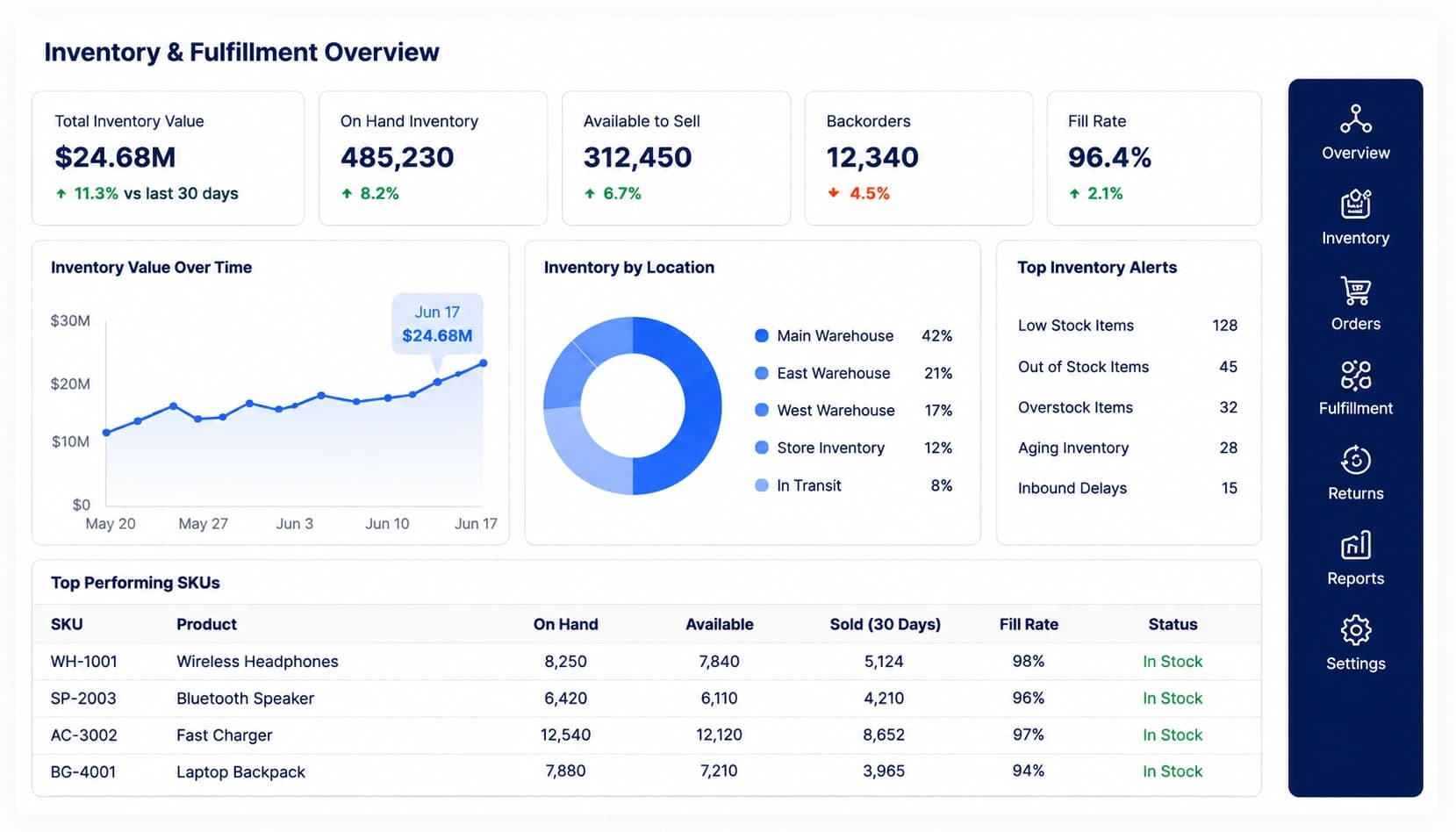
Teams know inventory exists but cannot confidently see what is available, committed, reserved, or ready to sell.
System quantities and physical inventory drift apart, creating adjustments, stockouts, overselling, and uncertainty across locations.
Teams rely on spreadsheets, messages, and manual checks to manage allocation, replenishment, transfers, and inventory movement.
Inventory may be available, but warehouse, store, or partner workflows cannot consistently turn that stock into completed orders.
Inventory and Fulfillment Reviewed as One Connected Operation
End-to-End Inventory Flow
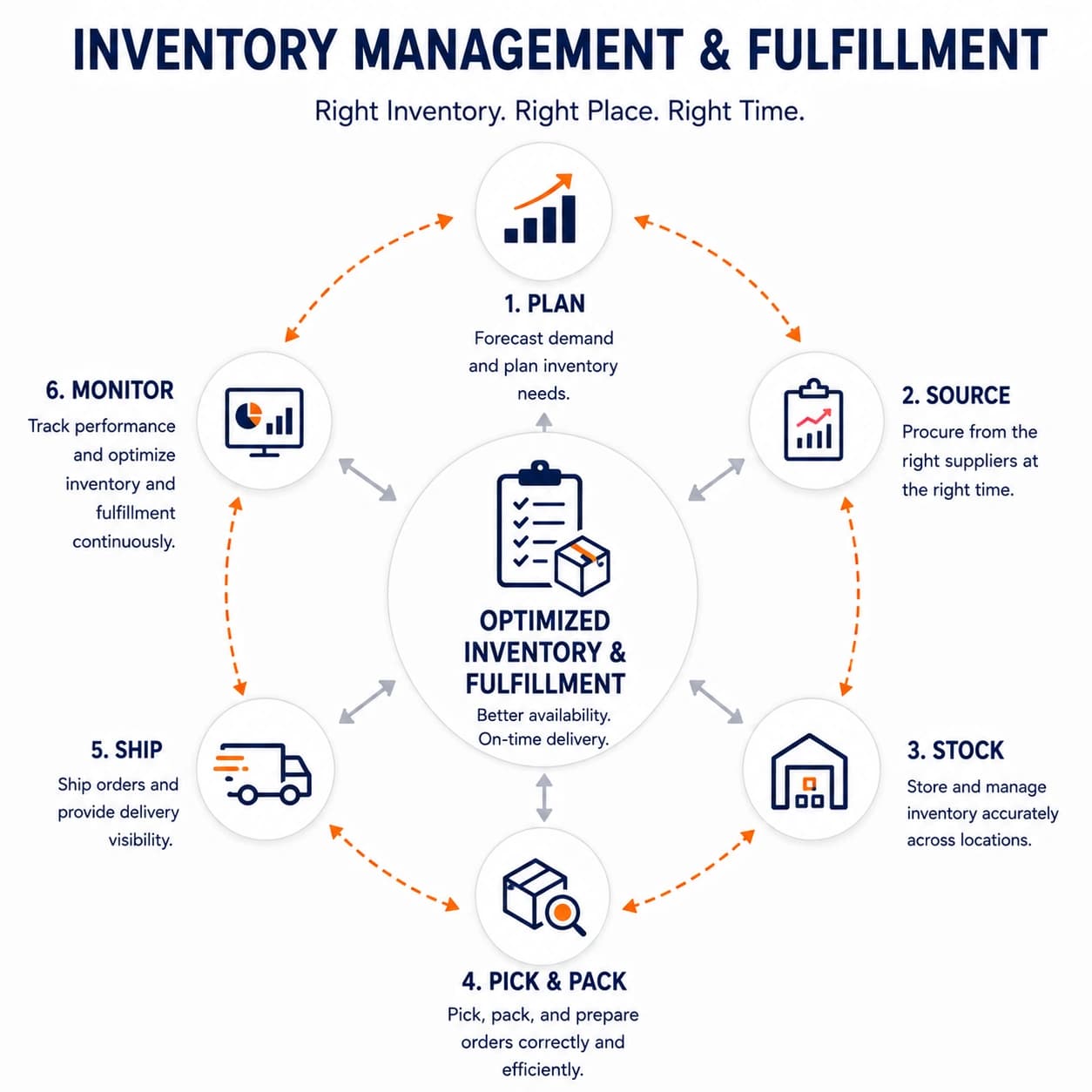
We examine how inventory moves from purchasing and receiving through storage, availability, allocation, fulfillment, delivery, returns, and reconciliation.
Multi-System Perspective
Inventory problems are reviewed across ecommerce platforms, ERP, OMS, WMS, POS, marketplaces, warehouses, stores, suppliers, and reporting—not as isolated system issues.
Review Through Implementation
When improvement requires integration, automation, dashboards, ERP/WMS changes, custom workflows, mobile tools, or other technology, Gyan can support implementation once the requirement is defined.
CONNECTED INVENTORY OPERATIONS
Inventory on Hand Is Not the Same as Inventory You Can Sell
Knowing the total stock number is not enough. Inventory may already be reserved, committed, in transit, damaged, awaiting receiving, assigned to another channel, or moving through a return.
We follow inventory across receiving, locations, availability, allocation, replenishment, fulfillment, returns, and reconciliation to identify where the physical operation and inventory record stop matching.
The goal is reliable inventory that teams can locate, understand, allocate, and fulfill with greater confidence.
Why This Matters
Better inventory decisions start with knowing what stock is actually available, where it is, and what can happen next.
Where We Review the Inventory-to-Fulfillment Flow
Review how inventory moves from receiving through availability, locations, allocation, replenishment, fulfillment, returns, and reporting across channels and systems.
Inventory Receiving
Review how incoming inventory becomes usable inventory inside the operation.
Review
- Purchase orders
- Advance shipment information
- Receiving
- Quantity verification
- Damaged inventory
- Discrepancies
- Lot / batch information where applicable
- Product identification
- Warehouse location
- Receiving status
- ERP/WMS updates
- Putaway
- Supplier discrepancies
Outcome
Create a clearer path from incoming shipment to validated, visible, and usable inventory.
Inventory Accuracy
Review why the quantity shown in systems differs from what is physically available.
Review
- Inventory adjustments
- Receiving errors
- Picking errors
- Damaged goods
- Unrecorded movements
- Returns
- Transfers
- Duplicate transactions
- Stale reservations
- Shrinkage
- Location errors
- Cycle counts
- Physical counts
- System synchronization
Outcome
Identify the workflow and system causes behind inventory discrepancies rather than repeatedly correcting the final number.
Available-to-Sell Inventory
Review how the business determines what inventory can actually be offered to customers.
Review
- On-hand inventory
- Reserved inventory
- Committed inventory
- Safety stock
- Damaged inventory
- Inbound inventory
- Channel reservations
- Pending transfers
- Pending returns
- Backorders
- Product holds
- Marketplace commitments
Outcome
Create clearer availability rules so channels do not treat every physical unit as immediately sellable inventory.
Multi-Location Inventory
Review how inventory is managed across warehouses, stores, fulfillment centers, third-party logistics providers, and other locations.
Review
- Inventory by location
- Location ownership
- Transfer workflows
- Store inventory
- Warehouse inventory
- 3PL inventory
- Fulfillment eligibility
- Local availability
- Location priority
- Inventory balancing
- Regional demand
- Location-level reporting
Outcome
Improve visibility into where inventory exists and which locations can actually support demand.
Channel Allocation
Review how inventory is shared across ecommerce, marketplaces, stores, B2B, wholesale, and other sales channels.
Review
- Direct ecommerce
- Marketplaces
- Retail stores
- B2B
- Wholesale
- Subscriptions
- Promotional allocations
- Safety stock
- Channel-specific inventory
- Priority products
- Overselling risk
- Channel reconciliation
Outcome
Create clearer rules for how inventory is exposed and reserved across competing sales channels.
Replenishment & Transfers
Review how inventory moves between suppliers, warehouses, stores, fulfillment locations, and sales channels.
Review
- Reorder triggers
- Replenishment rules
- Transfer requests
- Transfer approval
- Source location
- Destination location
- Transfer status
- In-transit inventory
- Receiving confirmation
- Stock balancing
- Slow-moving inventory
- Demand patterns
- Emergency transfers
Outcome
Reduce unnecessary stockouts and manual inventory movement by creating clearer replenishment and transfer workflows.
Order Allocation & Fulfillment
Review how available inventory becomes committed inventory and then moves into fulfillment.
Review
- Inventory reservation
- Order allocation
- Fulfillment location selection
- Warehouse routing
- Store fulfillment
- Partial orders
- Substitutions
- Split shipments
- Backorders
- Picking
- Packing
- Staging
- Shipment creation
- Pickup
- Delivery
Outcome
Create a clearer link between inventory availability and the physical execution required to complete the order.
Warehouse & Store Handoffs
Review how work moves between order management and the people responsible for inventory and fulfillment.
Review
- Order release
- Pick queue
- Inventory confirmation
- Shortages
- Substitutions
- Picking exceptions
- Packing
- Staging
- Store pickup
- Transfer orders
- Fulfillment acknowledgement
- Shipment confirmation
- Completion status
- Exception escalation
Outcome
Reduce delays caused by unclear ownership between systems, central operations, warehouses, stores, and fulfillment teams.
Returns & Inventory Recovery
Review what happens to inventory after a customer return, cancellation, failed delivery, damaged shipment, or other reverse-flow event.
Review
- Return authorization
- Product receipt
- Inspection
- Disposition
- Restocking
- Damaged inventory
- Quarantine
- Vendor return
- Resale eligibility
- Inventory adjustment
- Refund coordination
- Warehouse updates
- System reconciliation
Outcome
Create a controlled path for returned inventory so stock does not disappear into an operational blind spot.
Inventory & Fulfillment Reporting
Review whether management can see how inventory is moving through the operation and where problems are developing.
Potential Measures
- Available inventory
- Committed inventory
- Stockouts
- Backorders
- Inventory adjustments
- Days of inventory
- Slow-moving stock
- Receiving backlog
- Transfer backlog
- Fulfillment backlog
- Order cycle time
- Picking exceptions
- Fulfillment exceptions
- Returns
- Inventory accuracy
- Inventory by location
- Inventory by channel
- Fill rate
- Order completion
Outcome
Create clearer operational visibility into inventory and fulfillment instead of relying only on static stock reports.
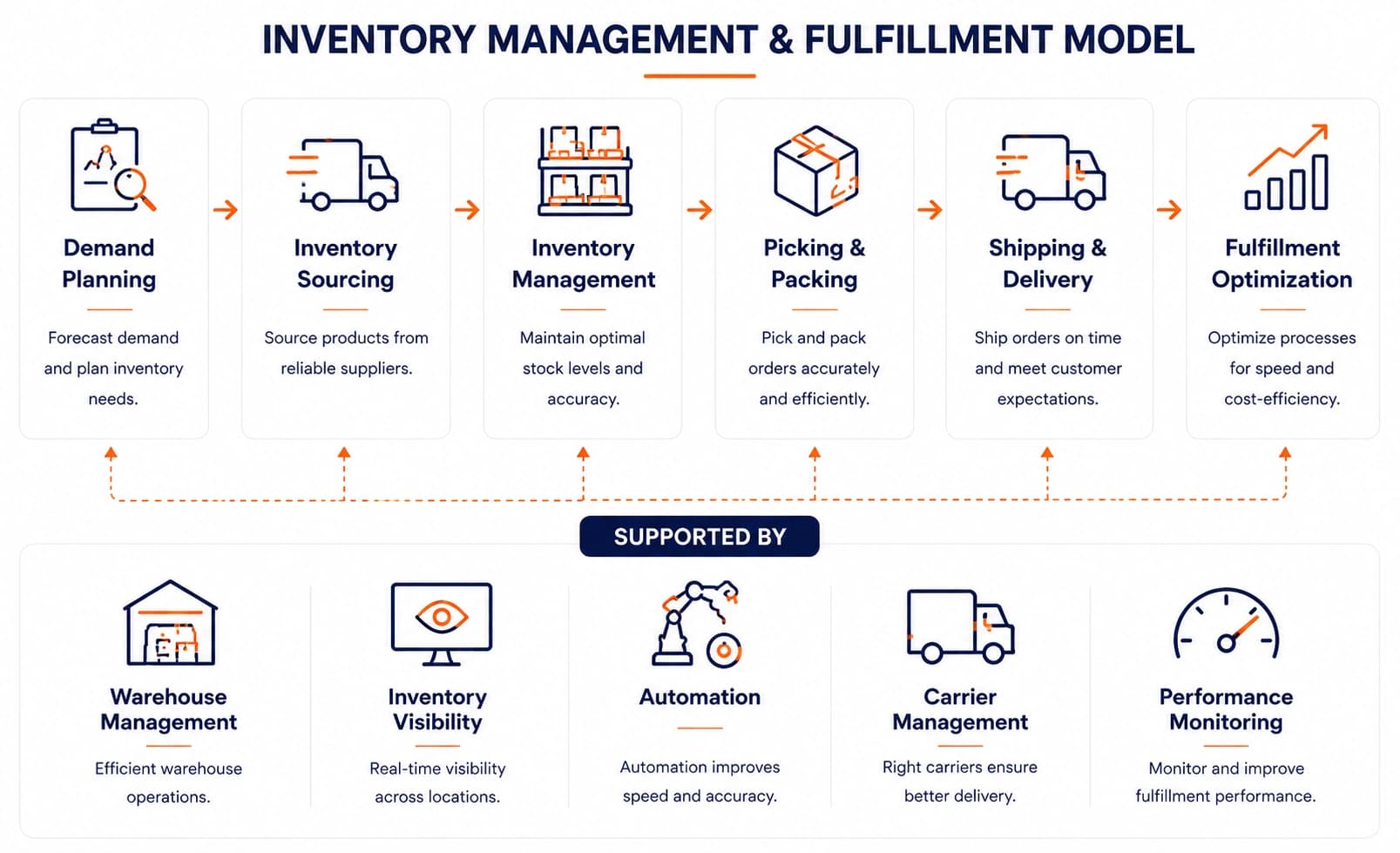
Follow Inventory From Arrival to Customer Completion
Receive
Bring incoming inventory into the operation with the required quantity and product information.
Validate
Confirm what was actually received and identify discrepancies before inventory becomes available.
Store
Put inventory into the correct physical and system location.
Expose
Determine what inventory should be made available to each selling channel.
Allocate
Reserve the appropriate inventory when demand becomes an order.
Fulfill
Pick, pack, stage, ship, deliver, or prepare the order for pickup.
Deliver
Complete the customer-facing fulfillment requirement and update the relevant systems.
Return / Reconcile
Process returns, cancellations, adjustments, damaged inventory, and system reconciliation.
When Inventory Exists but Teams Still Cannot Rely on It
Inventory problems are not always caused by having too little stock. The business may have enough inventory overall while teams still struggle to determine what is available, where it is located, what has already been committed, or which location should fulfill demand.
A closer review helps identify where inventory status, movement, ownership, or fulfillment workflows are creating uncertainty before those gaps become larger stock, service, and working-capital problems.
Signs the Inventory Flow Needs Attention
 System inventory regularly differs from what teams physically find.
- Stockouts occur while usable inventory exists at another location.
- Channels show availability that the operation cannot reliably fulfill.
- Transfers and replenishment require repeated manual coordination.
- Fulfillment teams discover inventory shortages after orders are released.
- Returns or cancellations do not reliably restore inventory availability.
Why This Matters
Inventory becomes difficult to manage when teams cannot confidently trust its status, location, or availability.
Turn Inventory Complexity Into a Clearer Operating Model
Inventory Flow Map
Document how inventory moves from purchasing and receiving through storage, availability, allocation, fulfillment, returns, and reconciliation.
Inventory Ownership Model
Clarify which systems and teams own on-hand, reserved, committed, in-transit, damaged, returned, and available inventory.
Availability & Allocation Rules
Define how inventory becomes available to channels and how stock is reserved when orders are created.
Fulfillment Handoff Model
Clarify how orders move from inventory allocation into warehouse, store, delivery, or third-party fulfillment workflows.
Inventory KPI Framework
Define the operational measures required to monitor inventory accuracy, availability, stockouts, backlog, fulfillment, transfers, and returns.
Prioritized Improvement Roadmap
Organize workflow, system, reporting, automation, integration, and implementation improvements by priority and dependency.
INVENTORY CONTROL
Correcting the Stock Number Does Not Correct the Process
When inventory is wrong, adjusting the quantity fixes today's number but not necessarily the reason it became inaccurate. The discrepancy may begin during receiving, putaway, picking, transfers, reservations, damaged-stock handling, cancellations, returns, or another inventory movement that was recorded late, incorrectly, or not at all.
We trace recurring discrepancies back through the inventory flow to identify where the physical movement and inventory record stop matching.
The goal is not simply to correct inventory faster. It is to reduce the operational conditions that keep making it inaccurate.
Define What Each Inventory Number Actually Means
On-Hand Inventory
What physically exists at a location.
Available Inventory
What can currently be offered for sale after holds, commitments, and other restrictions are considered.
Committed Inventory
What has already been reserved for an order, channel, customer, or workflow.
In-Process Inventory
What is moving through receiving, transfer, fulfillment, return, inspection, or another operational state.
Clear inventory definitions are essential before systems can be integrated or availability can be automated reliably.
One Pool of Inventory Can Support Many Channels—If the Rules Are Clear
A growing commerce operation may sell the same products through:
- Direct ecommerce
- Marketplaces
- Retail locations
- B2B
- Wholesale
- Subscriptions
- Sales representatives
- Partner channels
Without clear allocation rules, each channel can behave as though it owns the same inventory.
- Overselling
- Emergency transfers
- Cancelled orders
- Customer-service problems
- Manual reservations
- Inconsistent availability
How an Inventory Management & Fulfillment Engagement Works
Inventory & Fulfillment Fit Call
We discuss your sales channels, locations, inventory environment, receiving, order volumes, fulfillment model, systems, recurring stock issues, and the areas where your team is spending unnecessary time.
Inventory & Fulfillment Review
We map how inventory moves across suppliers, receiving, warehouses, stores, ecommerce, marketplaces, ERP, WMS, OMS, fulfillment, transfers, returns, and reporting. We identify where inventory ownership, status, availability, workflow, or system handoffs are creating operational problems.
Improvement Roadmap & Implementation Direction
We define the prioritized workflow, reporting, integration, automation, system, and implementation improvements required to create stronger inventory control and more reliable fulfillment.
30-minute call
No obligation
Review and implementation scoped separately
Who We Work With
We work with commerce businesses where inventory moves across multiple channels, locations, warehouses, stores, or fulfillment partners and requires stronger operational control.
This Tends to Be a Strong Fit If
Inventory availability cannot be trusted consistently across channels or locations.
Teams regularly reconcile, adjust, reserve, or move inventory manually.
Stock exists somewhere in the operation but cannot always be positioned against demand.
Receiving, replenishment, transfers, fulfillment, or returns create recurring inventory discrepancies.
This May Not Be the Right Fit If
You only need warehousing, shipping, or third-party logistics services.
You only need products or stock quantities entered into an ecommerce platform.
You need a narrowly defined warehouse task with no broader operational issue.
You want new inventory technology without examining the workflow and inventory rules behind it.
Not Sure Where Inventory Control Is Breaking?
Start with a fit call to identify whether the constraint sits in availability, accuracy, allocation, replenishment, fulfillment, returns, or across the inventory flow.
When Inventory & Fulfillment Improvement Requires Technology
Ecommerce Systems Integration
Connect ecommerce platforms, marketplaces, ERP, OMS, WMS, inventory, POS, shipping, and reporting around the inventory and fulfillment lifecycle.
Ecommerce Workflow Automation
Automate defined replenishment, transfer, inventory alerts, allocation, notifications, exception routing, and other repeatable workflows.
Commerce Dashboards & BI
Create operational reporting around inventory, stockouts, backorders, receiving, transfers, fulfillment, returns, channel availability, and exceptions.
ERP / WMS Improvements
Improve inventory workflows, data, configuration, reporting, integrations, and surrounding operational processes in existing ERP or warehouse systems.
Custom Ecommerce & Retail Software
Build internal inventory tools, warehouse views, exception queues, transfer workflows, operational portals, and applications where existing platforms do not support the required process.
AI for Ecommerce & Retail
Use AI for defined inventory and fulfillment support use cases such as exception summaries, information retrieval, operational analysis, and internal workflow assistance.
Inventory Management and Order Management Are Connected but Solve Different Problems
They work together, but they begin with different operational questions.
Inventory Management & Fulfillment
Focuses on where inventory is, what is actually available, how stock is allocated and replenished, and how it moves through locations, physical fulfillment, returns, and reconciliation.

Ecommerce Order Management
Focuses on how an order moves across capture, validation, allocation, routing, status, changes, exceptions, and ownership so teams know what should happen next throughout the order lifecycle.
Inventory & Fulfillment Directly Shape the Customer Experience
Customers experience inventory operations through product availability, stockouts, substitutions, fulfillment promises, pickup readiness, delays, cancellations, and returns. For the broader journey across buying, order communication, service, self-service, returns, and channel handoffs:
Selected Case Studies
Real outcomes from our operations consulting and implementation engagements.
See Inventory & Fulfillment Workflows in Action
Where Is Inventory Control Breaking Down?
Find where inventory accuracy, availability, allocation, or fulfillment is creating operational friction.
Request an Inventory & Fulfillment Fit Call→

30-minute call

No obligation

Consulting and implementation scoped separately
Find the Right Ecommerce Operational Starting Point
Inventory and fulfillment issues often connect with order management, customer experience, systems, reporting, automation, or other operational requirements. Explore the area closest to the problem you are trying to solve.
Explore by Operational Focus
Ecommerce Order Management
Connect inventory allocation and fulfillment execution with the order rules, routing, status, and exceptions driving demand.
Returns Management & Customer Service
Improve how returned products move through receiving, inspection, disposition, restocking, and customer resolution.
Ecommerce Customer Experience
Understand how availability, fulfillment accuracy, delivery, substitutions, and exceptions affect customers.
Ecommerce Analytics & Reporting
Improve visibility into inventory position, stock movement, fulfillment performance, capacity, and operational exceptions.
Explore by Technology & Integration
ERP and Ecommerce Integration
Align ecommerce demand with ERP inventory, purchasing, financial, and operational records.
Ecommerce POS Integration
Improve inventory visibility where ecommerce and physical stores share products, stock, orders, pickup, and returns.
Ecommerce Marketplace Integration
Coordinate inventory availability and fulfillment activity across marketplaces and owned ecommerce channels.
Software Development Services
Build inventory, warehouse, store, or fulfillment capabilities around requirements standard tools cannot support.
Common Questions
What is ecommerce inventory management?
Ecommerce inventory management is the process of maintaining accurate inventory information across purchasing, receiving, locations, sales channels, reservations, orders, fulfillment, transfers, returns, and reporting.Gyan reviews both the operational workflow and the systems responsible for maintaining that inventory information.
What is available-to-sell inventory?
Available-to-sell inventory is the inventory that can actually be offered to customers after commitments, reservations, holds, safety stock, damaged inventory, channel allocations, and other restrictions are considered.It may be different from total physical inventory.
Can Gyan help improve inventory accuracy?
Yes.Gyan can review where inventory discrepancies originate across receiving, transfers, picking, returns, reservations, damaged goods, manual adjustments, location management, and system synchronization.
Can you help manage inventory across multiple warehouses or stores?
Yes.The review can examine inventory ownership, transfers, location-level availability, allocation, replenishment, fulfillment eligibility, and reporting across multiple locations.
Can you help prevent overselling across ecommerce channels?
Potentially.We can review how inventory is allocated, reserved, synchronized, and exposed across ecommerce, marketplaces, stores, B2B, wholesale, and other channels.The appropriate solution depends on the systems and workflow involved.
Can Gyan help with warehouse fulfillment?
Gyan reviews and improves the workflows, systems, handoffs, data, reporting, and technology supporting warehouse or store fulfillment.Gyan is not a warehouse operator or third-party logistics provider.
Can inventory workflows be automated?
Yes, where the underlying rules are clear.Potential automation may include inventory alerts, transfers, replenishment triggers, allocation workflows, notifications, exception routing, reporting, and system synchronization.
Can Gyan integrate inventory across ERP, WMS, ecommerce, and marketplaces?
Yes, where the systems provide appropriate technical access.Gyan can support integration across ecommerce, ERP, OMS, WMS, POS, marketplaces, inventory systems, shipping platforms, reporting, and other operational applications.
What is the difference between Inventory Management & Fulfillment and Ecommerce Order Management?
Inventory Management & Fulfillment focuses on inventory accuracy, availability, location, allocation, replenishment, physical fulfillment, returns, and reconciliation.Ecommerce Order Management focuses on the lifecycle of the customer order across capture, validation, routing, status, exceptions, changes, and ownership.
Do we need to replace our ERP or warehouse system?
Not necessarily.Many inventory problems originate from workflow, data ownership, integration, configuration, reporting, or operating practices rather than the core platform itself.The right improvement may involve better use of existing systems rather than replacement.
Can you help improve inventory reporting?
Yes.Gyan can help define and implement operational reporting around inventory availability, accuracy, stockouts, backorders, receiving, transfers, fulfillment, returns, and channel/location performance.
Request an Inventory & Fulfillment Fit Call
Tell us where inventory accuracy, availability, channel allocation, warehouses, fulfillment, transfers, returns, or reporting are creating operational friction. We'll use the first 30 minutes to understand the current inventory flow, systems, locations, and fulfillment model and determine where a closer review may be useful.
Focused on your goals
You decide the next step.
Consulting & implementation