

ECOMMERCE & RETAIL / ERP INTEGRATION
Ecommerce ERP Integration Built Around Real Commerce Operations
Gyan Solutions helps ecommerce and retail organizations connect ecommerce platforms with ERP systems around the workflows that manage orders, inventory, products, customers, fulfillment, returns, finance, and reporting.
We design and implement ERP ecommerce integrations that reduce manual entry, align business data, improve transaction flow, and make exceptions easier to identify and resolve.
Choose the path that fits your current need for operational clarity or defined implementation.
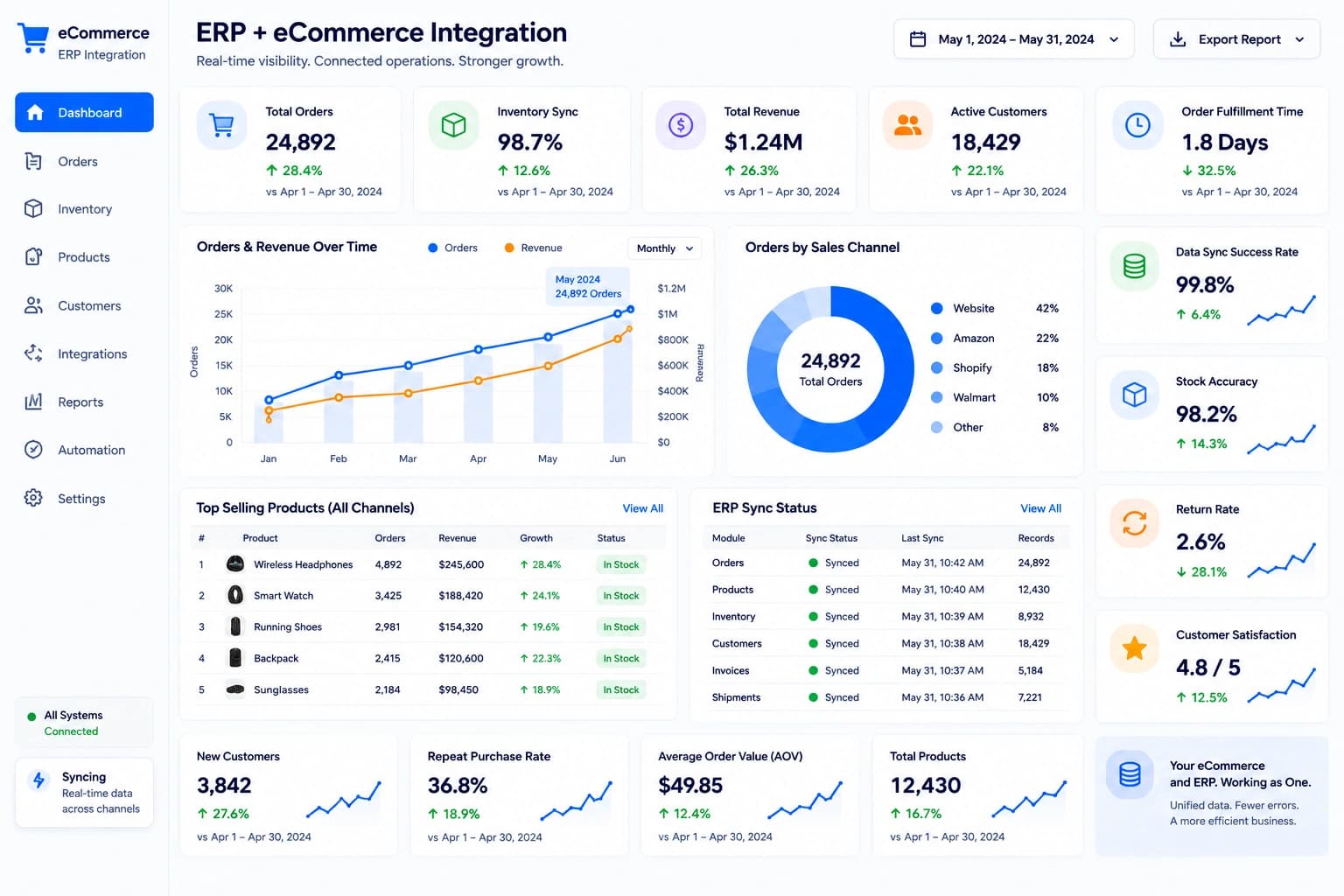
Connect ecommerce orders with ERP sales orders, customers, payments, taxes, discounts, and downstream operational workflows.
Align ecommerce availability with ERP inventory, reservations, locations, receipts, transfers, and adjustments.
Connect approved product, account, pricing, tax, and customer information without creating unnecessary duplicate ownership.
Keep shipment, return, refund, invoice, financial, and reporting information aligned across the commerce operation.
ERP Integration Problems Usually Appear Between Ecommerce and Business Operations
The ecommerce platform may handle customer transactions effectively while ERP manages inventory, purchasing, fulfillment, finance, and other core business functions.
Problems begin when employees still need spreadsheets, manual entry, exports, email, and repeated reconciliation to make the systems work together.
Ecommerce Orders Are Re-entered Into ERP
Employees manually create or correct ERP transactions because orders do not flow reliably from ecommerce.
Online Inventory Does Not Match ERP Reality
Ecommerce shows inventory that has already been sold, reserved, transferred, damaged, received, or committed elsewhere.
Product Information Is Maintained Twice
SKUs, products, pricing, units, status, and other information are updated separately because system ownership is unclear.
Customer Records Become Duplicated
Guest customers, registered accounts, B2B customers, addresses, and ERP account records do not align consistently.
Fulfillment Status Does Not Reach Ecommerce
ERP or warehouse systems show the actual order state while customers and service teams still see outdated ecommerce information.
Finance Still Reconciles Transactions Manually
Payments, invoices, refunds, taxes, shipping charges, discounts, and credits require recurring manual reconciliation.
Operational Clarity
Not sure whether the problem comes from ERP, ecommerce, integration logic, data ownership, or the operating workflow between them?
ERP Integration Should Connect the Transaction With the Operation Behind It
An ecommerce order does not end at checkout.
The business may still need to validate the order, allocate inventory, create an ERP transaction, release fulfillment, update shipment status, process returns, issue credits, reconcile payments, and report the financial result.
Those activities may span several systems.
That is why Gyan approaches ecommerce ERP integration around the complete transaction workflow rather than treating integration as simple data transfer.
Key Insight
The goal is not to synchronize everything. The goal is to move the right information between the right systems at the point where the operation needs it.
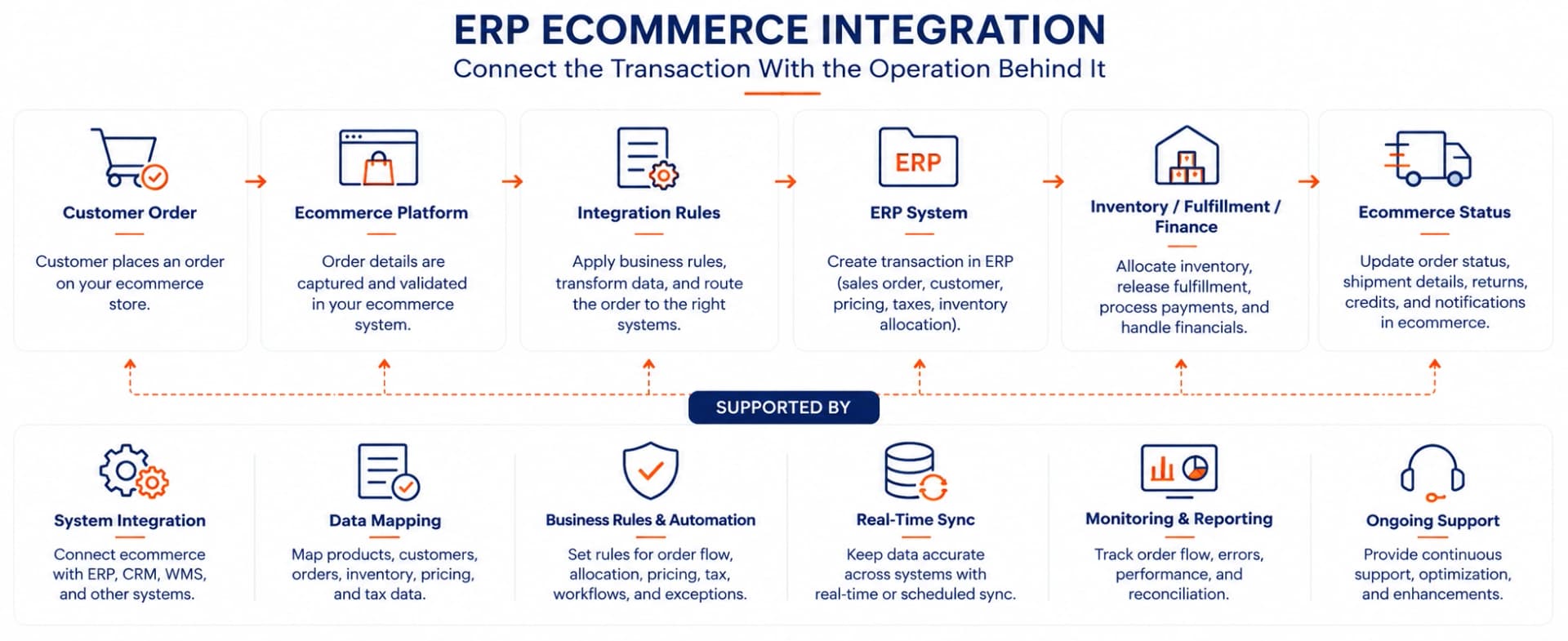
Customer Order → Ecommerce → Integration Rules → ERP → Inventory / Fulfillment / Finance → Ecommerce Status
Two Focused Ways to Improve Ecommerce & ERP Operations
Some organizations know ecommerce and ERP are creating manual work or inconsistent information but are not yet certain what should change.
Others already have a defined ERP integration requirement and need implementation.
Operational Review & Improvement
For ecommerce teams that need clarity across orders, inventory, customers, products, fulfillment, finance, reporting, system ownership, and data flow before deciding what should be integrated.
 Map how ecommerce transactions currently move into ERP and through fulfillment, inventory, finance, returns, and reporting.
- Identify where duplicate entry, inconsistent records, manual reconciliation, unclear ownership, or synchronization failures create friction.
- Define which system should own each important record and what information genuinely needs to move between systems.

Operational Review & Improvement can stand alone from assessment and redesign through prioritized ecommerce and ERP operational improvements.
Technology & AI Implementation
For organizations with a defined need to connect ecommerce with ERP and related operational systems.
- Turn the requirement into a practical integration plan with defined systems, mappings, triggers, rules, statuses, and exception handling.
- Connect orders, products, inventory, customers, fulfillment, returns, financial information, and other required data.
- Build APIs, middleware, synchronization, automation, monitoring, and exception workflows around actual commerce operations.
Technology & AI Implementation can begin independently or work alongside Operational Review & Improvement.
Ecommerce ERP
Integration Experience
Our ERP integration work is shaped by how customer transactions move into inventory, fulfillment, finance, customer service, reporting, and wider business operations.
We examine how ecommerce platforms, ERP, CRM, OMS, WMS, POS, marketplaces, payment systems, shipping tools, databases, and reporting environments interact around those transactions.
This reveals where data ownership, mappings, synchronization, workflow logic, exception handling, or focused implementation need to improve.
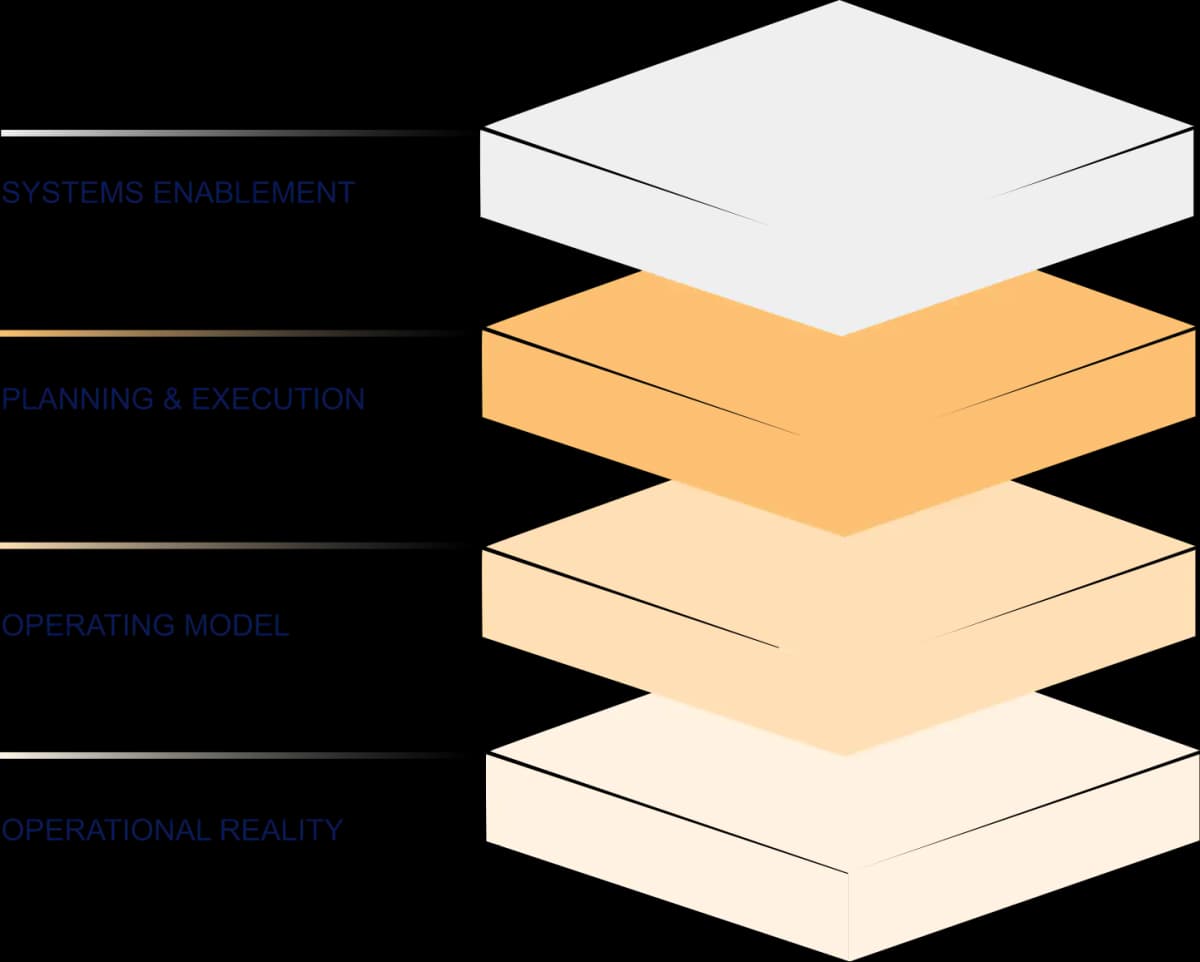
Where Ecommerce & ERP Integration Becomes Connected
We focus on the parts of ecommerce where customer transactions and ERP-driven operations depend on the same information.
Order Integration
Ecommerce orders often become the starting point for inventory, fulfillment, finance, customer service, and reporting workflows inside ERP.
What We Examine
- Ecommerce order identifiers
- ERP transaction creation
- Products and quantities
- Customer information
- Pricing
- Discounts
- Taxes
- Shipping charges
- Payment status
- Fulfillment method
- Duplicate prevention
- Order acknowledgement
Desired Outcome
Move ecommerce orders into ERP accurately without repeated manual entry or duplicate transactions.
Inventory & Availability
ERP often holds important inventory information while ecommerce needs to know what can realistically be sold. On-hand inventory alone may not represent true customer availability.
What We Examine
- On-hand inventory
- Available-to-sell inventory
- Reserved inventory
- Committed inventory
- Inventory by warehouse
- Inventory by store or location
- Receipts
- Transfers
- Adjustments
- Backorders
- Safety stock
- Synchronization timing
Desired Outcome
Keep ecommerce availability aligned with the inventory conditions the business actually uses to accept and fulfill orders.
Product & Item Data
Product information may originate in ERP, ecommerce, PIM, or another product-management environment. The integration should preserve clear ownership instead of maintaining every field everywhere.
What We Examine
- SKUs
- ERP item identifiers
- Ecommerce product identifiers
- Variants
- Units of measure
- Product status
- Categories
- Pricing references
- Product mappings
- Product creation workflows
- Updates
- Source-system ownership
Desired Outcome
Create clear ownership and mapping for product information while reducing repeated maintenance across systems.
Customer & Account Data
Ecommerce customers may need to become ERP customer or account records, particularly in B2B environments. Poor matching rules can quickly create duplicate and conflicting information.
What We Examine
- Guest customers
- Registered accounts
- B2B accounts
- Customer identifiers
- Billing addresses
- Shipping addresses
- Contact information
- Account hierarchy
- ERP account creation
- Duplicate detection
- CRM relationships
- Data ownership
Desired Outcome
Align customer and account information without creating unnecessary duplicate records or unclear ownership.
Pricing & Commercial Rules
Pricing, discounts, tax, freight, and customer-specific commercial rules may originate in ecommerce, ERP, or both. The integration needs to preserve the commercial result of the transaction.
What We Examine
- Base pricing
- Customer-specific pricing
- B2B pricing
- Promotions
- Discounts
- Coupons
- Taxes
- Shipping charges
- Currency
- ERP price lists
- Pricing ownership
- Transaction mappings
Desired Outcome
Keep commercial values consistent across ecommerce and ERP while preserving clear ownership of pricing and calculation logic.
Fulfillment & Shipment Status
Once an order enters ERP, fulfillment may continue through ERP, OMS, WMS, stores, warehouses, carriers, or other systems. Relevant information then needs to return to ecommerce.
What We Examine
- Order release
- Inventory allocation
- Fulfillment location
- Pick status
- Pack status
- Shipment creation
- Carrier information
- Tracking
- Partial fulfillment
- Backorders
- Cancellations
- Completion status
Desired Outcome
Keep ecommerce, customer service, and operational teams aligned with the actual fulfillment status.
Returns & Financial Workflows
Returns affect more than the ecommerce order. They may change inventory, payments, credits, invoices, tax, revenue, and financial reporting inside ERP.
What We Examine
- Return requests
- Return authorization
- Returned inventory
- Product disposition
- Refunds
- Credit notes
- Invoice adjustments
- Payment adjustments
- Taxes
- ERP updates
- Ecommerce status
- Financial reconciliation
Desired Outcome
Connect post-purchase transactions with inventory and financial workflows so ecommerce and ERP remain aligned.
Monitoring & Exceptions
Integration does not eliminate operational exceptions. Orders can fail, APIs can become unavailable, mappings can be missing, records can conflict, and data can arrive in unexpected states.
What We Examine
- Failed orders
- Duplicate records
- Inventory synchronization errors
- Product mapping failures
- Customer mapping failures
- Invalid ERP records
- API errors
- Authentication failures
- Retry rules
- Alerts
- Integration logs
- Exception ownership
Desired Outcome
Make integration failures visible and manageable instead of allowing problems to remain hidden between ecommerce and ERP.
Implement Around the Ecommerce & ERP Workflow the Business Needs
Technology should support a defined commerce requirement. Once the need is clear, Gyan can plan, build, connect, or improve the relevant ERP integration layer.
Order Integration
Connect ecommerce transactions with ERP sales orders, customers, fulfillment, inventory, and financial workflows.
Inventory Synchronization
Align ERP inventory with ecommerce availability across warehouses, stores, locations, and channels.
Product & Customer Integration
Connect approved product, customer, account, pricing, and other required business information.
Fulfillment & Status Integration
Move relevant ERP, warehouse, shipment, tracking, and fulfillment status back to ecommerce.
Returns & Financial Integration
Connect returns, refunds, credits, invoices, payment updates, and other post-purchase transactions.
Integration Monitoring & Automation
Implement logs, alerts, retries, reconciliation, exception queues, and operational monitoring.
Already Know What Needs to Be Connected?
Turn the ERP integration requirement into a practical implementation plan.
AI Should Support a Defined ERP Workflow—not Replace Transaction Logic
AI can help ecommerce and ERP teams retrieve information, organize exceptions, summarize operational context, and support investigation.
It should not replace reliable integration rules for orders, inventory, pricing, financial transactions, or other controlled system updates.
Integration Exception Support
Summarize failed transactions, missing mappings, synchronization problems, or unusual records so employees can investigate more efficiently.
Product Data Support
Assist with product categorization, normalization, attribute comparison, and incomplete-data identification where appropriate.
Customer-Service Context
Help authorized employees retrieve relevant ecommerce, order, fulfillment, return, or account information across connected systems.
Operational Knowledge Support
Help users retrieve approved ERP, ecommerce, integration, and exception-handling procedures.
Reporting & Analysis Support
Assist teams with investigating unusual order, inventory, return, reconciliation, or integration patterns.
Trust Statement
Before applying AI, Gyan assesses system ownership, data quality, business rules, transaction boundaries, access requirements, and human oversight.
When an Ecommerce ERP Integration Fit Call Makes Sense
Use the call to clarify an operating problem or discuss a defined integration requirement.
When You Need Operational Clarity
- Ecommerce orders are manually entered into ERP.
- Online inventory repeatedly differs from ERP inventory.
- Product or customer records are maintained separately.
- Fulfillment status does not reliably return to ecommerce.
- Finance spends significant time reconciling ecommerce activity.
- Teams are unsure which system should own important information.
When the Requirement Is Clear
- Ecommerce orders need to create ERP transactions automatically.
- ERP inventory needs to update ecommerce availability.
- Product or customer information needs synchronization.
- Fulfillment and tracking information needs to flow back to ecommerce.
- Returns and refunds need to update ERP.
- Integration monitoring and exception handling need implementation.
A Clear Starting Point Without a Forced Sequence
Start with Operational Review & Improvement, Technology & AI Implementation, or both based on how clearly the ERP integration requirement is already defined.
Ecommerce ERP Integration Fit Call
We discuss the ecommerce platform, ERP, orders, inventory, customers, products, fulfillment, returns, finance, reporting, current manual work, and any requirement already identified.
Engagement Scope
We define whether the work should focus on Operational Review & Improvement, Technology & AI Implementation, or both. The systems, records, mappings, triggers, synchronization rules, exceptions, responsibilities, priorities, timeline, and delivery approach are agreed before work begins.
Review, Implementation, or Both
We deliver the agreed work—from workflow and system review through integration design, APIs, middleware, synchronization, automation, monitoring, testing, reconciliation, and rollout.
30-minute call
No obligation
Review and implementation scoped separately
Who This Is For
This service is designed for established ecommerce and retail organizations where customer transactions need to connect reliably with ERP-driven inventory, fulfillment, finance, customer, and reporting operations.
Typical Environments
Ecommerce brands using ERP
Omnichannel retailers
Multi-location retailers
B2B ecommerce and distribution
Grocery and food commerce
Businesses with meaningful ecommerce transaction volume
Organizations using multiple warehouses or fulfillment locations
Businesses manually reconciling ecommerce and ERP activity
Organizations changing ecommerce platforms around an existing ERP
A Different Provider May Be Better If
You only need an ecommerce plugin installed
You only need an ERP account configured
You only need product information entered manually
Your ecommerce and ERP already exchange the required information reliably
There is no operating workflow or systems-integration requirement behind the project
Connect Ecommerce and ERP Operations
Clarify the systems, data, workflows, and ownership before defining the integration.
Discuss Your ERP Integration Requirement→

30-minute call

No obligation

Consulting and implementation scoped separately
Find the Right Ecommerce Operational Starting Point
ERP integration should follow the transaction and workflows the business actually needs to coordinate. Explore the operational process or connected commerce system closest to where information stops moving reliably.
Explore by Operational Focus
Ecommerce Order Management
Clarify how ecommerce orders should move through validation, ERP creation, allocation, release, fulfillment, status, exceptions, and completion.
Inventory Management & Fulfillment
Align online availability with reservations, receipts, transfers, adjustments, warehouse activity, allocation, and the inventory reality maintained across business systems.
Returns Management & Customer Service
Connect returns, refunds, credits, inventory recovery, order status, and customer-service information with the transaction history behind the original sale.
Ecommerce Analytics & Reporting
Reconcile ecommerce and ERP information around orders, revenue, refunds, inventory, fulfillment, finance, and other measures leadership needs to trust.
Explore by Technology & Integration
Ecommerce Analytics Dashboard
Turn connected ERP and ecommerce data into management views covering revenue, orders, inventory, fulfillment, customers, and operational exceptions.
Ecommerce Marketplace Integration
Carry marketplace orders, inventory, products, returns, and fulfillment activity into the same operational systems supporting direct ecommerce.
Ecommerce POS Integration
Coordinate store, ecommerce, and ERP information where inventory, customers, orders, returns, and financial activity cross physical and digital channels.
Retail Software Development
Build middleware, internal tools, exception workflows, portals, or specialized applications where integration requirements extend beyond standard platform capabilities.
Common Questions
What is ecommerce ERP integration?
Ecommerce ERP integration connects an ecommerce platform with an ERP so required information such as orders, inventory, products, customers, fulfillment, returns, invoices, and financial transactions can move between the systems.
Can ecommerce orders automatically create ERP orders?
Yes, where the platforms provide appropriate technical access.The integration can validate and map the ecommerce transaction before creating the required ERP record.
Can ERP inventory update ecommerce automatically?
Yes.Inventory synchronization can use defined rules around on-hand inventory, available-to-sell quantities, reservations, warehouses, locations, safety stock, and other relevant conditions.
Which system should own inventory?
That depends on the environment.In many organizations, ERP, WMS, or another inventory platform owns inventory while ecommerce receives the availability required for customer transactions.Ownership should be defined before implementation.
Can product information be synchronized?
Yes.Products, SKUs, variants, pricing references, status, units of measure, and other required fields can be synchronized where appropriate.The first step is determining which system is authoritative for each field.
Can customer information be integrated with ERP?
Yes.Customer and account information can potentially be created or updated in ERP from ecommerce where the workflow requires it.B2B account structures may require additional mappings and rules.
Can fulfillment and tracking flow back to ecommerce?
Yes.ERP, OMS, WMS, shipping, or other operational systems can provide relevant fulfillment and shipment information back to ecommerce where supported.
Can ecommerce returns and refunds update ERP?
Yes.Return, refund, inventory, credit, invoice, and other relevant transaction information can be integrated where supported by the systems and workflow.
Can Gyan integrate Shopify with ERP?
Yes, where Shopify and the ERP provide appropriate technical access.The implementation depends on the ERP, required data, transaction volume, workflow, existing applications, and business rules.
Can you integrate WooCommerce, Magento or BigCommerce with ERP?
Yes, where the required APIs or other supported integration methods are available.
Which ERP systems can Gyan integrate with?
Gyan can support environments including NetSuite, Microsoft Dynamics, Odoo, and other ERP platforms where appropriate technical access is available.
Do we need middleware?
Not always.Some integrations can use direct APIs. More complex environments may benefit from middleware because of transaction volume, transformations, monitoring, exception handling, or multiple connected systems.
How are integration failures handled?
A reliable implementation should include monitoring and exception handling.Failed transactions, missing mappings, API errors, duplicates, invalid information, and synchronization problems should be visible to the appropriate team.
Do we need an Operational Review before ERP integration?
No.If the systems, ownership, mappings, rules, workflows, and desired outcome are already defined, Gyan can move directly into Technology & AI Implementation.Operational Review & Improvement is useful when the ecommerce/ERP operating model still needs clarification.
Discuss Your Ecommerce ERP Integration Requirement
Tell us which ecommerce platform, ERP, orders, inventory, products, customers, fulfillment, returns, financial, reporting, or other systems need to work together. We'll use the initial conversation to understand the workflow, system ownership, data requirements, operational exceptions, and whether the right starting point is Operational Review & Improvement, Technology & AI Implementation, or both.
Focused on your goals
You decide the next step.
Consulting & implementation