

RETURNS MANAGEMENT & CUSTOMER SERVICE
Connect Returns, Refunds, and Customer Service Around a Clear Resolution Workflow
Returns and customer-service issues often move across ecommerce, order systems, warehouse teams, finance, shipping providers, CRM, email, spreadsheets, and customer-service platforms before they are actually resolved.
Gyan Solutions reviews how customer issues and returns move from request through validation, operational action, refund or exchange, inventory recovery, and final resolution—then identifies the workflow, system, reporting, and implementation improvements needed to make the process clearer for both customers and internal teams.
Review and implementation are scoped separately.
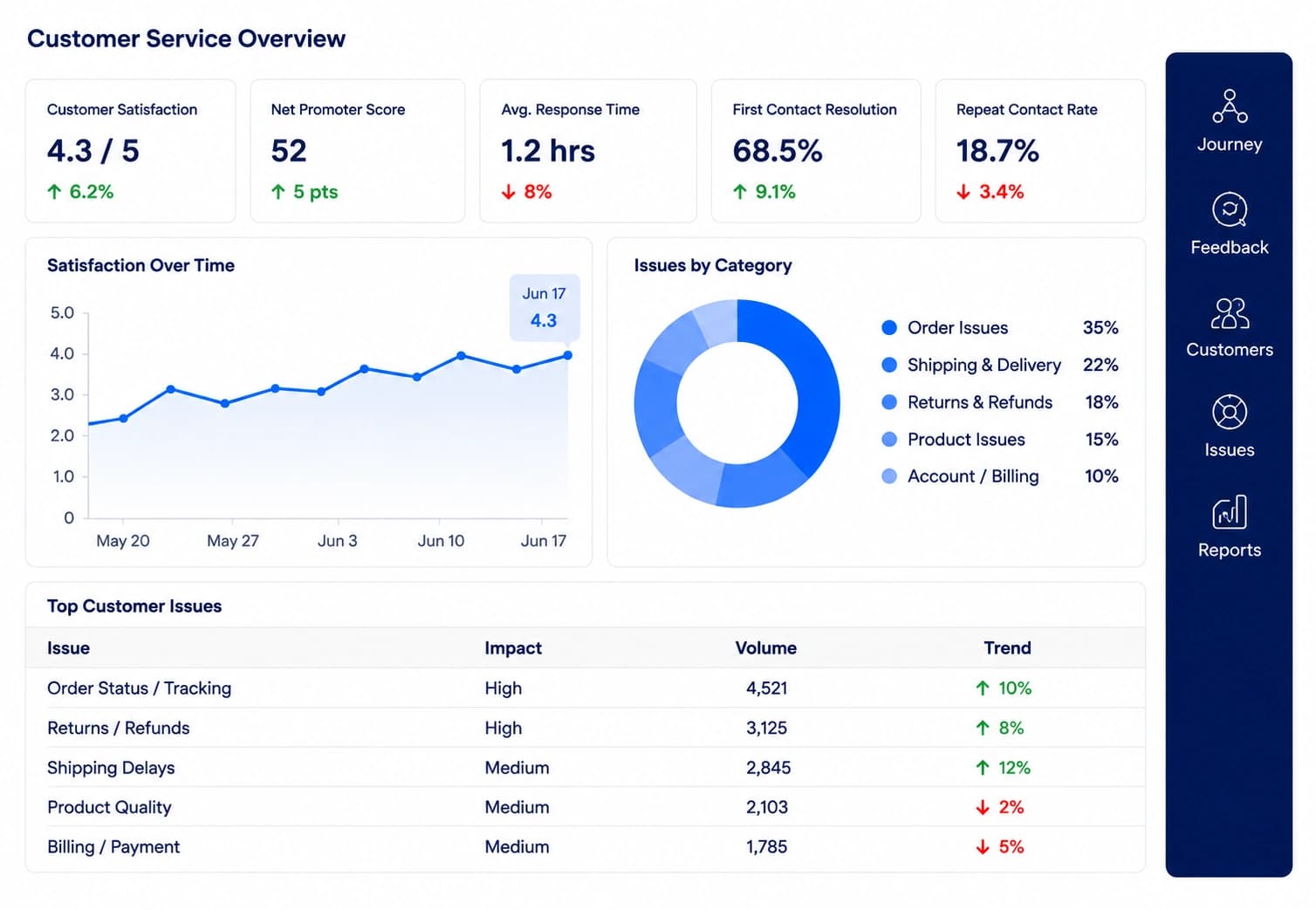
Customers repeatedly contact support because return, refund, replacement, or case status is unclear.
Service teams depend on operations, warehouses, finance, or shipping teams to resolve routine customer issues.
Returns move through approvals, shipping, receiving, inspection, refunds, and updates without clear end-to-end ownership.
Teams resolve individual cases while the operational causes behind recurring contacts, returns, and complaints remain unchanged.
Customer Service Connected to the Operation Behind the Issue
End-to-End Resolution Review
We examine what happens from the first customer request through ownership, operational action, return processing, refund or exchange, and final resolution.
Cross-Team Workflow Perspective
Customer-service problems are reviewed across ecommerce, CRM, orders, warehouse operations, finance, shipping, returns, and reporting—not as isolated support-ticket issues.
Review Through Implementation
When improvement requires integration, automation, customer portals, reporting, AI-assisted workflows, or custom tools, Gyan can support implementation once the requirement is defined.
CONNECTED SERVICE OPERATIONS
Customer Service Is Often Where Operational Problems Become Visible
Customers usually contact support because something earlier in the operation has already gone wrong: a delayed order, missing item, damaged product, unclear return, stalled refund, or inconsistent information.
The service team is then forced to coordinate across orders, warehouse operations, shipping, inventory, finance, and other teams to find the answer and move the issue forward.
We trace those recurring problems back to the workflow, ownership, and information gaps creating them so the business can improve resolution at the source.
The goal is not simply faster support. It is a clearer, more reliable customer-resolution operation.
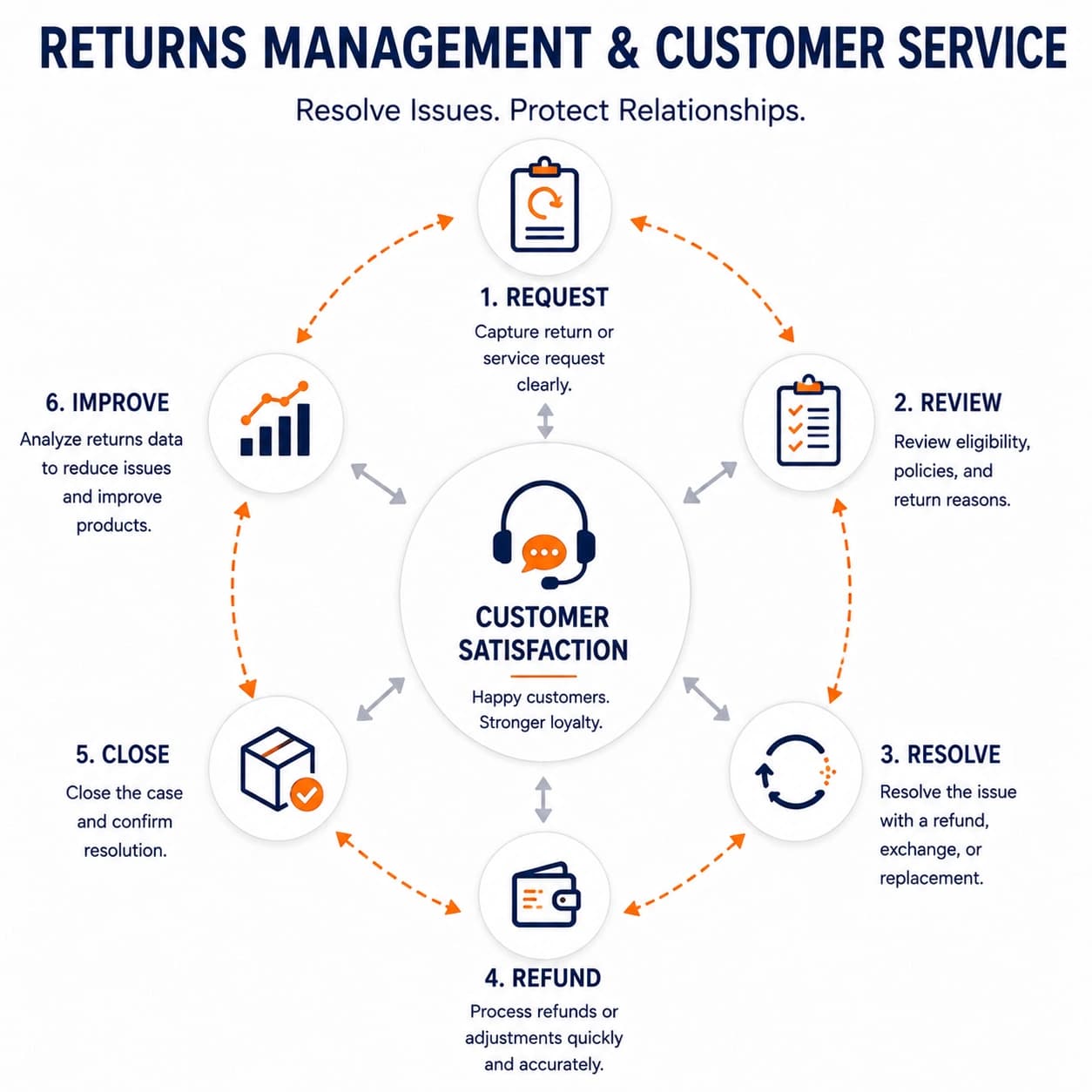
Why This Matters
Better service starts when teams can resolve the issue without chasing information or ownership.
Where We Review the Customer Resolution Workflow
Review how customer issues move from request and ownership through returns, refunds, operational action, escalation, self-service, and reporting.
Customer Request Intake
Review how customer questions, complaints, order issues, and return requests enter the business.
Review
- Phone
- Web forms
- Ecommerce account
- Chat
- Marketplaces
- Social channels where applicable
- Store requests
- B2B account requests
- Support tickets
- Return requests
- Order-related inquiries
- Issue categorization
- Required customer information
Outcome
Create a clearer intake process so the issue is captured with the information required to route and resolve it.
Case Ownership & Routing
Review how customer issues move to the person or team responsible for resolving them.
Review
- Request classification
- Support ownership
- Order-related routing
- Warehouse escalation
- Finance escalation
- Sales escalation
- Technical escalation
- Shipping issues
- Product issues
- Priority rules
- Service-level expectations
- Reassignment
- Status ownership
- Unresolved-case escalation
Outcome
Reduce the time spent forwarding messages and determining who should own the next step.
Reverse Logistics
Review how returned products physically move back into the operation.
Review
- Return labels
- Carrier handoff
- Customer drop-off
- Store return
- Warehouse return
- Return tracking
- Receiving
- Returned-product identification
- Return status
- Warehouse queue
- Return exceptions
- Missing packages
- Damaged shipments
Outcome
Create clearer visibility between the customer's return request and the point where the product is physically received and ready for operational action.
Return Inspection & Disposition
Review what happens after returned inventory reaches the warehouse, store, or other receiving location.
Review
- Product verification
- Condition assessment
- Damaged inventory
- Resale eligibility
- Restocking
- Repair routing
- Vendor return
- Disposal
- Quarantine where applicable
- Inventory adjustment
- Product discrepancy
- Disposition approval
- System update
Outcome
Create a defined path for determining what happens to returned inventory and ensuring the appropriate system status is updated.
Refunds, Credits & Exchanges
Review how the financial and order-side resolution is completed after the required conditions are met.
Review
- Refund approval
- Payment-method refund
- Partial refund
- Store credit
- Account credit
- Exchange
- Replacement order
- Shipping refund
- Promotional adjustments
- Tax adjustments
- Finance handoff
- Payment reconciliation
- Refund confirmation
- Customer communication
Outcome
Reduce delays and uncertainty between operational completion of the return and the financial resolution the customer expects.
Customer Service Information Access
Review whether customer-facing employees can see the information required to answer common questions and resolve issues.
Review
- Customer profile
- Order history
- Current order status
- Shipment information
- Inventory availability
- Return status
- Refund status
- Previous support interactions
- Account information
- Invoices
- Fulfillment status
- Marketplace orders
- Product information
- Internal notes
Outcome
Give customer-facing teams a clearer operational view so they do not need to contact other departments for information that should already be available.
Escalations & Exceptions
Review how cases are handled when the normal service or return workflow cannot resolve the issue.
Review
- Missing order information
- Disputed delivery
- Lost shipment
- Damaged products
- Repeated returns
- Refund failure
- Unusual return request
- High-value order
- Inventory discrepancy
- Unresolved complaint
- System mismatch
- Policy exception
- Repeat contact
- Customer escalation
Outcome
Define who owns unusual cases, what information they need, and when escalation should occur.
Customer Self-Service
Review which common requests customers should be able to complete without waiting for manual assistance.
Potential Areas
- Start a return
- Check return eligibility
- Print or access a return label
- Track return status
- View refund status
- Check order status
- Access invoices
- View order history
- Update account information
- Submit service requests
- Access approved product information
- Find support information
Outcome
Identify where portals, workflow improvements, integrations, automation, or approved AI support can reduce customer effort and repetitive support work.
Service & Returns Reporting
Review whether leadership can see why customers are contacting the business and where returns or service demand are originating.
Potential Measures
- Contact volume
- Contact reason
- Return volume
- Return rate
- Return reason
- Refund volume
- Refund processing time
- Exchange volume
- Repeat contacts
- Unresolved cases
- Escalation volume
- Resolution time
- Order issues
- Fulfillment issues
- Product issues
- Damaged-item frequency
- Channel-specific issues
- Return disposition
- Customer-service backlog
Outcome
Turn customer-service and return activity into operational information that can help identify recurring problems upstream.
Follow the Issue From Customer Request to Final Resolution
Capture
Collect customer, order, product, and issue details needed to begin resolution clearly.
Understand
Confirm what happened, current status, ownership, and the resolution likely required next.
Route
Assign the case to the right team, workflow, and accountable owner quickly.
Act
Complete required actions across service, warehouse, shipping, finance, or operations teams promptly.
Resolve
Complete the return, refund, exchange, replacement, correction, or approved resolution fully properly.
Close
Confirm final outcomes, update systems, inform customers, and capture recurring causes clearly.
When Customer Service Becomes the Coordination Layer
Customer service may appear to be functioning while representatives spend significant time checking systems, contacting other teams, following refunds, tracing returns, and explaining operational delays to customers.
A closer review helps identify where information, ownership, or resolution workflows are creating unnecessary service demand and repeated internal coordination.
Signs the Resolution Workflow Needs Attention
 Customers repeatedly contact support about the same unresolved issue.
- Service teams depend on other departments for routine information.
- Returns or refunds require repeated manual follow-up.
- Case ownership becomes unclear once another team is involved.
- Customers receive different answers depending on who handles the request.
- The same service or return problems continue appearing without corrective action.
Why This Matters
Service becomes expensive when support teams must compensate for gaps elsewhere in the operation.
Turn Customer Issues Into a Clearer Resolution Model
Customer Resolution Map
Document how requests, complaints, returns, refunds, exchanges, and exceptions move across teams and systems.
Ownership & Escalation Model
Clarify which team owns each stage of the customer-service and return workflow and when escalation is required.
Returns Workflow
Define the path from customer request through authorization, physical return, inspection, disposition, refund or exchange, and completion.
Customer Information Model
Clarify what customer, order, fulfillment, return, and refund information support teams need to resolve common cases.
Service KPI Framework
Define the operational measures needed to monitor case volume, reasons, backlog, resolution time, returns, refunds, and recurring issues.
Prioritized Improvement Roadmap
Organize workflow, system, reporting, integration, automation, self-service, and implementation opportunities by priority and dependency.
REVERSE OPERATIONS
A Return Is an Operational Workflow Running in the Opposite Direction
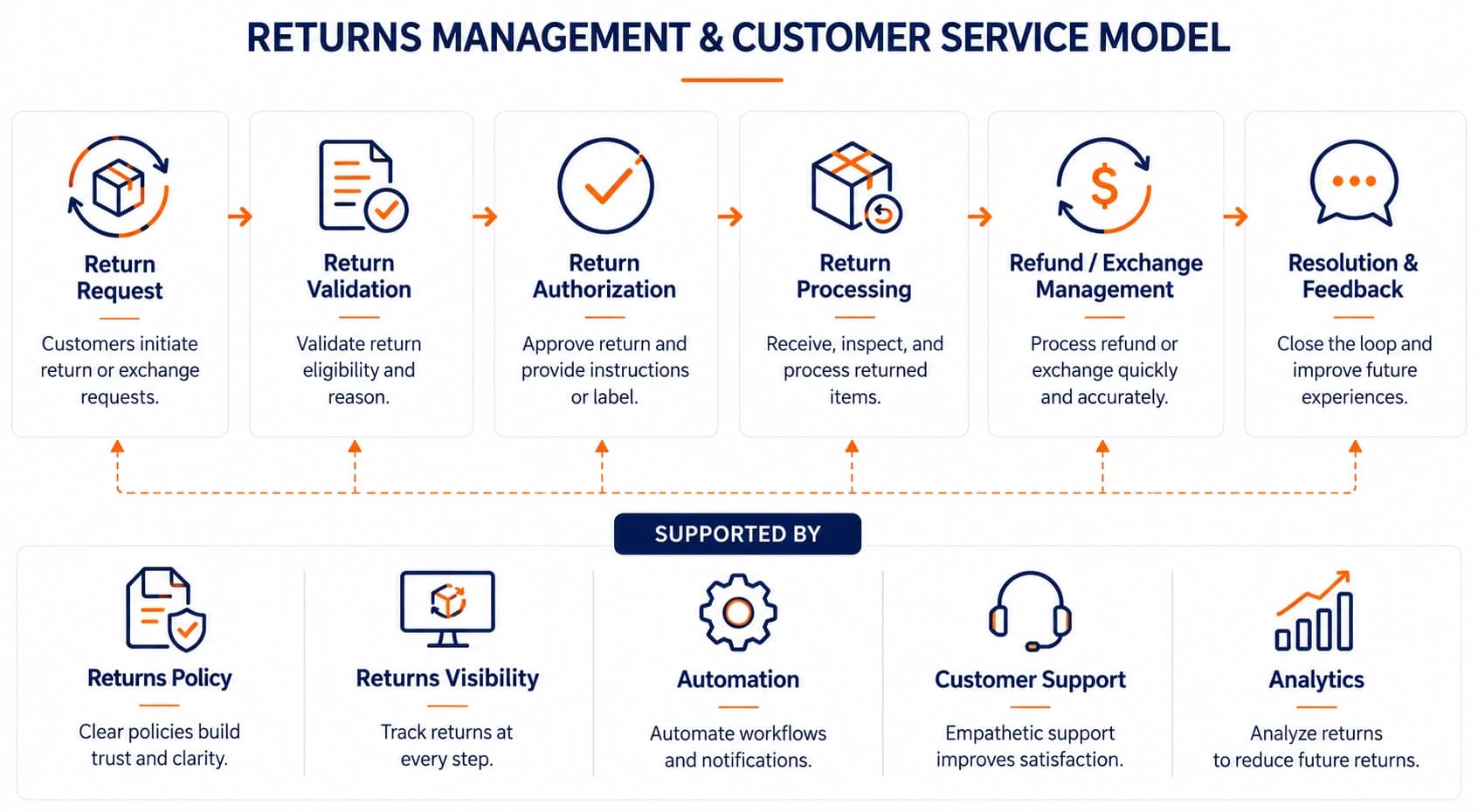
A return begins with a customer request, but resolution may require authorization, shipping, receiving, inspection, disposition, inventory updates, financial action, and customer communication.
When those steps operate separately, teams lose visibility into what has happened, who owns the next action, and when the customer can expect resolution. We review the complete return workflow so the customer outcome and internal operational actions remain connected.
The return is complete only when the product, transaction, systems, and customer resolution are aligned.
Give Customer Service the Information Needed to Resolve the Issue
Customer Context
Who is the customer and what is the history of the relationship?
Order Context
What was ordered, paid, allocated, fulfilled, shipped, or delivered?
Operational Context
What is currently happening in inventory, warehouse, fulfillment, return, or refund workflows?
Resolution Context
What action is allowed, who owns it, and what needs to happen next?
When support teams can access the right information and workflow, fewer cases require manual coordination across the business.
The Best Customer Service Improvement May Happen Before the Customer Contacts You
Recurring Issues Reveal the Real Problem
Repeated contacts can point to deeper issues in availability, order communication, fulfillment, shipping, product information, returns, refunds, or customer data.
Service Data Shows Where Work Is Breaking
Support and returns activity can reveal where workflows, ownership, information, or system handoffs are creating avoidable customer effort.
Fixing the Cause Reduces Future Demand
The goal is not only to resolve today’s case, but to reduce repeat contacts by improving the operational issue creating them.
How a Returns Management & Customer Service Engagement Works
Returns & Customer Service Fit Call
We discuss your customer-service channels, order volumes, return volume, support systems, warehouse and finance handoffs, recurring customer issues, and where your team is spending unnecessary time.
Service & Returns Workflow Review
We map how customer requests move across ecommerce, CRM, customer service, orders, warehouse operations, shipping, returns, inventory, finance, and reporting. We identify where information, ownership, workflow, or system handoffs are creating delays or repeated customer effort.
Improvement Roadmap & Implementation Direction
We define the prioritized workflow, reporting, integration, automation, self-service, system, and implementation improvements required to create a clearer customer-resolution operation.
30-minute call
No obligation
Review and implementation scoped separately
Who We Work With
We work with ecommerce businesses where customer issues and returns move across multiple teams, systems, channels, warehouses, or financial workflows.
This Tends to Be a Strong Fit If
Support teams regularly chase other departments for customer information.
Returns, refunds, or exchanges require repeated manual coordination.
Cases remain open while operational work happens elsewhere.
Recurring customer issues are resolved individually without addressing their underlying cause.
This May Not Be the Right Fit If
You only need outsourced customer-service agents or call-center staffing.
You only need someone to answer customer emails or messages.
You need a basic helpdesk configuration without a broader workflow problem.
You want new service technology without reviewing the resolution process behind it.
Not Sure Where Resolution Is Slowing Down?
Start with a fit call to identify whether the constraint sits in information, ownership, returns, refunds, escalations, or cross-team handoffs.
When Better Customer Resolution Requires Implementation
Ecommerce Systems Integration
Connect ecommerce, CRM, ERP, OMS, WMS, helpdesk, shipping, inventory, finance, and reporting so support teams have better information.
Ecommerce Workflow Automation
Automate defined case routing, notifications, return approvals, status updates, escalation, refund handoffs, and other repeatable workflows.
Customer Portals & Self-Service
Create customer workflows for returns, order status, invoices, account information, return tracking, support requests, and other defined use cases.
Commerce Dashboards & BI
Create reporting around service demand, case reasons, returns, refunds, resolution time, operational causes, and recurring exceptions.
AI for Ecommerce & Retail
Use AI for defined support workflows such as inquiry classification, knowledge retrieval, case summaries, response preparation, customer context, and internal service assistance.
Custom Ecommerce & Retail Software
Build service tools, return-management workflows, exception queues, customer portals, internal applications, and operational interfaces where existing systems do not support the requirement.
Customer Experience and Customer Service Are Connected—but Solve Different Problems
They overlap during service and returns, but they begin with different questions.
Returns Management & Customer Service
Focuses on how customer issues move through intake, ownership, escalation, returns, refunds, exchanges, and operational resolution so teams can move each case toward a clear outcome.

Ecommerce Customer Experience
Focuses on what customers experience across discovery, buying, order communication, fulfillment, service, returns, self-service, and future interactions and where operational gaps make that broader journey harder.
Returns Directly Affect Inventory & Fulfillment
A return does not end when the customer sends the product back. Receiving, inspection, disposition, restocking, damaged stock, and inventory reconciliation determine what happens to that inventory next. For the broader physical inventory and fulfillment operation:
Customer-Service Issues Often Begin With the Order
Order changes, cancellations, partial fulfillment, substitutions, delays, and status problems frequently become customer-service cases. For the broader order lifecycle across validation, allocation, routing, status, exceptions, and ownership:
Selected Case Studies
Real outcomes from our operations consulting and implementation engagements.
See Customer Service & Returns Workflows in Action
Where Is Customer Resolution Breaking Down?
Find where returns, refunds, ownership, information, or handoffs are slowing customer resolution.
Request a Returns & Customer Service Fit Call→

30-minute call

No obligation

Consulting and implementation scoped separately
Find the Right Ecommerce Operational Starting Point
Customer-service and returns problems often connect with orders, inventory, customer experience, systems, reporting, automation, or other operational requirements. Explore the area closest to the issue you are trying to improve.
Explore by Operational Focus
Ecommerce Customer Experience
See how service, returns, refunds, and issue resolution affect the broader customer journey.
Ecommerce Order Management
Connect service cases with order changes, cancellations, shortages, delays, and exceptions that often create them.
Inventory Management & Fulfillment
Connect returned products with receiving, inspection, disposition, restocking, damaged inventory, and reconciliation.
Ecommerce Analytics & Reporting
Use return reasons, service demand, resolution times, and recurring issues as operational performance signals.
Explore by Technology & Integration
AI Chatbot Solutions for Ecommerce
Improve self-service for appropriate order, return, account, and routine customer questions.
Software Development for Ecommerce
Build service workflows, return portals, case tools, and integrations around defined resolution requirements.
Ecommerce POS Integration
Connect online and store returns, exchanges, orders, customer records, and inventory updates.
ERP and Ecommerce Integration
Connect refunds, returned inventory, orders, financial records, and downstream operational actions.
Common Questions
What is ecommerce returns management?
Ecommerce returns management is the process of handling a return from customer request through eligibility, authorization, reverse shipping or drop-off, receiving, inspection, disposition, inventory update, refund or exchange, and final reconciliation.Gyan reviews both the operational workflow and the systems supporting that process.
Can Gyan help improve customer-service operations?
Yes.Gyan can review how customer requests are captured, classified, assigned, escalated, resolved, measured, and connected with ecommerce, orders, warehouse operations, finance, inventory, CRM, and other systems.
Does Gyan provide outsourced customer-service agents?
No.Gyan improves the operational workflows, systems, information, automation, reporting, and tools used by customer-service teams.This service is not positioned as call-center or customer-service staffing.
Can Gyan help reduce customer-service volume?
Potentially.Part of the review is identifying recurring reasons customers contact the business and determining whether better communication, self-service, system visibility, workflow improvements, automation, or upstream operational changes can reduce avoidable contacts.
Can you help improve refund processing?
Yes.The review can examine how refund requirements move between customer service, warehouse operations, order systems, finance, payment platforms, and customer communication.
Can you help improve return visibility?
Yes.Gyan can review return statuses, ownership, warehouse receiving, inspection, disposition, refund status, system synchronization, and reporting so teams have a clearer view of where each return stands.
Can customer-service workflows be automated?
Yes, where the underlying rules are clear.Potential automation may include request classification, routing, notifications, return workflows, status updates, escalation, information retrieval, reporting, and defined refund handoffs.
Can AI support customer-service workflows?
Yes, where there is a defined use case.AI can assist with inquiry classification, internal knowledge retrieval, case summarization, response preparation, customer context, and other controlled support workflows.
Can you build a customer return portal?
Yes.Where the requirement is defined, Gyan can implement customer self-service workflows for return requests, status, labels, order history, account information, support requests, and other approved functions.
Request a Returns & Customer Service Fit Call
Tell us where customer requests, returns, refunds, escalations, warehouse handoffs, system visibility, or service reporting are creating unnecessary work. We'll use the first 30 minutes to understand the current customer-resolution workflow, systems involved, and where a closer review may be useful.
Focused on your goals
You decide the next step.
Consulting & implementation