

ECOMMERCE ORDER MANAGEMENT
Manage Orders Across Channels, Systems, and Fulfillment Workflows
Ecommerce orders rarely stay inside one platform. An order may move through ecommerce, marketplaces, payment systems, ERP, inventory, warehouse operations, fulfillment partners, customer service, shipping, returns, and financial reporting before it is truly complete.
Gyan Solutions reviews how orders move across those systems and teams, identifies where status, ownership, data, or exceptions break down, and helps improve the workflows and technology required to manage orders more reliably from capture through completion.
Review and implementation are scoped separately.
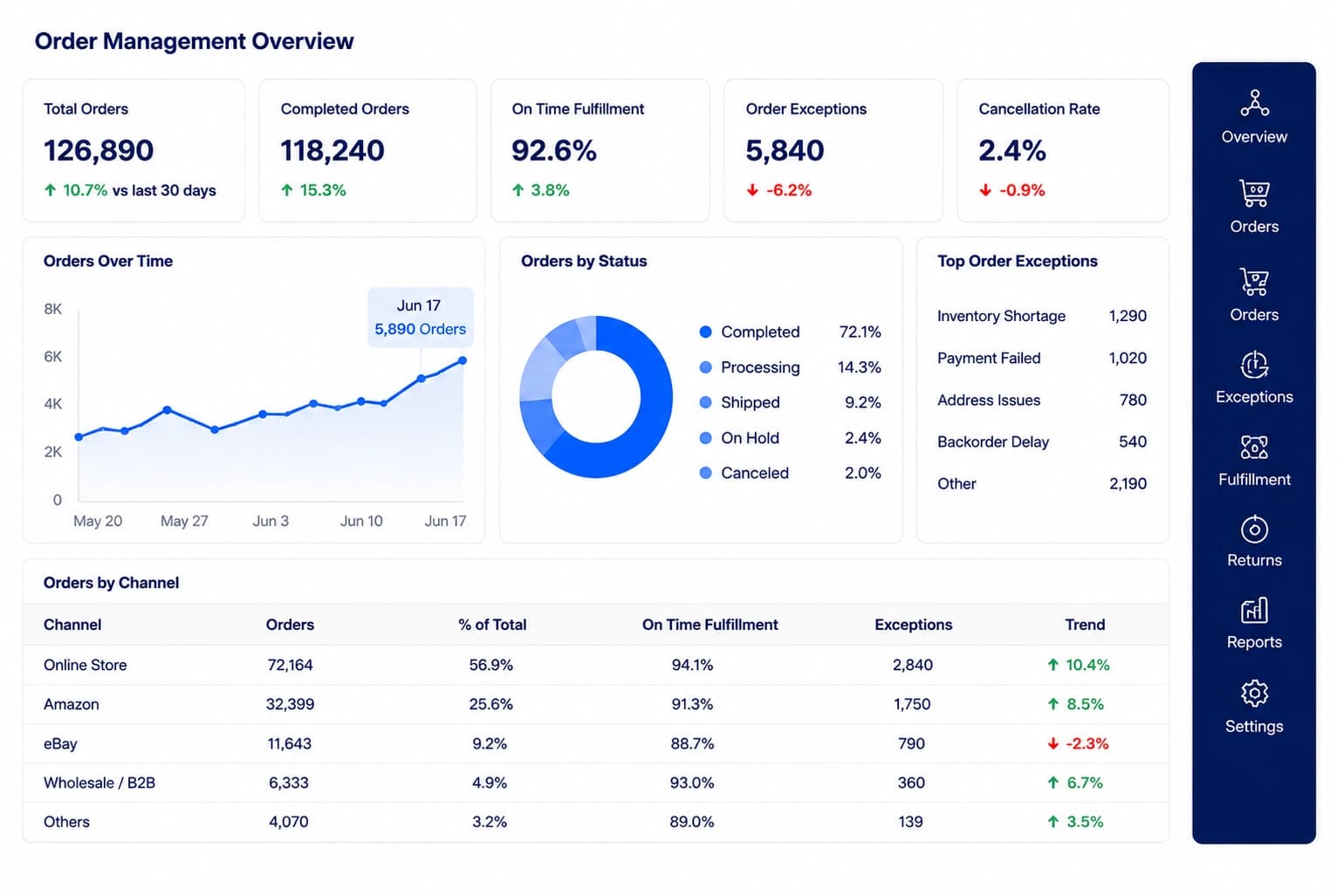
Teams move order information across systems, spreadsheets, email, and channels just to keep orders progressing.
Operations, service, fulfillment, and customers may see different versions of where the same order stands.
Shortages, changes, backorders, cancellations, and payment issues require manual follow-up because ownership is unclear.
Orders from ecommerce, marketplaces, stores, B2B, and other channels follow inconsistent workflows and rules.
Order Management Connected to the Operation Behind It
End-to-End Order Review
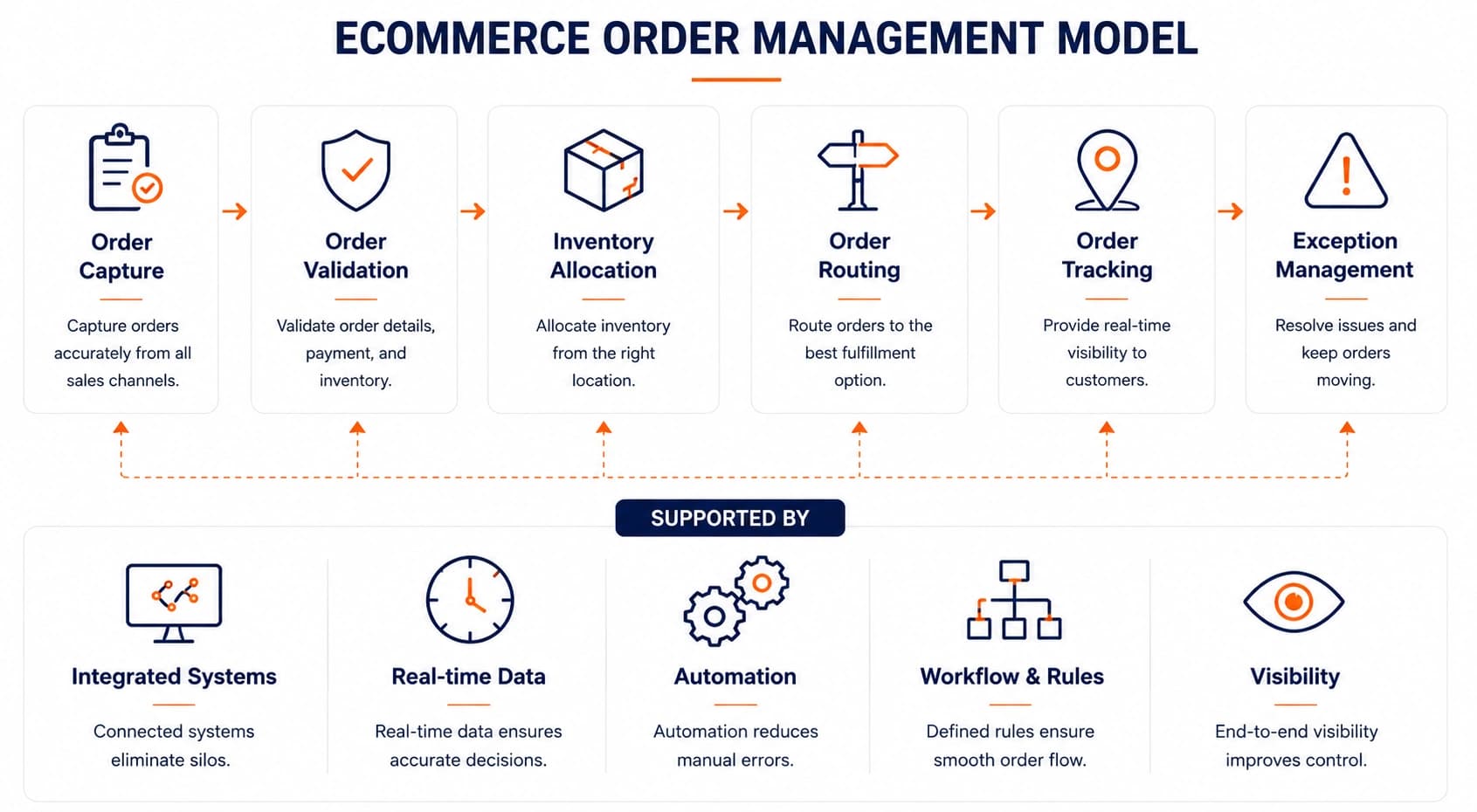
We examine how an order moves from capture through validation, inventory, routing, fulfillment, status updates, exceptions, completion, and post-order workflows.
Systems & Workflow Perspective
Order problems are reviewed across ecommerce platforms, marketplaces, ERP, OMS, WMS, inventory, shipping, customer service, and reporting—not as isolated software issues.
Review Through Implementation
When improvement requires system integration, automation, reporting, custom workflows, portals, AI, or other technology, Gyan can support implementation after the requirement is defined.
CONNECTED ORDER OPERATIONS
An Order Is a Workflow, Not Just a Transaction
An order may pass through payment, inventory, allocation, routing, fulfillment, customer service, shipping, and reporting before it is truly complete. When ownership, status, or information changes between those steps, teams begin checking systems, chasing updates, and manually resolving gaps.
We follow the order across the full lifecycle to identify where workflows, responsibilities, and information stop moving together.
The goal is a clearer order operation with stronger ownership, visibility, exception handling, and fewer manual handoffs.
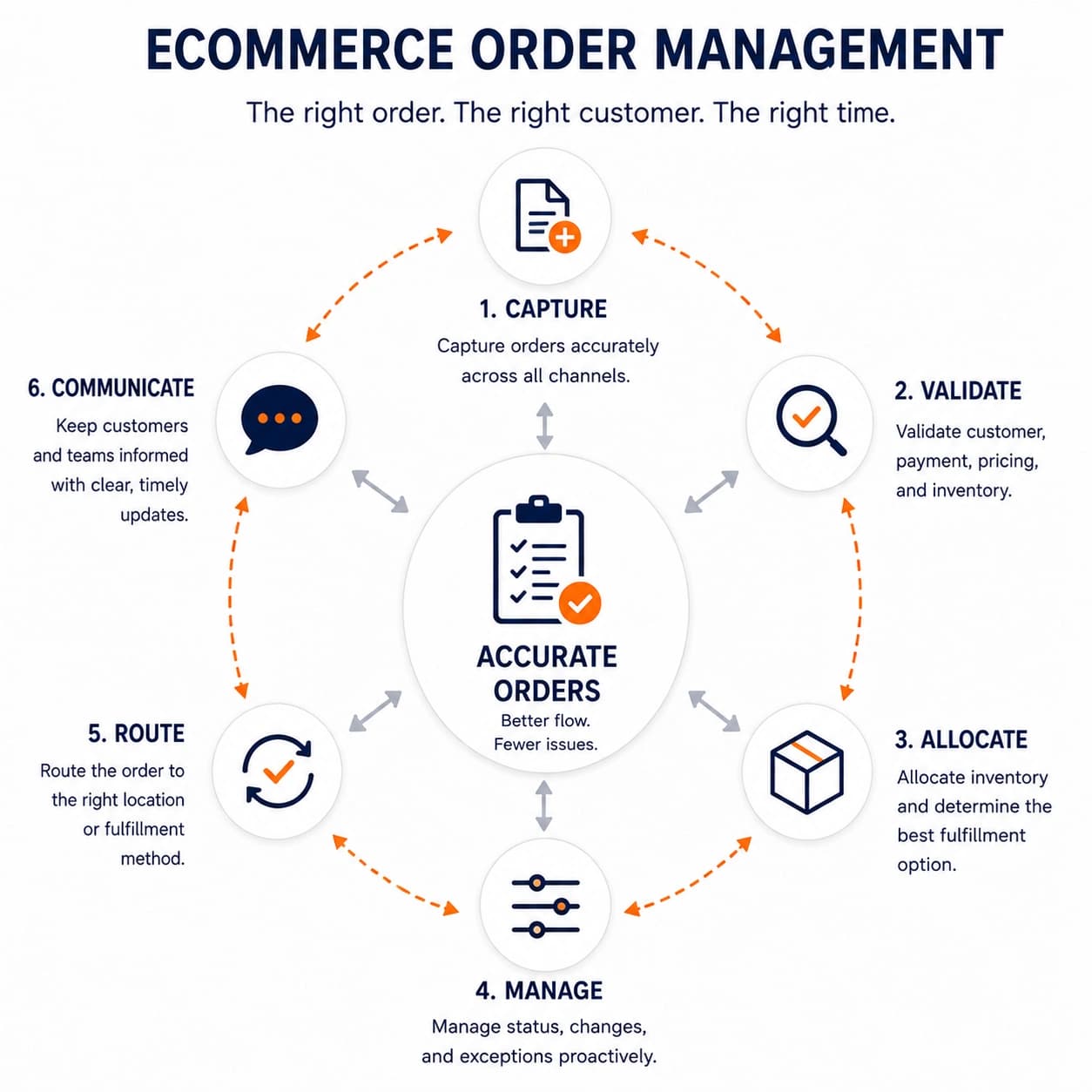
Why This Matters
Reliable order management keeps information, ownership, and action aligned as orders move through the business.
Where We Review the Ecommerce Order Lifecycle
Review how orders move from capture through validation, allocation, routing, fulfillment, status, exceptions, changes, and completion across channels, systems, and teams.
Order Capture
Review how orders enter the business and whether different channels create consistent, usable order information.
Review
- Ecommerce orders
- Marketplace orders
- B2B orders
- Wholesale orders
- Sales-assisted orders
- Phone/manual orders
- POS/store orders
- Subscription orders
- Customer account information
- Payment information
- Promotions
- Tax information
- Shipping information
Outcome
Create a clearer entry point for order information so downstream teams and systems receive the information required to process the order correctly.
Order Validation
Review what must be confirmed before an order can move forward.
Review
- Payment status
- Customer information
- Billing information
- Shipping address
- Fraud/risk flags where applicable
- Inventory
- Product restrictions
- Pricing
- Promotions
- Tax
- Shipping method
- Account terms
- B2B approvals
- Order completeness
Outcome
Reduce situations where incomplete or conflicting information is discovered later in the fulfillment process.
Inventory Availability & Allocation
Review how the business determines whether inventory is available and which location, warehouse, store, or source should fulfill the order.
Review
- Available inventory
- Reserved inventory
- Incoming inventory
- Warehouse inventory
- Store inventory
- Marketplace inventory
- Channel allocation
- Backorders
- Substitutions
- Partial availability
- Inventory reservations
- Safety stock
- Multi-location inventory
Outcome
Create clearer inventory decisions at the point where the order needs to be committed and routed.
Order Routing
Review how orders are directed to the appropriate warehouse, store, supplier, fulfillment partner, or internal team.
Review
- Warehouse selection
- Store fulfillment
- Local fulfillment
- Dropship routing
- Supplier routing
- Geographic rules
- Inventory rules
- Order priority
- Delivery requirement
- Product type
- Customer type
- Channel-specific rules
- Split-order logic
Outcome
Reduce manual routing decisions and create a more consistent method for determining where each order should be fulfilled.
Fulfillment Handoffs
Review the point where an accepted order becomes work for the warehouse, store, fulfillment provider, or other operational team.
Review
- Order release
- Pick instructions
- Packing requirements
- Shipment creation
- Store pickup
- Local delivery
- Special handling
- Order priority
- Split shipments
- Fulfillment acknowledgement
- Status updates
- Completion confirmation
Outcome
Improve the handoff between order management and the teams responsible for physically completing the order.
Order Status & Visibility
Review whether teams and customers can see an accurate version of where each order stands.
Review
- Order received
- Payment confirmed
- Inventory allocated
- Released to fulfillment
- Picking
- Packed
- Shipped
- Ready for pickup
- Delivered
- Partially fulfilled
- Delayed
- Backordered
- Cancelled
- Returned
- Refunded
Outcome
Create a clearer shared order-status model across ecommerce, operations, customer service, and reporting.
Order Exceptions
Normal orders are usually easy. The operational burden comes from the orders that do not follow the normal path.
Review
- Payment failure
- Inventory shortage
- Backorder
- Substitution
- Partial fulfillment
- Missing information
- Address problem
- Shipping issue
- Damaged order
- Failed pickup
- Fraud/risk review
- Order hold
- Duplicate order
- System mismatch
- Customer-requested change
- Cancellation
Outcome
Define who owns each exception, what information is required, what system action should occur, and when escalation is necessary.
Multi-Channel Orders
Review how orders from different sales channels enter and move through the operation.
Channels May Include
- Direct ecommerce
- Amazon or other marketplaces
- Retail stores
- POS
- B2B portal
- Wholesale
- Sales representatives
- Customer-service-assisted orders
- Subscription channels
- Partner channels
Review
- Common order structure
- Customer identity
- Inventory allocation
- Pricing
- Promotions
- Fulfillment routing
- Status mapping
- Returns
- Reporting
- Channel ownership
Outcome
Create stronger coordination across channels without requiring every channel to operate as a separate business process.
Changes, Cancellations & Adjustments
Review how the business handles orders that need to change after submission.
Review
- Quantity changes
- Product changes
- Address changes
- Shipping changes
- Cancellation requests
- Partial cancellation
- Substitutions
- Credits
- Price adjustments
- Order holds
- Refund requirements
- Customer communication
- Warehouse impact
Outcome
Create clear rules and ownership for order changes before they create conflicting information across systems or teams.
Order Reporting & Performance
Review whether management can see how orders are moving through the operation and where problems are occurring.
Potential Measures
- Orders received
- Orders released
- Order backlog
- Processing time
- Fulfillment time
- Delayed orders
- Backorders
- Partial orders
- Cancellations
- Order holds
- Exception volume
- Order-change volume
- Channel volume
- Fulfillment location
- Return volume
- Order completion time
Outcome
Create operational visibility into order flow instead of relying only on sales and revenue reporting.
Follow the Order From Capture to Completion
Capture
Receive complete, usable order information from every active sales channel.
Validate
Confirm payment, customer, pricing, inventory, and required order information before processing.
Allocate
Commit the right inventory from the appropriate warehouse, store, or source.
Route
Direct the order into the correct fulfillment workflow using defined business rules.
Monitor
Keep order status visible across operations, service, fulfillment, and reporting.
Resolve
Manage shortages, changes, delays, cancellations, and other exceptions with clear ownership.
When Orders Move but Teams Still Have to Chase Them
Orders may continue reaching customers even while employees spend significant time checking status, reconciling systems, routing exceptions, and coordinating updates manually.
A closer review helps identify where order ownership, information, routing, or exception workflows are creating unnecessary work before higher volume makes those gaps harder to manage.
Signs the Order Lifecycle Needs Attention
 Teams check multiple systems to understand current order status.
- Customer service depends on operations for routine order updates.
- Backorders, changes, or cancellations are handled through email or chat.
- Orders require manual routing between warehouses, stores, or partners.
- Channel, inventory, or system statuses do not consistently match.
- Increasing order volume creates more administrative work and follow-up.
Why This Matters
Order complexity becomes expensive when people have to compensate for unclear workflows.
Turn Order Complexity Into a Clearer Operating Model
Order Lifecycle Map
Document how orders enter, move through, and exit the operation across channels, teams, and systems.
Order Ownership Model
Clarify responsibility for validation, allocation, routing, fulfillment, exceptions, changes, and completion.
Order Status Framework
Define consistent status meanings and ownership across ecommerce, ERP, OMS, WMS, customer service, and reporting.
Exception Management Model
Define how non-standard orders are identified, assigned, escalated, resolved, and monitored.
Systems & Data Recommendations
Identify where order information needs stronger alignment across ecommerce, ERP, OMS, WMS, CRM, marketplaces, shipping, and reporting.
Prioritized Improvement Roadmap
Organize workflow, reporting, integration, automation, system, and implementation opportunities by priority and dependency.
EXCEPTION MANAGEMENT
The Standard Order Is Usually Not the Hard Part
Most orders move normally. Operational pressure appears when inventory is unavailable, payment fails, an address changes, part of an order cannot ship, or two systems disagree about status.
Without a defined exception workflow, employees become the coordination layer checking systems, messaging teams, updating records, and deciding what should happen next.
We help clarify how exceptions should be identified, assigned, escalated, resolved, and measured.
Strong order management does not eliminate exceptions. It makes them visible, owned, and easier to resolve.
One Order Should Not Have Five Different Truths
Order System of Record
Define which system owns the authoritative order record at each stage of the lifecycle.
Inventory Ownership
Define where available, reserved, committed, and fulfilled inventory status originates.
Status Ownership
Clarify which system or workflow is responsible for changing each order status.
Exception Ownership
Define which team or user owns the order when the normal workflow stops.
System integration becomes much more reliable once ownership of the order, inventory, status, and exception is clear.
How an Ecommerce Order Management Engagement Works
Order Management Fit Call
We discuss your sales channels, order volumes, systems, inventory, fulfillment model, current order workflow, recurring exceptions, and where your team is spending unnecessary time.
Order Workflow & Systems Review
We map how orders move across ecommerce, marketplaces, ERP, OMS, WMS, inventory, warehouse operations, shipping, customer service, and reporting. We identify where ownership, status, information, or system handoffs are creating friction.
Improvement Roadmap & Implementation Direction
We define the prioritized workflow, reporting, integration, automation, system, and implementation improvements required to create a more reliable order-management operation.
30-minute call
No obligation
Review and implementation scoped separately
Who We Work With
We work with ecommerce businesses where orders move across multiple channels, systems, locations, and fulfillment workflows and require clearer operational control.
This Tends to Be a Strong Fit If
Teams spend too much time checking order status or coordinating routine order movement.
Backorders, changes, cancellations, or partial orders lack consistent ownership and resolution.
Orders from different channels follow different routing, allocation, or status workflows.
You need operational clarity before investing in an OMS, automation, integrations, or custom order tools.
This May Not Be the Right Fit If
You only need basic ecommerce-platform configuration or product setup.
You only need shipping rates, payment configuration, or another isolated technical task.
Your order workflow is already defined and you only need a narrow implementation task.
You want new order-management technology without reviewing the workflow it needs to support.
Not Sure Where Orders Are Breaking Down?
Start with a fit call to identify whether the constraint sits in routing, allocation, status, exceptions, ownership, or across the lifecycle.
When the Order Management Improvement Requires Technology
Ecommerce Systems Integration
Connect ecommerce platforms, marketplaces, ERP, OMS, WMS, CRM, shipping, inventory, and reporting around the order lifecycle.
Ecommerce Workflow Automation
Automate defined order validation, routing, notifications, exception handling, status changes, handoffs, and repetitive administrative workflows.
Commerce Dashboards & BI
Create operational reporting around orders, backlog, exceptions, fulfillment, inventory, channel performance, and order-cycle time.
Custom Order Management Tools
Build internal order queues, exception screens, routing tools, operational portals, and other applications where existing systems do not provide the required workflow.
AI for Ecommerce & Retail
Use AI for defined order-support use cases such as inquiry classification, exception summaries, customer-service assistance, order-context retrieval, and workflow support.
Mobile Operational Tools
Support warehouse, store, field, or operational users with defined mobile order-management workflows where required.
Order Management and Fulfillment Are Connected but Solve Different Problems
They work together, but they start from different operational questions.
Ecommerce Order Management
Focuses on how an order moves across channels, inventory allocation, routing, status, changes, exceptions, and ownership so teams know what should happen next and who is responsible when the normal order path changes.

Order Flow & Fulfillment
Focuses on how accepted orders are physically executed through picking, packing, staging, shipping, pickup, delivery, and fulfillment exceptions so products move accurately and reliably from inventory to the customer.
Order Operations Directly Shape the Customer Experience
Customers experience order management through availability, confirmations, status updates, substitutions, changes, cancellations, delivery expectations, and support. For the broader customer journey across buying, fulfillment, service, returns, self-service, and channel handoffs:
Selected Case Studies
Real outcomes from our operations consulting and implementation engagements.
See Order & Commerce Workflows in Action
Where Is the Order Really Getting Stuck?
Review the order lifecycle to find where ownership, status, routing, or exceptions are creating unnecessary work.
Request an Order Management Fit Call→

30-minute call

No obligation

Consulting and implementation scoped separately
Find the Right Ecommerce Operational Starting Point
Order-management problems often connect with inventory, fulfillment, customer experience, systems, automation, reporting, or other operational requirements. Explore the area closest to the issue you are trying to solve.
Explore by Operational Focus
Inventory Management & Fulfillment
Connect order allocation and routing with the inventory and physical execution required to fulfill each order.
Returns Management & Customer Service
Improve how order changes, cancellations, shortages, returns, and other exceptions move toward resolution.
Ecommerce Customer Experience
Understand how order visibility, changes, delivery expectations, and exceptions affect the broader customer journey.
Ecommerce Analytics & Reporting
Measure order volume, status, exceptions, cycle times, channel performance, and other operational signals.
Explore by Technology & Integration
ERP and Ecommerce Integration
Keep order, inventory, financial, and operational information moving consistently between ecommerce and ERP systems.
Ecommerce Marketplace Integration
Bring marketplace orders into clearer routing, inventory, status, fulfillment, and exception workflows.
Ecommerce POS Integration
Connect store and online orders where fulfillment, inventory, pickup, returns, or customer records cross channels.
Software Development for Ecommerce
Build order workflows, integrations, exception tools, and operational interfaces when standard capabilities are insufficient.
Common Questions
What is ecommerce order management?
Ecommerce order management is the process of managing an order from capture through validation, inventory allocation, routing, fulfillment, status updates, exception handling, changes, and completion.Gyan reviews both the operational workflow and the systems responsible for moving the order through that lifecycle.
What systems are normally involved in order management?
Depending on the business, the order lifecycle may involve ecommerce platforms, marketplaces, ERP, OMS, WMS, CRM, inventory systems, POS, payment platforms, shipping providers, customer-service tools, reporting, and custom applications.
Do we need a dedicated Order Management System?
Not necessarily.Some organizations need a dedicated OMS.Others can improve order management by aligning workflows, integrations, ERP, ecommerce platforms, warehouse systems, automation, and reporting.The right system direction should follow the operational requirement.
Can Gyan integrate ecommerce orders with ERP or warehouse systems?
Yes, where the systems provide appropriate technical access.Gyan can support integrations across ecommerce, ERP, OMS, WMS, inventory, marketplaces, CRM, shipping, reporting, and other operational systems.
Can you help manage orders from multiple sales channels?
Yes.The review can examine how direct ecommerce, marketplaces, retail stores, POS, B2B, wholesale, and other channels feed into inventory, routing, fulfillment, status, and reporting workflows.
Can you help with order exceptions?
Yes.Exception management is an important part of this service.We can review how shortages, backorders, payment failures, substitutions, partial orders, address problems, delays, cancellations, and other exceptions are identified, assigned, resolved, and measured.
Can you help improve order visibility?
Yes.Gyan can review order-status definitions, systems of record, system synchronization, reporting, exception visibility, and the information available to operations, customer service, management, and customers.
Can order-management workflows be automated?
Yes, where the rules and ownership are sufficiently clear.Potential automation may include order validation, routing, notifications, status synchronization, exception assignment, reporting, and other defined workflows.
What is the difference between Order Management and Order Flow & Fulfillment?
Order Management covers the broader lifecycle of an order across channels, systems, inventory allocation, routing, status, exceptions, and ownership.Order Flow & Fulfillment focuses more deeply on the physical and operational execution required to prepare and complete the order.
Does order management affect customer experience?
Yes.Customers experience order management through availability, confirmations, status updates, delivery expectations, substitutions, changes, cancellations, support, and returns.For a broader customer-journey review, see Ecommerce Customer Experience.
Do we need to replace our ecommerce platform?
Not necessarily.Many order-management problems exist between systems and workflows rather than inside the ecommerce storefront itself.The right improvement may involve integration, workflow changes, automation, reporting, OMS/ERP configuration, or custom operational tools.
Request an Ecommerce Order Management Fit Call
Tell us where orders are getting stuck across channels, inventory, systems, fulfillment, exceptions, customer service, or reporting. We'll use the first 30 minutes to understand the current order lifecycle, the systems involved, and where a closer review may be useful.
Focused on your goals
You decide the next step.
Consulting & implementation