



Quick Summary:
The biggest difference between Strapi and Directus is not the feature list, it is what you need the platform to own. Strapi is a natural fit when structured content is the starting point, while Directus becomes especially relevant when an existing SQL data model is central to the application. The right choice depends on your content, data, permissions, integrations, and long-term architecture.
If you are comparing Strapi and Directus, you probably do not need another feature checklist. You need to know something much more practical:
Which one fits the way your business actually manages content, data, integrations, and applications?
The simplest answer is this:
Strapi makes the most sense when you are building a structured content system. Directus becomes especially interesting when important relational data already exists and you need an application, API, permissions, and workflows around it.
That sounds simple, but the difference affects almost everything that comes later: how developers build, how editors work, where data lives, how integrations behave, how permissions are managed, and how easily the platform can evolve.
So before comparing features, ask one question:
What should this system actually own?
That is where the Strapi-versus-Directus decision really begins.
Start With the Real Question: Are You Building a Content System or Opening Up a Data System?
Imagine you are replacing WordPress. Your website needs service pages, articles, case studies, landing pages, resources, multiple languages, reusable page sections, and a Next.js frontend.
Marketing needs to update content regularly. Developers want to control the components and data structure, but they should not be required every time somebody changes a headline, FAQ, image, or page section. That situation naturally points toward Strapi.
Your team creates structured content models inside the CMS. Editors manage the content. Your frontend retrieves that information through APIs and decides how it should appear. Now change the situation.
This separation of content from the presentation layer is the foundation of headless CMS development. The CMS manages structured content and exposes it through APIs, while websites, applications, portals, and other frontend experiences determine how that content is presented.
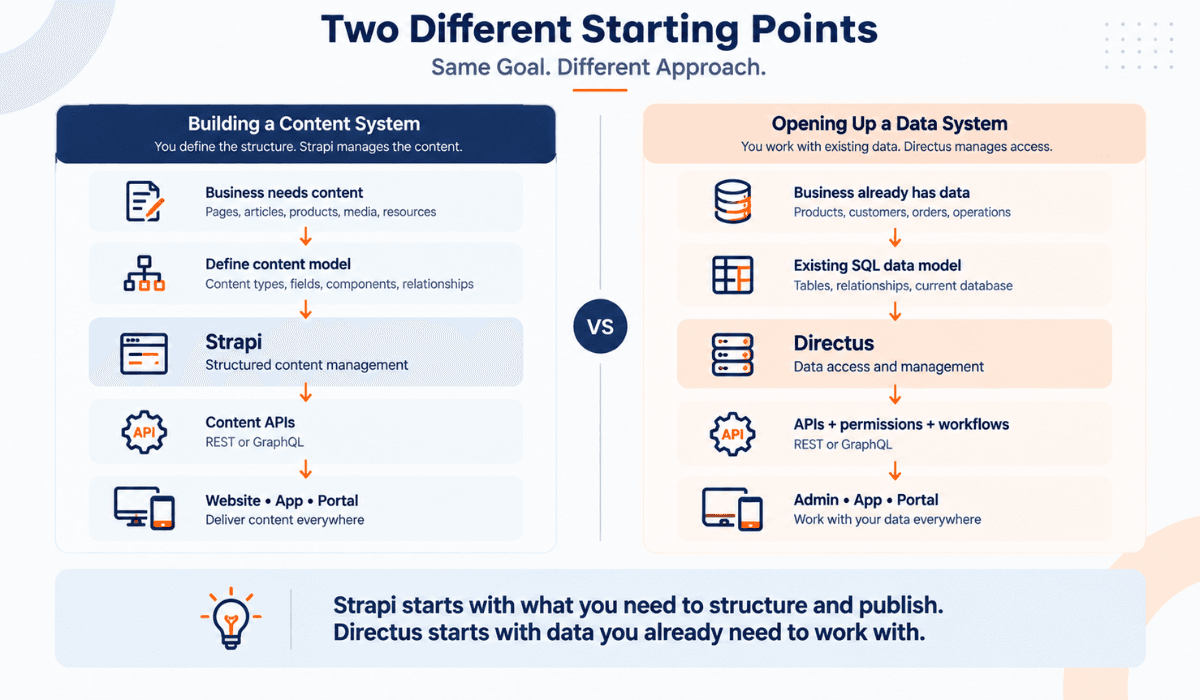
Your company already has PostgreSQL containing products, customers, locations, inventory, suppliers, equipment, orders, or other operational records. That database is already part of the business.
You do not want another platform quietly creating a second copy of the same information. You need controlled access, an admin interface, APIs, permissions, workflows, and applications around the data that already exists. That is where Directus becomes much more interesting.
A useful way to remember the difference is:
- Strapi starts with the content model. Directus starts with the data model.
Neither approach is automatically better.
The right question is which starting point matches your architecture.
When You Are Building a New Content Platform, Strapi Feels Natural
Suppose your marketing team says:
“We need to build new pages without asking developers to create every page from scratch.”
That does not necessarily mean marketing should have unlimited layout control. Your developers may still want to define which page sections exist, what information those sections can contain, and how they behave on the frontend.
For example:
Service Page
│
├── Hero
├── Introduction
├── Benefits
├── Feature Grid
├── Case Study
├── FAQ
└── CTA
Your developers control the structure. Your editors control the content placed inside that structure. That separation becomes increasingly valuable as a website grows.
Twenty pages may be manageable through developer involvement. Two hundred pages, several content owners, multiple languages, campaigns, resources, product information, and several digital channels quickly become a different problem.
This is the environment where Strapi's content-first approach tends to make sense. It is particularly relevant when your main challenge is organizing and delivering structured content across websites, applications, portals, ecommerce experiences, or other frontend channels.
When Important SQL Data Already Exists, Look Closely at Directus
Now imagine you tell me:
“We already have the database. We do not need another database pretending to own the same information. We need people and applications to work with it safely.”
That changes the decision considerably.
Your architecture might look more like this:
Existing PostgreSQL
│
├── Products
├── Inventory
├── Locations
├── Suppliers
├── Customers
└── Orders
│
▼
Directus
│
┌────┼────┐
▼ ▼ ▼
Admin API App
The important idea here is not simply that Directus “supports PostgreSQL.” Strapi can also use relational databases. The architectural difference is how the system thinks about the information.
With Directus, your database and its relational model can remain central to the architecture. Directus provides application capabilities around that data rather than forcing you to recreate every business record inside a separate content model.
That can matter enormously when other systems already depend on the database. You do not want your ERP saying inventory is 240 units while your CMS says 231. You do not want customer information maintained independently in three places. You do not want developers spending the next two years synchronizing data that should never have been duplicated in the first place.
Before choosing either CMS, establish which system owns which information.
Your Editors Will Experience the Difference Too
Architecture is not only a developer decision. Think about the language your users naturally use. Does your marketing team talk about:
- Pages
- Articles
- Authors
- Categories
- Campaigns
- Content blocks
- Publishing
- Localization
- Media
- Landing pages
That way of thinking aligns naturally with a content-focused CMS. Strapi gives developers control over the content model while giving editors an environment built around managing that content. Now consider a different team.
They talk about:
- Customers
- Orders
- Inventory
- Locations
- Suppliers
- Assets
- Statuses
- Relationships
- Records
- Permissions
Directus may feel much more natural in that environment because the relational data model remains highly visible. This does not mean Directus cannot manage website content. It can. You can create reusable page structures, relational components, editorial content, versions, previews, and publishing workflows.
Likewise, Strapi is not limited to simple marketing websites. The more useful distinction is this:
- If people primarily need to publish structured content, Strapi often provides the more natural mental model.
- If people primarily need to work with structured records and relationships, Directus deserves much closer consideration.
What Happens When Marketing Needs to Build New Pages?
Imagine your marketing manager needs a campaign page tomorrow.
The page requires:
- Hero content
- Benefits
- Product information
- Customer evidence
- Images
- FAQs
- Calls to action
They should not need to open a development ticket simply to change approved content. With Strapi, developers can define reusable content structures that correspond with frontend components. Marketing then manages the information inside those structures.
That provides a useful balance. Developers keep control over the system. Editors gain control over routine publishing. Directus can accomplish similar page-building patterns through relational models and reusable blocks. The difference is that those structures remain more closely connected to its broader data-first model.
If the website is primarily a marketing and publishing environment, Strapi's terminology and workflow often feel more immediately familiar. If website content is only one part of a much larger relational data platform, Directus can become a compelling alternative.
Which One Is Better for SEO?
This is where comparisons often become misleading. Neither Strapi nor Directus automatically gives your website better rankings. They are headless platforms. Your frontend still determines much of what users and search engines actually receive, including:
- Rendered HTML
- Page titles
- Meta descriptions
- Canonical URLs
- Heading structure
- Structured data
- Internal links
- Image handling
- Sitemap generation
- Redirect behavior
- Page speed
- Rendering strategy
You can model SEO fields in either platform. The more important question is whether your content team can manage the information required for search-facing pages without depending on developers for routine changes.
For example, can your editors easily manage:
- SEO titles
- Meta descriptions
- URL information
- Canonical settings
- Open Graph content
- Structured content fields
- Image alternatives
- Related content
- Internal linking inputs
For a marketing-heavy website, Strapi's content-first structure can make this organization feel straightforward. Directus can support the same information, especially when website content needs to live alongside a wider relational data model.
Do not choose a headless CMS because somebody claims the CMS itself will improve SEO.
Choose an architecture that makes it easier for your team to consistently create technically sound, useful pages and make sure the frontend renders them correctly.
What If You Use Next.js or React?
If you tell me:
“Our frontend is Next.js. Which CMS should we use?”
I still would not choose based on Next.js. Both platforms can supply a decoupled frontend through APIs.
The more useful question is:
What should your Next.js application be reading?
If the frontend primarily needs:
- Pages
- Articles
- Marketing content
- Product descriptions
- Resources
- Reusable content sections
then a purpose-built content model may be the cleanest architecture. That naturally brings Strapi into the conversation.
But if your frontend primarily presents:
- Inventory
- Orders
- Locations
- Customers
- Operational records
- Existing relational information
then the fact that Directus can operate around the existing data model becomes much more important.
Do not ask:
“Which CMS works with Next.js?”
Both can.
Ask:
“What information is Next.js presenting, and which system should own that information?”
That will get you much closer to the correct decision.
Permissions Become More Important as More Teams Enter the System
A simple marketing website might only need:
- Administrator
- Editor
- Author
That is relatively straightforward.
Now imagine the same platform supports marketing, regional managers, operations, finance, warehouse teams, customer service, and developers. Suddenly permissions become more complicated.
For example:
A warehouse manager may see inventory for one location but not another. Finance may see cost fields that marketing should never access. Marketing may update descriptions without changing inventory. A regional team may manage only records assigned to its territory.
Directus becomes particularly interesting in environments like this because permissions can sit very closely around collections, fields, actions, and individual records. Strapi also supports roles and permissions, while broader editorial governance capabilities can be introduced depending on the implementation and plan.
The important lesson is:
Do not compare the platforms by checking whether both have “permissions.”
Write down your actual permission requirements.
Who can:
- See this information?
- Edit it?
- Delete it?
- Publish it?
- Approve it?
- Access only certain records?
- Access only certain fields?
Once you map those requirements, the comparison becomes much more useful.
Directus Becomes More Interesting When Workflows Are Data-Driven
Suppose an order changes status. Your business now needs the system to:
- Check a condition.
- Update another record.
- Call an external service.
- Notify somebody.
- Continue down a different path if the condition fails.
That is not an editorial workflow. It is operational automation. Directus includes Flows for event-driven processes such as these. That can be valuable when teams want workflows represented visibly inside the platform rather than implementing every process in a separate application layer.
For example, an event might trigger when:
- A record changes
- A webhook arrives
- A schedule runs
- A user initiates an action
The workflow can then perform additional operations. This raises an important question that is often missing from CMS comparisons:
Who will own this workflow six months after launch?
If an operations team needs visibility into the process, a configurable workflow may be attractive. If software developers want business logic reviewed, tested, versioned, and deployed as application code, a code-driven approach may be preferable.
The technology decision should reflect who is expected to maintain the system after implementation, not only who can build the first version fastest.
Strapi Makes Sense When Custom Application Behavior Lives Around Content
Now imagine your requirement sounds different:
“When this content changes, validate these fields, call our ERP, transform the data, apply our own business logic, and expose a custom endpoint for another application.”
At that point, you are not simply configuring a CMS. You are developing application behavior around the content layer. This is one reason Strapi can be attractive to development teams. The backend can be extended through custom application logic, APIs, integrations, services, middleware, policies, plugins, and other development patterns.
Directus is also extensible.
So this is not a question of:
Customizable vs not customizable.
The better question is:
- Where do you want most of your custom behavior to live?
- Inside a content-oriented backend application?
- Or around a data-oriented platform?
That difference becomes important as your requirements move further beyond ordinary content management. If your project reaches this stage and you need support with architecture, migration, API integration, custom backend behavior, or implementation, our Strapi Development Services can support the technical work around a defined content and application model.
What About Real-Time Data?
Real-time requirements can completely change the architecture.
Imagine users looking at:
- Inventory levels
- Order status
- Messages
- Fulfillment progress
- Equipment status
- Operational dashboards
If those values frequently change while somebody is looking at the screen, your real-time strategy matters.
Directus provides real-time capabilities that can make it especially relevant for applications built around frequently changing records. That may be highly valuable for an operations portal. For an ordinary marketing website, it may add almost no value. This is why comparing two platforms by counting features can be misleading.
A feature only matters when your application actually needs it. Do not choose Directus merely because real-time capability exists. Do not choose Strapi because your website never needed it. Choose based on the difficult requirements in your architecture.
Editorial Workflows Are Not a Simple Strapi-Wins Comparison
It would be too simplistic to say:
Strapi is for editors. Directus is only for databases.
Directus also provides serious content-management capabilities. Teams can work with versioned content, previews, relational page structures, and publishing processes. Strapi provides its own editorial model around structured content, Draft & Publish, and broader governance capabilities depending on the implementation.
So the question is no longer:
“Can Directus manage content?”
It can.
The more useful question is:
“Do we want an editorial system built primarily around content, or a broader data platform that also supports editorial work?”
That distinction is much more accurate.
Migration Is More Than Moving Articles From One CMS to Another
If you are moving away from WordPress, Contentful, a custom CMS, or another platform, do not start migration by copying records. First determine what should survive. A migration may involve:
- Pages
- Articles
- Images
- Documents
- Metadata
- URLs
- Redirects
- Authors
- Categories
- Languages
- Relationships
- Reusable components
- Publishing states
- Permissions
- Integrations
- Historical structures
Some of those things should move. Others should probably disappear.
This is the mistake I would avoid:
Taking a badly designed content structure and reproducing it exactly inside a newer platform.
You end up with new technology and the same operational problem.
Before migration, determine:
- What does the current system own?
- What should the new CMS own?
- Which information belongs somewhere else?
- Which structures still provide value?
- Which legacy decisions should not be carried forward?
That architecture work is usually more important than the import script.
Development, Staging and Production Matter Too
The first prototype is rarely the hardest part.
Eventually you will have:
- Development
- Staging
- Production
- Database changes
- Content-model changes
- Deployment workflows
- Backups
- Testing
- Rollbacks
- Multiple developers
Your team needs a predictable way to move structural changes between environments. Directus provides tools around schema snapshots and applying schema changes across environments. Strapi's content model sits naturally within the application development workflow. Both approaches can support controlled deployments.
But again, they reveal the same underlying architectural difference:
- Strapi begins from the application and its content model.
- Directus remains strongly connected to the underlying data model.
That difference may seem small during the prototype. It becomes much more visible after the platform has been maintained for several years.
Do Not Compare Cost Using Only the Hosting Price
Suppose one platform costs less to host.
Does that make it cheaper?
Not necessarily.
Your total cost may include:
- Hosting
- Databases
- Development
- Environments
- Backups
- Monitoring
- Security
- Paid platform capabilities
- Migration
- Integrations
- Upgrades
- Custom extensions
- Internal administration
- Ongoing maintenance
But the biggest hidden cost is often architectural friction. Imagine selecting the cheaper platform and then spending two years:
- Synchronizing duplicate data
- Building unnecessary middleware
- Writing workarounds
- Fixing permission limitations
- Asking developers to make routine changes
- Maintaining integrations created only because ownership was unclear
That architecture can cost far more than the hosting plan you initially compared. Evaluate the cost of operating the system, not merely the price of starting it.
Strapi vs Directus: Which Should You Evaluate First?
Use this table as a starting point, not an absolute rule.
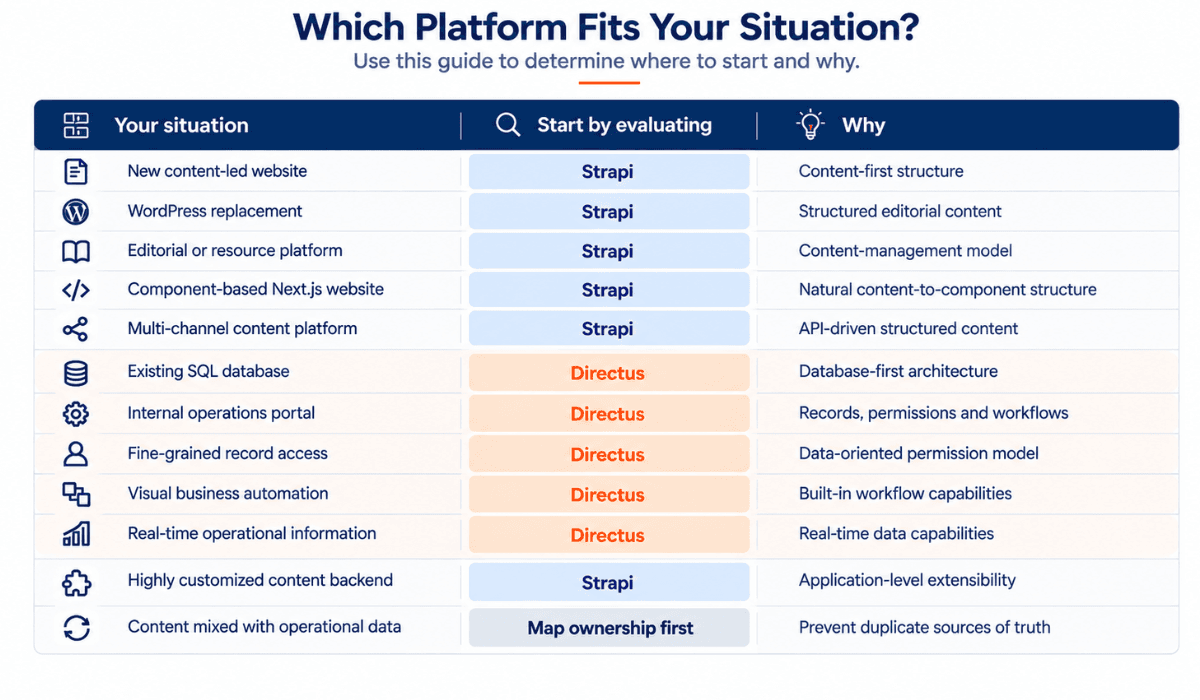
The important wording here is:
Start by evaluating.
Not:
Automatically choose. Directus can power content-rich websites. Strapi can power complex applications. You are trying to find the architecture that best matches your hardest long-term requirement.
Five Questions to Answer Before Choosing Strapi or Directus
Before comparing plugins, pricing, GitHub activity, or screenshots, answer these five questions.
1. Are You Creating a New Content Model or Protecting an Existing Data Model?
This may eliminate half the comparison immediately. If you are designing structured content from scratch, Strapi becomes highly relevant. If critical SQL data already exists, Directus deserves serious consideration.
2. Which System Should Own Each Type of Information?
Write down:
- Pages
- Product descriptions
- Prices
- Inventory
- Customers
- Orders
- Media
- Campaigns
- Locations
- Operational records
Then assign an authoritative system to each. One business object should not casually acquire five competing sources of truth.
3. How Do Your Users Think About Their Work?
- Are they editors managing content?
- Or operational users managing records?
The interface and underlying model should reflect how people actually work.
4. How Complex Will Permissions and Workflows Become?
Simple editorial roles and highly conditional record access are not the same requirement. Map what each group genuinely needs.
5. Where Will Your Future Complexity Live?
Will most complexity come from:
- Content structure
- Publishing
- Reusable digital experiences
- Custom content APIs
Or from:
- Relational data
- Operational workflows
- Permissions
- Automation
- Real-time records
Choose the architecture that makes the difficult part of your system easier to manage.
One Exercise Can Make the Decision Much Easier
Before choosing either platform, build a simple ownership table. For example:
Now ask:
Which platform can work with these boundaries without forcing us to duplicate information unnecessarily?
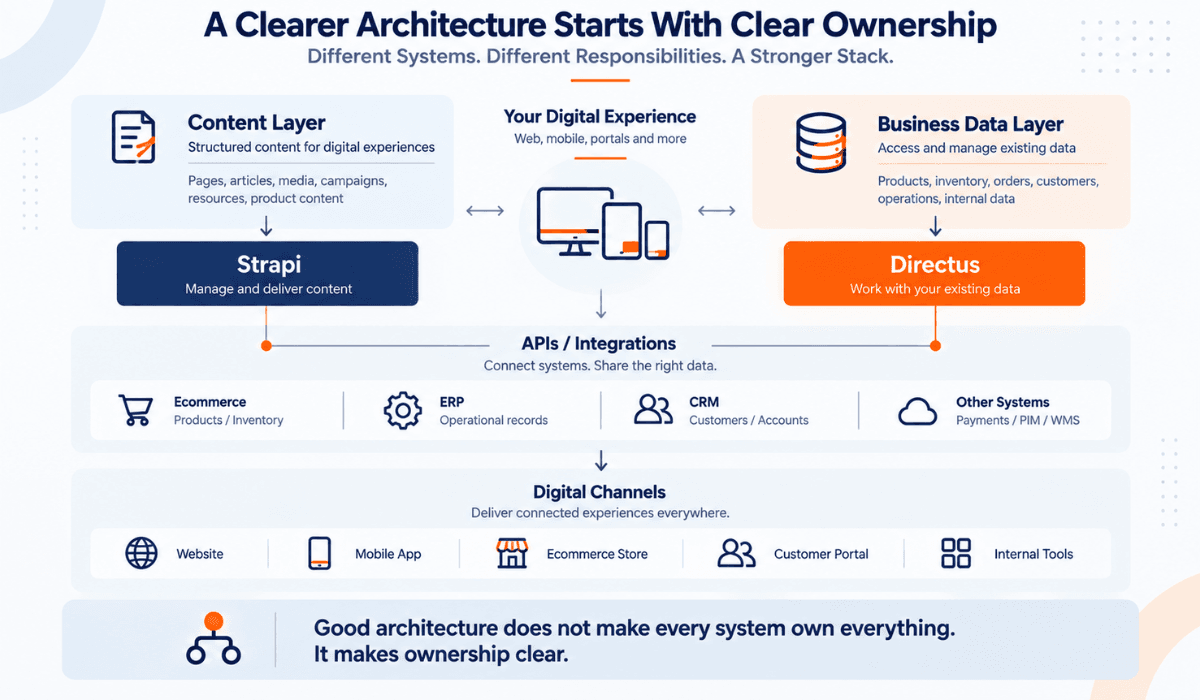
This is often far more useful than comparing fifty features. If pricing belongs in your ERP, your CMS should not quietly become another pricing database. If marketing owns campaign content, marketers should not need to edit configuration files every time they change a headline.
Good architecture makes ownership clearer. Bad architecture creates synchronization work.
Strapi vs Directus: The Final Answer
Choose Strapi when your hardest problem is primarily about structuring, managing, publishing, extending, and delivering content across websites and digital applications.
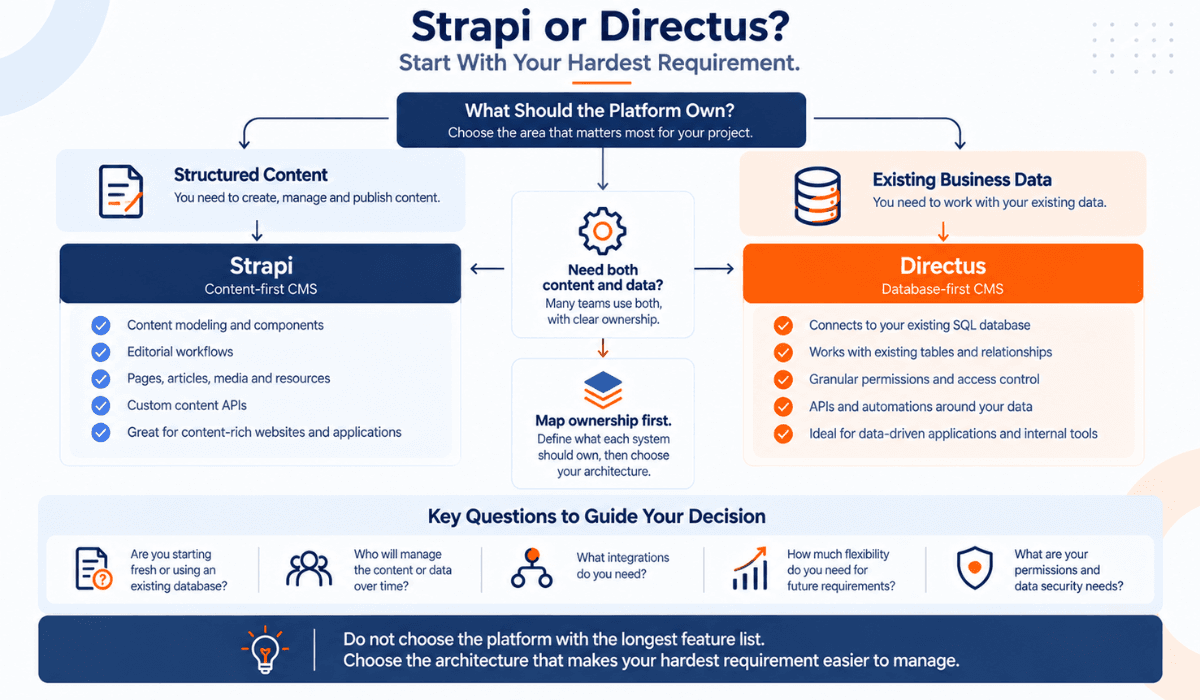
Look closely at Directus when your hardest problem is primarily about exposing, governing, automating, and working with relational business data, particularly when important SQL data already exists. If your project sits somewhere between those worlds, do not force the answer from a feature comparison.
Map:
- Content ownership
- Database ownership
- Integrations
- Permissions
- Editorial workflows
- Operational workflows
- Frontend requirements
- Real-time requirements
- Development responsibilities
- Long-term maintenance
Then ask one final question:
- Where does our complexity live, and which system should own it?
Once that becomes clear, the Strapi-versus-Directus decision usually becomes much easier.

NATHAN ALLEN
I'm Nathan Allen, Director of Artificial Intelligence at Gyan Solutions. With 8+ years building AI systems, custom software, and cloud-native platforms, I deliver applications that scale reliably and drive measurable business outcomes.





