


Quick Summary
Choose WordPress when the website itself is the center of the content operation. Consider headless WordPress when you want to preserve its editorial workflow but need a separate frontend. Choose Strapi when structured content needs to exist independently and serve multiple applications, APIs, or digital experiences.
If you are comparing Strapi and WordPress, the real decision is not which CMS has more features. It is whether content should remain closely connected to your website or become an independent layer that can support several digital experiences.
WordPress grew around website publishing. Content, editing, presentation, themes, plugins, media, URLs, and publishing can all operate inside one ecosystem. Strapi starts differently: it manages structured content separately and delivers that content through APIs to whichever application needs it.
Neither approach is automatically better. If your main requirement is a marketing website with strong editor independence, WordPress may solve the problem with less engineering. If content must support a wider application architecture, Strapi may provide a cleaner foundation.
There is also a third option that should not be ignored: WordPress itself can run headlessly. That means the real comparison is between traditional WordPress, headless WordPress, and a platform designed around headless architecture from the beginning.
Strapi vs WordPress: The Fast Answer
Traditional WordPress makes the most sense when the website itself is the primary digital experience. It gives content teams an integrated environment for publishing pages, managing media, using plugins, building layouts, and making routine changes without depending heavily on developers.
Strapi becomes more relevant when content needs to behave like reusable application data. If the same products, services, resources, locations, or other structured information must feed a website, mobile application, customer portal, or additional frontend, separation creates real value.
Headless WordPress sits between those models. It allows organizations to preserve WordPress as the editorial backend while replacing the WordPress frontend with something such as Next.js. That can be useful when editors value WordPress but developers need greater frontend flexibility.
The useful question is therefore not simply which CMS is stronger. Ask whether you are mainly building a website or creating a content layer that needs to serve a broader digital platform.
Strapi vs WordPress Is Not Simply Headless vs Traditional
Describing WordPress as traditional and Strapi as headless is convenient, but incomplete. WordPress has APIs that allow separate applications to consume its content, so it can also operate as a decoupled backend rather than rendering the final website itself.
Traditional WordPress keeps content management and presentation together. WordPress controls the content, templates, themes, publishing experience, and final website, which makes the architecture relatively straightforward when one website remains the center of the digital experience.
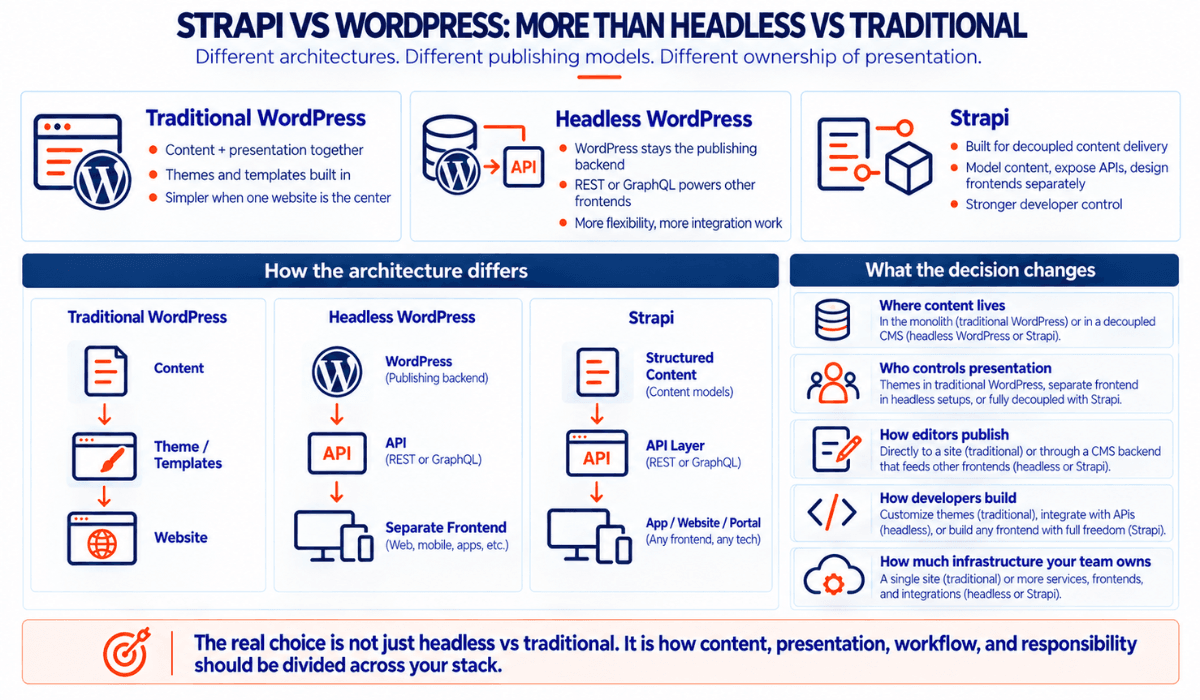
Headless WordPress separates the frontend while preserving WordPress as the publishing environment. Content can be consumed through REST or GraphQL by Next.js, React, or another frontend, although some traditional WordPress functionality requires additional integration work.
Strapi begins from decoupling rather than adding it later. Developers model structured content in the CMS, expose it through APIs, and let separate applications decide how that information should appear to users. That distinction matters because the decision is not simply about technology. It determines where content lives, who controls presentation, how developers work, how editors publish, and how much responsibility your team takes on outside the CMS.
Start With One Question: What Should the CMS Actually Own?
Imagine your company needs a home page, service pages, case studies, articles, campaign landing pages, forms, SEO controls, and regular marketing updates. The website is the primary experience, and marketing wants to operate it without continual developer involvement.
That is exactly the kind of environment where traditional WordPress remains strong. The CMS can manage both the information and much of the website experience without requiring separate frontend infrastructure for an otherwise straightforward publishing problem.
Now imagine the business manages products containing specifications, documentation, categories, manufacturers, markets, related products, regulatory information, and translations. That same information must feed a website, mobile application, customer portal, and partner experience.
Those requirements are different because you are no longer managing only web pages. You are managing structured content entities with relationships, and several applications need access to the same information without tying it to one particular presentation layer.
That is where Strapi becomes more compelling.
WordPress Thinks Naturally in Websites. Strapi Thinks Naturally in Content Models.
WordPress naturally organizes information around pages, posts, media, taxonomies, custom post types, blocks, templates, and publishing. It can model significantly more than basic articles, but its operating model still comes from a platform designed around publishing websites.
Strapi begins by asking what the information actually represents. A product, service, clinician, location, resource, course, category, market, manufacturer, or reusable page section can become a structured content type with its own fields and relationships.
That difference becomes important when information must live independently from a page. A product description might appear on a product page today, inside an application tomorrow, and within a partner portal later without becoming three separately maintained versions.
WordPress can also model custom structures through custom post types, taxonomies, metadata, and APIs. The distinction is therefore not that WordPress lacks structured content, but that structured application content sits closer to Strapi's primary design philosophy.
WordPress Has an Advantage Strapi Should Not Pretend to Have
Consider a marketing manager launching a campaign. They want to create a page, arrange approved sections, change copy, replace images, preview the result, update SEO information, publish it, and return next week without opening several development tickets.
WordPress is particularly strong in this operating model. Its block-based editing and site-editing environment give nontechnical teams considerable control over pages, layouts, templates, styles, and routine website publishing without requiring the frontend to be rebuilt separately.
That matters because developer experience cannot be the only architectural measure. A technically elegant CMS can still become the wrong business system if marketers become permanently dependent on engineers for routine content changes that were previously simple.
The decision should therefore consider developer experience, editor experience, and the operating model together. An architecture that improves one while significantly damaging another may simply move the problem instead of solving it.
Strapi Becomes Stronger When Content Is No Longer Just a Page
Suppose a healthcare organization manages locations connected with services, clinicians, opening hours, insurance networks, directions, related resources, and localized content. Or an ecommerce company manages products connected with specifications, documents, compatibility information, categories, applications, and buying guides.
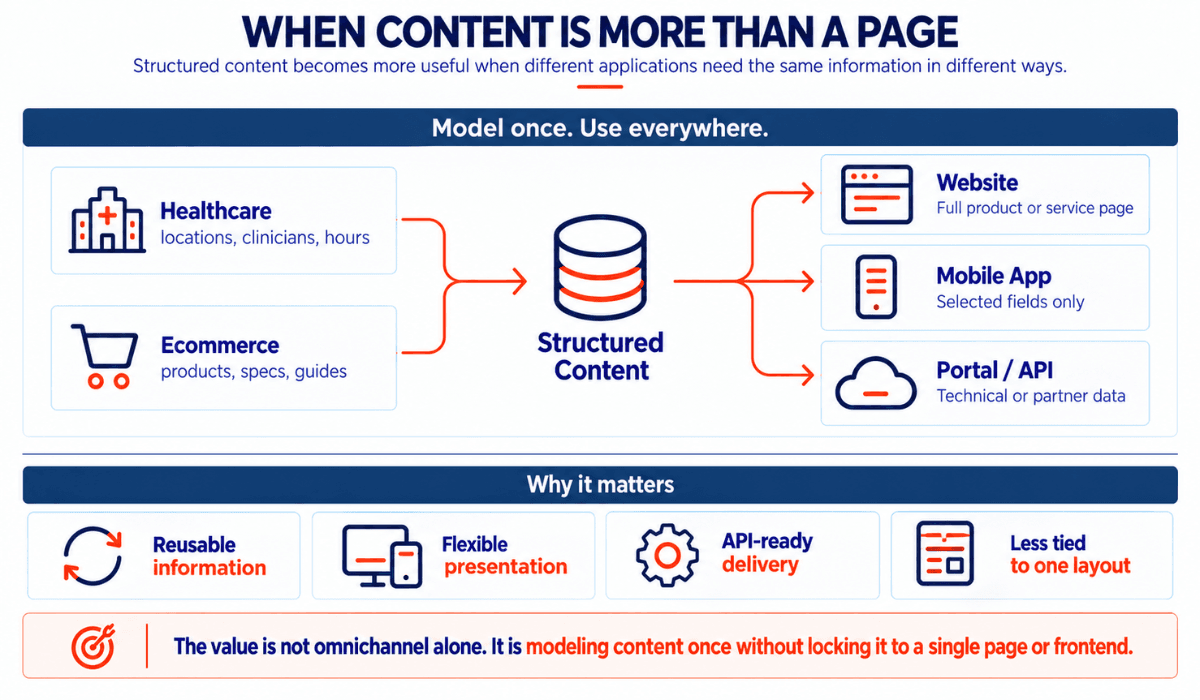
Those structures are more than pages. They are reusable information models that may need to appear differently depending on the application consuming them, which is where separating the content layer from presentation begins creating meaningful architectural value.
A website might display the complete product record. A mobile application may show only selected fields. A partner portal may expose technical information, while another application consumes the same underlying content through an API. The important benefit is not the word “omnichannel.” It is that content can be modeled once without belonging permanently to a specific page layout or frontend application.
Do You Actually Need Headless Architecture?
Headless architecture makes sense when separating content from the frontend solves a real business or technical problem. If you mainly need one marketing website, adding a separate CMS, frontend, APIs, and deployment process may create unnecessary complexity.
Look for requirements such as:
- Content across multiple channels: Website, mobile app, portal, or partner platform.
- Independent frontend control: Greater freedom over rendering, performance, and user experience.
- Structured content: Products, locations, services, specifications, or other reusable entities.
- Shared content across applications: One source of truth instead of duplicate information.
- Strong technical ownership: Your team can manage APIs, deployment, SEO, caching, and integrations.
If your needs are mainly pages, blogs, landing pages, forms, and easy publishing, WordPress may be the simpler choice. Headless is valuable when separation solves a real problem, not simply because it is a modern architecture.
What If You Want WordPress Editors but a Next.js Frontend?
Suppose marketing already works effectively in WordPress, editors know the publishing process, and years of existing content live there. At the same time, engineering wants a component-based Next.js frontend and greater control over rendering and deployment.
Replacing WordPress with Strapi is not automatically necessary. WordPress can remain the content backend while a separate application consumes content through REST APIs or GraphQL, giving the organization a familiar editorial environment alongside a custom frontend.
That model can work particularly well when WordPress's publishing workflow remains valuable enough to preserve. However, teams should remember that some WordPress functionality assumes WordPress controls presentation, so additional development may be required around previews, plugins, blocks, forms, menus, and redirects.
Headless WordPress can therefore combine WordPress editorial strength with modern frontend freedom, but it can also combine WordPress complexity with headless complexity. The architecture should be chosen because both sides provide genuine value.
Using Next.js Does Not Automatically Mean You Need Strapi
A Next.js frontend does not decide the CMS architecture for you. Both WordPress and Strapi can supply content to a Next.js application, so the decision should depend on what kind of information the frontend needs to consume and manage.
If Next.js primarily displays marketing pages, articles, campaign content, and other website-oriented information, headless WordPress may remain entirely reasonable, particularly when content teams already depend on its editing environment.
If the application consumes complex reusable content entities, relationships, or information shared with several other applications, Strapi becomes more compelling because content modeling and API delivery are central to its architecture.
Choose the CMS according to the content and operating model, not simply because the frontend happens to use a modern JavaScript framework.
Strapi Gives Development Teams Greater Backend Control
Strapi becomes especially useful when requirements move beyond ordinary content publishing. Developers may need custom validation, API behavior, external-system integrations, business rules, data transformations, authentication logic, or specialized endpoints around the content layer.
Because Strapi operates as an extensible backend, application-specific behavior can live around the structured content model rather than being forced into a website-oriented publishing system. This can fit naturally within JavaScript and TypeScript development environments.
If your project reaches that level and requires content architecture, migration, custom APIs, integrations, or implementation support, our Strapi Development Services can help turn those requirements into a maintainable system rather than simply replacing one CMS with another.
WordPress's Real Superpower Is Its Ecosystem
WordPress remains difficult to replace for conventional websites because an enormous amount of common functionality has already been solved. Teams can add forms, SEO controls, redirects, ecommerce, memberships, analytics, multilingual support, caching, search, and CRM integrations without building everything themselves.
That ecosystem can dramatically reduce implementation time and engineering cost. However, it also introduces governance responsibilities because business-critical functionality may become distributed across plugins, themes, hosting configurations, and custom modifications that all need to remain compatible.
The correct criticism is therefore not that plugins make WordPress bad. The real issue is that each important third-party dependency introduces another component that must be selected, maintained, updated, secured, and tested over time.
A disciplined WordPress architecture can work extremely well. A poorly governed collection of extensions can become increasingly difficult to operate.
Which Is Better for SEO: Strapi or WordPress?
Neither platform automatically ranks better. The real difference is how each lets your team manage the content and technical elements that search engines eventually receive.
With WordPress, teams get:
- Ready-made SEO tooling
- Redirect and sitemap support
- Easy metadata management
- More independence for content teams
With Strapi, developers gain more control over:
- Metadata and canonicals
- Structured data
- Hreflang
- Sitemaps and redirects
- Rendering and URL structure
- Internal linking and performance
WordPress usually gives marketers more out-of-the-box SEO tools, while Strapi gives developers more control over the final implementation. Neither guarantees stronger rankings on its own.
Is Strapi Faster or More Secure Than WordPress?
Strapi is not automatically faster because it is headless. A modern frontend can use static generation, server rendering, caching, CDN delivery, and other optimization strategies, but poor implementation can still create excessive API calls, large bundles, slow rendering, or inefficient caching.
WordPress can also perform extremely well with appropriate hosting, caching, database optimization, asset management, and disciplined plugin usage. Headless architecture changes where optimization happens; it does not remove the need to optimize.
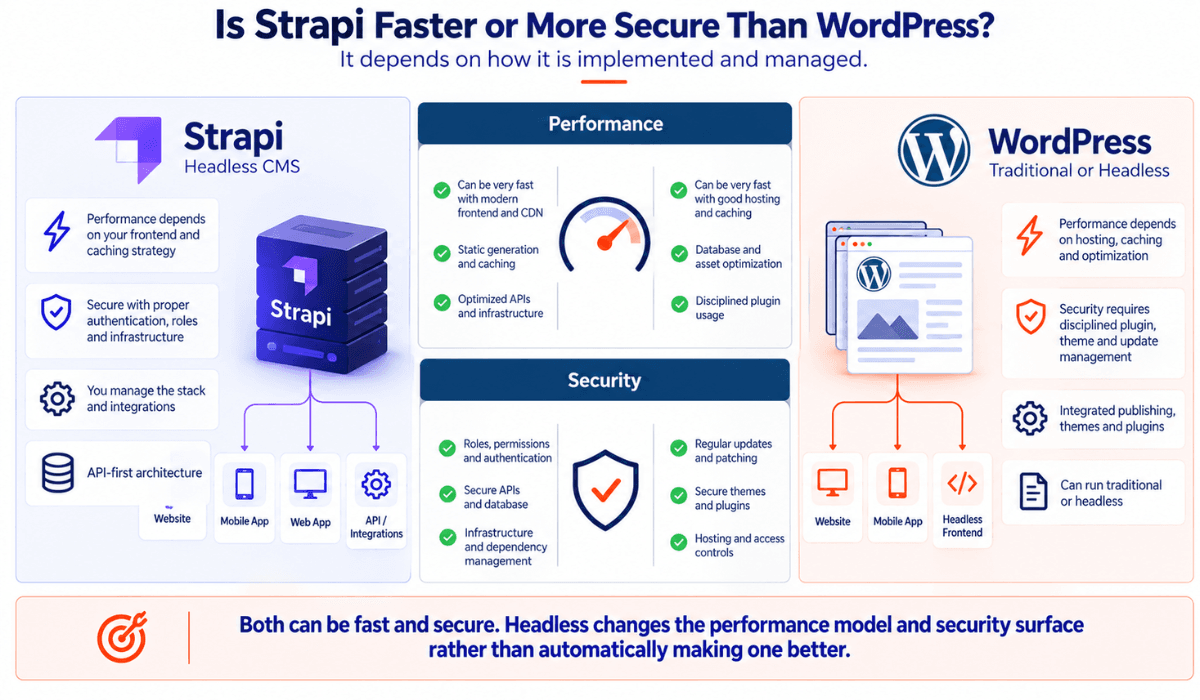
Security works similarly. WordPress requires disciplined plugin, theme, and update management, while Strapi still exposes an admin environment, APIs, authentication, permissions, databases, infrastructure, dependencies, uploads, and integrations that require proper security engineering.
The more accurate conclusion is that headless architecture changes both the performance model and the security surface rather than automatically making either one better.
Ecommerce Makes the Difference Easier to See
For a conventional ecommerce website, WordPress has a major advantage through WooCommerce. Products, checkout, payments, orders, shipping, extensions, and content management can operate within one familiar ecosystem, which can make strong business sense for many small and midsized stores.
Strapi is not a WooCommerce replacement. In a composable commerce architecture, Strapi would usually manage content while a separate commerce platform owns transactional functions such as cart, checkout, payments, orders, and inventory.
That separation can be powerful when an organization needs sophisticated experiences across several channels. For a straightforward online store, however, it may create significantly more architecture than the business actually needs.
Strapi vs WordPress vs Headless WordPress
Seven Questions to Ask Before Choosing
Before selecting either platform, determine whether you are primarily building a website or a broader digital product, whether content must exist independently from presentation, and whether the same structured information will eventually serve several different applications.
Also examine how much publishing independence your editors require, whether your content consists mainly of pages or complex reusable entities, and whether your development team can realistically own frontend rendering, APIs, deployments, previews, SEO, caching, security, and integrations.
If WordPress already provides a strong editorial workflow, ask whether headless WordPress could solve the frontend requirement without forcing a complete CMS migration. Preserving what already works can sometimes be more valuable than replacing everything.
Most importantly, ask whether you are choosing headless architecture because it solves an identifiable operational problem or simply because it appears more modern. If the value of decoupling cannot be explained clearly, the additional architecture may not be justified.
Strapi vs WordPress: The Final Answer
Choose traditional WordPress when the central problem is publishing and operating a website. Its integrated editing experience, enormous ecosystem, page-building capabilities, and familiar publishing model make it particularly strong when one website remains the primary digital experience.
Consider headless WordPress when the editorial environment is worth preserving but the organization has a genuine requirement for a separate frontend. It can provide modern frontend flexibility without immediately replacing the content-management workflow editors already understand.
Choose Strapi when content needs to become an independent, structured layer inside a larger application architecture. That becomes especially valuable when reusable content must serve multiple frontends, complex relationships, custom APIs, integrations, or digital products beyond one website. The decision is therefore not whether Strapi is more modern than WordPress, nor which product has the longest feature list. The real question is:
- Where should the boundary between content and the application actually sit?
If WordPress can own content, presentation, and publishing without creating meaningful constraints, separating those responsibilities may add little value. If content needs to exist independently of any single website and support a wider digital ecosystem, that separation begins solving a real architectural problem. That is when headless stops being a technology preference and starts becoming a business requirement.
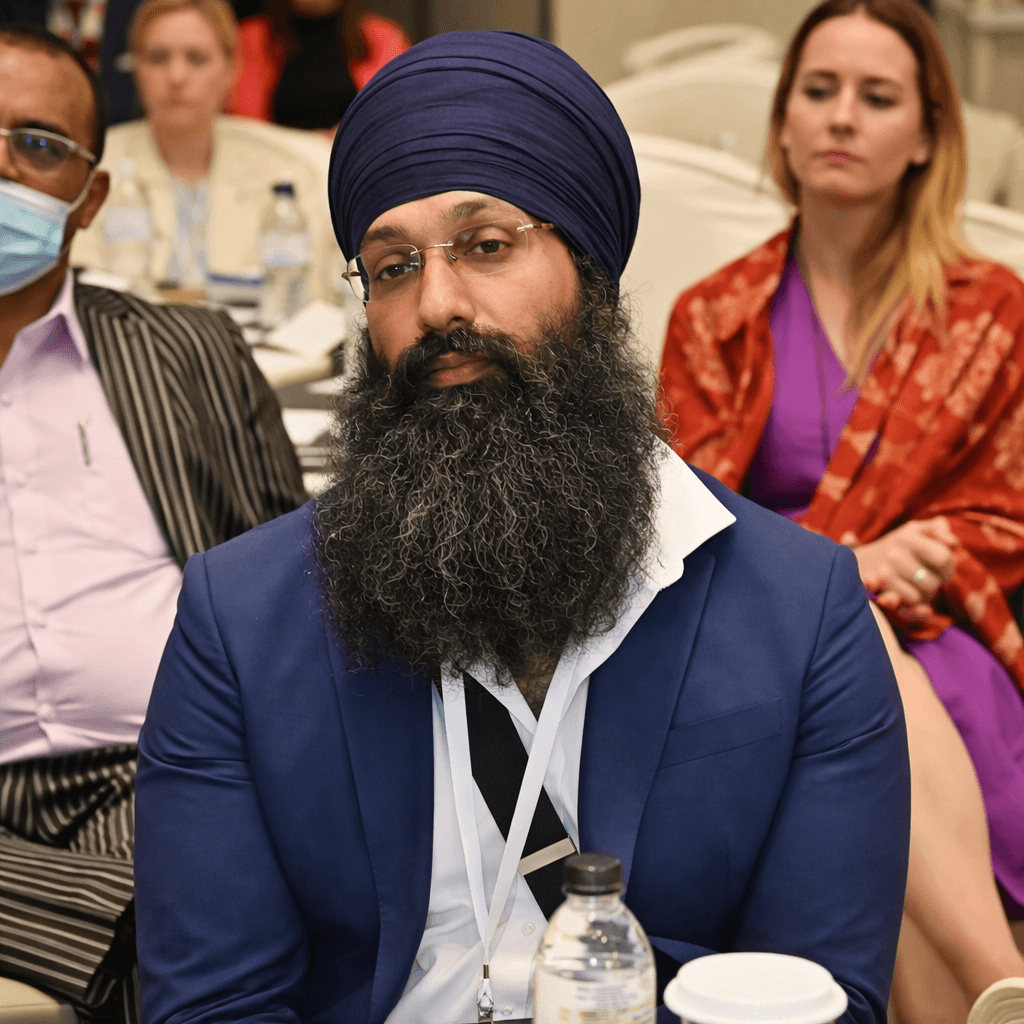
SUKHPREET SINGH
I'm Sukhpreet Singh, Director of Innovation & Technology at Gyan Solutions. With 8+ years in generative AI and ERP integration, I build AI-powered decision-support systems that adapt to real operational complexity without replacing existing infrastructure.





