


A company completes its CMS migration on schedule, celebrates the launch, and then discovers that changing a banner, fixing a headline, or reordering a landing-page section still requires a developer ticket. Nothing about daily work has actually moved.
The consequences are quiet but real. Marketing waits for small changes, engineers lose focus on harder work, and the expensive new platform starts to feel like the old one with a nicer interface and a larger invoice.
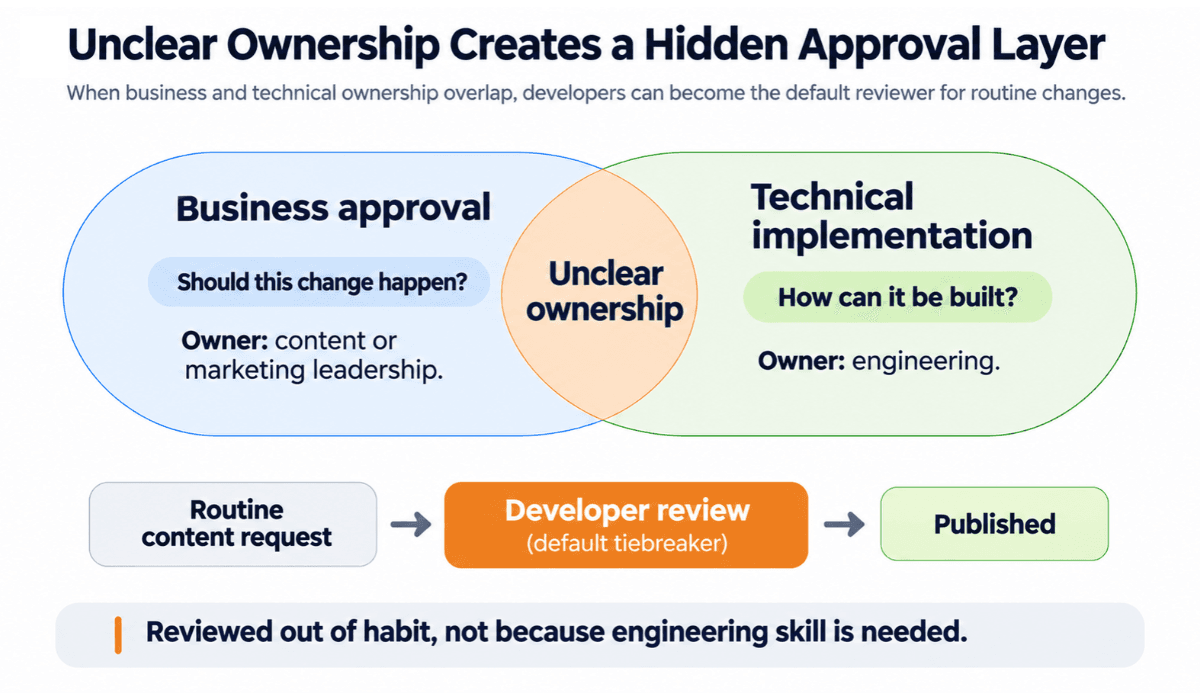
Leaders usually ask whether they chose the right platform. The better question is whether anyone decided who owns everyday content changes, because dependency often survives migration as an unmade decision, not a missing feature, and unmade decisions default to developers.
The Platform Changed, but the Operating Model Did Not
Migration moves content, templates, and integrations. It does not move habits. Requests keep following the old path because roles, approvals, and assumptions about what marketers may touch were never named as part of the project scope, and nobody revisited them.
This is not a verdict against migration; many projects deliver real gains. But technical capability, editorial authority, and operational responsibility are three different things, and a migration usually secures only the first, leaving the other two unexamined and unowned.
Content Access Is Not the Same as Content Control
Access: Editing What Exists
Hypothetical example: an editor can change a landing-page headline but cannot add a testimonial block or reorder sections. The text is editable, yet the page experience still belongs to developers, so every meaningful adjustment becomes a fresh engineering request.
Control: Shaping the Experience
Access means editing fields. Control means shaping the intended experience within agreed limits. Netlify’s vendor-commissioned 2024 survey of marketing and development leaders found 87.42% of surveyed marketers wanted more direct control over website content without always needing developer support.
Why Routine Content Changes Still Become Developer Tasks
Routine requests reach developers for operational reasons, not because editors lack skill. The blockers are structural, and each one quietly converts a simple edit into a full engineering handoff.
Rigid templates limit layout, content blocks, and section order. Needed components may not exist in the design system yet. Previews often fail to show the finished page, so editors hesitate to publish without a developer’s check.
Unclear publishing rules and caution after past mistakes keep the pattern going. Sanity’s visual editing documentation describes live preview and click-to-edit, but both typically need frontend integration. A documented feature is not a capability editors actually have.
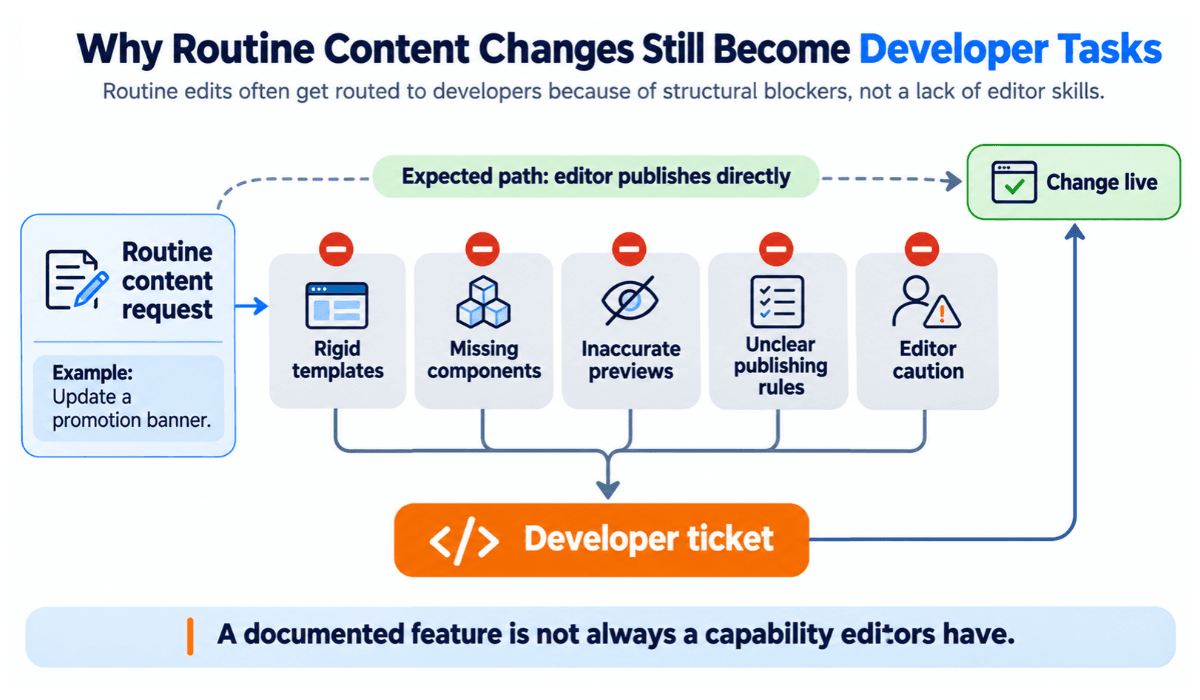
Rigid templates limit layout, content blocks, and section order. Needed components may not exist in the design system yet. Previews often fail to show the finished page, so editors hesitate to publish without a developer’s check.
Unclear publishing rules and caution after past mistakes keep the pattern going. Sanity’s visual editing documentation describes live preview and click-to-edit, but both typically need frontend integration. A documented feature is not a capability editors actually have.
The New CMS May Still Reflect Old Decisions
Teams often rebuild what already existed. If developers formerly owned page layouts, exceptions, and field definitions, the new system can quietly preserve that arrangement, because nobody ever asked whether those decisions still suit today’s editors, campaigns, and approval needs.
Netlify’s survey adds a complication: 68.21% of its developer respondents said marketers underuse existing tools. Both sides can also be partly right, which may suggest the gap sits in unassigned decisions rather than in either team’s competence or effort.
The Editor Experience Was Not Treated as an Operating Requirement
Migration plans usually measure architecture, integrations, performance, and launch readiness. Editor effectiveness tends to appear late, if at all, because the people who edit daily are not always the people who define success criteria or approve the project scope.
Hypothetical example: a retailer launches on time and passes every performance test. Three months later, adding a seasonal promotion block to a category page still requires engineering, so the launch succeeded technically while everyday editorial work stayed just as slow.
Developer Dependency Has a Business Cost
Webflow’s survey found 96% of technical leaders said platform and process gaps pull their teams into work non-technical colleagues should handle. This is self-reported vendor research, not proof of causation. Small requests still interrupt engineering focus.
Marketing waits for simple changes, campaign timing can slip, and updates become less frequent when every edit feels expensive. Not every ticket causes delay. The real cost is accumulation: scattered handoffs that quietly compete with higher-value engineering work.
Not Every Developer Dependency Is a Problem
Where Engineering Belongs
Complete independence is the wrong target. Some dependencies protect performance, security, and brand consistency. The useful test is whether a dependency was chosen or merely inherited: engineering should own what needs engineering, not everything nobody assigned.
| Change Type | Appropriate Responsibility | Reason |
|---|---|---|
| Routine approved content update | Content team | Existing editorial capability and approved content rules |
| Existing approved content section | Content team, where enabled | Work within defined, documented editing boundaries |
| Regulated or legal-claims content | Content team with compliance review | Risk, not tooling, determines the approval step |
| New website component | Engineering team | Requires changes to application behavior |
| New external system integration | Engineering team | Requires technical design, security review, and testing |
Why Context Changes the Answer
Roles vary with organizational risk, technical architecture, and governance. A regulated company may require engineering review for changes a smaller team would hand directly to editors, and both choices can be reasonable when the reason is clearly stated.
What Genuine Editor Autonomy Should Mean
Genuine autonomy is confident, authorized routine work: understandable editing tools, clear content ownership, and safeguards that catch mistakes. It is not unlimited permission, which can simply shift risk from engineering queues to the live website and the brand.
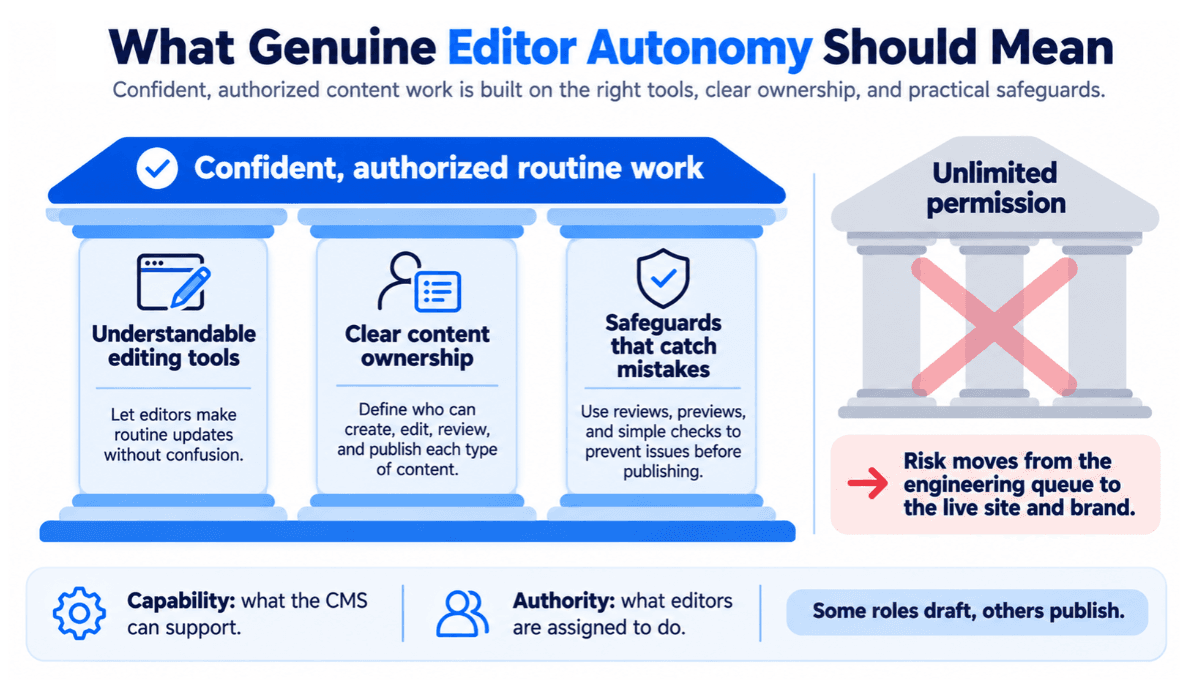
Sanity’s roles documentation shows capability and authority are separate: some built-in roles only draft, while others publish. Teams should decide that early, whether through internal planning or outside Sanity CMS implementation support, rather than discovering it after launch.
What Leaders Should Examine Before Replacing Another CMS
A new platform purchase may repeat the same pattern if the blockage is organizational. Before comparing vendors, leaders should read ticket history as evidence of unmade decisions.
- Which routine requests reached developers most often, and why?
- Which of those requests genuinely required engineering skill?
- Who approved those changes before developers ever touched them?
- Which limits came from tools, templates, permissions, or policy?
- Which ownership decisions were carried over without fresh review?
These questions separate software limitations from genuine ownership gaps. Without answers, another migration may simply reproduce the same request queue inside a different interface, at considerable cost and effort.
Measure the Work Editors Can Complete, Not Just CMS Features
These are suggested measurements, not established industry benchmarks. Useful signals include the share of routine requests that needed developer tickets, time spent waiting for technical help, rework caused by unclear boundaries, changes editors completed independently, and exceptions that required genuine engineering.
Tracked together, these figures show whether editors can finish routine work and where engineering time is truly needed. They should guide decisions about training, permissions, and capacity without promising performance gains, because every organization’s baseline and risk tolerance differ.
The Real Outcome of CMS Modernization
A CMS migration is complete when the technology has moved. Modernization succeeds when responsibilities and everyday work improve: editors handle authorized routine changes, and engineers spend their time on components, integrations, and architecture decisions that genuinely need them.
The right objective is appropriate control over routine content changes, backed by clear responsibilities and technical safeguards. The useful question after launch is not whether the CMS is modern, but who now decides, who still waits, and why.



