


Quick Summary
Operation monitoring provides real-time data that offers businesses immediate access to information about machines, workflows, supply chains, and resources. Teams identify issues immediately they arise, minimize downtimes and make quicker decisions. Managers do not respond to yesterday reports, they respond to what is occurring at that time. The outcome is reduced expenses, less interference and increased working capacity on a daily basis.
Imagine a production line goes down at 9 PM on a Tuesday. Nobody notices until the morning shift manager reads a report at 7 AM. By then, ten hours of output are lost and the repair costs have doubled. This is not a rare situation. It happens every day in businesses that rely on delayed reporting instead of real-time operational data. Existence of real-time information in operations monitoring is to avoid just that. This article takes you through 10 obvious advantages explaining why live data can help modern business to spot issues in real-time, lessen downtime, enhance efficiency, and make quicker decisions each day in every sector of their businesses.
What Is Real-Time Data in Operations Monitoring?
Real-time data can be defined as the information that is gathered, processed and dispatched in real time when something happens. In monitoring operations, this implies that managers will be able to view live updates of machines, systems, workflows and supply chains. Waiting is not necessary until a report comes. The information is never outdated, never wrong, never inactive.
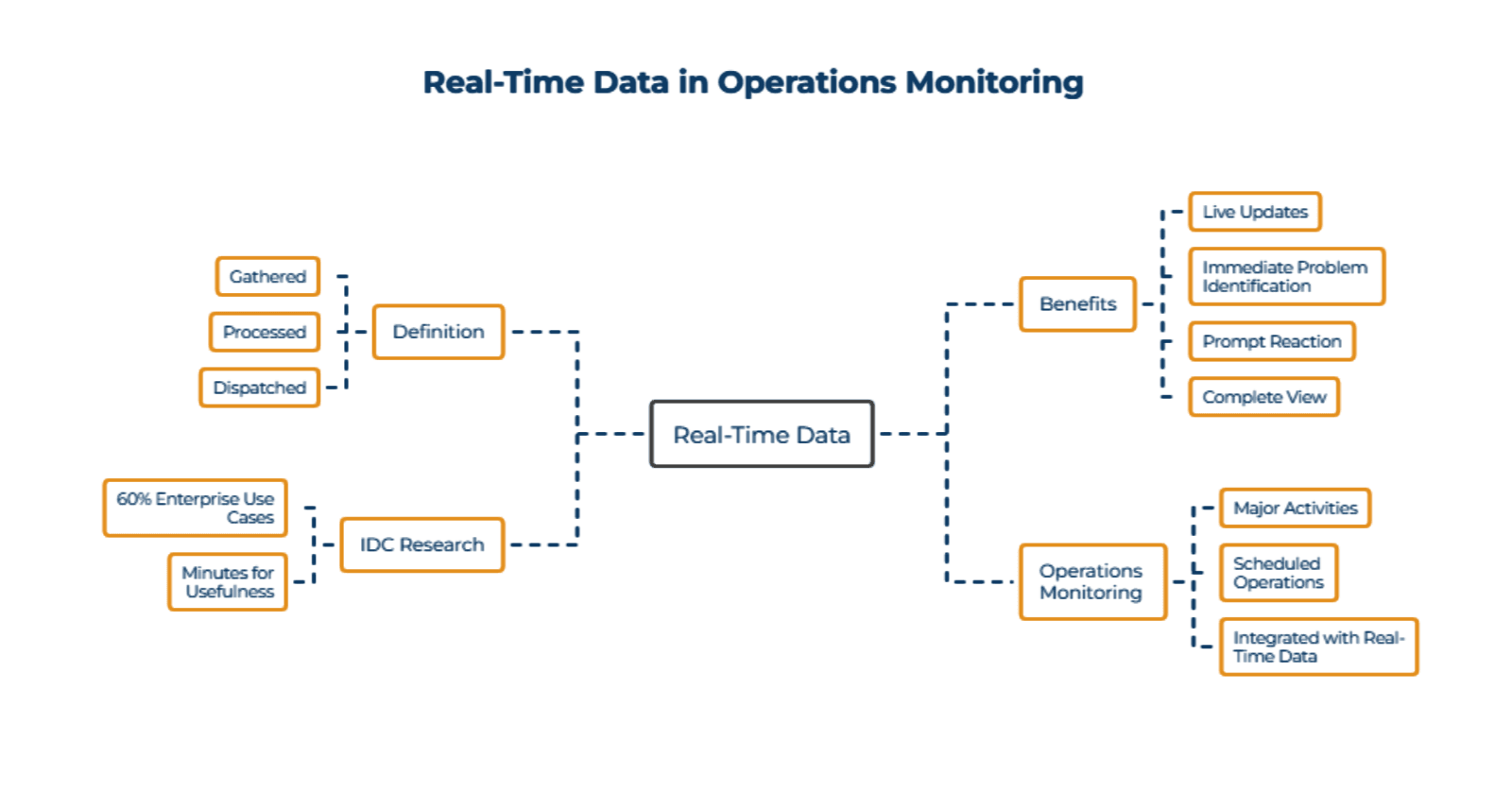
IDC research has shown that over 60% of enterprise use cases need to have their data be processed in minutes in order to be useful, which is why real-time monitoring is emerging as a critical component of contemporary operations.
Operations monitoring involves tracking of major activities within a business to make sure that all operations proceed as scheduled. It is a potent tool when it is integrated with real-time information. Teams are able to identify any problems immediately, react to shifts promptly, and continuously have a complete view of all aspects of their functioning without any flaws or time loss.
Why Traditional Reporting Falls Short in Daily Operations
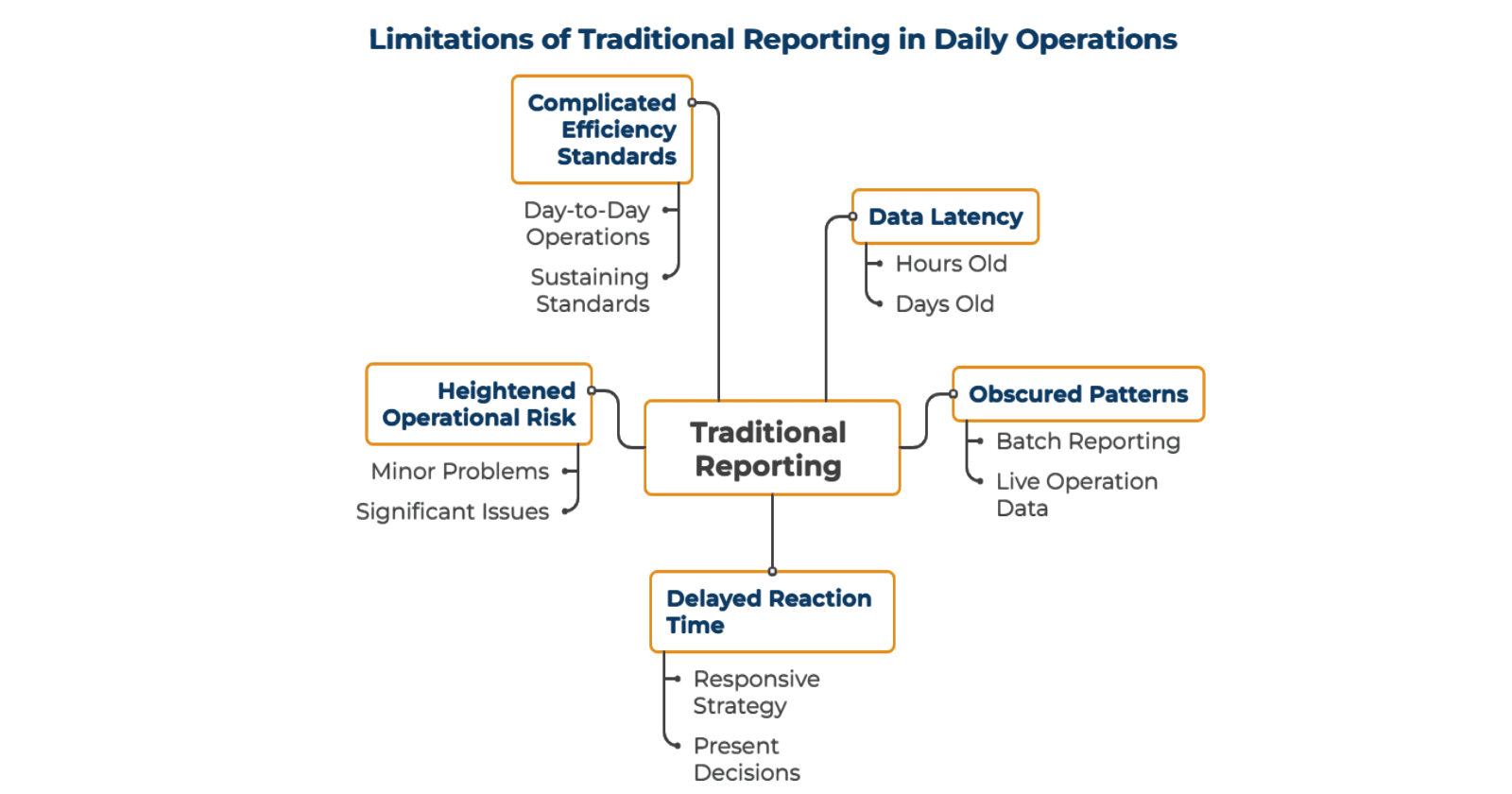
The traditional reporting system is supported by information that may be hours or even entire days old at the time when a manager reads it. At this point, a minor problem can also become a significantly larger and more expensive one. A delay in production that can be observed in a morning report could have begun last night and the harm is already done before it can be noticed.
Real time patterns are also obscure under batch reporting. In the absence of live operation data the managers will make decisions on what has occurred in the past rather than the present. This responsive strategy delays reaction time, heightens operational risk, and complicates it far too difficult to sustain standards of efficiency in day-to-day operations.
10 Benefits of Real-Time Data in Operations Monitoring
Operation monitoring in real-time will enable businesses to identify problems and enhance decision-making, decrease downtime, and sustain complete operational visibility. All these advantages of real-time data in operations monitoring assist companies in shifting to proactive operations rather than reactive management to enable the teams to quickly react and ensure operations proceed seamlessly.
1. Faster Operational Decision-Making
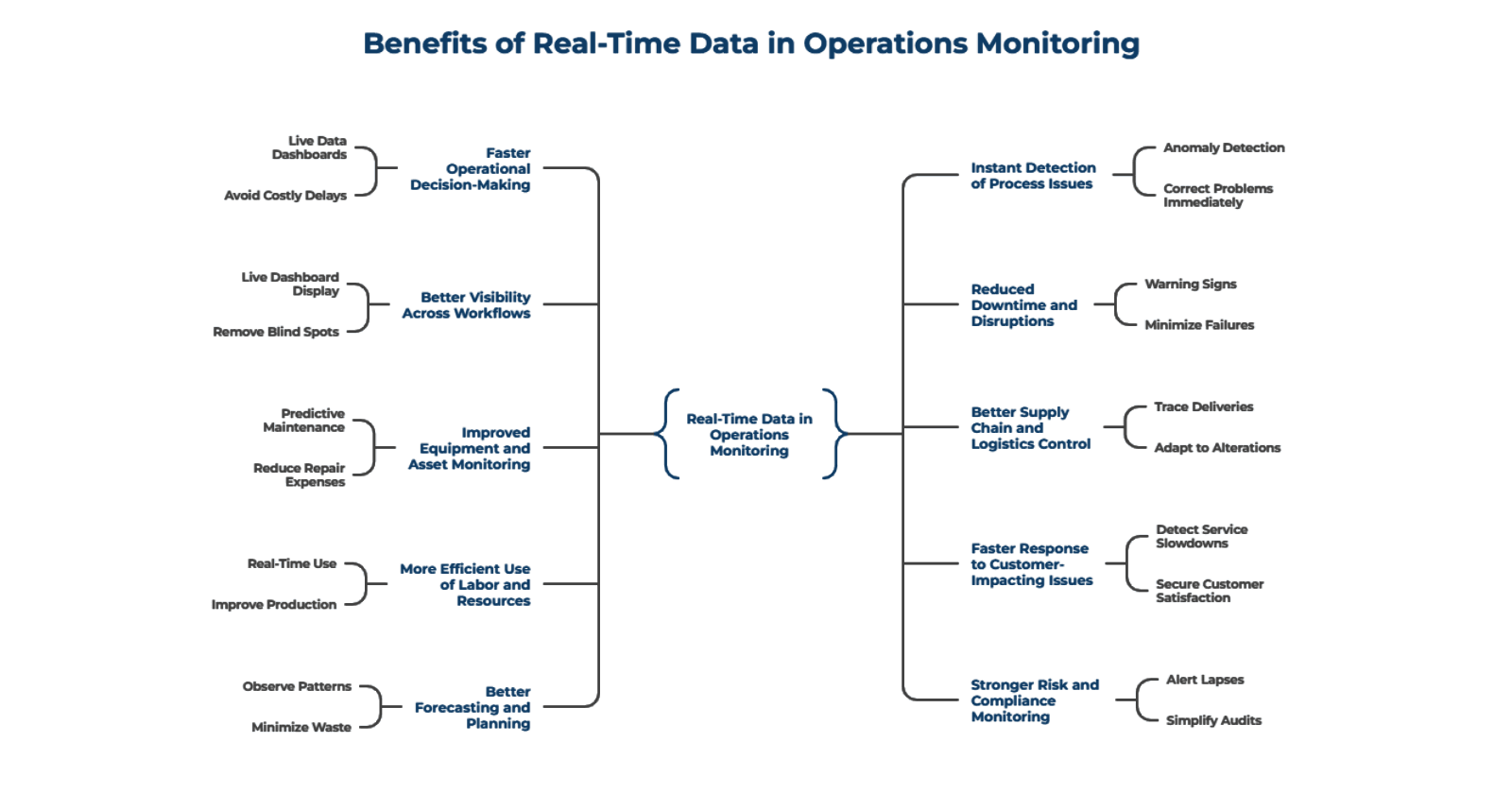
When managers have live data dashboards, they make faster and smarter decisions. Real-time monitoring removes the delay between an event happening and a manager learning about it. Instead of waiting for daily reports, teams act on what is happening right now. This kind of operational visibility helps businesses respond quickly and avoid costly delays.
2. Instant Detection of Process Issues
Anomaly detection is one of the most powerful advantages of real-time data. Live monitoring systems alert immediately in case a process fails or becomes slow. As an example, a warehouse can identify a delay in picking the orders before they impact the shipments. The operations teams will then be able to correct the problem immediately before it becomes a bigger problem.
3. Better Visibility Across Workflows
Operational data is provided in real time which makes managers see the entire situation in their workflows. Every action of a process is displayed on a live dashboard. As an example, a factory manager can track the production rate, machine productivity, and employee performance simultaneously. This entire workflow tracking removes the blind spots in day-to-day operations.
4. Reduced Downtime and Disruptions
One of the largest costs in operations is unplanned downtime. It can be prevented with the help of real-time monitoring the cases when systems start to demonstrate any warning signs. Indicatively, sensors would be able to sense when the equipment is heated and before a failure is experienced. This enables the maintenance teams to respond quickly, minimizing failures and operating without hitches.
5. Improved Equipment and Asset Monitoring
Real-time asset monitoring makes predictive maintenance much easier. Teams monitor performance data instead of waiting until equipment has been broken. The system notifies a machine as soon as it displays some abnormal signs. This live equipment monitoring prolongs the life of the assets, reduces the repair expenses and avoids unexpected failures in busy production.
6. Better Supply Chain and Logistics Control
Live data provides organizations with a superior supply chain analysis up to the very end. Managers can trace deliveries, observe the stock amount, and identify the delays in real-time. An example is that a logistics team can divert a delivery truck when a route is slowed down by traffic. Such live monitoring ensures that the whole chain of supply becomes more adaptive and reactive to urgent alterations.
7. More Efficient Use of Labor and Resources
This means that operational efficiency is dramatically improved when teams are able to see the real-time use of labor and resources. Managers can see where employees are not doing any work or where work is being performed at a slower rate than anticipated. Indicatively, a shift supervisor can identify a bottleneck in one production line and relocate the workforce to resolve it. This results in an improved production at reduced idle time.
8. Faster Response to Customer-Impacting Issues
In the event of a service slowdown or product delay, it is immediately detected through real-time monitoring. The teams can take action earlier than the customers are aware of the issue. A support operations team, for instance, may identify an influx of service tickets and redeploy agents in a matter of a few minutes. This quick action helps to secure customer satisfaction and avoid unnecessary small problems that might result in complaints.
9. Better Forecasting and Planning
Live information enhances future planning in business. As managers observe patterns as they emerge, they will be able to make changes in staffing, inventory and production plans within a short period of time. As an example, a retailer who continuously monitors sales data in real-time can repurchase quickly moving goods before a stockout occurs. This ensures that planning is more precise, and waste and lost revenue is minimized.
10. Stronger Risk and Compliance Monitoring
Real time data assists businesses to remain up to date on risk and regulatory requirements. Live monitoring systems have the ability to alert any lapses of compliance or unsafe conditions immediately they arise. Using the case in point, a food facility can monitor temperature levels on a continuous basis to monitor the standards of storage. Such operational supervision minimises risk and simplifies audits to a large extent.
How Real-Time Data Improves Monitoring Across Different Operations
Manufacturing
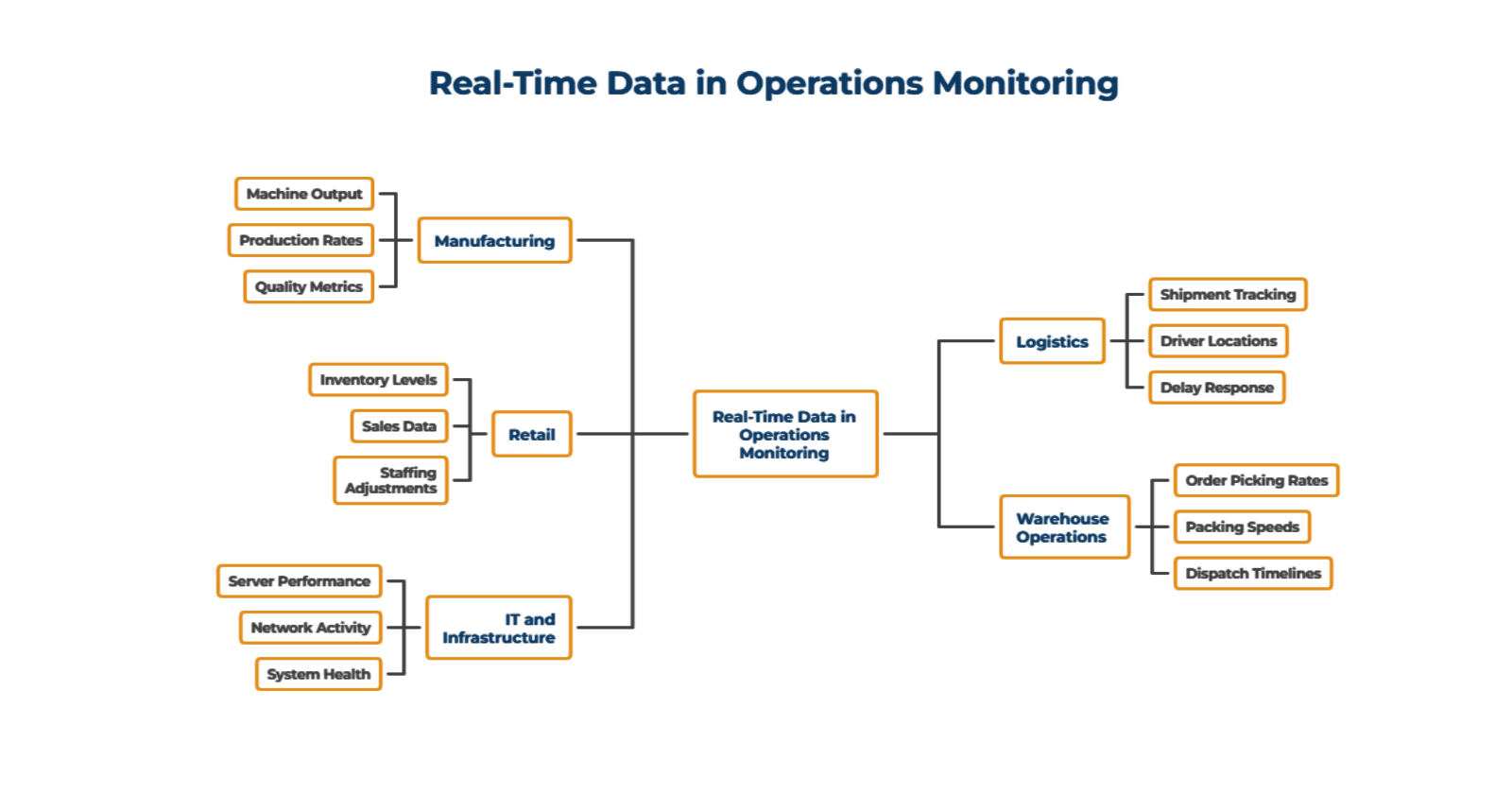
In manufacturing, real-time monitoring tracks machine output, production rates, and quality metrics. Supervisors get instant alerts when a line slows or a product fails a check. Teams respond immediately, reducing costly waste. Live operational data keeps production on track and minimizes unplanned interruptions across the factory floor.
Logistics
Logistics teams use real-time data to track shipments, monitor driver locations, and respond to delays. If a delivery runs late, managers reroute vehicles or notify customers right away. This supply chain visibility improves reliability and builds trust. Real-time operational insights make the entire delivery process more efficient and predictable.
Retail
Retailers rely on live inventory and sales data to keep shelves stocked and customers satisfied. When a product sells faster than expected, real-time monitoring triggers a restocking alert before a stockout. Store managers track foot traffic and adjust staffing accordingly. This visibility reduces both overstock and missed sales opportunities.
Warehouse Operations
In warehousing, live dashboards track order picking rates, packing speeds, and dispatch timelines. When a bottleneck appears in the picking zone, supervisors reassign workers right away. Real-time workflow monitoring ensures every order moves through on time. This level of oversight reduces errors and keeps fulfillment targets on track every day.
IT and Infrastructure
IT teams use real-time monitoring to track server performance, network activity, and system health. When an anomaly appears, alerts go out instantly so engineers can respond before a full outage occurs. This live operational monitoring reduces downtime, protects reliability, and ensures critical systems stay available around the clock for users.
Examples of Real-Time Data in Operations Monitoring
A steel manufacturer has temperature sensors that can measure the heat level of a furnace in real time. In the case of a reading that surpasses a safe limit an alert is sent to the maintenance staff. They find out and remedy the problem before equipment collapses. In the absence of real-time information, the identical issue may take hours to be detected and trigger an entire production shutdown.
A freight corporation follows the fleet of deliveries with the help of GPS and live traffic information. Where a road blockage is visible, the system automatically proposes alternative routes. Goods are delivered in time and clients remain updated. This real-time supply chain visibility avoids wastage of time, which would certainly harm the efficiency in operations, as well as customer satisfaction.
Inventory is tracked in dozens of locations and in real time by a retail chain. An automatic reorder is activated when stock on a high selling product reaches a pre-determined level. There is never any need to physically check inventory by store managers. This strategy minimizes the stockouts, enhances sales and ensures the operations run efficiently without the need to have them monitored manually.
Technologies That Make Real-Time Operations Monitoring Possible
IoT sensors are among the most important tools behind real-time operations monitoring. These devices attach to machines and equipment to collect data continuously. They send live readings to a central system where managers view everything at once. This technology allows businesses to monitor physical assets and processes from anywhere at any time.
Cloud analytics platforms process large amounts of operational data instantly and share it across teams. Stream processing tools analyze live data flows and trigger alerts in seconds. APIs connect all systems so data moves between platforms smoothly, creating a fully connected real-time monitoring environment for businesses of any size.
Common Challenges Businesses Face Without Real-Time Data
Without real-time data, operations teams always react to problems instead of preventing them. Managers rely on reports that are hours old, so decisions are based on outdated information. Small issues escalate fast because no one sees them in time. This reactive approach increases costs, delays responses, and puts business performance at risk.
Hidden inefficiencies are a major challenge when real-time monitoring is absent. Workflow bottlenecks go unnoticed for days. Labor gets misallocated without anyone realizing it. Inventory errors build silently before affecting customers. Without live operational data, problems stay invisible until they cause real damage and become far more costly.
How Businesses Can Start Using Real-Time Data for Operations Monitoring
Operations in the absence of real time information will never prevent problems but rather respond to them. Managers subscribe to reports that have been sent hours ago, hence, making decisions using old information. Minor problems grow exponentially since nobody notices them before it is too late. Such a reactive strategy adds expenses, slows down reaction, and jeopardises business operations.
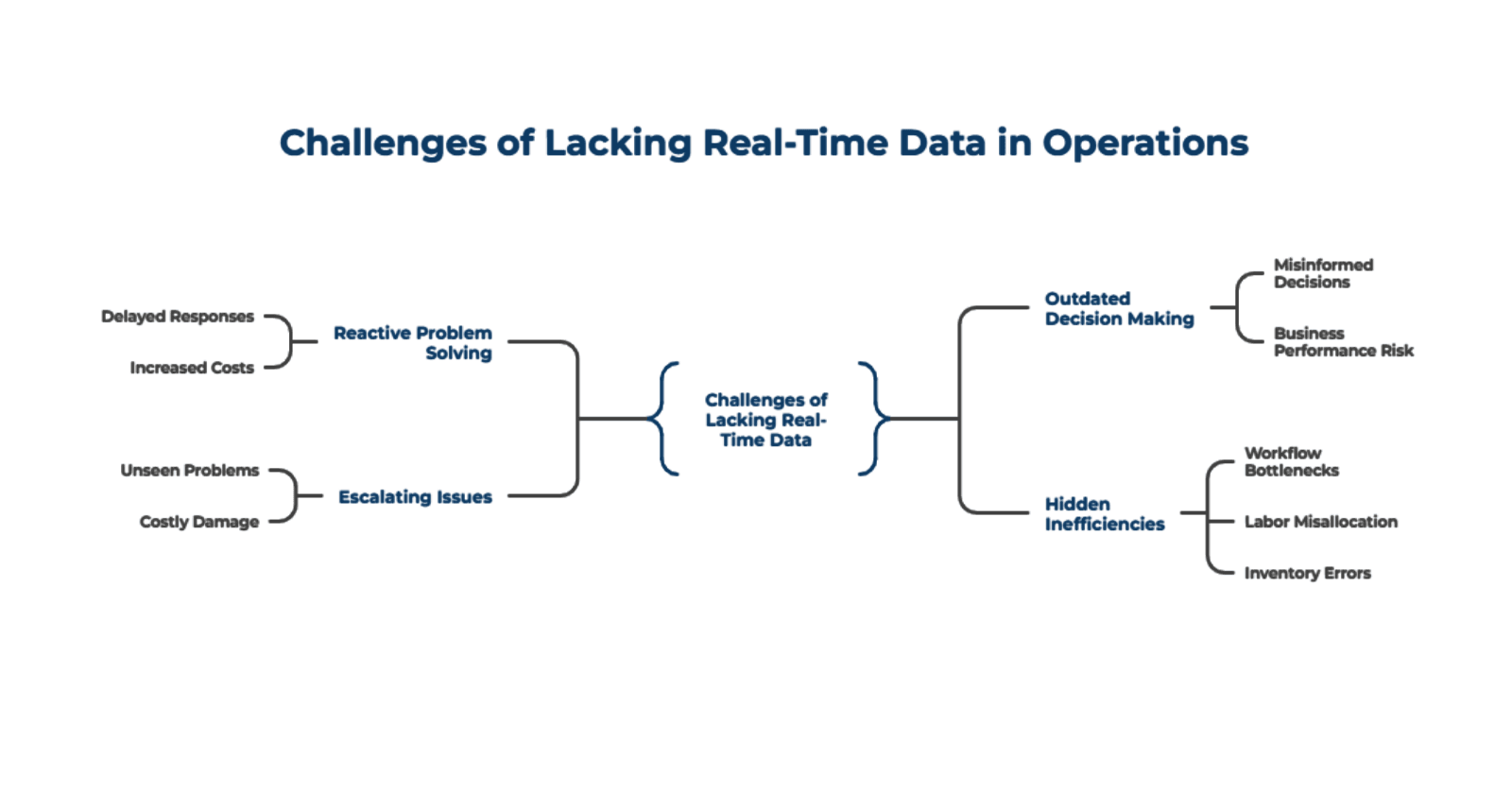
The absence of real-time monitoring is a significant challenge that includes hidden inefficiencies. The bottlenecks of the workflow are not felt until a few days. Labor is misallocated without the knowledge of anybody. Inventory mistakes accumulate without warning their impact on the customers. Without real time running data, issues remain undetected until they actually damage and become much more expensive.
Final Thoughts: Real-Time Data Turns Monitoring Into Action
Real time data does not just inform you of what is happening. It empowers your team to take action before the issues escalate. The use of live and correct data will make operations monitoring a real asset. Companies that are open to this model make decisions more quickly, use less, and make decisions in a better way daily in all aspects of their businesses.
One of the key transformations any business nowadays should be prepared to make is reactive to proactive operations management. The cornerstone of that change is the real time tracking. Whether it is the management of a warehouse, factory or even a logistical network, live data can deliver the speed and clarity that are necessary to ensure that one is ahead of the competition at any given time.
Listen to the Podcast: Benefits of Real-Time Data in Operations Monitoring for Businesses

PAUL LUCKI
I'm Paul Lucki, Head of Business Development at Gyan Solutions. With 9+ years in business automation and ERP implementation, I help leaders eliminate operational silos through integrated systems and real-time reporting that drive competitive advantage





