


Quick Summary
Improving ecommerce rankings takes more than adding keywords or publishing new content. This article explains how indexing problems, poorly structured product categories, technical SEO issues, and ecommerce platform limitations can affect search visibility. It also helps retailers identify which website problems to investigate first, so they can focus on improvements that matter.
Many ecommerce businesses invest considerable time optimizing product descriptions, researching keywords, and improving their website's appearance, only to discover that their Google rankings barely improve. The frustration is understandable. If the products are competitive, the website looks professional, and the content is optimized, why are customers still finding competitors first?
The answer often extends beyond traditional SEO. An online store depends on several interconnected systems, including its ecommerce platform, product catalog, navigation, hosting, and content management. Problems within these systems can affect how search engines discover and understand the website, regardless of how carefully individual pages have been optimized.
Understanding how to improve rank for ecommerce requires examining the entire environment supporting the store, not simply adding more keywords.
Your Website Can Be Working Perfectly for Customers but Not for Google
A website that appears healthy to customers is not necessarily accessible to search engines in the same way. Visitors can search for products, apply filters, and navigate interactive menus, while Google's crawler may encounter missing links, duplicate URLs, or content that depends on JavaScript processing.
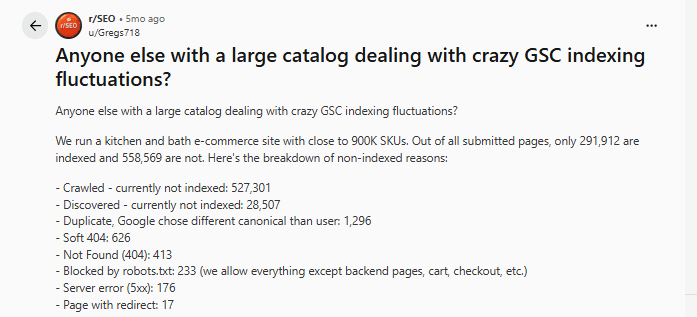
The challenge becomes more pronounced as product catalogs grow. In an April 2026 Reddit discussion, an operator of a kitchen and bath ecommerce website reported managing approximately 900,000 SKUs. According to the operator's Search Console figures, only 291,912 submitted pages were indexed, while 558,569 were not. The operator also reported that some previously indexed pages periodically disappeared from Google's index despite containing genuine product information.
That experience illustrates an important distinction: having a product page does not guarantee that Google will retain it in search results. Large catalogs need carefully designed product discovery, internal linking, consistent URLs, and useful content. Even then, Google may decide not to index every available page.
For store owners, the first question should therefore be whether their important product and category pages are being discovered and indexed correctly. Rewriting descriptions is unlikely to solve a problem caused by inaccessible navigation or incorrect indexing directives.
The Ecommerce Platform Influences What You Can Optimize
Shopify, WooCommerce, BigCommerce, Adobe Commerce, and headless ecommerce platforms can all support strong search performance. Google does not inherently reward one platform over another, but each platform comes with different technical responsibilities.
Shopify provides built-in features such as sitemaps and canonical tags, reducing some of the technical configuration required. However, heavily customized themes and multiple third-party applications can introduce performance issues. WooCommerce offers considerable flexibility, but its performance can depend on hosting, plugins, caching, and database maintenance. Adobe Commerce can manage complex catalogs, although its extensive filtering and product structures require careful technical configuration.
Headless ecommerce introduces another consideration. A storefront built with Next.js and connected to a commerce platform such as Medusa may deliver excellent performance, but developers must ensure that product information, metadata, and links are accessible to search engines. Adding a CMS such as Strapi can improve content management, but the frontend must still present that content correctly.
Google can process JavaScript, yet its JavaScript SEO documentation identifies additional rendering considerations. For some stores, improving how pages are rendered and linked can be more important than changing their written content.
The practical lesson is that choosing a platform does not automatically improve rankings. The quality of its implementation matters more than the platform's name.
Website Health Can Affect More Than One Product Page
When store owners hear the term website health, they often think about loading speed. Performance matters, particularly on mobile devices, but technical health involves more than how quickly a page appears.
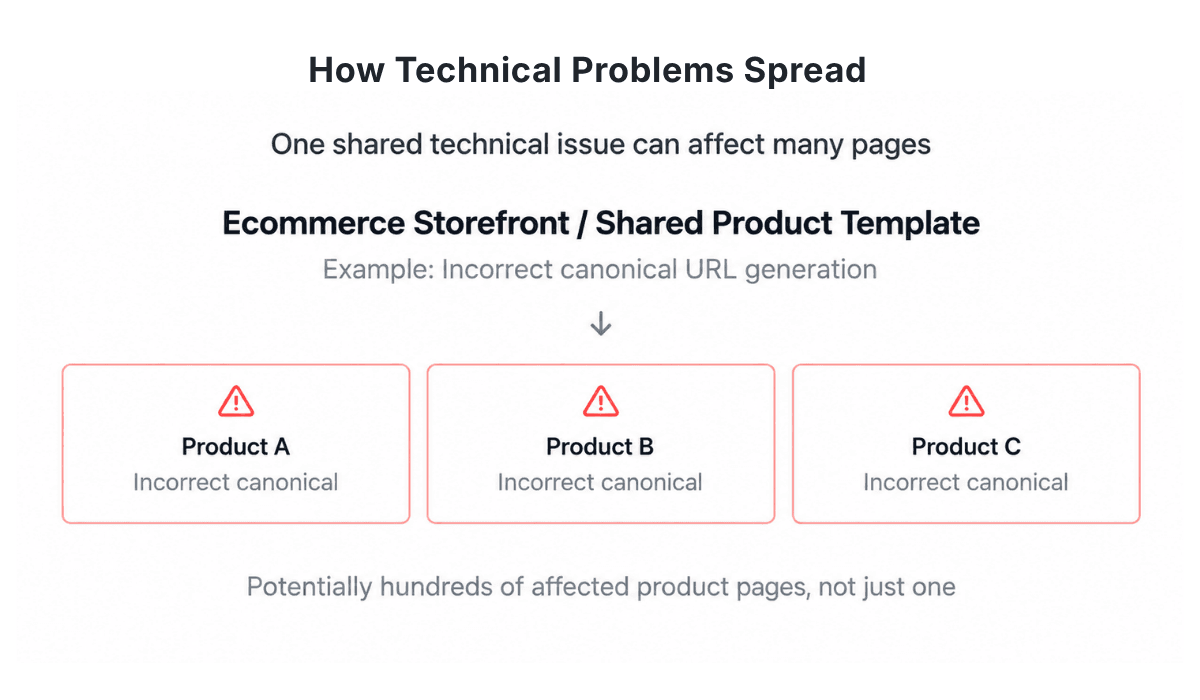
Consider a retailer whose product pages share the same template. If that template generates incorrect canonical tags, hundreds of products could be affected. If the server repeatedly returns errors, Google may have difficulty accessing pages. If category navigation relies on interactions that do not expose crawlable links, important products may remain difficult to discover.
These problems differ from ordinary keyword optimization because they can affect entire groups of pages.
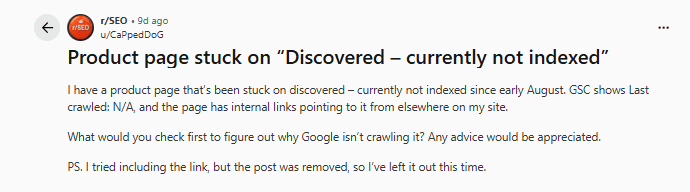
In a separate September 2026 Reddit discussion, a website operator described a product page that remained marked Discovered – currently not indexed despite having internal links and repeated indexing requests. The discussion did not establish the underlying cause, but it highlights why repeatedly requesting indexing is not a substitute for diagnosing the actual problem.
Google does not assign every website a universal health score that controls all rankings. However, recurring technical defects, poor navigation, and inaccessible content can have consequences across many pages when they originate from shared website systems.
Before investing in another SEO campaign, businesses should establish whether the website's underlying technology is preventing existing content from performing effectively.
Product Categories and Navigation Can Matter More Than Additional Blog Posts
Online retailers often concentrate their SEO efforts on individual products. Yet customers frequently search for broader categories before deciding which product to purchase.
Someone searching for waterproof hiking boots may want to compare several options, while someone searching for a particular model and size is more likely to want a specific product page. These searches serve different purposes, and the website should provide appropriate destinations for both.

This creates a practical challenge for store owners. In a Reddit discussion about Shopify collection pages, one participant questioned whether creating more collections for keywords was worthwhile if it meant compromising the shopping experience. The concern reflects a genuine business decision: how much should navigation be designed for search engines versus customers?
The best approach is to build categories around meaningful shopping needs. A category should organize relevant products, help visitors compare options, and provide sufficient context for Google to understand its purpose. Creating numerous nearly identical categories solely to capture keyword variations can introduce unnecessary complexity.
Filtering systems also require attention. Combinations of brand, price, color, size, and availability can generate thousands of URLs. Google's guidance on faceted navigation explains how excessive filtered URLs can consume crawling resources and delay discovery of important content.
Good architecture helps both customers and search engines reach the pages that actually matter.
More SEO Content Does Not Always Mean Better Rankings
A business can spend years following SEO advice without understanding why its results remain disappointing.
In February 2026, a Shopify store owner described this frustration on Reddit. After operating the store for five years and trying various recommended marketing methods, the owner reported little return and remained uncertain about what was holding the business back.
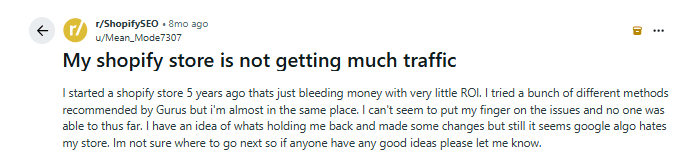
The post does not prove that technical SEO was responsible. It demonstrates something equally important: applying tactics without identifying the actual constraint can lead to prolonged spending without clarity.
Some ecommerce stores need better category content or stronger product information. Others need technical corrections, more relevant incoming links, improved navigation, or a clearer understanding of what customers are searching for.
The solution depends on the evidence.
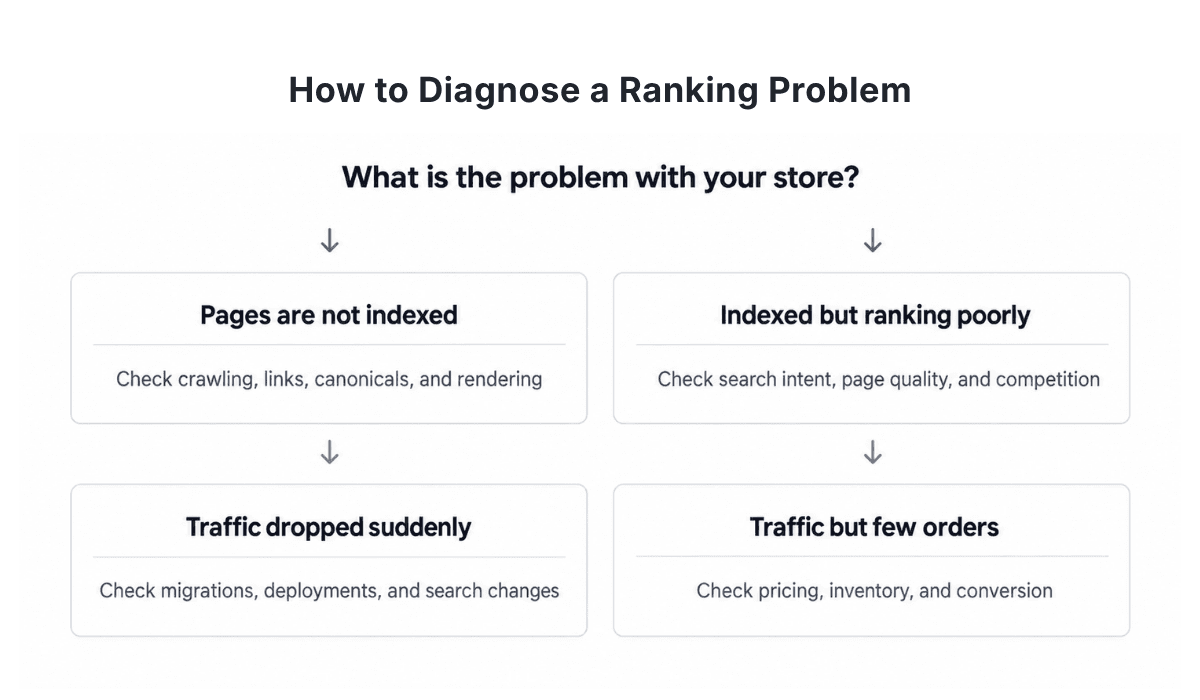
A store whose products are not indexed needs an indexing investigation. A store whose pages are indexed but rarely appear for relevant searches needs to evaluate relevance and competition. A store attracting substantial traffic but generating few orders may need a broader ecommerce growth strategy that considers product availability, pricing, checkout, and customer experience rather than focusing exclusively on rankings.
What Should Ecommerce Businesses Fix First?
The most effective starting point is an audit that connects search performance with the website's technical condition.
Google Search Console can identify which pages receive impressions and clicks, which URLs are excluded from indexing, and whether important products are appearing for relevant searches. Those findings should be compared with the store's actual structure, including categories, product pages, canonical URLs, internal links, and the way content is rendered.
From there, improvements can be prioritized according to their likely impact. An important category accidentally marked noindex should generally be addressed before rewriting its meta description. A product template generating widespread technical errors deserves attention before publishing more supporting articles. Where technical accessibility is sound, the focus can shift toward content quality, search intent, and competition.
Product information also deserves review, particularly when inventory, pricing, and descriptions originate from multiple systems. Inconsistent data between a POS, ecommerce backend, storefront, and Google Merchant Center can create product-listing problems and undermine the customer experience.
The objective is not to resolve every technical warning. It is to identify the problems affecting commercially important pages and make improvements that can be measured.
Better Ecommerce Rankings Start With Better Diagnosis
Improving ecommerce rankings requires more than following a standard SEO checklist. Search visibility depends on the relationship between content, website architecture, platform implementation, and the experience delivered to customers.
For some retailers, better product descriptions and relevant content will make the greatest difference. For others, the real opportunity lies in correcting technical problems, restructuring categories, improving frontend rendering, or connecting product information more reliably across systems.
At Gyan Solutions, our work in ecommerce development, systems integration, and storefront architecture addresses the technology behind online commerce. Understanding how these systems operate helps businesses identify when poor search visibility may be connected to limitations in their underlying website.
The first step toward better rankings is not necessarily producing more content. It is understanding what is preventing the content you already have from reaching the right customers.

SUKHPREET SINGH
I'm Sukhpreet Singh, Director of Innovation & Technology at Gyan Solutions. With 8+ years in generative AI and ERP integration, I build AI-powered decision-support systems that adapt to real operational complexity without replacing existing infrastructure.



