
Health & Life Sciences
Help teams locate approved procedures, operational documentation, internal knowledge, records, and relevant system information within defined access and review requirements.
Explore Health & Life Sciences →

ENTERPRISE AI & KNOWLEDGE ACCESS
Help employees, customers, and partners find approved information across documents, procedures, policies, records, applications, and business systems without manually searching through disconnected sources. Gyan Solutions builds AI assistants and enterprise knowledge solutions around defined users, trusted information sources, role-based access, source visibility, workflow requirements, and existing business systems.
Start with who needs the answer, what information they can access, and what they need to do next.
Give employees faster access to approved company information while keeping the assistant connected to the context of their role and work.
Search across approved documents, procedures, policies, records, knowledge bases, and business systems through one controlled interface.
Provide customers or partners with guided access to approved information while separating public, customer-specific, and internal knowledge.
Use retrieved information inside operational workflows, applications, approvals, service processes, and decision-support environments.
Years of Implementation Experience
Projects Delivered Successfully
Industries Supported
Average Efficiency Improvement




Some organizations know employees spend too much time searching for information but aren't yet certain whether the problem is documentation, access, or fragmentation. Others already know they need AI assistants for enterprise knowledge and want the right implementation support. Choose the path that matches where you already have clarity.
For organizations that need to understand why information is hard to find or use before introducing an enterprise AI assistant.
 Review how employees find policies, procedures, records, and operational information todayIdentify fragmented sources, duplicated documentation, unclear ownership, and repeated knowledge-search workDetermine whether the fix is better process, ownership, search, integration, or AI assistance
Operational Review & Improvement can stand alone as a complete engagement, from diagnosis through improvement.
For organizations that already know which users, knowledge sources, and workflows an AI assistant needs to support directly.
Define the users, approved knowledge sources, permissions, and required retrieval behaviourConnect AI with documents, databases, ERP, CRM, portals, and reporting sourcesImplement role-based access, source references, human escalation, and workflow integrationTechnology & AI Implementation can be engaged independently or alongside operational review work.
An enterprise AI assistant should do more than generate conversational answers. It should help the right user access the right approved information, understand where the answer came from, and move into the appropriate workflow when further action is required.
Give employees one interface for finding approved information relevant to their role.
When employees repeatedly ask colleagues where information is located or search several systems before completing routine work.
Search across approved business knowledge without forcing users to know exactly where information is stored.
Help users locate and understand approved operational documentation.
When teams have extensive procedures or policies but employees spend unnecessary time locating the correct document or section.
Allow users to ask questions across an approved set of documents.
Help users understand what information supports an AI-generated response.
Where technically appropriate, the assistant retrieves information from approved sources and presents references or links alongside its response.
Provide customers with guided access to approved product, service, account, process, or support information.
Give approved external users access to information relevant to their relationship with the organization.
Ensure users only retrieve information appropriate to their role and permissions.
Bring relevant information together from more than one approved business system.
Allow an assistant to move from answering a question into a defined business workflow where appropriate.
Building an AI assistant is not only a model-selection problem. The knowledge environment needs clear sources, permissions, ownership, access, retrieval rules, and expectations about what the assistant should and should not answer.
Define which documents, records, applications, and systems the assistant is permitted to use.
Identify who is responsible for the accuracy, maintenance, and availability of source information.
Define which users can access each source and which information must remain restricted.
Define how information is retrieved, referenced, presented, and reviewed before users act on it.
An AI assistant becomes expensive when the technology is clear but the knowledge environment behind it is not. Before building a chatbot, portal, or search tool, determine which sources are trustworthy, who owns them, and who is allowed to see what.
Most organizations aren't short on information. Policies, procedures, records, and system data all exist somewhere spread across folders, platforms, and individual people's memory. The real cost isn't missing knowledge; it's the time employees spend hunting for something that's already been written down.
That's where AI assistants for enterprise knowledge earn their place. Built on approved sources with clear permissions, they give the right person the right answer with the source attached, so they can trust it.
Employees repeatedly ask the same internal questions.Important knowledge is spread across documents and systems.Teams spend significant time locating policies or procedures.New employees struggle to find operational information.Internal search returns too many irrelevant results.Users need source references before trusting an answer.An assistant is only as good as the knowledge behind it. Sources, ownership, and access rules matter more than the interface.
Choosing a chat interface or AI model should come after the knowledge environment is understood. Start by identifying who needs answers, what they're allowed to see, and where the source information actually lives.
We review who needs information, what they typically ask, and where they search for it today. This shows which information is genuinely hard to find, which systems are involved, and what needs to stay restricted.
We determine the approved sources, who owns each one, and what permissions apply. This includes retrieval rules, source-reference requirements, and how outdated or missing information gets escalated and corrected.
We implement the assistant interface, retrieval layer, document connections, and permissions — then test it against real employee or customer questions before anyone relies on it.

SOPs
Policies
Manuals
Internal documents
ERP
CRM
Databases
Business applications
Permissions
Search
Retrieval
Source filtering
User context
Understand question
Retrieve relevant information
Prepare response
Show supporting sources
Employee
Manager
Customer
Partner
Open record
Start request
Create task
Escalate
Submit workflow
Human review
SOPs
Policies
Procedures
Manuals
Internal documentation
Shared file repositories
Knowledge bases
Training material
Internal records
Microsoft Dynamics
NetSuite
Odoo
QuickBooks
Custom ERP platforms
Salesforce
HubSpot
Existing CRM
Custom customer-management systems
Power BI
Tableau
Metabase
Custom dashboards
QMS
LIMS
Inventory systems
Order management
Scheduling
Field-service applications
Custom databases
Internal software
Customer portals
OpenAI
Claude
Other approved model/API environments when required
LangChain
Retrieval workflows
Custom AI services
Structured output
Tool/API-connected workflows
Knowledge retrieval architecture
Node.js
Python
.NET
PostgreSQL
MySQL
MongoDB
Existing business databases
AWS
Microsoft Azure
Google Cloud
Docker
Where appropriate, let users inspect the information behind an answer.
Route questions to a responsible person when the assistant cannot appropriately resolve them.
Limit knowledge according to approved user roles and source permissions.
Clearly define what the assistant is intended to answer, what information it may use, and when it should defer.
Identity
Login
User roles
Access permissions
Approved sources
Restricted information
Department access
External/internal separation
Information passed to AI services
Client restrictions
Storage requirements
Required data only
API authentication
Credentials
System permissions
Controlled connectivity
User identity, source permissions, restricted information, data handling, system access, and integration requirements should be defined around the specific knowledge environment.
Designed for employees and authorized internal users.
Internal policiesSOPsERP dataCRM dataInternal recordsOperational reportingEmployee knowledgeInternal applicationsDesigned for external users and limited to information intentionally made available to those users.
Public documentationCustomer-specific recordsPartner proceduresSupport informationApproved portal contentProduct/service informationDo not use one unrestricted knowledge environment for internal and external users. Access should follow the intended user and information boundary.
Help teams locate approved procedures, operational documentation, internal knowledge, records, and relevant system information within defined access and review requirements.
Explore Health & Life Sciences →
Support internal teams and customers with product, order, inventory, service, process, and operational knowledge drawn from approved information sources.
Explore Ecommerce →
Give field and office teams faster access to procedures, site information, service documentation, technician knowledge, work-order context, and approved customer information.
Explore Facilities & Field Services →
Help plant and business teams find procedures, operational documentation, maintenance information, internal knowledge, reporting context, and approved system information.
Explore Manufacturing →We first understand what users need to find, interpret, summarize, or act on across business knowledge before defining how an AI assistant should support that work.
We discuss your users, documents, knowledge sources, recurring questions, search needs, access controls, systems, reporting requirements, and any defined enterprise assistant use case.
We review how knowledge is currently accessed and define whether the need involves knowledge organization, retrieval improvement, AI implementation, system integration, or both, including sources, permissions, outputs, and review requirements.
From there, we support the agreed need through knowledge workflow improvement, source alignment, retrieval services, enterprise search, AI assistants, permissions, integrations, structured outputs, and human-review controls.
30-minute call
No obligation
Consulting and implementation scoped separately
Real outcomes from our operations consulting and implementation engagements.
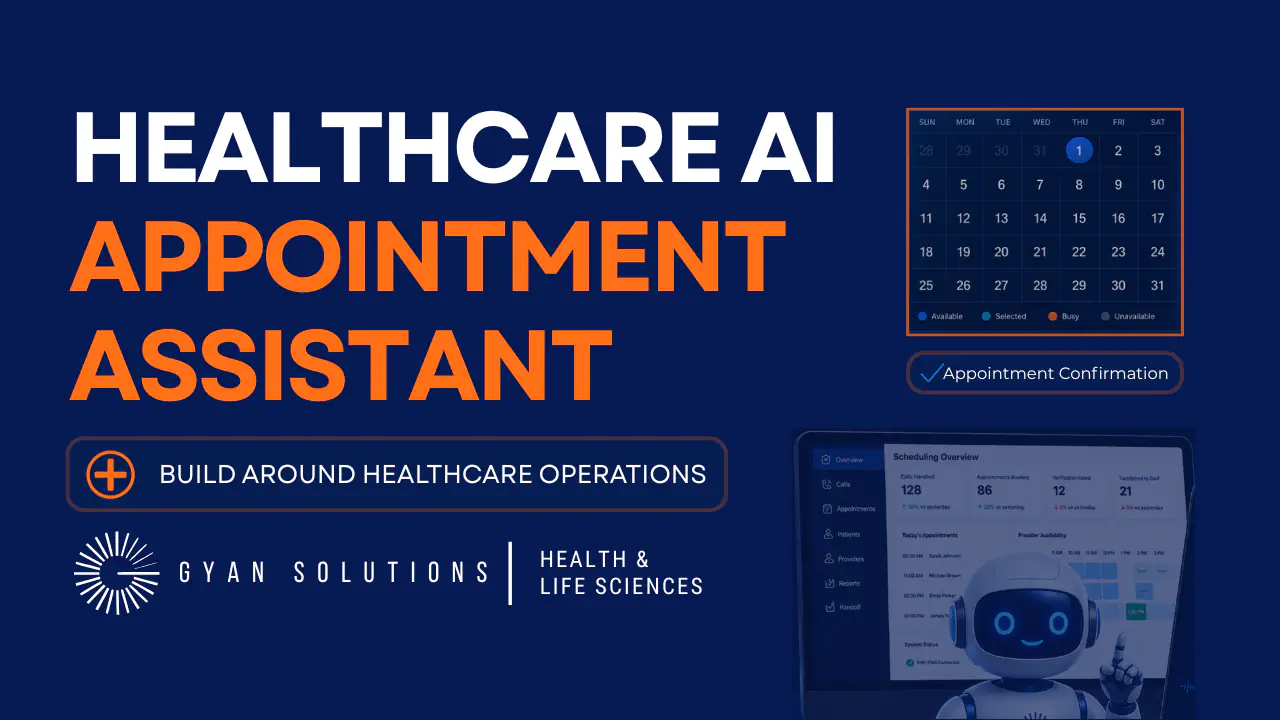
See how Gyan Solutions Health & Life Sciences experts designed an AI-enabled scheduling workflow around patient verification, provider availability, EHR/PMS updates, confirmation steps, and safe staff handoff.
Verify patients before system changesCheck provider availability and scheduling rulesSend confirmation details after bookingTransfer safely when human review is needed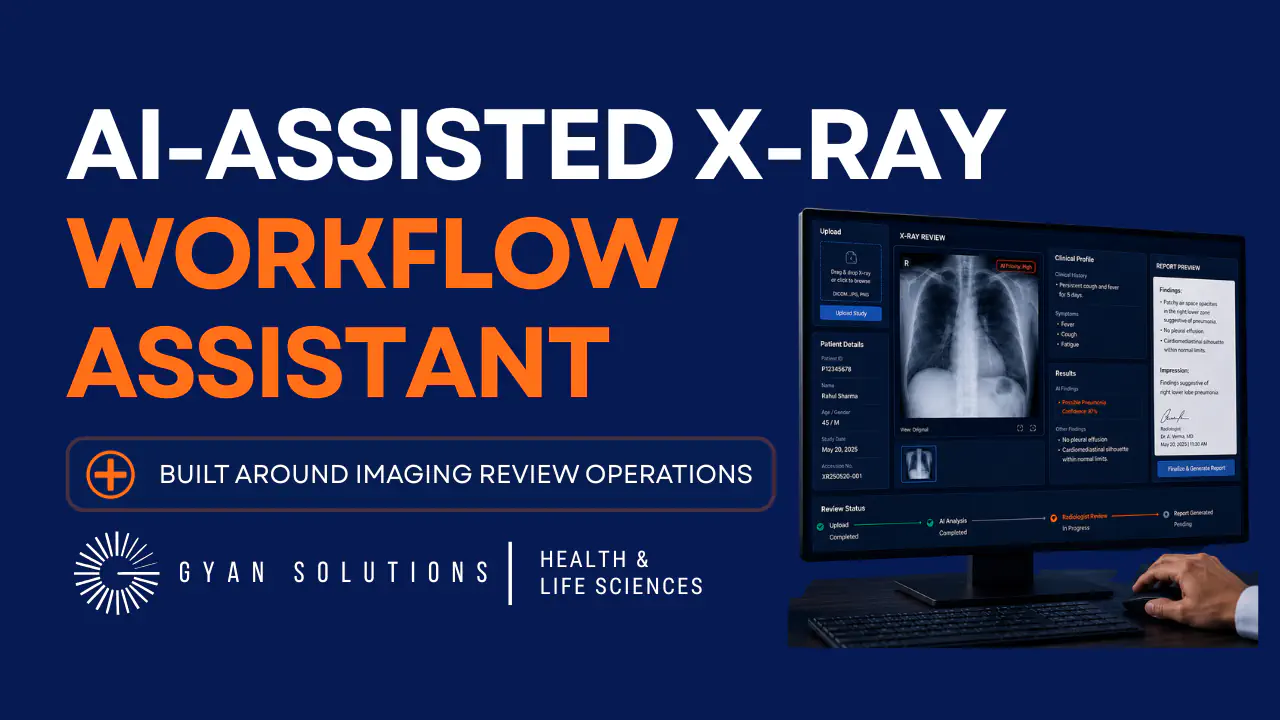
See how Gyan Solutions Health & Life Sciences experts designed an AI-assisted X-ray workflow around image upload, patient context, clinical information, human-initiated review, results support, and structured reviewer handoff.
Connect image, patient details, and clinical context in one workspaceStart AI-assisted review only when the case is readySeparate model output from final clinical interpretationSupport clearer reviewer handoffs with labs, notes, and treatment contextReal outcomes from operations consulting and implementation work that drives clarity, efficiency, and measurable business impact.



Gyan Solutions understood that we needed more than a standard booking tool. They translated our clinic’s scheduling requirements into an AI-assisted operator that could support appointment inquiries, booking, and staff handoffs while keeping our team in control of the process.


Gyan Solutions brought a structured and practical approach to our work. They understood the importance of clear processes, defined accountability, and solutions that could operate effectively within a quality-focused pharmaceutical environment.
Biotechnology Company
Gyan Solutions brought structure and visibility to a complex clinical-stage development program. They took the time to understand the dependencies across CMC, Quality, Clinical Operations, supply, and external partners, then established a practical framework that improved ownership, coordination, and decision-making without disrupting our existing systems.
Tell us where employees or customers keep searching multiple systems for information that already exists.
Request a Free Operations Fit Call→


Enterprise knowledge assistants often depend on the same systems, documents, workflows, and decisions that support broader AI implementation. Explore the related operational need.
When the requirement extends beyond retrieval into summarization, structured generation, document processing, or contextual content workflows.
When retrieved information needs to trigger routing, approvals, task creation, system updates, or other controlled workflow actions.
When enterprise knowledge is distributed across applications, databases, document stores, ERP, CRM, and other operational systems.
When users need more than answers and require assembled context to support recurring operational decisions.
An enterprise AI assistant helps approved users retrieve and work with information from defined business knowledge sources such as documents, policies, procedures, databases, and business systems.
Not necessarily.A conversational interface may be part of the solution, but the important elements are the approved knowledge sources, retrieval architecture, permissions, source visibility, integrations, and workflow requirements behind the interface.
Yes.Approved documents can be connected to an AI knowledge environment subject to technical, access, security, and data-handling requirements.
Yes, where appropriate technical access is available.A knowledge solution can retrieve from documents as well as ERP, CRM, databases, internal applications, reporting, and other approved systems.
Yes, where the architecture supports source retrieval.Answers can include references or links to the underlying approved information.
Yes.Role-based access and source permissions can be incorporated so users retrieve information appropriate to their responsibilities.
Yes.Customer-facing assistants can provide access to approved support, product, service, account, process, or portal information.Internal information should remain separated from external knowledge.
The solution can be designed to:state that the required information was not found;direct the user to a relevant source;request clarification;route the issue to a responsible employee; or start another defined workflow.
Yes, where explicitly designed.After retrieving information, an assistant can connect to defined workflows or system actions through integrations, permissions, business rules, and approval controls.Contextual Link Explore AI Workflow Automation →https://www.gyan.solutions/ai-development/ai-workflow-automation/
Yes, where technical access is available.Contextual Link Explore AI in ERP & Business Systems →https://www.gyan.solutions/ai-development/ai-in-erp-development-company/
Depending on the project, technologies may include OpenAI, Claude, LangChain, Node.js, Python, .NET, APIs, databases, retrieval services, and cloud infrastructure.Technology selection should follow the use case and enterprise environment.
Not always.If the users, knowledge sources, permissions, use cases, integrations, and expected outcomes are already clear, implementation can be scoped directly.If the organization mainly knows that employees cannot find information efficiently, Operational Review & Improvement can help define what needs to change before technology is selected.
Tell us where employees, customers, or partners are struggling to find information across documents, systems, policies, procedures, or internal knowledge. We'll schedule a 30-minute Operations Fit Call to understand the current environment and determine whether an AI assistant, enterprise knowledge solution, integration, workflow improvement, or another approach is the right next step.
Focused on your goals
You decide the next step.
Consulting & implementation
 View Case Study