
Health & Life Sciences
Build AI-enabled applications supporting approved knowledge access, document-heavy workflows, operational reporting, information review, and defined decision-support requirements.
Explore Health & Life Sciences →

GENERATIVE AI & APPLICATION DEVELOPMENT
Build generative AI into custom applications, portals, internal tools, document workflows, reporting environments, and existing business systems. Gyan Solutions develops AI-enabled applications around defined users, approved information, business workflows, system integrations, structured outputs, and appropriate human review.
Build the application around the business requirement—not around the model.
Build internal or customer-facing software where generative AI is part of a defined business function.
Add summarization, retrieval, drafting, analysis, search, or other AI-enabled functionality to applications users already work with.
Connect generative AI with approved documents, data, systems, and business knowledge instead of relying only on general model knowledge.
Turn model outputs into defined records, reports, documents, workflow steps, or system actions with validation and human review where required.
Years of Implementation Experience
Projects Delivered Successfully
Industries Supported
Average Efficiency Improvement




Some organizations know a workflow or information problem exists but aren't yet certain whether generative AI is the right solution. Others already have a defined generative AI application or feature and need the right implementation support. Choose the path that matches where you already have clarity.
For organizations that need to understand the workflow, users, and information requirements before deciding whether generative AI should be introduced.
 Review the workflow, users, documents, systems, and current manual work involvedIdentify where teams repeatedly search, summarize, draft, or reconstruct information manuallyDetermine whether the fix is process redesign, integration, automation, or AI development
Operational Review & Improvement can stand alone as a complete engagement, from diagnosis through improvement.
For organizations that already know what generative AI application, feature, or workflow they want built and ready.
Define the AI feature, users, approved information, outputs, and review requirementsBuild the AI application, interface, APIs, retrieval layer, and system connectionsImplement structured outputs, source retrieval, business rules, and workflow integration fullyTechnology & AI Implementation can be engaged independently or alongside operational review work.
Generative AI becomes useful when it is implemented as part of a defined application or workflow.
Build purpose-specific applications around a defined business use case.
Add AI functionality to software users already rely on.
Build AI applications around approved business information rather than relying only on the model's general knowledge.
Use generative AI to prepare defined document or content outputs within a controlled workflow.
Generate outputs that applications and workflows can use reliably.
Help users find relevant information across approved business sources.
Add AI functionality to employee, customer, partner, or supplier portals.
Use generative AI to help users understand approved reporting information.
Connect generative AI models with applications and business systems.
Connect generative AI outputs with operational systems and actions.
A generative AI project becomes expensive when the model is chosen before the application requirement is clear. Before building an AI feature, tool, or interface, determine what the software actually needs to do and where AI genuinely fits.
Traditional application logic handles structured data well fields, records, and fixed rules. But once the work involves reading documents, answering open-ended questions, or turning free-form text into something usable, ordinary software starts falling short, no matter how much logic you add to it.
That's where generative AI development earns its place not as a replacement for good software, but as the piece that handles language and unstructured information inside an application built around real business logic, validation, and human review.
Users need to work with large volumes of documents or text.Employees repeatedly prepare similar summaries or drafts by hand.Existing applications contain information but are difficult to search.Users need conversational, source-backed access to business information.Free-form information needs to become structured, usable data.An existing application would clearly benefit from AI assistance.Generative AI should solve a defined application requirement not get added simply because a model can generate content.
Choosing a model or AI platform should come after the business use case is understood. Start by identifying what the software needs to do, what output is required, and where human review must remain.
We review the user, the task, the workflow, and the information already in use along with the current effort involved and the decision or action that follows. This clarifies exactly where generative AI can add real value.
We determine what the model should handle versus what traditional software logic should handle, what format the output should take, and where human review and validation belong before anything moves downstream.
We implement the full application interface, AI services, retrieval layer, APIs, databases, and integrations with structured outputs and human review built in from the start, not added afterward.

Employees
Managers
Customers
Partners
Web application
Portal
Mobile application
Internal tool
Existing software
Rules
Retrieval
AI model
Structured outputs
Validation
Workflow logic
Documents
ERP
CRM
Databases
Reporting
APIs
Display result
Save record
Generate document
Start workflow
Update system
Human approval
OpenAI
Claude
Other approved model/API environments where required
LangChain
Retrieval workflows
Structured outputs
Tool/API workflows
Custom AI services
React
Next.js
Vue
TypeScript
Node.js
Python
.NET
PostgreSQL
MySQL
MongoDB
Existing business databases
AWS
Microsoft Azure
Google Cloud
Docker
Microsoft Dynamics
NetSuite
Odoo
QuickBooks
Custom ERP
Salesforce
HubSpot
Existing CRM
Custom customer-management systems
Power BI
Tableau
Metabase
Custom reporting
SOPs
Policies
Procedures
Manuals
Internal records
Knowledge bases
Approved document stores
Inventory
Order management
Scheduling
Field-service systems
QMS
LIMS
Custom applications
Portals
Databases
Business applications often require AI output to follow a defined structure so it can be reviewed, stored, compared, or passed into another system.
Specify the fields, structure, format, or document the application needs.
Check required fields, formats, rules, and other conditions before downstream use.
Send material outputs to an appropriate user where judgment or approval is required.
Use validated output to update another application, generate a document, start a workflow, or create a record.
Keep responsible users in control of material decisions and consequential actions.
Provide supporting information where the application relies on retrieved business knowledge.
Specify what the AI feature is intended to do and when it should defer.
Route incomplete, uncertain, conflicting, or unusual cases for additional review.
Authentication
Roles
User permissions
Application access
Approved information
Data sent to AI services
Client restrictions
Storage requirements
APIs
Credentials
Database access
Required-data principles
Application errors
AI output issues
Integration failures
Exception handling
Application access, approved information, AI-service data handling, credentials, database access, and monitoring requirements should be defined around the specific implementation.
Build AI-enabled applications supporting approved knowledge access, document-heavy workflows, operational reporting, information review, and defined decision-support requirements.
Explore Health & Life Sciences →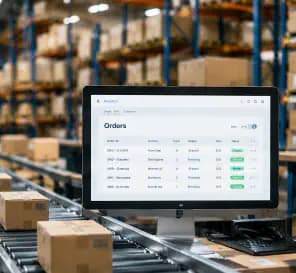
Build AI functionality around customer workflows, product information, order operations, internal support, reporting, document handling, and business-system integration.
Explore Ecommerce →
Build AI-enabled applications for technician knowledge, work-order context, service requests, operational documentation, customer workflows, and field-to-office support.
Explore Facilities & Field Services →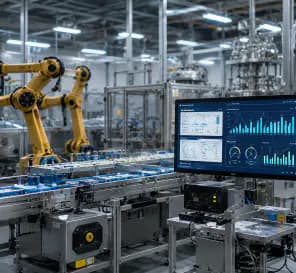
Build AI-enabled applications around operational knowledge, documentation, reporting, exception review, maintenance information, and plant/business workflows.
Explore Manufacturing →We begin by understanding the content, knowledge, workflow, users, and business decisions involved before defining where generative AI can support practical operational work.
We discuss your documents, data, systems, users, recurring content or analysis tasks, governance requirements, and any generative AI use case already under consideration.
We review the use case and define whether the need is workflow improvement, AI readiness, generative AI implementation, integration, or both, including sources, outputs, permissions, controls, and review requirements.
Where generative AI fits, we support the agreed scope through data and workflow alignment, retrieval, AI applications, assistants, integrations, structured outputs, automation, and controlled human-review processes.
30-minute call
No obligation
Consulting and implementation scoped separately
Real outcomes from our operations consulting and implementation engagements.
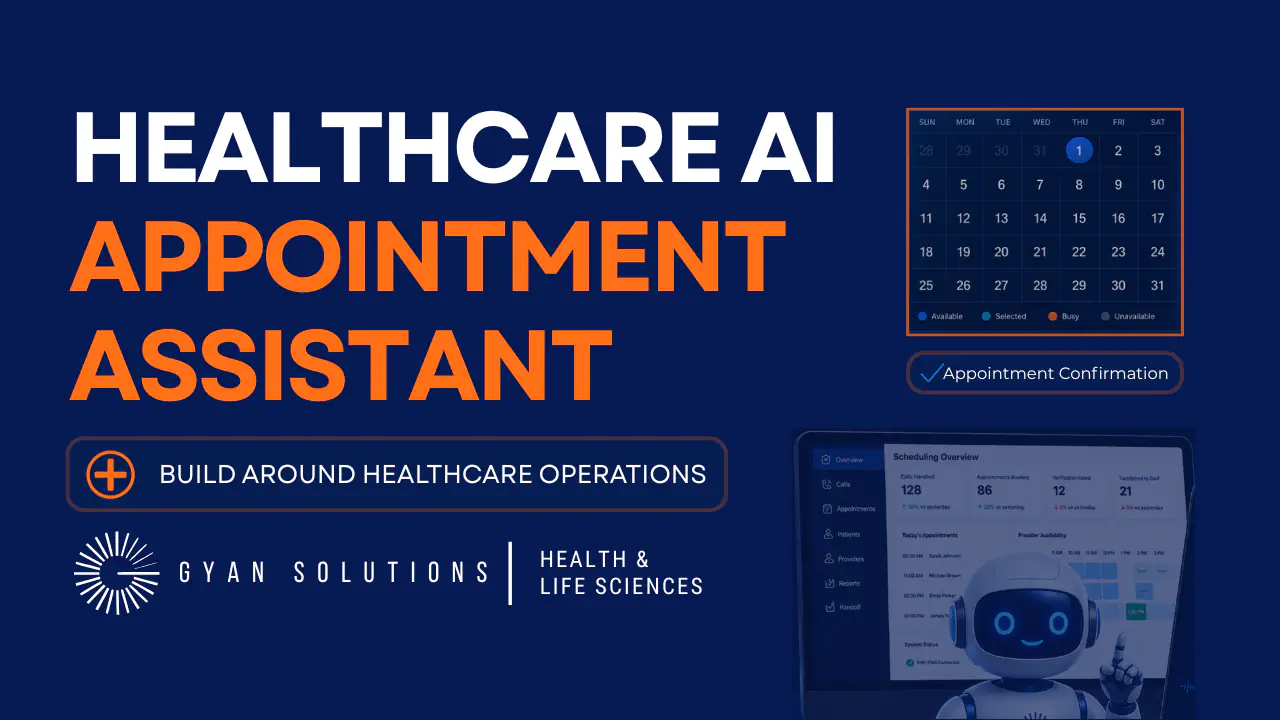
See how Gyan Solutions Health & Life Sciences experts designed an AI-enabled scheduling workflow around patient verification, provider availability, EHR/PMS updates, confirmation steps, and safe staff handoff.
Verify patients before system changesCheck provider availability and scheduling rulesSend confirmation details after bookingTransfer safely when human review is needed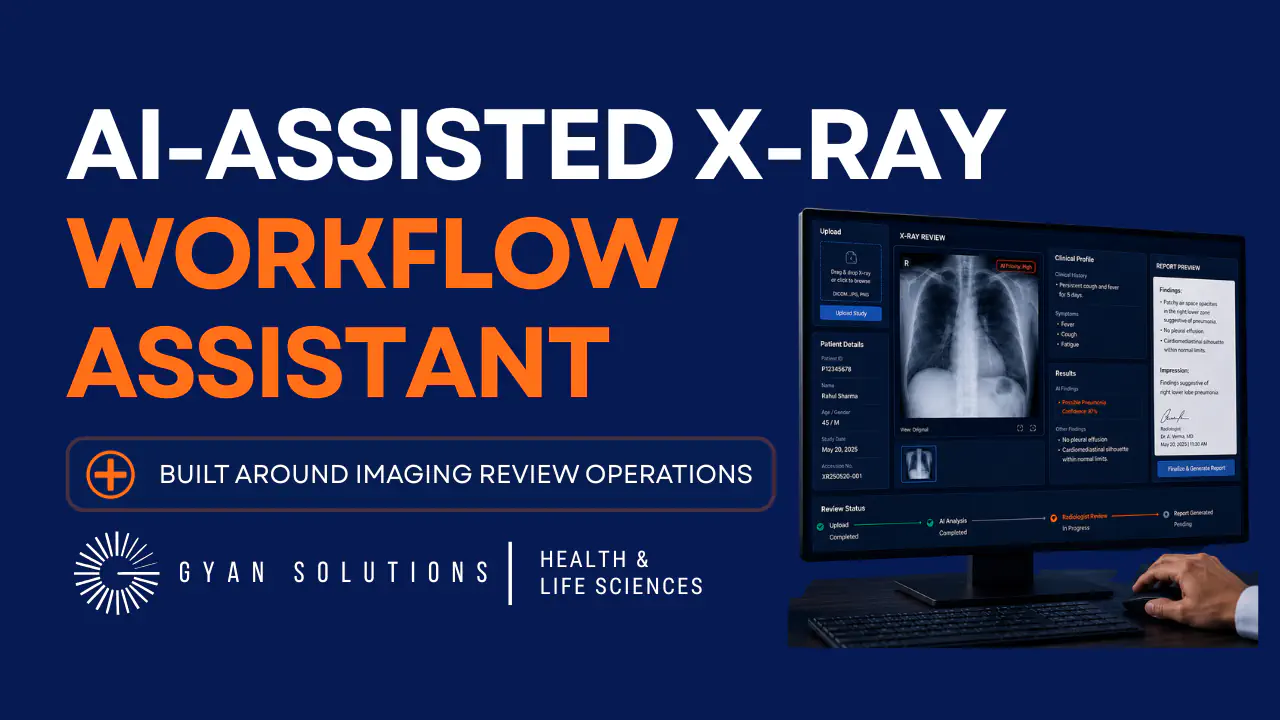
See how Gyan Solutions Health & Life Sciences experts designed an AI-assisted X-ray workflow around image upload, patient context, clinical information, human-initiated review, results support, and structured reviewer handoff.
Connect image, patient details, and clinical context in one workspaceStart AI-assisted review only when the case is readySeparate model output from final clinical interpretationSupport clearer reviewer handoffs with labs, notes, and treatment contextTell us what users need to do, what information the application needs, and what should happen after AI produces an output.
Request a Free Operations Fit Call→


Generative AI creates the most value when it is connected to a defined knowledge, workflow, system, or decision requirement rather than deployed as a standalone capability.
When employees need grounded answers, summaries, and retrieval across internal documents, policies, records, and knowledge sources.
When generated or interpreted information needs to move into approvals, routing, systems, tasks, or human-review workflows.
When generative AI should help assemble context, summarize evidence, compare information, or prepare recurring decisions.
When the use case is still broad and the team needs to understand where AI fits across data, workflows, systems, and operational decisions.
Generative AI development involves building software that uses generative models to work with language, documents, knowledge, structured information, or user requests as part of a defined application or business workflow.
Depending on the requirement:- Internal AI applications- Knowledge-grounded applications- AI-enabled portals- Document-generation workflows- AI-assisted reporting- Search and retrieval applications- Structured-output tools- AI features inside existing software- AI-connected workflow applications
Yes, where appropriate to the requirement.Gyan can integrate OpenAI APIs as part of a broader application architecture.We can also work with other approved model/API environments depending on project requirements.
Yes, where appropriate.The model should be selected around the use case, data requirements, application environment, and technical considerations.
Yes.AI features can often be added to existing applications, portals, dashboards, ERP-connected systems, CRM-connected systems, and internal tools.
Yes, where the solution is designed to use approved internal knowledge sources and appropriate access controls.Contextual Link Explore AI Assistants & Enterprise Knowledge →https://www.gyan.solutions//ai-development/ai-assistants-enterprise-knowledge/
Yes.AI applications can be designed to produce defined structured outputs that can be validated and used by other application components or workflows.
Yes, where the required technical access is available.Contextual Link Explore AI in ERP & Business Systems →https://www.gyan.solutions/ai-development/ai-in-erp-development-company/
Yes.Once required validation, rules, and approvals are satisfied, AI-generated outputs can be connected to workflow or system actions.Contextual Link Explore AI Workflow Automation →https://www.gyan.solutions/ai-development/ai-workflow-automation/
The application should be designed around the consequences of the use case.Approaches may include:- source retrieval;- structured outputs;- validation;- business rules;- human review;- exception handling; and- defined fallback behaviour.Do not promise error-free AI output.
This is not the primary positioning of this service.Gyan's focus is applying approved AI models and services within useful business applications, workflows, data environments, and operational systems.
Not always.If the application, users, AI use case, systems, information sources, and expected outcome are clearly defined, development can be scoped directly.Where the organization mainly knows it wants to “use AI” but the operational requirement is unclear, Operational Review & Improvement can define the use case first.
Tell us about the generative AI application, feature, workflow, or system integration you are considering. We'll schedule a 30-minute Operations Fit Call to understand the requirement and determine the appropriate implementation direction.
Focused on your goals
You decide the next step.
Consulting & implementation