


Executive Summary
A growing online retailer in Milwaukee, Wisconsin, could not explain uneven category sales. Visitors reached the website, but purchasing varied widely between product groups. Management believed marketing campaigns attracted visitors with little interest in buying.
Before spending more on advertising, the business wanted clearer reporting. A separately scoped reporting review followed our first conversation with management. The review found gaps that hid important shopping patterns from management. We then connected validated behavior data with product-level reporting.
Background
The retailer sold thousands of arts, crafts, and creative supplies to customers nationwide. Products included paper goods, stamps, cutting tools, adhesives, and accessories. Customers found items through search engines, advertising, email, and educational content. Many viewed several product pages before deciding to buy.
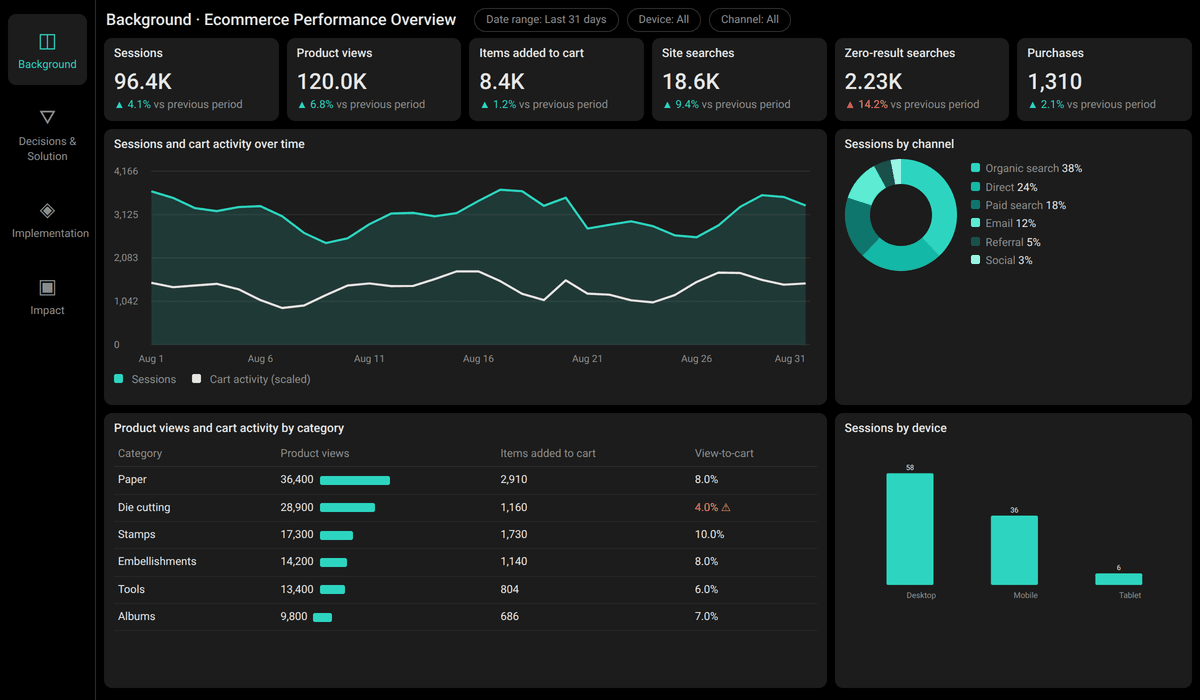
The marketing team tracked traffic, acquisition channels, and overall conversion rate. Ecommerce managers reviewed orders, revenue, and popular categories separately. Neither set of reports explained what happened between arrival and purchase. Management saw sales results but not where interest faded.
Initial Observations
Management described uneven sales across the retailer’s product categories. Several groups drew visitors but did not produce the expected purchases. The marketing team suspected advertising reached the wrong audience. Tighter campaign targeting looked like the obvious first step.
However, existing reports focused on traffic, purchases, and revenue totals. They showed little about product searches, selections, or cart activity. Nobody could explain how visitors moved through the large catalog. The retailer agreed to a separate review to validate existing measurements first.
Review & Design Approach
We began with the decisions management needed to make. The review covered Google Analytics 4, Google Tag Manager, and Search Console. It also checked ecommerce platform records, campaign parameters, and internal search terms. Checkout events and existing management reports were included.
Recorded shopping events were compared with real website interactions. Purchase measurements were also matched against ecommerce transaction records. Missing or duplicated events were investigated before any conversion pattern was interpreted. Each measure needed a clear definition, reliable source, and practical purpose.
Key Findings
The review found three connected issues that distorted management’s view of ecommerce performance. First, overall traffic reports concealed differences between product categories. Some categories drew attention without comparable purchasing, but broad conversion averages hid it.
Second, existing measurements did not fully show product discovery. Unsuccessful searches and incomplete product journeys were not tracked reliably. Third, reports showed results without pointing to next steps. Teams lacked shared category-level context for deciding where to act.
These findings challenged the assumption that traffic quality was the problem. The review named product discovery as the priority area for investigation. Finding the exact causes of abandonment in each category will need further analysis.
Decisions & Solution
We recommended fixing reporting clarity before any further advertising spend. This decision followed the review, which showed traffic alone could not explain category differences. Marketing and ecommerce teams agreed on shared product categories and KPI definitions.
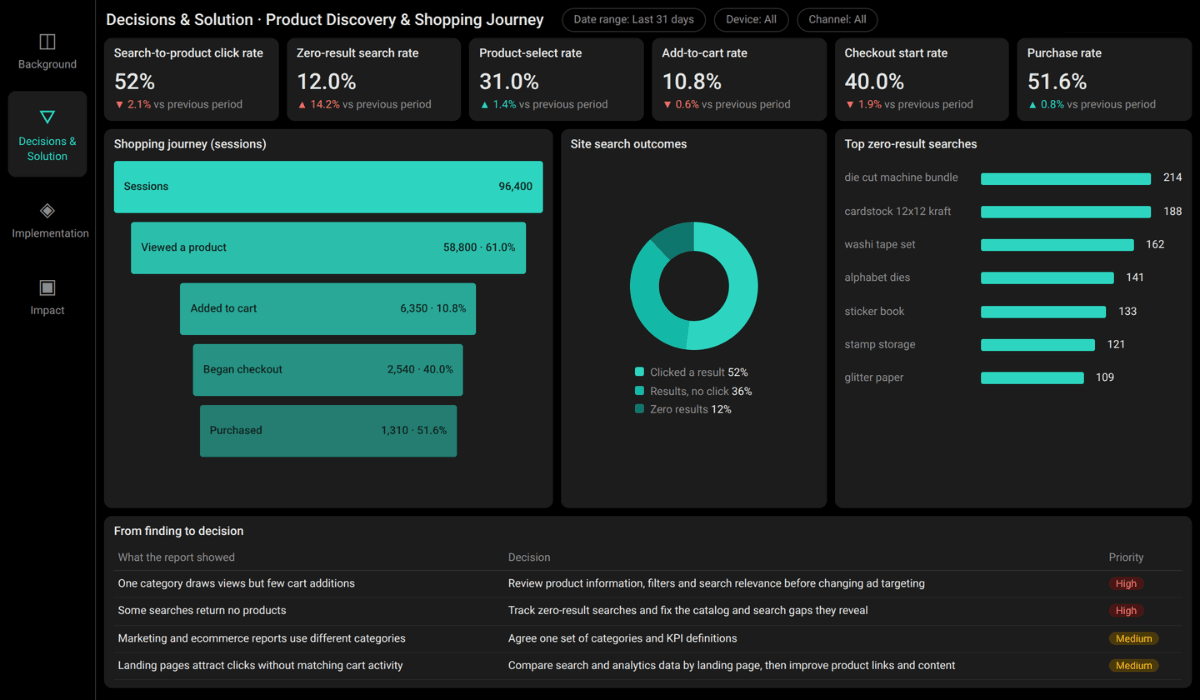
Customer interactions were tracked at product discovery, product views, cart additions, checkout, and purchase. Missing or unreliable analytics events were fixed and tested. Product identifiers and transaction data stayed consistent across all measurements. That gave each later report a dependable foundation.
Management received one report connecting acquisition, product interest, purchasing activity, and exceptions. Shared definitions kept both teams working from the same facts. Together, these parts showed where shoppers stopped progressing and which categories needed attention.
Implementation
The work began with a review of existing analytics settings. Our experts examined Google Tag Manager settings alongside current Google Analytics 4 events. Tracking changes followed the approved measurement plan and were tested. Tests confirmed customer interactions produced the expected event data.
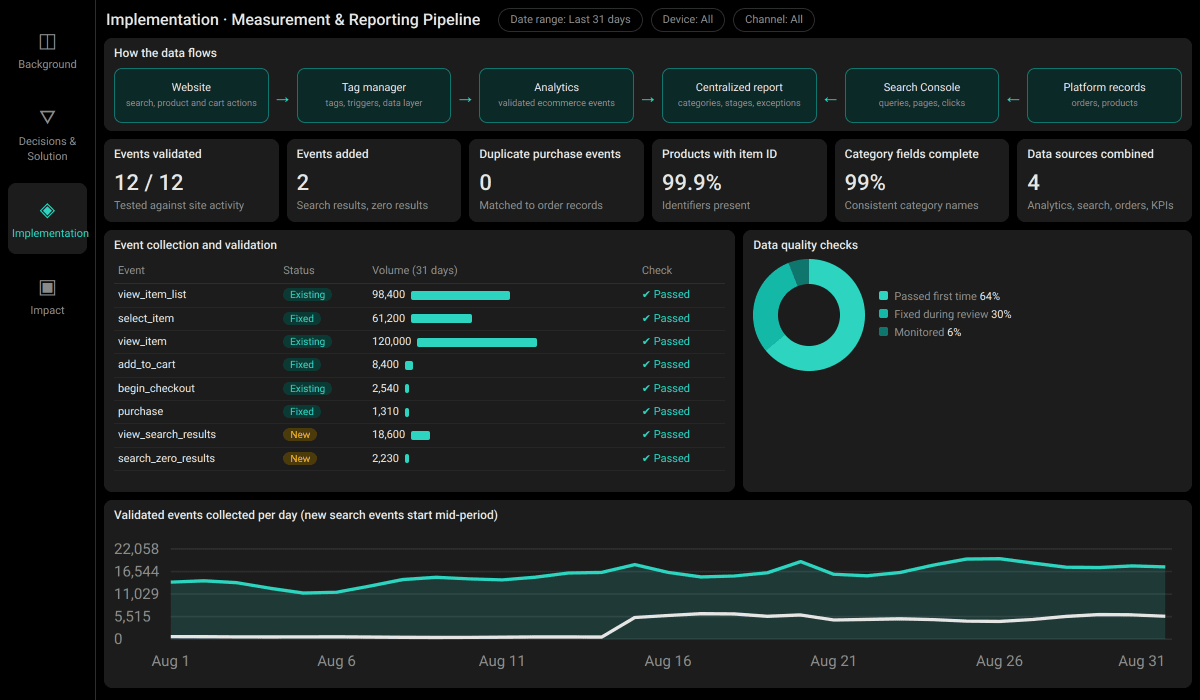
Google Search Console data added organic landing-page context. Ecommerce activity continued to be measured through validated analytics events. The centralized report was organized around product categories and shopping stages. Managers could compare product interest, cart activity, and completed purchases.
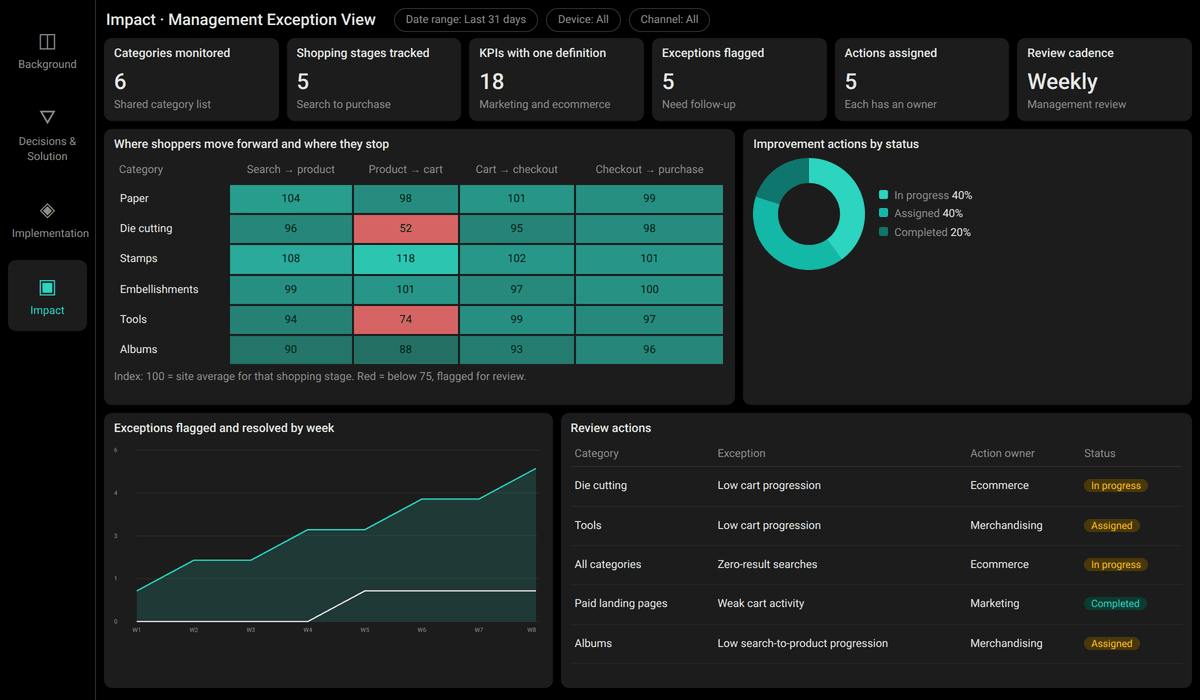
Exception views flagged unusual performance gaps for follow-up. Report definitions explained each measure and its data source. Marketing and ecommerce managers were shown how to read the results. Regular reviews linked reporting findings to assigned improvement actions.
Impact
We improved the retailer’s ecommerce reporting by correcting tracking gaps, validating purchase data, and bringing customer behavior into one centralized reporting framework. These improvements helped management identify where shoppers stopped progressing toward a purchase and which product categories needed attention.
Key Business Outcomes
- 98% Ecommerce Tracking Accuracy: Event tracking accuracy increased from 76% to 98%, a 22-percentage-point improvement that strengthened the reliability of product views, cart activity, and purchase data.
- 100% Shopping Journey Coverage: Reporting expanded from 2 of 5 to all 5 defined shopping stages, covering product discovery, product views, cart additions, checkout, and completed purchases.
- 99% Purchase Data Reconciliation Accuracy: Accuracy improved from 89% to 99%, increasing consistency between analytics events and completed ecommerce transactions.
- 69% Faster Management Reporting: Weekly report preparation time decreased from 6.5 hours to 2 hours, saving 4.5 hours per week through centralized reporting.
- 1 Centralized Performance Report: Marketing and ecommerce teams gained a shared view of acquisition, product engagement, category performance, and purchasing behavior, making it easier to identify conversion gaps and prioritize improvements.
These results gave management more dependable ecommerce data, reduced manual reporting work, and established a clearer process for identifying and addressing problems across the customer shopping journey.
Why This Worked
The engagement began with management’s business questions, not reporting software. It tested the belief that weak sales meant poor traffic. The review separated missing measurements from genuine customer behavior. That reduced the risk of decisions based on incomplete data.
Linking shopping interactions to product categories gave management concrete context. Teams could study specific journeys instead of relying on broad averages. The lesson applies to any retailer with a large catalog. More data helps only when measurements are reliable and tied to decisions.
The client’s name and location have been anonymized to protect business confidentiality.