


Quick Summary
Ecommerce growth can expose operational gaps that smaller order volumes hide. Inventory becomes harder to trust, exceptions need more intervention, fulfillment adds handoffs, and reporting can lose consistency. Finding where your team repeatedly steps in is the first step toward fixing the real bottleneck.
Have your orders started growing faster than the operation behind them? Inventory gets harder to trust, exceptions create more manual work, fulfillment requires extra handoffs, and your reports can start telling different stories about the same business.
You do not need to be a national retailer for this to happen. Adding one marketplace, warehouse, 3PL, retail location, product range, or B2B channel can be enough to expose gaps in how your orders, inventory, people, and systems work together.
The growth itself is not the problem. The problem appears when the processes that worked at a smaller scale still depend on people checking systems, correcting information, chasing updates, and remembering what to do when an order does not follow the normal path.
That matters in a growing U.S. ecommerce market. U.S. retail ecommerce sales reached an estimated $340.2 billion in Q2 2026, up 12.2% from Q2 2025, according to the U.S. Census Bureau. More demand creates opportunity, but your operation still has to keep every promise made at checkout.
Your Growth Problem May Actually Be an Operating Problem
When order volume is manageable, you may not notice the gaps. Someone knows which inventory number to trust. Another person knows how to handle a split shipment. Customer service knows exactly who to message when tracking stops updating.
That knowledge keeps orders moving, so the process appears to work. But as volume grows, those same people start handling more exceptions, checking more systems, answering more questions, and stepping into workflows that were never designed for the business you have today.
The important question is therefore not simply, “Can we handle more orders?” Ask whether each additional order moves through your business predictably or creates more checking, coordination, correction, escalation, and follow-up for the people responsible for getting it fulfilled.
Start with the orders your team has to rescue
Think about the last order someone on your team had to “fix.” Inventory was unavailable. A shipment split unexpectedly. The 3PL rejected the order. Tracking stopped updating. A customer cancelled after fulfillment had already started.
What happened next? If someone opened another system, checked a spreadsheet, messaged another team, contacted the warehouse, or asked the person who “knows how these orders work,” that exception is telling you something important about your operation.
A completed order can therefore be misleading. Your dashboard may show fulfilled, while behind that status an employee compared inventory, corrected an address, contacted the 3PL, updated customer service, and reconciled the transaction after shipment.
If your best people are constantly stepping in to keep orders moving, their experience may be hiding the process problem you actually need to fix.
Inventory is often where the problem becomes visible
Your ERP says you have 120 units. Your 3PL shows 112. Some units are already allocated to marketplace orders, others are awaiting return inspection, and your ecommerce site is still accepting new orders. Which number should your team actually trust?
That is the difference between knowing what you physically own and knowing what you can confidently promise. As you add locations and channels, inventory has to account for allocation, reservations, transfers, returns, fulfillment eligibility, and commitments already made elsewhere.
This is a real multichannel operating problem. Shopify describes multichannel inventory as stock moving across online stores, marketplaces, retail stores, warehouses, and 3PL facilities, with availability needing to stay synchronized as transactions occur across those channels.
Strong inventory management and fulfillment therefore starts with clear rules: what counts as available, where that number originates, which location can fulfill the order, when inventory becomes reserved, and which system owns each decision.
Exceptions show whether your order process really scales
Your normal order is easy to understand. Payment clears, inventory is available, the warehouse receives the order, the carrier collects it, tracking updates, and the customer receives the package. That happy path does not tell you much about operational resilience.
Instead, follow an order with a shortage, partial shipment, address change, cancellation, fulfillment rejection, backorder, or delayed 3PL response. Then ask: Who owns the next action, and can that person immediately see the information needed to make the decision?
If the answer changes depending on who notices the problem first, you may not have a technology problem yet. You may have an ownership problem between ecommerce, operations, warehouse, 3PL, customer service, finance, or another team involved in the order.
That is why effective ecommerce order management is not only about sending orders from checkout to fulfillment. It also requires clear status definitions, ownership, routing logic, exception paths, and reliable information when an order stops following the expected process.
Five Signs Your Operation Is Not Scaling With Your Sales
These problems usually do not arrive as one dramatic failure. You see them as small pieces of additional work across different teams. Each workaround looks manageable, but together they can show that your operating model is falling behind your growth.
Look inside your own operation for these signals:
- Your team regularly checks multiple systems before confirming order or inventory status.
- Exceptions move into email, chat, spreadsheets, or individual employee knowledge.
- Customer service needs operations or your 3PL to answer routine order questions.
- Ecommerce, inventory, operations, and finance show different numbers for the same activity.
- Every new channel, warehouse, location, or fulfillment partner creates noticeably more manual coordination.
Seeing one of these does not automatically mean you need another platform. First determine why the intervention exists. The underlying issue could be ownership, process design, inventory rules, system configuration, integration, delayed data, exception handling, or reporting definitions.
What Your Ecommerce Bottleneck May Actually Be Telling You
The same operational symptom can have several causes. Before changing software or adding automation, use the recurring problem to identify which workflow, rule, handoff, or information gap deserves investigation first.
Your customer service team may see the problem before leadership does
Suppose customers repeatedly ask, “Where is my order?” It is tempting to treat that as a customer-service problem and automate the response. But first ask why customer service cannot already see and confidently communicate the current order status.
Maybe your warehouse updated the order but the status did not return to ecommerce. Perhaps your 3PL uses a different status. Maybe tracking arrived late. Or customer service has to ask operations because the information is spread across several systems.
The same pattern can appear with cancellations, backorders, substitutions, returns, and refunds. What looks like a support problem can actually begin several steps earlier in inventory, fulfillment, order management, returns, integration, or ownership.
Your reports can hide how much work each order required
Your dashboard may show 98 orders fulfilled. It may not show that twelve required inventory checks, six needed warehouse follow-up, four required manual customer updates, and three were corrected before finance could reconcile them.
That distinction matters. If management sees only final status, an operation can appear healthy while employees spend increasing amounts of time recovering orders. Your reporting should help you see recurring exceptions and intervention, not only completed transactions.
Reliable ecommerce analytics and reporting starts before the dashboard. Your teams need to agree on what each metric means, which system owns it, when it updates, how exceptions affect it, and what decision someone is expected to make from it.
How an Ecommerce Brand Scaled Support Without Adding More People
A practical example of how a team moved from scattered updates and spreadsheet reporting toward clearer operational visibility.
See how fragmented order and fulfillment information increased support workload and how the operating model was redesigned.
How an Ecommerce Brand Scaled Support Without Adding More People
Before You Buy Another Tool, Follow the Work
When manual work grows, an OMS, integration, automation, AI tool, dashboard, or custom application can look like the answer. Sometimes technology is exactly what is needed. But first you need to know what operating problem that technology is supposed to remove.
Choose several recent orders that required intervention. Include different exceptions rather than only successful orders. A cancellation, stock discrepancy, split shipment, delayed fulfillment, return, refund, or failed handoff can reveal much more than another review of your normal order flow.
For each order, ask:
- Where did the order enter your business, and which systems received it?
- Which inventory number determined whether you could promise the product?
- Where did the expected workflow first stop working cleanly?
- Who noticed the problem, and who owned the next action?
- What information did that person need before making a decision?
- Which systems, spreadsheets, emails, or messages were needed?
- What did your customer see while the issue was being resolved?
- Did your reporting capture the exception or only the final outcome?
Now compare the orders. You are looking for repetition. If employees repeatedly intervene at the same point, you have something specific to investigate instead of a broad feeling that the business has become “too manual.”
Fix the operating rule before automating it
Suppose your team manually chooses a warehouse for certain orders. Before automating routing, determine why that decision is manual. Is it based on inventory availability, customer location, shipping cost, product restrictions, service level, channel priority, or knowledge held by one employee?
Once the decision rule is clear, you can determine whether configuration, integration, automation, or another technology change should execute it. Automating before defining the rule can simply move an unclear process into software.
The same principle applies to inventory. Before integrating two systems, define which system owns on-hand inventory, available inventory, reservations, allocation, transfers, returns, and financial valuation. Integration moves information; it does not decide what that information should mean.
Measure the intervention your current KPIs miss
You do not need a large analytics project to start. Take four weeks of orders and identify the ones requiring manual intervention. Group those interventions by reason and record where they occurred, who became involved, and what was required to resolve them.
Useful measures can include:
- Orders requiring manual intervention
- Inventory discrepancies
- Split shipments
- Fulfillment rejections
- Cancellation reasons
- Delayed order handoffs
- Repeat customer contacts
- Returns requiring manual review
- Time required to resolve common exceptions
Do not chase a generic benchmark immediately. Your first useful baseline is your own operation. If one recurring exception affects 40 orders this month and requires the same manual steps each time, you already have a specific improvement opportunity to investigate.
The solution will not be the same for every business
Two ecommerce businesses can process similar order volumes and have completely different constraints. One may struggle because inventory allocation is unclear. Another may have reliable inventory but poor order routing. A third may have strong fulfillment but disconnected customer-service information.
Your first improvement might therefore be clearer ownership or a workflow change. It could also be system configuration, data alignment, an integration, reporting improvement, automation, or focused software development. The diagnosis should determine the implementation, not the other way around.
Make Growth Easier to Operate, Not Just Easier to Sell
If sales are increasing while your team spends more time checking orders, comparing inventory, chasing fulfillment updates, answering avoidable questions, and reconciling reports, do not assume that operational friction is simply the price of growth.
Start with one recurring problem. Follow the work from the moment the order enters your business until the customer receives it and management sees the result. Find where information becomes unclear, ownership changes, or someone repeatedly has to step in.
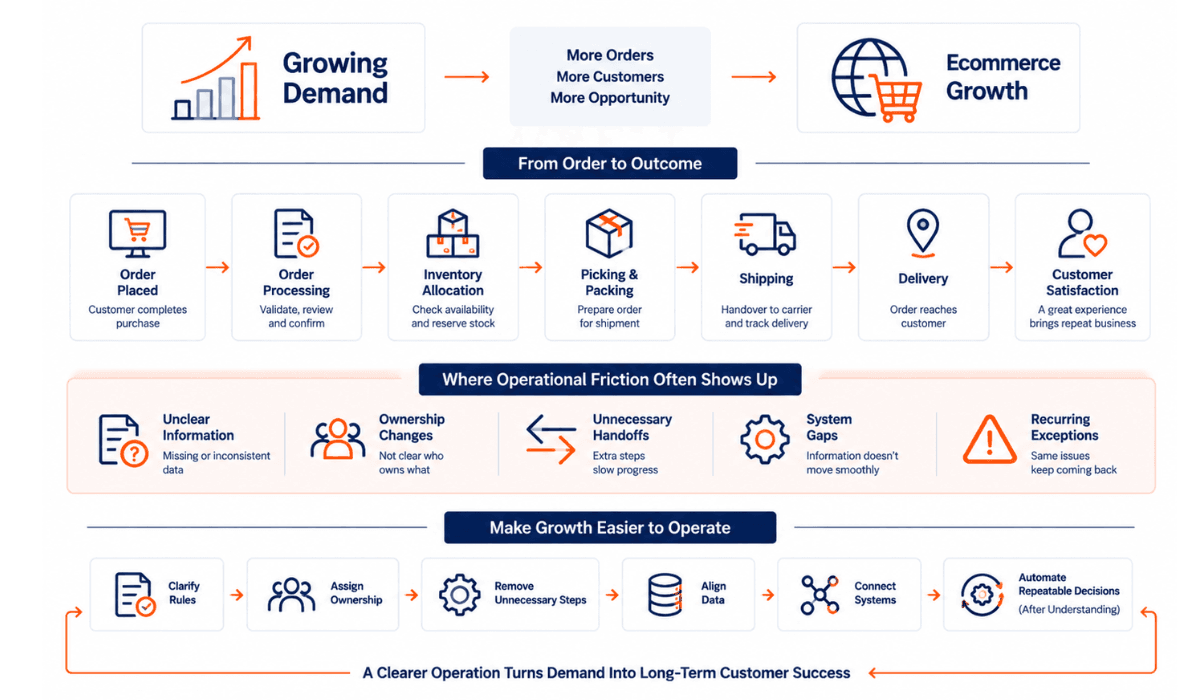
Then fix the smallest meaningful constraint first. Clarify the rule. Assign ownership. Remove an unnecessary handoff. Correct a configuration. Align the data. Connect systems when information genuinely needs to move between them. Automate a repeatable decision only after the decision itself is understood.
Your goal is not a completely touchless operation. Ecommerce will always have exceptions that require judgment. Your goal is to stop using valuable people to repeatedly compensate for predictable gaps that should already have a clear process, reliable information, or appropriate system support.
If you have a specific ecommerce problem involving orders, inventory, fulfillment, customer service, systems, or reporting, you can bring it to Gyan Solutions in a free 30-minute Operations Fit Call. We start with the problem, identify what appears to be breaking, and discuss the practical next step before recommending implementation.

SUKHPREET SINGH
I'm Sukhpreet Singh, Director of Innovation & Technology at Gyan Solutions. With 8+ years in generative AI and ERP integration, I build AI-powered decision-support systems that adapt to real operational complexity without replacing existing infrastructure.



